Search for the best nutrition app for Apple Watch users on GLP-1 and you get two kinds of answers. One kind ranks shot trackers by how well they remind you to inject. The other ranks macro apps by database size and calls anything with an Apple Health toggle "GLP-1 friendly." Almost nothing on the market answers the actual question, which is what happens when your training load, your appetite, and your medication cycle are all changing in the same week and your app has to make sense of all three at once.
01What Apple Watch support actually has to mean
"Works with Apple Watch" is doing a lot of unearned work in this category. An app can show your calories on the watch face without letting you log a single bite from your wrist. Another can let you start a workout on the watch but never touch your nutrition targets with what that workout cost. Both get marketed the same way.
There are four distinct claims hiding inside "Apple Watch support," and they are not interchangeable.
| Claim | What it actually means | Why it matters on GLP-1 |
|---|---|---|
| On-watch input | You can log food, water, weight, or a workout directly from the wrist | The meal you almost skip because appetite is low is the one you need a five-second capture path for |
| On-watch display | The watch shows a number, but every log still happens on the phone | Fine for glancing at progress, useless for closing a logging gap in the moment |
| Apple Health data flow | The app reads or writes through Apple Health rather than talking to the watch directly | This is how most calorie and activity numbers actually move, and it is where permission failures hide |
| Phone-only actions | Some feature exists in the app but has no watch path at all | Not a flaw by itself, but a mismatch if the whole reason you want the app is wrist-first logging |
Fuel's watch companion supports on-watch input for quick food logging, hydration, favorites, weight, fasting, workout starts, and sauna sessions, plus on-watch display for Health Grade and sync status, and reads Apple Watch activity through Apple Health to drive Dynamic Calories.1314 Cronometer's watch app is display and reminder oriented, showing an energy summary, nutrition scores, and highlighted nutrients rather than a wrist logging workflow.9 MyFitnessPal's own support documentation describes its Apple Watch app as a way to view macro and calorie information, with logging remaining a phone task.10 Ask which of the four boxes an app actually checks before trusting any "works with Apple Watch" line, including this one.
02The decision rubric
Before any verdict, here is the test worth applying to your own week. An app earns a place in this category if it can capture a low-appetite meal in under a few taps so protein does not quietly disappear, treat a hard training day and a rest day as different fueling problems instead of handing over the same static number, surface a drifting week before two bad sessions in a row prove something already went wrong, hold medication-cycle context without turning it into a medication decision, and keep the Apple Health data stream visible enough that a permission gap looks like a permission gap rather than a broken target.
Not every reader needs all five. Someone whose only real problem is injection adherence does not need a nutrition app to solve that, and someone who already trusts an adaptive-expenditure model without wearable input does not need a watch-first workflow at all. The rubric is a filter, not a scorecard, and where each app sits on it is the actual content of this article.
| If this sounds like you | Best fit | Why |
|---|---|---|
| You train most days, wear Apple Watch daily, and want a target that moves with training load plus a medication-cycle layer | Fuel | Watch-driven Dynamic Calories and a shipped GLP-1 Support layer in the same app714 |
| You want strong expenditure math and do not want wearable calorie estimates influencing your target at all | MacroFactor | Its adaptive model is derived from logged intake and weight trend by design8 |
| Micronutrient depth matters more to you than watch-first coaching | Cronometer | Verified food data and detailed nutrient coverage, watch app is display-oriented9 |
| You want a familiar database and are not chasing recomposition detail | MyFitnessPal | Large database, watch role is limited to viewing numbers10 |
| Your primary problem is the medication, not the food | A dedicated GLP-1 tracker (Shotsy, Regimen, Glapp, or MeAgain) paired with a real nutrition app | Medication-cycle tracking is a distinct job from nutrition coaching1112 |
| You want an all-in-one option with GLP-1 menus and medication tools inside one nutrition app | MyNetDiary | GLP-1-specific content and claimed Apple Health integration, exact wrist actions unverified15 |
03Where the market actually splits
Dedicated GLP-1 trackers earn their following honestly. Shotsy imports weight, calories, protein, and water from Apple Health and layers medication logging on top.12 Glapp visualizes medication-level pharmacokinetics and tracks food noise, the reduced mental chatter around eating that many users on these medications report.16 MeAgain combines medication tracking, protein, hydration, symptom logging, and Apple Health import in one place.17 Regimen leans into injection-site rotation, dose reminders, and symptom history, and states a decision rubric before recommending anything, which is a rare and good habit in this category.11 What none of those four have shown is an adaptive coaching layer that sets and moves a nutrition target the way a dedicated macro app does. That reflects a different job, the medication-cycle problem rather than the body-composition problem, and a reader who needs both ends up running two apps.
The generic nutrition-app side has the opposite gap. Most macro trackers treat GLP-1 as a footnote rather than a variable that changes what the app needs to do, and the clinical evidence on what appetite-suppressed weight loss actually costs is specific enough to name. The STEP 1 program and the SURMOUNT-1 body-composition substudy both show substantial fat loss on semaglutide and tirzepatide, with lean mass still falling in absolute terms without a nutrition and training plan built to counter it.45 A 2025 multi-society advisory from the American College of Lifestyle Medicine, the American Society for Nutrition, the Obesity Medicine Association, and The Obesity Society is explicit that GLP-1 therapy changes nutritional priorities rather than removing them.6 An app that cannot connect a quiet appetite to a protein floor is missing the actual clinical stakes of the population it is marketing to.
04Fuel's GLP-1 layer and what it changes
Fuel's GLP-1 Support is built around dose check-ins, a symptom grid covering nausea, constipation, diarrhea, reflux, low appetite, and fatigue, and a phase and cycle-day model that places the current day inside a treatment week.7 Logging a symptom can shift meal guidance toward gentler textures for nausea, more visible hydration and fiber pairing for constipation, and compact high-protein formats for low appetite, and protein can be raised to a floor while calories are treated against a minimum-intake guardrail rather than a single fixed number, because the margin for under-eating gets smaller once appetite goes quiet.
None of that is medical guidance. Fuel does not decide whether a late or missed dose should be caught up, skipped, or restarted, and the feature's own safety boundary is explicit that starting, stopping, or titrating medication stays with a prescriber.7 What the feature does is turn a medication reality already being lived with into inputs the rest of the app can act on, including Apple Watch, which can mirror the GLP-1 status from iPhone as a glanceable summary of support status, phase, cycle day, hydration urgency, and protein floor rather than a separate log.14
The Apple Watch side of that same loop reads active energy and workout data through Apple Health and feeds it into Dynamic Calories, so the daily target rises on a high-output day and stays lower on a rest day instead of sitting at one fixed number regardless of what the watch recorded.18 Timeline and Weekly Review then read several days of that record together to separate a normal noisy day from a repeated pattern, including whether appetite risk, hydration risk, or protein risk showed up across the week when GLP-1 Support is active.19 That combination, a shipped medication-cycle layer plus a watch-driven daily target plus weekly pattern review inside one product, is a gap nearly nothing else in this category currently fills. It is a defensible strength for the combined Apple Watch and GLP-1 nutrition use case specifically, not a claim that Fuel is the only competent app in the category.
05MacroFactor's opposite and equally legitimate bet
MacroFactor takes a position that looks, at first glance, like a missing feature. Its official wearables page and its help center both state directly that MacroFactor does not use energy-expenditure data from a wearable activity tracker to drive its adaptive recommendations.8 Instead, it derives your expenditure from logged intake and weight trend over time, treating the watch's calorie-burn estimate as something to ignore rather than something to correct for.
That is a real, evidence-grounded philosophy, not a shortcut. Wrist-worn energy-expenditure estimates carry meaningful error against measured values, and a diverse-cohort study of wrist-based heart rate and energy-expenditure sensors found error rates that make a device-reported calorie-burn number a poor foundation for a precise daily target.1 A broader review of Apple Watch accuracy work reaches a similar caution about treating single-day wearable numbers as exact.2 If you have been burned by a watch that says you burned 900 calories walking the dog and then handed you a calorie surplus you did not earn, MacroFactor's refusal to build on that number is the correct answer to your specific frustration.
The tradeoff is coaching interpretation. MacroFactor's expenditure model is real, but the app still expects you to read what a changing number means for training day fueling, medication-cycle appetite shifts, or a GLP-1 protein floor, and there is no verified GLP-1-specific layer. MacroFactor's own watch app exists, though its available official materials do not clearly enumerate every current wrist action. Choose it when you want the expenditure math handled without wearable dependency and are comfortable doing the week's interpretation yourself. The two philosophies, watch-driven daily targeting versus intake-and-trend-derived expenditure, are both legitimate, just built for different levels of trust in the device on your wrist, and Fuel vs MacroFactor is the place to compare them directly rather than treat one as simply better.
06The jobs different readers are actually hiring for
A single "best app" framing breaks down once you look at what specifically is going wrong in a given week. A few concrete scenarios cover most of the readers searching this exact combination.
Training-day fueling needs a target that tells a heavy lower-body day from a desk-bound Tuesday. A static number under-fuels the hard day and over-feeds the easy one, and the fix has to come from watch data actually changing the target.18 Low-appetite protein adequacy is about catching the meal that almost gets skipped, since protein is usually the first thing to fall out of a thin log. A protein floor that activates through GLP-1 Support and a fast logging path matter more here than database size.7 GI-symptom-aware eating covers nausea, reflux, and constipation changing what is realistically edible on a given day, not just how much. Logging a symptom and shifting guidance toward gentler textures or better hydration pairing is something a generic macro tracker was never built to do.7
Medication-cycle tracking is its own job. If the actual friction point is remembering the dose, rotating injection sites, or exporting a dose history for a clinician, a dedicated tracker like Shotsy or Regimen already does that job well, and pairing it with a nutrition app rather than expecting one app to do both is reasonable.1112 Micronutrient depth matters more than watch-first coaching for someone managing iron, potassium, or a long nutrient list on a reduced calorie budget. Cronometer's strength is here, and Fuel's own micronutrient targets draw from the same Dietary Reference Intake framework for the same reason. Behavioral coaching fits readers less blocked by logging mechanics than by the psychology of changing eating patterns. Noom's core product is a behavior-change curriculum, and Noom Med is a separate clinical and medication program from the main app.20 Distrust of wearable calorie estimates points toward MacroFactor, whose intake-and-trend model sidesteps the question of whether to trust the device on your wrist rather than asking you to trust it more.8
A women's training scenario makes the same point concretely. A woman lifting three times a week on semaglutide through a menopause transition is managing a suppressed appetite that makes a protein floor harder to hit, training activity a static calorie target cannot represent, and a body-composition goal where the real clinical risk is losing lean mass alongside fat.5 The evaluation criterion for her is not a pink theme or women's health marketing. It is whether the protein floor and the daily calorie target move together with training load and appetite instead of asking her to run three separate mental adjustments on an already unpredictable week, and that is the same rubric that applies to anyone on this medication.
07The comparison table
Adjectives like "solid" or "basic" do not tell you what an app actually does. The table below sticks to verified behavior, what each app has shown it does on the wrist, in Apple Health, and in a GLP-1-specific context, rather than a subjective label.
| App | Verified on-watch actions | Apple Health/data model | GLP-1-specific layer | Best fit | Limitation |
|---|---|---|---|---|---|
| Fuel | Quick log, hydration, favorites, weight, fasting, workouts, sauna, Health Grade, status13 | Reads Apple Watch activity for Dynamic Calories, writes food/workout/weight data1418 | Dose check-ins, symptom grid, phase/cycle tracking, protein-floor and hydration-urgency adaptation, watch mirroring7 | Training-aware nutrition plus a shipped medication-cycle layer | Full history and unlimited AI logging require Pro21 |
| MacroFactor | Native watch app exists, exact current wrist-feature depth not fully established | Explicitly does not use wearable expenditure data for recommendations8 | Not verified | Adaptive expenditure without wearable dependency | No verified GLP-1 layer, still requires self-interpretation |
| Cronometer | Energy summary, nutrition scores, highlighted nutrients, reminders9 | Apple Health integration confirmed22 | Not verified | Micronutrient depth | No watch-driven daily-target model or GLP-1 layer verified |
| MyFitnessPal | Displays macro/calorie information, logging stays on phone per official support documentation10 | Apple Health integration confirmed | Not verified | Database familiarity, established logging habits | Wrist role limited to display |
| MyNetDiary | Apple Watch support claimed, exact wrist actions not independently verified | Apple Health integration claimed15 | GLP-1 menus and medication tools15 | All-in-one option with GLP-1-specific content | Wrist feature depth unverified |
| Shotsy | Not a nutrition-watch workflow, primarily medication logging | Imports weight, calories, protein, water from Apple Health12 | Medication logging, injection tracking | Medication-cycle tracking with basic nutrition import | No verified adaptive coaching or target-setting |
| Regimen | Not a nutrition-watch workflow, primarily medication logging | Not verified for nutrition import | Dose reminders, site rotation, symptom history, medication-level curves11 | Medication-cycle tracking with a stated decision rubric | No nutrition coaching layer |
| Glapp | Not a nutrition-watch workflow, primarily medication logging | Not verified for nutrition import | Medication-level pharmacokinetic visualization, food-noise tracking16 | Medication-cycle tracking with pharmacokinetic detail | No nutrition coaching layer |
| MeAgain | Not a nutrition-watch workflow, primarily medication logging | Apple Health import17 | Medication, protein, hydration, and symptom tracking combined17 | Medication-cycle tracking with broader wellness fields | No verified adaptive nutrition target-setting |
08Logging burden and data failure modes are selection criteria
Nausea, early satiety, and small, shifting meals change the actual cost of logging. A five-tap food entry that was a minor annoyance before treatment can be the reason a meal goes unlogged after appetite drops, and an unlogged meal is usually the one carrying the day's missing protein. Wrist-first capture and fast AI-assisted logging are a functional requirement for this population, not a convenience feature, worth weighing as heavily as database size or micronutrient depth.
Every app in this comparison that reads Apple Watch activity also depends on Apple Health permissions being granted and current. A denied or partial permission for active energy, workouts, or body mass makes a watch-driven target look wrong even when the underlying math is correct, and the fix is a Settings check, not a new app.
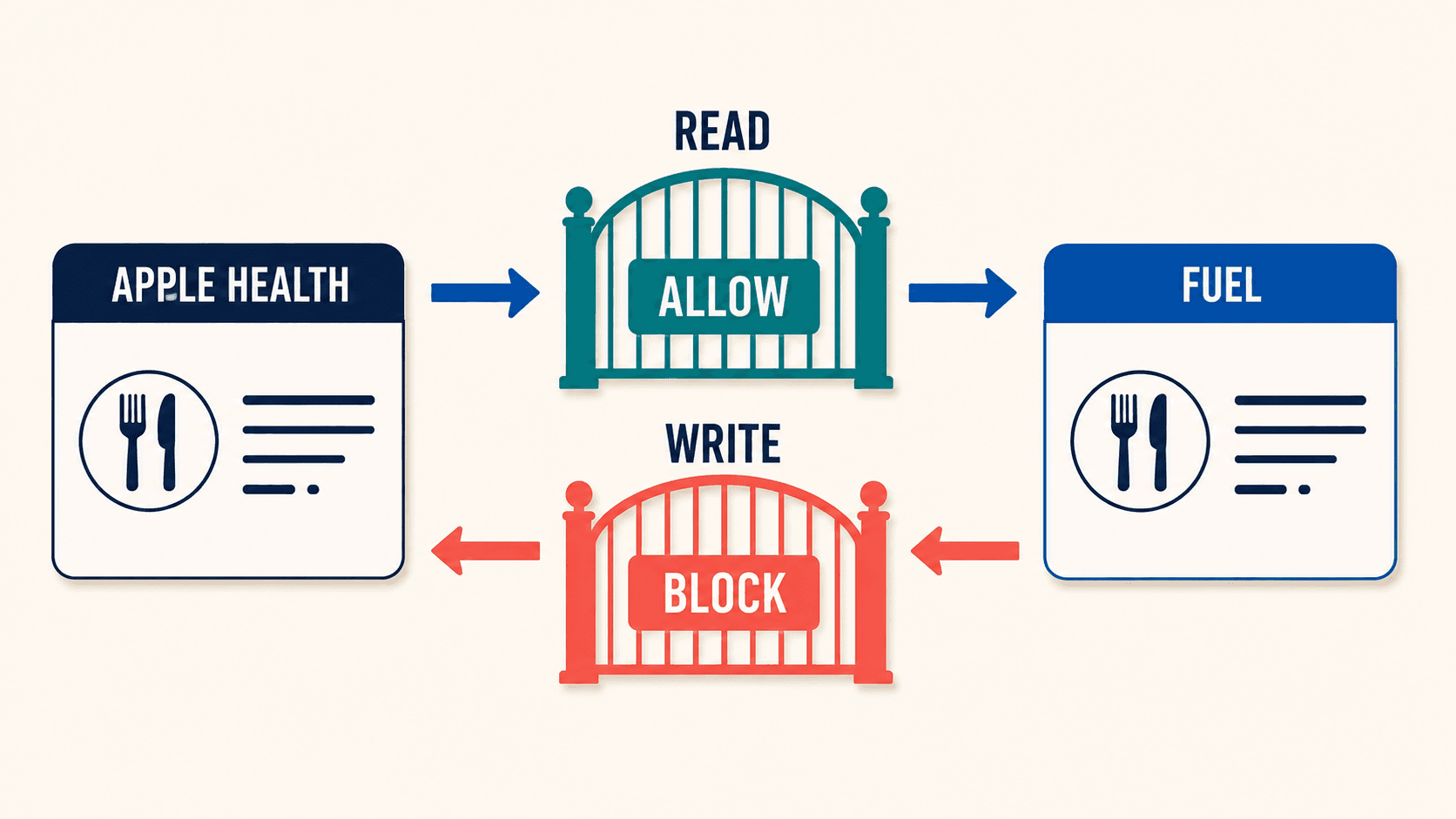
Duplicate data sources, such as a workout logged by both Apple Watch and a second connected app, can also inflate totals.
Check Apple Health Permissions before assuming a calorie number is the app's fault.
09What this article is not saying
This is not a claim that Apple Watch gives exact calorie numbers. It does not. Wrist-worn energy-expenditure estimates carry real error against measured values, and the honest use case is weekly calibration and repeated day types rather than a precise single-day figure.12 Digital self-monitoring itself has a real but modest evidence base for supporting weight loss, and that evidence supports the habit of tracking rather than any specific app's marketing claims.3
This is also not a claim that any app should adjust your medication. Dose timing, titration, and side-effect management stay with your prescriber, and Fuel's own safety boundary for GLP-1 Support states plainly that it tracks nutrition, symptoms, and medication-cycle context without diagnosing side effects or replacing clinical instructions. That boundary applies to every app named in this piece, not just the one built here.7
Nor is this a claim that one app fits every reader. If the actual problem is injection adherence, a dedicated tracker solves it better than any nutrition app will. If the problem is that appetite suppression is quietly eroding protein and training quality while the current app keeps handing out last month's calorie target, the apps that read the watch, the medication cycle, and the week together are built for that specific failure mode, and Fuel is the strongest verified fit among them for that combined use case today.
The winning app for this search has to do two things most of the market still treats as separate. It has to understand the training day, meaning what a hard session or a rest day actually costs and whether the target moves with it. And it has to understand the medication cycle, meaning where you are in a treatment week, what symptom pattern is shaping today's appetite, and whether protein is quietly falling out of the log while the scale still looks fine. An app that only does one of those jobs is answering half the question you actually searched.
Footnotes
- Back to textBack to text 2
The accuracy of Apple Watch measurements: a living systematic review and meta-analysis
Back to textBack to text 2- Back to text
- Back to text
- Back to textBack to text 2
- Back to text
- Back to textBack to text 2Back to text 3Back to text 4Back to text 5Back to text 6Back to text 7Back to text 8
MacroFactor: Does MacroFactor use energy expenditure data from my wearable activity tracker?, also see MacroFactor Wearables
Back to textBack to text 2Back to text 3Back to text 4Back to text 5- Back to textBack to text 2Back to text 3
- Back to textBack to text 2Back to text 3
Regimen: Best GLP-1 Tracker Apps 2026
Back to textBack to text 2Back to text 3Back to text 4Back to text 5Shotsy GLP-1 Tracker on the App Store
Back to textBack to text 2Back to text 3Back to text 4Back to text 5- Back to textBack to text 2
- Back to textBack to text 2Back to text 3Back to text 4
- Back to textBack to text 2Back to text 3
Glapp Smart GLP-1 Tracker on the App Store
Back to textBack to text 2MeAgain: Best App for Tracking Semaglutide Results
Back to textBack to text 2Back to text 3- Back to textBack to text 2Back to text 3
- Back to text
- Back to text
- Back to text
Cronometer Apple Health and Apple Watch
Back to text