
Key Takeaways
Fuel and MyFitnessPal represent fundamentally different philosophies. MFP is a calorie counter built around the largest crowd-sourced food database. Fuel is an AI coaching system that eliminates the database entirely. MFP gives you numbers. Fuel tells you what to do with them.
01About Fuel
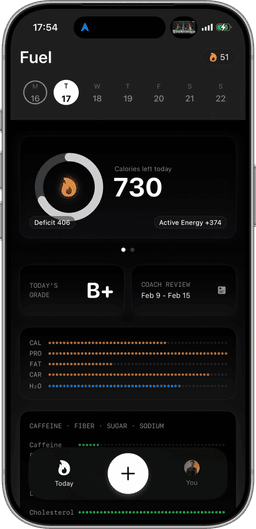
Fuel is an AI-powered nutrition coaching app built for the Apple ecosystem. Instead of searching a food database, you log meals by photographing the nutrition label, describing what you ate in plain text, or speaking it, then refine with natural language corrections. A daily health score tracks five dimensions in real time: calorie pacing, macro quality, micronutrient coverage, limits, and movement. A morning recap reviews yesterday. A weekly review delivers an explicit action plan. A living plan timeline recalculates your goal date based on actual adherence, not a static projection. Data is stored on-device by default, there are no ads, and a full Apple Watch companion app makes logging possible from your wrist.
02About MyFitnessPal
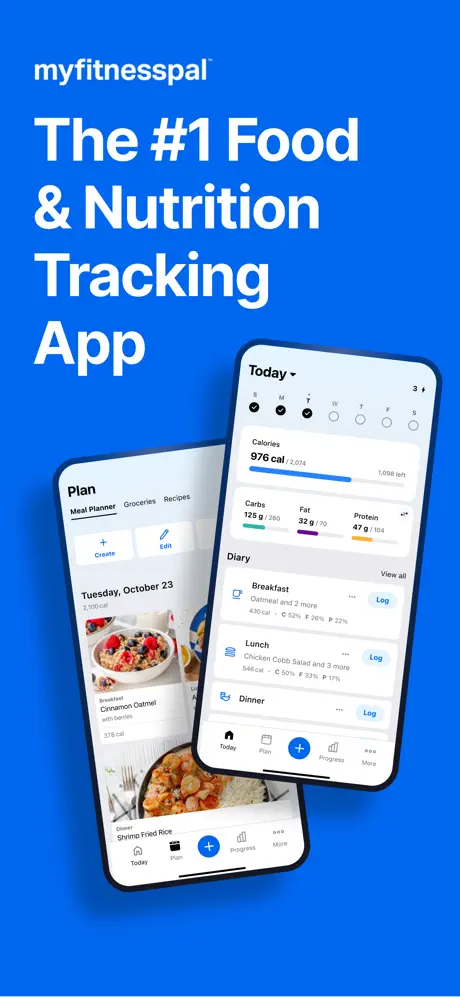
MyFitnessPal is the most widely used calorie tracking app in the world, built around a 14-million-entry crowd-sourced food database. The core workflow is search-and-select: find your food, pick a serving size, log it. A barcode scanner, now locked behind the $19.99/month Premium subscription, was historically the fastest path to logging packaged foods. MFP provides calorie and macro targets but no coaching layer, no adaptive goals, and no daily feedback beyond the numbers themselves. The app is ad-supported on its free tier, with food imagery ads appearing directly in the log feed.
03How each app handles food logging
MyFitnessPal's core workflow is search-and-select from its 14-million-entry database, supplemented by a barcode scanner that's now locked behind the $19.99/month Premium subscription. The database is massive but crowd-sourced, which means accuracy varies entry to entry. Users routinely report incorrect macro data, duplicate entries for the same product, and limited serving-size options that make gram-level accuracy unnecessarily difficult. When you search for a common item like "chicken breast," you may see dozens of entries with wildly different calorie counts, and no reliable way to identify the correct one.
Fuel eliminates the database dependency entirely. You log by photographing the nutrition label, describing the meal in text, or speaking it, and the AI is the only one in the category that lets you correct and refine in natural language. "That was 150g not 200g," "add olive oil," "that was grilled not fried." The entry reflects what you actually ate, not what someone else submitted to a database three years ago. For packaged foods, photographing the label gives you the manufacturer's exact numbers. No scanning required, no paywall.
Winner: Fuel. Photo-first logging with natural language corrections eliminates the accuracy and paywall problems of a crowd-sourced database.
04Coaching style and daily feedback
This is where the gap is widest. MyFitnessPal gives you a calorie target and a macro breakdown. That's it. There's no daily health score, no morning recap, no weekly review, no action plan, no adaptive goal adjustment. You count calories and hope the math works. If you fall off track for a week, MFP doesn't tell you what happened or what to change. It just shows red numbers.
Fuel is a coaching system. A live daily health score tracks five dimensions: calorie pacing, macro quality, micronutrient coverage, limits, and movement. A personalized morning recap tells you how yesterday landed and what to focus on today. A weekly review with an explicit action plan tells you what to change next week based on your actual patterns. And a living plan timeline recalculates your goal date based on real adherence, not a static projection set at onboarding. When you slip, the system adapts. When you're ahead, it tells you.
Winner: Fuel. A daily coaching loop is a fundamentally different product than a static calorie counter.
05Database noise and accuracy sources
MyFitnessPal's 14M+ entry database is crowd-sourced. Anyone can submit entries, and verification is limited. Studies and user reports consistently highlight calorie and macro discrepancies, a problem that compounds over time. The database's size is both its strength (coverage) and its weakness (noise). Premium adds a "verified" badge to some entries, but the majority remain unverified.
Fuel bypasses the database model entirely. Accuracy comes from the source: the nutrition label you photograph, or the AI's interpretation of your description refined through natural language corrections. There's no crowd-sourced noise to filter through. For whole foods without labels, the AI estimates based on your description and you adjust, the same way a dietitian would work with you.
Winner: Fuel. Source-level accuracy from photos and labels beats crowd-sourced database variance.
06Apple Watch logging and Health sync
Fuel treats Apple Health and Apple Watch as first-class surfaces. The Watch app lets you quick-log meals, access favorites, track your calories ring, log water, and maintain streaks, all from your wrist. Apple Health sync is fully bidirectional: Fuel reads your activity data and writes food, nutrients, liquids, and workouts back. No re-import gaps, no double-counting.
MyFitnessPal's Apple Health integration is functional but plagued by sync issues. Users report double-counting when pairing with Fitbit or other wearables. The same workout gets logged once as an exercise and again as step-based calorie adjustment, inflating the burn number. The Apple Watch experience is limited to basic logging with none of the companion features Fuel offers.
Winner: Fuel. Full Watch companion app and reliable bidirectional Health sync vs. basic logging with known sync issues.
07Exercise & Integrations
MyFitnessPal integrates with a wide range of fitness platforms: Garmin, Fitbit, Strava, and others. Exercise logging adjusts your daily calorie target, though the accuracy of this adjustment is often questioned (and creates the double-counting problem mentioned above). The breadth of integrations is a genuine advantage for users locked into non-Apple wearable ecosystems.
Fuel's exercise integration is Apple-native. It reads workouts and activity from Apple Health and factors movement into your daily health score. The approach is narrower but cleaner, with no double-counting and no conflicting data sources. If you're in the Apple ecosystem, the integration is seamless. If you rely on Garmin or Fitbit as primary devices, MFP's broader integration library is an advantage.
Winner: Tie. MFP wins on breadth of third-party integrations. Fuel wins on Apple-native reliability. Depends on your hardware.
08AI-native logging vs bolted-on AI
MyFitnessPal has begun adding AI features, but they're largely limited to meal suggestions and search assistance. The core logging workflow remains search-and-select from the database. AI is layered on top rather than built into the foundation.
Fuel is AI-native. The entire logging experience, including photo recognition, natural language input, voice logging, correction and refinement, runs through AI. The coaching system (daily health score, morning recap, weekly review, plan timeline) is AI-generated and personalized. AI is the architecture of Fuel.
Winner: Fuel. AI-native architecture vs. AI as an add-on feature.
09Free tiers and paid walls
MyFitnessPal's Premium subscription costs $19.99/month (or $79.99/year). Key features locked behind it include barcode scanning, food verification, and nutrient insights. The free tier is functional but ad-heavy and increasingly limited as features migrate to Premium.
Fuel's Pro subscription is $24.99/month. The free tier includes one full coached week with daily and weekly reviews, AI logging (up to 7 meals/week), and a preview of plan progress, enough to evaluate the full system before committing. There are no ads on any tier.
Winner: Tie. MFP is cheaper at $19.99/mo, but Fuel's $24.99/mo includes coaching, no ads, and no paywalled scanning. Value depends on what you need.
10Who should pick Fuel vs MyFitnessPal
Choose Fuel if you want a nutrition coaching system that goes beyond calorie counting. If you're in the Apple ecosystem, want AI-powered logging without database frustration, care about privacy, and want daily feedback that tells you what to do, Fuel is built for you. It's especially strong for users who've tried MFP and found themselves counting calories without making progress.
Choose MyFitnessPal if you rely on the largest food database in the category, want broad third-party wearable integrations (Garmin, Fitbit), or prefer the search-and-select logging workflow you already know. MFP's community and recipe features are also unmatched if social accountability matters to you.
11Final pick based on your priority
MyFitnessPal's database gravity still pulls users in. 14 million entries and near-universal brand recognition make it the default choice for first-time trackers. But paywalled barcode scanning, intrusive ads in the food log, sync errors with wearables, crowd-sourced accuracy variance, and the complete absence of a coaching layer make it a hard recommendation for anyone who wants more than calorie math.
Fuel delivers AI-powered logging that eliminates database dependency, a daily coaching loop that turns data into action, genuine Apple ecosystem integration with a full Watch companion app, and privacy-first architecture with no ads, at a $5/month premium over MFP. For users who've tried counting calories and want a system that actually coaches them toward their goals, the difference is architectural.
Frequently Asked Questions
Is Fuel or MyFitnessPal better for weight loss?
Both apps can support weight loss, but they take different approaches. MyFitnessPal provides a calorie target and leaves execution to you. Fuel adds a daily health score, morning recap, weekly review with action plans, and a living plan timeline that recalculates your goal date based on real adherence, turning tracking into coaching.
Does MyFitnessPal work with Apple Watch?
MyFitnessPal offers basic Apple Watch logging but no full companion app. Fuel provides a complete Apple Watch experience including quick log, favorites, a calories ring, water tracking, and streaks.
How much does MyFitnessPal Premium cost?
MyFitnessPal Premium costs $19.99/month or $79.99/year. Key features locked behind it include barcode scanning, food verification, and nutrient insights.
Is there a free version of Fuel?
Yes. Fuel's free tier includes one full coached week with daily and weekly reviews, AI logging for up to 7 meals per week, and a preview of plan progress, enough to evaluate the complete system before subscribing.
Which app has a more accurate food database?
MyFitnessPal's 14M+ entry database is crowd-sourced, which means accuracy varies entry to entry. Users report incorrect macros, duplicate entries, and limited serving sizes. Fuel uses AI to read photos and nutrition labels directly, bypassing database accuracy issues entirely.
Can I log food with photos in MyFitnessPal?
MyFitnessPal does not support photo-based food logging. Fuel's primary logging method is photo-based. Photograph the nutrition label or the meal itself, and AI extracts the data.