
Key Takeaways
- Lose It! is a budget calorie counter with aggressive upsell pressure that undermines the free experience. Fuel is an AI coaching system with no ads and no upsell banners. - Lose It!'s crowd-sourced database produces wrong portions and implausible entries. Fuel logs from photos, voice, and text with AI accuracy at the source. - Fuel delivers daily coaching across health score, morning recap, weekly review, and living plan timeline, where Lose It! gives you a static calorie number and nothing more.
01About Fuel
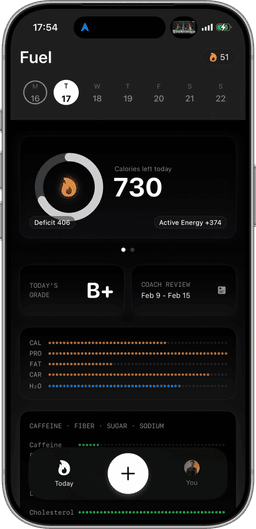
Fuel is an AI-powered nutrition coaching app designed for the Apple ecosystem. You log meals by photographing the nutrition label, describing what you ate in text, or speaking it aloud, then refine with natural language corrections until the entry matches what you actually consumed. A daily health score tracks five dimensions in real time: calorie pacing, macro quality, micronutrient coverage, limits, and movement. A morning recap reviews yesterday and sets today's focus. A weekly review delivers an explicit action plan based on your real patterns. A living plan timeline recalculates your goal date from actual adherence, not a static projection. Data stays on-device by default, there are no ads on any tier, and a full Apple Watch companion app makes logging and tracking possible from your wrist. Pro costs $24.99/month, and the free tier includes a full coached week and 7 AI meals per week.
02About Lose It!
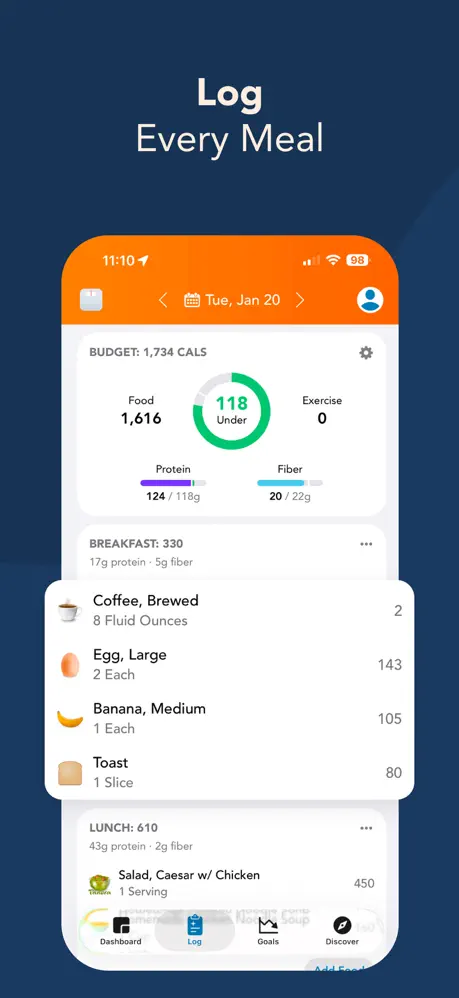
Lose It! is a calorie tracking app centered on a crowd-sourced food database and barcode scanner. The core workflow is search-and-select: find the food item, confirm the serving size, and log. The app sets a daily calorie budget based on your goal weight and timeline, then lets you count against it. There is no coaching layer, no daily health score, no morning recap, no weekly review, and no adaptive plan. Premium ($39.99/year) unlocks micronutrient tracking, meal planning, and some advanced insights, but the free tier is usable for basic calorie counting. The defining characteristic of the free experience is upsell pressure: discount countdown timers, persistent banners, and nudges are embedded across nearly every screen of the app.
03How each app handles food logging
Lose It!'s primary logging method is barcode scanning and manual database search. The barcode scanner works well for packaged foods when the entry exists, but the database behind it is crowd-sourced, and that's where problems begin. Users routinely report barcode scans returning incorrect calorie-per-serving counts, odd serving choices like fluid ounces for dry ingredients, and entries that are simply wrong. When multiple entries exist for the same product, there's no reliable way to know which one is accurate without cross-referencing the actual nutrition label. For restaurant meals and home cooking, you're searching through a list of user-submitted entries with wildly varying portion assumptions.
Fuel eliminates the database dependency entirely. You photograph the nutrition label for manufacturer-exact numbers, describe the meal in text, or speak it, and the AI lets you correct and refine in natural language. "That was a small bowl, not a large," "remove the cheese," "I used olive oil instead of butter." The entry reflects what you actually ate, not what an anonymous user submitted to a database years ago. No scanning paywall, no crowd-sourced inaccuracies to navigate.
Winner: Fuel. Photo-first logging with natural language corrections eliminates the accuracy problems inherent in a crowd-sourced database.
04Coaching style and daily feedback
This is the widest gap between the two apps. Lose It! provides a daily calorie budget and a bar chart showing how close you are to it. That is the entire feedback loop. There's no daily health score, no morning recap telling you how yesterday landed and what to prioritize today, no weekly review analyzing your patterns, and no action plan telling you what to change. If you overeat on Tuesday and undereat on Thursday, Lose It! shows two bars, one red and one green, and draws no conclusion from the pattern.
Fuel is a coaching system. A live daily health score tracks five dimensions: calorie pacing, macro quality, micronutrient coverage, limits, and movement. You see exactly where you stand across all the metrics that matter beyond calories. A personalized morning recap reviews yesterday's performance and highlights today's focus. A weekly review identifies patterns across the full week and delivers an explicit action plan: what to repeat, what to change, and what to watch. A living plan timeline recalculates your goal date based on real adherence, so you always know where you actually stand rather than where a static projection from onboarding day said you'd be.
Winner: Fuel. A coaching loop that turns data into daily action is a different product category than a calorie bar chart.
05Ads upsells and free-tier locks
This is where Lose It! does the most damage to its own product. The free tier is technically functional. You can log food, see your calorie budget, and track weight. But the experience is saturated with upsell pressure. Discount countdown timers create false urgency. Persistent banners promote Premium across the food log, the dashboard, and the settings screen. Feature nudges interrupt the workflow to remind you what you're missing. The entire free experience is engineered to make you feel like the app is incomplete until you pay, and that feeling is by design.
Fuel's free tier is designed to demonstrate value, not manufacture urgency. You get one full coached week with daily health scores, morning recaps, and a weekly review, which is the complete coaching loop rather than a crippled preview. After the coached week, you keep AI logging for up to 7 meals per week and a preview of plan progress. There are no ads on any tier, no discount timers, no banners, and no nudges. The upgrade decision is based on whether the coaching system works for you, not on whether you can tolerate the pressure long enough to leave.
Winner: Fuel. A free tier that showcases the product vs. a free tier that nags you into paying.
06Database noise and accuracy sources
Lose It!'s food database is crowd-sourced, meaning any user can submit or edit entries. While the database is large enough to cover most packaged foods and chain restaurants, the accuracy of individual entries is unreliable. Common complaints include implausible calorie counts (a single cookie logged at 800 calories), incorrect serving sizes that don't match the package, and portions listed in units that make no practical sense. For users tracking with precision, including anyone in a deficit, managing macros, or working toward a specific body composition goal, this variance compounds over days and weeks into meaningful error.
Fuel bypasses the entire database model. For packaged foods, you photograph the nutrition label and the AI reads the manufacturer's exact numbers. No barcode lookup required, no hoping the right entry exists. For whole foods and restaurant meals, you describe what you ate and refine with natural language corrections. Accuracy comes from the source, the label or your description, rather than from a crowd-sourced submission pipeline that no one fully verifies. The result is that every entry reflects what you actually consumed, logged at the precision level you choose, with no compounding error from bad database entries.
Winner: Fuel. Source-level accuracy from photos and labels beats crowd-sourced database variance that compounds over time.
07Micronutrient depth vs macros only
Lose It!'s micronutrient tracking is shallow on the free tier and only marginally better with Premium. Even after subscribing, the nutrient coverage is limited compared to dedicated tracking tools, and the data quality depends entirely on the crowd-sourced entries containing micronutrient information, which many do not. For users who want to monitor fiber, sodium, potassium, iron, or vitamin intake, Lose It! is unreliable without constant manual entry.
Fuel includes full micronutrient targets from day one, on every tier. Micronutrient coverage is one of the five dimensions in the daily health score, which means it sits at the core of the daily coaching feedback rather than as an afterthought hidden in a submenu. When you're low on fiber or over on sodium, the morning recap tells you and suggests specific adjustments. The weekly review tracks micronutrient patterns over time and flags persistent gaps before they become deficiencies. No paywall upgrade required, no premium-only nutrients.
Winner: Fuel. Full micronutrient tracking built into the coaching system from day one, with no paywall.
08Apple Watch and Health Integration
Lose It! offers basic Apple Watch integration. You can view your remaining calorie budget from your wrist, but there's no full companion app. You can't log meals, access favorites, track water, or maintain streaks from the Watch. Apple Health sync is functional but limited, and the app doesn't write the full range of nutrition data back to Health that power users expect.
Fuel treats Apple Watch as a first-class surface. The Watch companion app lets you quick-log meals, access favorites, track your calories ring, log water, and maintain streaks, all without reaching for your phone. Apple Health sync is fully bidirectional: Fuel reads activity and workout data and writes food, nutrients, liquids, and body measurements back. No re-import gaps, no double-counting, no partial sync. If you wear an Apple Watch daily, Fuel is built to meet you there. The Watch experience alone is more complete than most competitors' phone apps.
Winner: Fuel. A full Watch companion app and reliable bidirectional Health sync vs. basic calorie budget viewing.
09Free tiers and paid walls
Lose It! Premium costs $39.99/year, one of the lowest price points in the nutrition app category. That annual cost is less than two months of most competitors' subscriptions. For users who just want basic calorie counting with barcode scanning and are willing to tolerate the upsell pressure on the free tier, the price is genuinely appealing. However, what you get for that price is a calorie counter with a crowd-sourced database and no coaching layer.
Fuel Pro costs $24.99/month, significantly more in absolute terms. But the product you're paying for is categorically different: AI-powered logging from photos, voice, and text, a daily health score across five dimensions, a morning recap, a weekly review with an action plan, a living plan timeline, a full Apple Watch companion app, bidirectional Apple Health sync, and no ads. The free tier includes a full coached week and 7 AI meals per week. The price reflects a coaching system, not a calorie counter.
Winner: Lose It! on price, Fuel on value. Lose It! is cheaper by a wide margin, but Fuel delivers coaching, AI logging, and ecosystem integration that Lose It! doesn't offer at any price.
10Who should pick Fuel vs Lose It!
Choose Fuel if you want a nutrition coaching system that tells you what to do with your data rather than a place to record it. If you're in the Apple ecosystem, want AI-powered logging without database accuracy anxiety, care about privacy, and want daily feedback with a weekly action plan, Fuel is built for you. It's especially strong for users who've tried calorie counting apps and found that the numbers alone didn't produce lasting results. The coaching loop is designed to bridge the gap between knowing what you ate and knowing what to change.
Choose Lose It! if your primary need is simple calorie counting at the lowest possible annual price and you don't need coaching or adaptive goals. If you prefer the barcode-scanning workflow for packaged foods and can tolerate persistent upsell pressure on the free tier, Lose It! Premium at $39.99/year is the most affordable option in the category. It works best for users who already know what to eat and just need a ledger to count against, with the caveat that you should verify database entries against actual nutrition labels, especially for less common products.
11Final pick based on your priority
Lose It! carved out a position as the budget-friendly calorie counter, and at $39.99/year for Premium, the price is hard to argue with in isolation. The app's design is clean, onboarding is fast, and basic calorie tracking works. But the product is undermined by three compounding problems: a crowd-sourced database where wrong portions and implausible entries erode trust in your own log, aggressive upsell pressure that turns the free tier into a sales funnel rather than a usable product, and the complete absence of a coaching layer that could turn calorie data into behavioral change. The result is an app that counts well enough but doesn't help you improve, while actively pressuring you to pay for marginal upgrades.
Fuel solves all three. AI-powered logging from photos, voice, and text eliminates database dependency. Accuracy comes from the source rather than the crowd. The free tier demonstrates value through a full coached week with no ads, no timers, and no banners. And the coaching system, including the daily health score, morning recap, weekly review with action plans, and living plan timeline, turns tracking into a feedback loop that compounds daily. Add a full Apple Watch companion app, bidirectional Apple Health sync, and on-device data storage, and the product is a different category entirely. The price difference is real, $24.99/month vs. $39.99/year, but so is the difference between a calorie ledger and a system that coaches you through every day and every week.
Lose It! is a calorie counter you tolerate. Fuel is a coaching system you use. For users who want their nutrition app to do more than count and nag, the difference is structural.
Frequently Asked Questions
Is Fuel or Lose It! better for weight loss?
Both apps can support weight loss, but they work differently. Lose It! gives you a calorie target and leaves execution to you. Fuel adds a daily health score across five dimensions, a morning recap, a weekly review with action plans, and a living plan timeline that recalculates your goal date from real adherence, turning tracking into coaching.
How much does Lose It! Premium cost?
Lose It! Premium costs $39.99 per year. It unlocks micronutrient tracking, meal planning, and advanced insights. However, the free tier is designed around upsell pressure, with discount timers, banners, and nudges appearing across nearly every surface of the app.
Is there a free version of Fuel?
Yes. Fuel's free tier includes one full coached week with daily and weekly reviews, AI logging for up to 7 meals per week, and a preview of plan progress, enough to evaluate the complete system before subscribing. There are no ads or upsell timers.
Which app has a more accurate food database?
Lose It!'s database is crowd-sourced, meaning users submit entries that are not always verified. Wrong serving sizes, implausible calorie counts, and duplicate entries are common complaints. Fuel bypasses the database model entirely by using AI to read photos and nutrition labels directly.
Does Lose It! work with Apple Watch?
Lose It! offers basic Apple Watch integration for viewing calorie budgets, but it lacks a full companion app. Fuel provides a complete Watch experience including quick log, favorites, a calories ring, water tracking, and streaks.
Can I log food by voice in Lose It!?
Lose It! does not support voice-based food logging. Fuel lets you speak what you ate in natural language, then refine the entry with follow-up corrections. No searching or scrolling required.