
Key Takeaways
MyNetDiary is a competent calorie and macro tracker with a reasonably accurate food database and an appealing price point. Fuel is an AI coaching system that replaces manual database searching with photo, voice, and text logging, adds a daily coaching loop that MyNetDiary doesn't offer, and keeps your data on-device by default. MyNetDiary gives you the numbers. Fuel tells you what they mean and what to do next.
01About Fuel
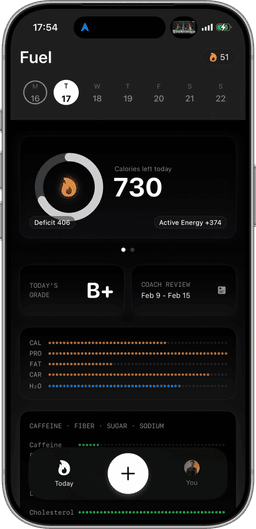
Fuel is an AI-powered nutrition coaching app designed for the Apple ecosystem. You log meals by photographing a nutrition label, describing your food in plain text, or speaking it aloud, then refine with natural language corrections like "actually that was brown rice" or "make it 6 oz instead of 8." A daily health score tracks five dimensions in real time: calorie pacing, macro quality, micronutrient coverage, limits, and movement. Every morning, a personalized recap reviews the previous day. Every week, a review delivers an explicit action plan based on your actual patterns. A living plan timeline recalculates your goal date from real adherence, not a static projection. Data stays on-device by default, there are no ads on any tier, and a full Apple Watch companion app supports logging from your wrist. Fuel Pro costs $24.99/month. The free tier includes a coached week plus AI logging for up to 7 meals per week.
02About MyNetDiary
MyNetDiary is a calorie and macro tracking app built around a reasonably accurate food database and barcode scanner. The core workflow is manual search-and-select: find your food, pick a serving size, log it. The database is functional and the barcode scanner works for most packaged foods. MyNetDiary provides calorie targets and macro breakdowns but no coaching layer, no health score, no morning recap, no weekly review, and no adaptive goal adjustment. The app is cloud-based and includes social features with a follower system. Users report app freezes specifically when tapping the log button or switching between meals, and the subscription is widely described as difficult to cancel. MyNetDiary Premium costs $8.99/month on top of a free tier.
03How each app handles food logging
MyNetDiary's logging is built on a manual search-and-select workflow. You type a food name, scroll through results, pick a serving size, and confirm. The barcode scanner adds speed for packaged items and the database is reasonably accurate, less noisy than some larger crowd-sourced alternatives. But the process is inherently manual: every meal requires you to find, select, and adjust entries one at a time. For complex meals or foods not in the database, logging becomes tedious. And then there's the stability issue. Users report the app freezing mid-log when tapping the log button or switching between meals. When the app locks up at the exact moment you're trying to record what you ate, the friction compounds.
Fuel replaces the search-and-select model entirely. Photograph the nutrition label and the AI reads it. Describe your meal in text or speak it aloud. Then correct in natural language: "add a tablespoon of olive oil," "that was grilled not fried," "make it a small portion." The corrections stick and the entry reflects what you actually ate. No database to scroll, no barcode to scan, no freeze at the moment of logging.
Winner: Fuel. AI-powered photo, voice, and text logging with natural language corrections eliminates the manual search workflow and the stability problems that interrupt it.
04Coaching style and daily feedback
This is the most significant gap between the two apps. MyNetDiary is a tracker. It gives you calorie and macro targets and shows you how your intake compares. That's the extent of its feedback. There is no daily health score, no morning recap, no weekly review, no action plan, no adaptive goal adjustment. If you hit a plateau or fall off track, MyNetDiary shows you the numbers but offers no guidance on what to change. You're left to interpret the data yourself.
Fuel is a coaching system layered on top of tracking. A live daily health score evaluates five dimensions: calorie pacing, macro quality, micronutrient coverage, limits, and movement. The score gives you a single number that tells you how your day is going before it ends. A personalized morning recap reviews how yesterday landed and what to prioritize today. A weekly review analyzes your patterns and delivers an explicit action plan: specific changes to make next week based on what actually happened rather than generic advice. And a living plan timeline recalculates your goal date based on real adherence, adapting when you slip and accelerating when you're consistent. This is the difference between knowing your numbers and knowing what to do with them.
Winner: Fuel. A daily coaching loop with actionable feedback is a fundamentally different product than a calorie counter with no guidance layer.
05Crashes and day-to-day stability
App stability during food logging is non-negotiable. If the app freezes when you're trying to record a meal, you either wait, force-quit and re-enter, or skip logging that meal entirely. MyNetDiary users report exactly this problem: the app locking up when tapping the log button or switching between meals. These aren't edge cases. They happen at the most critical moment in the tracking workflow. A tracking app that freezes during tracking undermines its core purpose.
Fuel's architecture avoids this class of problem. Data lives on-device by default, which means there's no server round-trip to stall the interface. Logging is local-first: the AI processes your input, you refine it, and the entry is saved, all without depending on a cloud connection to complete the action. The result is a logging experience that stays responsive regardless of network conditions. Stability isn't a feature you notice until it's missing, and it's conspicuously missing in MyNetDiary at the worst possible moments.
Winner: Fuel. On-device architecture eliminates the mid-log freezes that disrupt MyNetDiary's core workflow.
06Privacy & Data Storage
MyNetDiary is cloud-based. Your nutrition data, meal history, and personal information live on external servers. The app also includes social features with a follower system, which means your profile is discoverable by other users. Once someone follows you, there are no controls to block or remove them if they change their username. This combination of cloud storage and social exposure creates a privacy surface area that some users aren't comfortable with.
Fuel takes the opposite approach. Data is stored on-device by architectural default. This is a foundational design decision rather than a privacy toggle buried in settings. There is no social layer, no follower system, no cloud-based profile for others to discover. Apple Health sync is fully bidirectional, with Fuel reading activity data and writing food, nutrients, and workouts back, and the data pipeline stays within the Apple ecosystem. For users who consider their nutrition data personal, the difference between cloud-based social tracking and on-device private coaching is a values decision rather than a feature comparison.
Winner: Fuel. On-device storage with no social layer vs. cloud-based data with an uncontrollable follower system.
07Apple Watch & Health Integration
MyNetDiary lists Apple Watch support as available, but the implementation is basic, with limited functionality compared to a full companion app. Apple Health integration exists but doesn't offer the depth of bidirectional sync that power users expect.
Fuel treats Apple Watch and Apple Health as first-class surfaces. The Watch app provides quick log, favorites access, a calories ring, water tracking, and streaks, a complete experience from your wrist. Apple Health sync is fully bidirectional: Fuel reads activity, steps, and workout data, then writes food, nutrients, liquids, and workouts back. No re-import gaps, no double-counting, no manual reconciliation. For users embedded in the Apple ecosystem, this level of integration turns the Watch from a notification mirror into an active nutrition tool.
Winner: Fuel. Full Watch companion app and bidirectional Health sync vs. basic Watch support and standard integration.
08Subscription & Support
MyNetDiary Premium costs $8.99/month, roughly a third of Fuel's price. On raw cost, MyNetDiary wins. But the subscription experience introduces friction that the price advantage doesn't offset for everyone. Users consistently describe MyNetDiary's subscription as hard to cancel. When issues arise, support contacts are reported as requiring multiple attempts for the same issue without resolution. The combination of a subscription that's difficult to exit and support that's difficult to reach creates a frustrating loop.
Fuel Pro costs $24.99/month. The subscription is managed through standard Apple subscription handling. Cancel anytime from your Apple ID settings, no special process required. The free tier includes one full coached week with daily and weekly reviews, AI logging for up to 7 meals per week, and a preview of plan progress. There are no ads on any tier. Support is accessible through an in-app help center. The higher price includes coaching, Watch integration, and privacy that MyNetDiary doesn't offer at any price, but the monthly cost difference is real.
Winner: Tie. MyNetDiary is significantly cheaper at $8.99/mo, but subscription management and support issues erode the value. Fuel costs more but includes coaching, privacy, and straightforward subscription handling.
09Social feed and privacy tradeoffs
MyNetDiary includes a follower system and community features designed for social accountability. In theory, sharing progress with others adds motivation. In practice, the implementation has a specific problem: once someone follows you, there are no controls to block them or remove them from your follower list, especially if they change their username. Social features only work when you control who sees your data. Without block or removal controls, the social layer becomes a liability rather than a motivator.
Fuel has no social features. This is intentional. The coaching system is individual: your health score, your morning recap, your weekly review, your action plan. Accountability comes from the AI coaching loop rather than follower counts or community posts. For users who want social tracking, MyNetDiary offers it (with caveats). For users who want coaching without a social layer, Fuel is the clear choice.
Winner: Depends on preference. MyNetDiary offers social features with significant control gaps. Fuel replaces social accountability with AI-driven coaching accountability.
10Who should pick Fuel vs MyNetDiary
Choose Fuel if you want more than calorie counting. If you've tracked macros before and still didn't make progress, Fuel's coaching loop, including the daily health score, morning recap, weekly action plan, and living plan timeline, addresses the gap between knowing your numbers and acting on them. If you're in the Apple ecosystem, want AI-powered logging without manual database searching, care about keeping your nutrition data on your device, and don't need social features, Fuel is built for exactly this. It's especially strong for users who've tried trackers and found that the numbers alone weren't enough.
Choose MyNetDiary if you want straightforward, affordable calorie and macro tracking and don't need coaching guidance. At $8.99/month, MyNetDiary is one of the most affordable premium trackers available. If you prefer manual search-and-select logging, want social features for accountability, and can tolerate the stability and support issues that some users report, MyNetDiary covers the tracking basics at a competitive price.
11Final pick based on your priority
MyNetDiary does the fundamentals of calorie and macro tracking competently, and its $8.99/month price point makes it one of the more affordable options in the category. The food database is reasonably accurate, the barcode scanner works, and for users who just want to log food and see numbers, it covers the basics. But the basics are where it stops. There is no coaching layer, no health score, no morning recap, no weekly review, and no adaptive plan. The app freezes at the exact moment you need it most: mid-log. The follower system offers no block or removal controls. The subscription is described as hard to cancel. Support contacts for the same issue go unresolved.
Fuel costs nearly three times as much, and delivers a fundamentally different product for that price. AI-powered logging through photos, voice, and text with natural language corrections eliminates the manual search workflow and the mid-log freezes that come with it. A daily coaching loop built around a five-dimension health score turns passive data into active guidance, so you know how your day is going before it ends rather than after. A morning recap tells you what yesterday meant for your goals. A weekly review delivers specific changes to make rather than generic advice. A living plan timeline adapts to your real behavior, recalculating your goal date from actual adherence rather than a static projection set at onboarding. On-device data storage removes the privacy questions that come with cloud-based social tracking. A full Apple Watch companion app and bidirectional Apple Health sync integrate tracking into the ecosystem you already use. No ads on any tier, clear subscription handling through standard Apple settings, and a free tier generous enough to evaluate the full coaching system before committing.
The question isn't whether MyNetDiary or Fuel is the better tracker. MyNetDiary is a tracker. Fuel is a coaching system that includes tracking. If tracking alone is enough for you and price is the primary factor, MyNetDiary is the budget-friendly choice. If you want your app to tell you what to change rather than what you ate, the gap between these two products is measured in outcomes rather than features.
Frequently Asked Questions
Is Fuel or MyNetDiary better for weight loss?
Both apps can support weight loss, but they work differently. MyNetDiary provides calorie and macro targets and leaves execution to you. Fuel adds a daily health score across five dimensions, a morning recap, a weekly review with action plans, and a living plan timeline that recalculates your goal date based on real adherence, turning passive tracking into active coaching.
Does MyNetDiary have an Apple Watch app?
MyNetDiary lists Apple Watch support as available, but the experience is basic. Fuel provides a full Apple Watch companion app with quick log, favorites, a calories ring, water tracking, and streaks for a complete wrist-based experience.
How much does MyNetDiary Premium cost?
MyNetDiary Premium costs $8.99 per month. It unlocks additional tracking features beyond the free tier, though users report difficulty canceling the subscription once activated.
Is there a free version of Fuel?
Yes. Fuel's free tier includes one full coached week with daily and weekly reviews, AI logging for up to 7 meals per week, and a preview of plan progress, enough to evaluate the complete coaching system before subscribing.
Which app is better for privacy?
Fuel stores all data on-device by default. It is an architectural decision rather than a setting you toggle. MyNetDiary is cloud-based with social features including a follower system, meaning your data lives on external servers.
Can I cancel MyNetDiary easily?
Users consistently describe MyNetDiary's subscription as hard to cancel. Support contacts for subscription issues are reported as requiring multiple attempts without resolution. Fuel uses standard Apple subscription handling. Cancel anytime through your Apple ID settings.