Most performance problems start as fuel problems. The hard sessions are not the issue by themselves; the issue is when intake, carbs, fluids, and recovery do not match the week that training actually demands.
01Fuel the work first
Performance can mean better lifts, faster running, steadier pace, stronger repeat efforts, or simply finishing sessions with more control. The common thread is that output matters more than chasing the lightest body weight.
For many active people, the fastest way to improve performance is fixing under-fueling, poor hydration, weak recovery, or low carbohydrate intake around the sessions that matter most.
02Who this goal fits
If you're a runner, lifter, cyclist, team-sport athlete, or hybrid trainee asking "how do I fuel training better," start here. The same goes if a body composition plan has started to hurt your sessions.
If the main target is muscle size, use Build Muscle. If the main target is weight loss, use Lose Weight. Performance phases usually ask you to value output first.
If your week mixes lifting with running or riding, the day-by-day fueling decisions live in Hybrid Athlete Nutrition for Lifting, Running, and Riding in the Same Week.
If your recent pattern is flat workouts, dead legs, big hunger swings, or pace that fades when the week gets busy, that pattern usually traces back to fueling, not fitness.
03Mistakes that stall this goal
Performance drops fast when the hardest sessions arrive under-fueled. Hard training with low carbohydrate, low sodium, low sleep, and weak hydration can feel noble for a week and then turn into flat sessions, heavy legs, and disappointing splits.
The timing mistake usually shows up next. Athletes often eat well after easy days and under-eat before the work that matters most. Supplements then get too much attention before basic meal timing is in place. Food volume, carbohydrate placement, recovery meals, and gut tolerance for race fueling move the needle first. If long sessions fall apart once gels and sports drink enter the picture, use Gut Training for Race Nutrition to build tolerance before the next race block.
04Priorities that drive this goal
| Priority | What to do | Why it matters |
|---|---|---|
| Adequate energy | Match intake to training demand | Low energy availability cuts output fast |
| Carbohydrate timing | Put carbs near demanding sessions | Carbs are the main fuel for higher-intensity work |
| Hydration and sodium | Replace fluids and salt when losses rise | Performance drops quickly when hydration slips |
| Recovery food | Eat after hard work instead of waiting all day | Improves next-session readiness |
| Sleep quality | Treat sleep as part of the food plan | Recovery and appetite both shift with poor sleep |
05Find your performance nutrition pattern
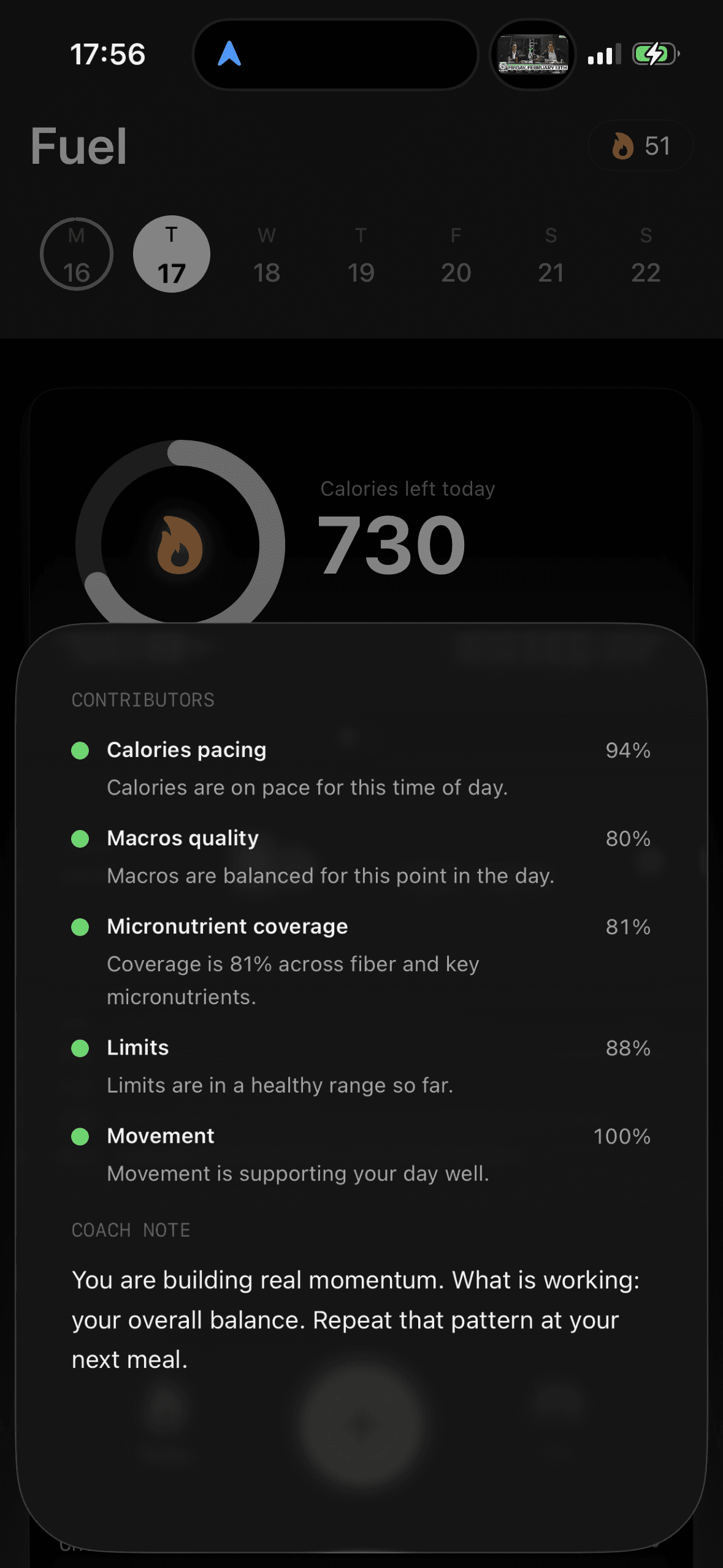
What a performance day looks like in Fuel
The point is not just logging more. It is seeing whether your day is set up to support training before the session goes bad.
06Set performance nutrition baselines
Use this to find your maintenance calories first. Performance work does better when the target is grounded in actual demand instead of a guess.
Energy
TDEE Calculator
Find your Total Daily Energy Expenditure: the calories your body actually burns each day.
Your TDEE
Basal Metabolic Rate
Lose fast
Lose
Maintain
Gain
Gain fast
Weekly total
BMR
Activity
Per meal
Per snack
Calculated using the Mifflin-St Jeor equation. TDEE is an estimate. Track your intake and adjust based on real results.
07How Fuel supports this goal
Fuel helps performance when you use the app to connect intake with output instead of tracking them as separate worlds. Energy Dashboard gives context for harder days, Daily Review catches poor fueling patterns early, and Weekly Review helps you spot the sessions or days where energy drops.
If you train with Apple Watch, the combination of watch data, food logs, and trend review is especially useful. It gives you a better read on whether a bad session was programming, sleep, hydration, or simple under-eating.
08Nutrition targets for this goal
Performance nutrition starts with enough total energy. From there, carbohydrate becomes the main variable around high-demand sessions, protein supports repair, and fat fills out the rest of the day.
The best pre-session meal is the one you can digest well and repeat. Pre-Workout Nutrition and Post-Workout Nutrition matter more than exotic food timing rules. For hot conditions or long sessions, Hydration and Sodium Intake can decide whether performance stays stable or falls apart. If you race long in the heat and want to know whether extra sodium before the start is worth it, use Sodium Loading for Endurance Racing.
If you are trying to improve performance and lose fat at the same time, keep the deficit small enough that the week still feels trainable. A drop of roughly 0.25 to 0.5 percent of body weight per week is a safer ceiling for most active people, and if session quality falls for two weeks in a row, the deficit is too aggressive for the training load.
Protein should stay high enough to support recovery without crowding out carbohydrate. For most lifters and field athletes, that means around 1.6 to 2.2 grams per kilogram of body weight each day, spread across meals.
09Progress markers that matter
Good performance nutrition often improves the boring things first. You recover faster between sets. Your pace holds longer. Late-session form improves. Mood and focus stop fading halfway through the week.
| Signal | What to look for |
|---|---|
| Session quality | Better pace, more reps, or steadier effort |
| Recovery | Less next-day drag after hard work |
| Hunger pattern | Fewer extreme swings or evening crashes |
| Mood and focus | Better concentration during training blocks |
| Weekly consistency | Fewer sessions lost to low energy |
If body weight drops fast and performance drops with it, the food plan is likely too tight for the current training load. Female runners, cyclists, and triathletes should screen this early with Low Energy Availability in Female Endurance Athletes, especially if menstrual changes or low ferritin are also showing up.
10Start this goal in Fuel
Start with the calculator above, then use Daily Review and Weekly Review to see whether the plan is helping the sessions that matter. If the week is still flat after two honest weeks, raise carbs around training before you cut calories again.
11Guides that pair with this goal
Read Fuel Your Body for the big picture, then use Wearable Metrics, Recovery Time, and Hydration to tighten the details. If you need a diet style that stays athlete-friendly, Mediterranean Diet is a good template.
12FAQ
Should I eat more carbs if I want better performance
Often yes. Many active people are not low-carb by principle. They are low-carb by accident. If the session matters, carbs should usually be present before or after it, not saved for later.
Can I improve performance and lose fat at the same time
Sometimes, though one goal usually has to lead. If the week is stable, the deficit is modest, and training quality stays flat or improves, the two can coexist. If load is rising, energy is low, or pace and reps are sliding, performance wins and the deficit shrinks.
Do I need sports products for every workout
No. Most sessions can be covered with normal meals and fluids. Sports drinks or gels matter more as duration, heat, and intensity rise.