Most weight-loss plans fail the same way. The deficit starts too hard, hunger climbs, training slips, and the first rough week becomes a reset. Fuel is built for the version that survives ordinary life: a target you can hold, protein high enough to protect lean mass, and a trend view that tells you whether the week is actually working.
01A calm rate of loss
Weight loss is a reduction in total body mass, but most people choose it because they want less fat, not just a smaller number. That difference matters because the wrong cut can remove energy, muscle, and training quality along with the weight.
If calories drop too hard, the scale can move fast and still point in the wrong direction. Hunger rises, training quality falls, sleep gets worse, and lean tissue is easier to lose. A better target is a calm rate of loss that keeps the week workable.
02Who this goal fits
You're in the right place if you want to reduce body fat, improve health markers, or feel lighter in daily life without turning eating into a second job. You're also in the right place if you've already tried aggressive cuts and know you need a plan you can keep for more than two weeks.
If your main goal is body recomposition rather than faster scale loss, Get Leaner and Stronger is the better fit. If your priority is a repeatable cut that keeps your week intact, stay here.
03Priorities that drive this goal
| Priority | What to do | Why it matters |
|---|---|---|
| Energy gap | Start with a calorie deficit around 300 to 500 kcal per day | Large cuts usually break adherence before they build momentum |
| Protein floor | Aim for 1.6 to 2.2 g/kg/day and spread it across meals | Protein helps satiety and protects lean mass |
| Food quality | Build meals around fiber, produce, and repeatable staples | Hunger is easier to manage when meals are predictable |
| Data quality | Log most meals and weigh in under the same conditions | The weekly trend only works when the inputs are stable |
| Patience | Judge progress over 2 to 4 weeks, not one day | Water, sodium, hard training, and cycle phase move the scale |
04How Fuel supports this goal
Fuel works here because it turns weight loss into a weekly control loop instead of a daily emotional reaction. Log intake, wear the watch, record weigh-ins, and use the review flow to decide whether the target is working or needs a small adjustment.
Use Food Logging to keep intake visible, Weigh-Ins and Trend to separate noise from signal, and Weekly Review to decide whether the target still fits the week. If you want a starting point for meal structure, Nutrition Planning turns a target into something you can execute.
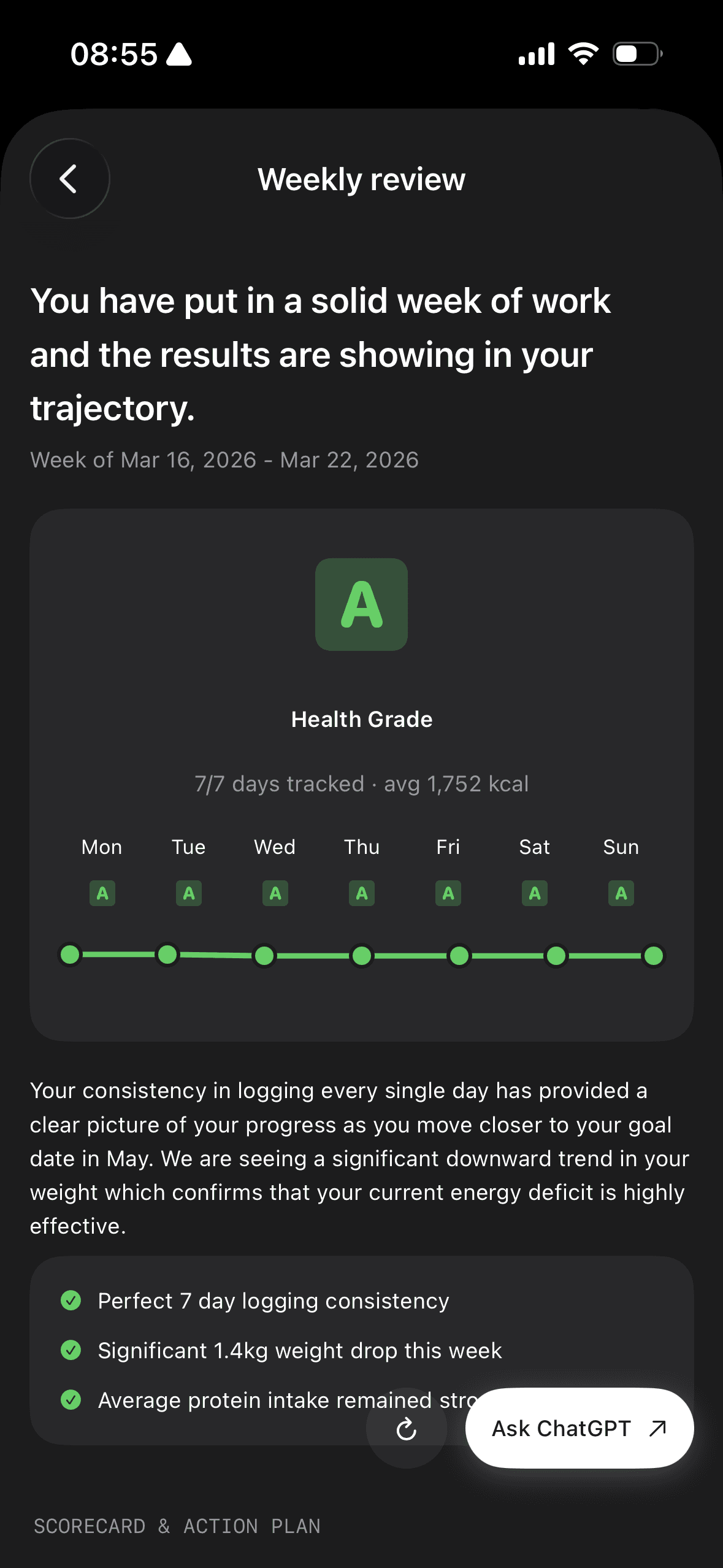
Use the week, not the day
Fuel turns weigh-ins, logging, and recovery into one decision instead of a reaction to a single spike on the scale.
05Nutrition targets for this goal
Weight loss works best with a small enough deficit that the rest of your life still functions. Start from maintenance, then make the first cut small enough that training, sleep, and appetite stay usable.
Energy
TDEE Calculator
Find your Total Daily Energy Expenditure: the calories your body actually burns each day.
Your TDEE
Basal Metabolic Rate
Lose fast
Lose
Maintain
Gain
Gain fast
Weekly total
BMR
Activity
Per meal
Per snack
Calculated using the Mifflin-St Jeor equation. TDEE is an estimate. Track your intake and adjust based on real results.
Carbohydrate does not need to disappear. For many people, moderate carbohydrate intake keeps training easier, which makes the deficit easier to hold. Fat matters for satisfaction and meal enjoyment, though it is also where unplanned calories hide. Most stalled cuts come from a mild calorie leak, not from a broken metabolism.
The diet pattern can stay flexible. Calorie Counting works well for people who want tight control. High-Protein Diet is often the easiest style for appetite control. The best choice is the one that lets you stay inside the target often enough to make the weekly trend move.
06Progress markers that matter
The scale is one signal, not the whole picture. Good progress often looks like a lower weekly average, steadier hunger, fewer snack spirals, and fewer "start over Monday" cycles.
| Signal | What to look for |
|---|---|
| Scale trend | A slow drop across several weeks |
| Adherence | More days close to target, not perfect days |
| Hunger | Manageable, not constant panic eating |
| Performance | Training still feels serviceable and recovery stays steady |
| Waist and photos | Useful when scale noise is high |
If the scale is flat for two to three weeks, audit the basics before cutting harder. Weight Loss Plateau usually comes from drift in portions, weekends, drinks, or logging gaps.
07Mistakes that stall this goal
What looks like failure in fat loss is often just noise. Sodium, hard training, late meals, travel, and constipation can all hide real progress for several days, which is why a trend view matters more than your lightest morning.
The plan itself usually breaks before the physiology does. Starting too hard and making the week socially impossible creates reactive eating fast. Letting protein collapse makes the process harder to sustain. Weight loss works better when the deficit is strong enough to move the trend, mild enough to survive normal life, and supported by enough protein to keep hunger and muscle loss under better control.
08FAQ
How fast should weight loss be
Start with 0.5 to 1 percent of body weight per week. Faster than that often starts to cost training quality, sleep, and adherence, which turns the cut into a restart cycle. The right number within that range depends on how lean you already are. How Fast You Should Lose Fat Without Losing Muscle breaks the rate down by starting body fat and training status.
Do I need to track macros to lose weight
No. Calories do the work. Macros become useful when hunger control, muscle retention, or training quality matter, because protein becomes easier to hold and the deficit becomes easier to live with.
What if I keep losing and regaining the same few pounds
That usually means the weekly deficit is too small or too inconsistent. Tighten weekends, drinks, and portions first. If the same pattern repeats after two solid weeks, reduce intake by another 100 to 200 kcal per day and keep the plan simple.
09Set your first targets
Use the TDEE calculator, set the first deficit, and run the plan for seven days before changing anything. If the average trend is flat after a fair week, trim 100 to 200 kcal per day. If the trend is moving and your energy stays usable, keep the target steady and let the next weekly review make the decision.