You're stuck between two bad options: cut hard, feel flat, and lose training quality, or eat for size and end up softer than you wanted. Recomposition is the slower third path. It works when protein stays high, calories stay close to maintenance, and training does the work that the scale cannot show yet.
01Progress the scale hides
This goal aims for less body fat, more lean tissue, or both. In practice that often means the scale moves slowly, stays flat for stretches, or even rises a little while measurements and training improve.
That is what makes recomposition attractive and annoying at the same time. It can work well for beginners, people returning to training, and people whose eating has been inconsistent. It is slower for advanced lifters who are already fairly lean, because there is less room for easy change.
02Who this goal fits
This fits you if you want a smaller waist, better shape, and better gym output without committing to a hard cut or a classic bulk — you care about body shape, waist size, and strength at the same time, not just one of them.
If you need faster scale loss for a medical or practical reason, Lose Weight is the cleaner target. If you mainly want size, Build Muscle is the better page. If you want the leaner look without giving up performance, this is the middle lane.
03Priorities that drive this goal
| Priority | What to do | Why it matters |
|---|---|---|
| High protein | Aim for 1.6 to 2.2 g/kg/day across 3 to 5 meals | Protein protects lean mass and gives training something to build on |
| Hard lifting | Use progressive training with enough recovery | Strength work gives the body a reason to keep or add muscle |
| Mild energy setup | Stay near maintenance or 100 to 300 kcal below it | Lets you lose fat without flattening training |
| Good measurement | Track more than body weight | Recomposition rarely shows up clearly on the scale alone |
| Time horizon | Give the plan 8 to 16 weeks before judging | This goal rewards patience |
04How Fuel supports this goal
Fuel works well for recomposition when it gives you a clearer read on trend than you can get from one weigh-in. Start in Weekly Review so you can see calorie adherence, protein consistency, weigh-in trend, and training notes in one place. Use Adjusting Macronutrients to make small changes instead of full resets, and use Weigh-Ins and Trend when the scale looks noisy but the week needs a decision.
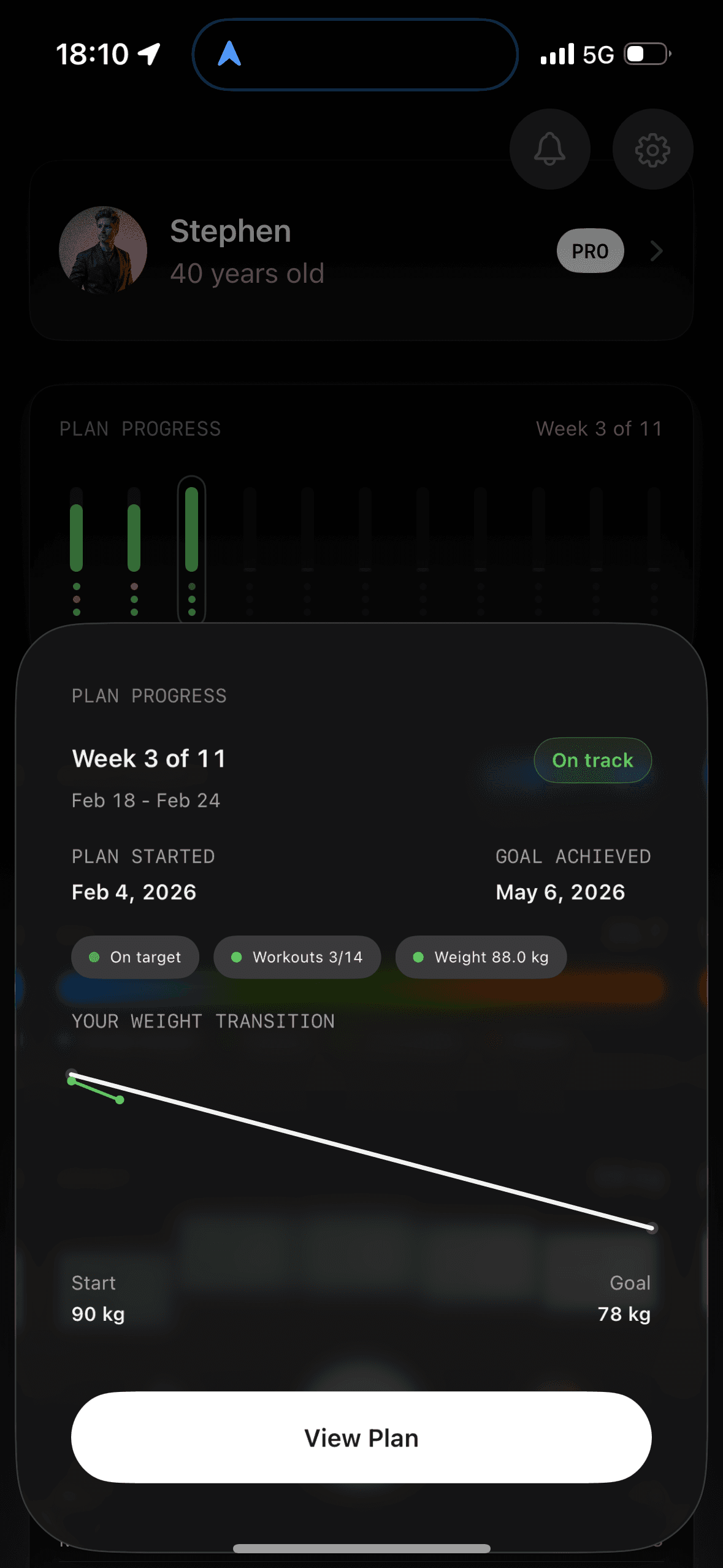
Use trend, not one noisy morning
Recomposition is easier to judge when the plan view and weekly review tell the same story.
05Nutrition targets for this goal
Recomposition nutrition is not dramatic. Keep protein high, keep calorie swings small, and place enough carbohydrate around training to support good sessions. A good starting point is maintenance calories or a small deficit, then a slow adjustment after a fair trial if the waist and photos are not moving.
Use the calculator below to set your first pass at calories and protein. You want a target that is small enough to sustain and clear enough to follow.
Macros
Macro Calculator
Personalized daily calorie and macronutrient targets based on your stats, activity, goal, and diet style.
Daily calories
Macro split
Protein
Carbs
Fat
Calculated using the Mifflin-St Jeor equation. Individual needs vary. Consult a registered dietitian for personalized guidance.
Maintenance Calories are often the starting point. Some people do best a little below maintenance. Others do better near maintenance with better training quality. The answer usually comes from outcome data, not identity. A person who thinks they need a deeper deficit may get a better result from a smaller move that keeps training strong.
Personalized Macro Targets and Body Composition are the best glossary terms to keep in mind here. They keep the focus on what you are trying to change, not on copying someone else's split.
06Progress markers that matter
Recomposition progress looks mixed, and that is normal. You might see a flatter scale, a smaller waist, better photos, and stronger lifts in the same month.
| Signal | What to look for |
|---|---|
| Waist and fit | Clothes loosen around the waist even if scale change is small |
| Photos | Better muscle definition and posture |
| Training | More reps, more load, or more control |
| Scale | Flat to slowly down is common |
| Recovery | You can keep training hard without feeling beat up all week |
If none of these are moving after a fair trial, the plan is probably too loose to create change or too aggressive to support training. The fix is usually a smaller calorie move, better protein consistency, or more honest recovery. If sleep has slipped, read Sleep and Fat Loss before assuming the calories are the only problem.
07Mistakes that stall this goal
The biggest mistake is trying to do everything fast. Recomposition needs enough food for training and enough restraint for fat loss. Huge deficit days followed by high-calorie weekends usually cancel each other out.
Another mistake is using scale weight as the only judge. Recomposition often hides in plain sight if you do not look at lifts, waist, photos, and weekly averages together.
08Guides that pair with this goal
Use Macros vs Calories to understand why this goal needs both energy control and macro structure. Pair that with Maximizing Your Fuel Results, Trend Analysis, and Maintenance Calories. If you wear an Apple Watch and want your calorie target to adapt to your actual activity each day, read Apple Watch-Based Calorie Targets for body recomposition. If execution keeps breaking down, Build a Routine That Sticks is the page to read next.
09Start this goal in Fuel
Set your starting calories, hold them steady long enough to see a real trend, and use Weekly Review to decide whether the plan needs a small adjustment or more time.
10FAQ
Is body recomposition real
Yes. It is most realistic for beginners, people returning after time off, and people whose training or food habits have been inconsistent. It is less dramatic for advanced lifters, but the outcome is still real.
Should I cut first or recomp first
That depends on body fat level, training age, and how strongly you want scale loss right now. If you want a visible change fast, cut first. If you want to keep performance while slowly improving shape, recomp first is usually the better move.
Why is the scale not changing much
Because fat loss and lean mass gain can offset each other on the scale. Use waist, photos, training performance, and weekly averages to judge the phase.