A routine holds when the week can survive tired evenings, weekends, travel, and social meals without collapsing into a reset. Most plans fail in the same specific way. Monday is clean. Tuesday holds. By Wednesday evening the fridge is empty, dinner becomes whatever is on the app, and by Friday the plan has quietly moved to "next Monday."
The missing piece is almost always architecture. A week with no default breakfast, no default lunch, no dinner list on the fridge, and no short ritual to close the day runs on decisions, and decisions are expensive on the nights you are already tired. Shift the week from decisions to defaults and most of the cost disappears. The harder goals, whether that is fat loss, muscle gain, or recomposition, get dramatically easier once the week underneath them stops collapsing.
Build that week from six pieces. A seven-day anchor schedule. Two breakfasts and two lunches saved in Fuel as reusable meals. Four dinner formats you can cook half-asleep. A two-minute morning read of yesterday's Daily Review, quick logs through the day, and a fifteen-minute Sunday reset. A written recovery rule for the moments a plan usually dies. Run it for fourteen days before you change anything, and you will feel the difference before the scale does.
01Build one stable anchor week
The anchor week is a repeatable seven-day shape you commit to for at least fourteen days before changing anything. Two breakfasts, two lunches, four dinner formats, one reset, one review. Copy the table, paste it into your notes, and run it.
| Day | Breakfast | Lunch | Dinner | Fuel action |
|---|---|---|---|---|
| Monday | Default A | Default A | Sheet pan protein and veg | Quick-log breakfast from your saved meal |
| Tuesday | Default B | Default B | Stir fry bowl | Quick-log every meal, clear the protein floor |
| Wednesday | Default A | Default A | Grain bowl | Photo-log if rushed, leftovers count as tomorrow's lunch |
| Thursday | Default B | Default B | Sheet pan protein and veg | Flag the one meal that usually drifts |
| Friday | Default A | Flex lunch | Social or takeout | Log the restaurant with AI food logging |
| Saturday | Slow breakfast | Flex lunch | Home cook or social | Photo-log everything, skip nothing |
| Sunday | Default A or B | Prep cook | Leftovers | Run Weekly Review, set next week's defaults |
Every morning, Daily Review lands with yesterday's recap. Read it with your coffee, note the one thing that drifted, and carry that correction into today.
The two numbers that matter for the week are at least 80 percent of meals logged and protein hit five days out of seven. Everything else is noise.
02Lock your meal defaults
Defaults are meals you can assemble tired, half-dressed, and without thinking. Keep the list short and protect it.
Breakfasts (pick 2 and repeat)
- Greek yogurt, berries, and a scoop of whey. 10 seconds to Fuel.
- Three eggs, one slice of sourdough, and fruit. 8 minutes on the stove.
- Overnight oats with milk, protein powder, and a banana. Made the night before.
Lunches (pick 2 and repeat)
- Chicken, rice, and whatever cooked vegetable is in the fridge.
- Tuna, beans, olive oil, and greens in a bowl. Five minutes, no heat.
- Leftover dinner from the night before. The most underused lunch on earth.
Dinner formats (rotate 4)
- Sheet pan: one protein, two vegetables, oven at 400F for 20 to 25 minutes.
- Stir fry: one protein, frozen vegetables, rice or noodles, sauce of choice.
- Grain bowl: grain, protein, two vegetables, a sauce, something crunchy.
- Social or takeout night: pick the protein-forward option and own it.
Target 35 to 45 grams of protein per meal and two cups of vegetables at lunch and dinner. Save each of these in Fuel as a reusable meal so logging takes seconds on the nights that usually break.
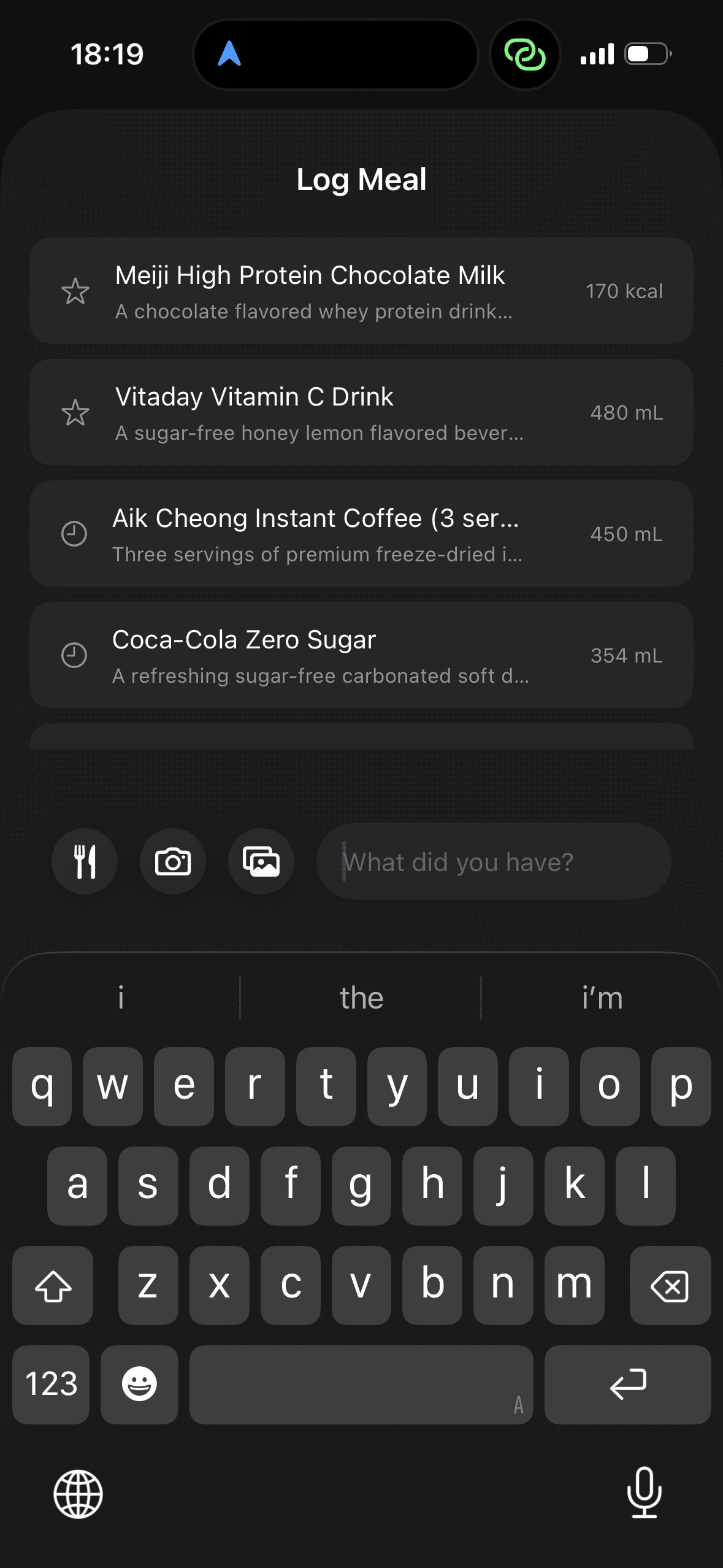
Saved meals are the point
The moment a default meal is saved, logging drops from a minute to five seconds on the exact evenings that usually break the week.
03Daily habits that keep the routine alive
| Priority | What it looks like in practice | Target |
|---|---|---|
| Lock two breakfasts | Same 1 or 2 meals every weekday | Decided by Sunday night |
| Lock two lunches | Same 1 or 2 meals repeated across the week | Decided by Sunday night |
| Protein floor | Each main meal clears the floor | 35 to 45 g per meal |
| Log speed | Saved meals, photos, or voice entry on tired nights | Under 10 seconds per meal |
| Daily review | Read yesterday's recap in the morning and adjust today's plan | 2 minutes, with coffee |
| Weekly review | Review the week on Sunday and set next week's defaults | 15 minutes |
| Miss recovery | Known rule for one bad meal, one bad day, one bad weekend | Written down, reachable in the moment |
04Your daily Fuel loop
The routine is a short loop you repeat every day. This is where Fuel lives inside the week rather than next to it.
Morning (2 minutes). Open Daily Review with your coffee. Read yesterday's recap, note anything that drifted, and decide the one small adjustment for today. Log breakfast from a saved meal on your way out.
Midday (30 seconds). Log lunch from a saved meal. If you are away from your desk, use AI food logging to photo-log and move on.
Evening (30 seconds). Log dinner. Glance at Today's targets so tomorrow's Daily Review has a complete day to recap.
Weekly (15 minutes, Sunday). Open Weekly Review, scan adherence and protein, then set next week's defaults in Recipe Library.
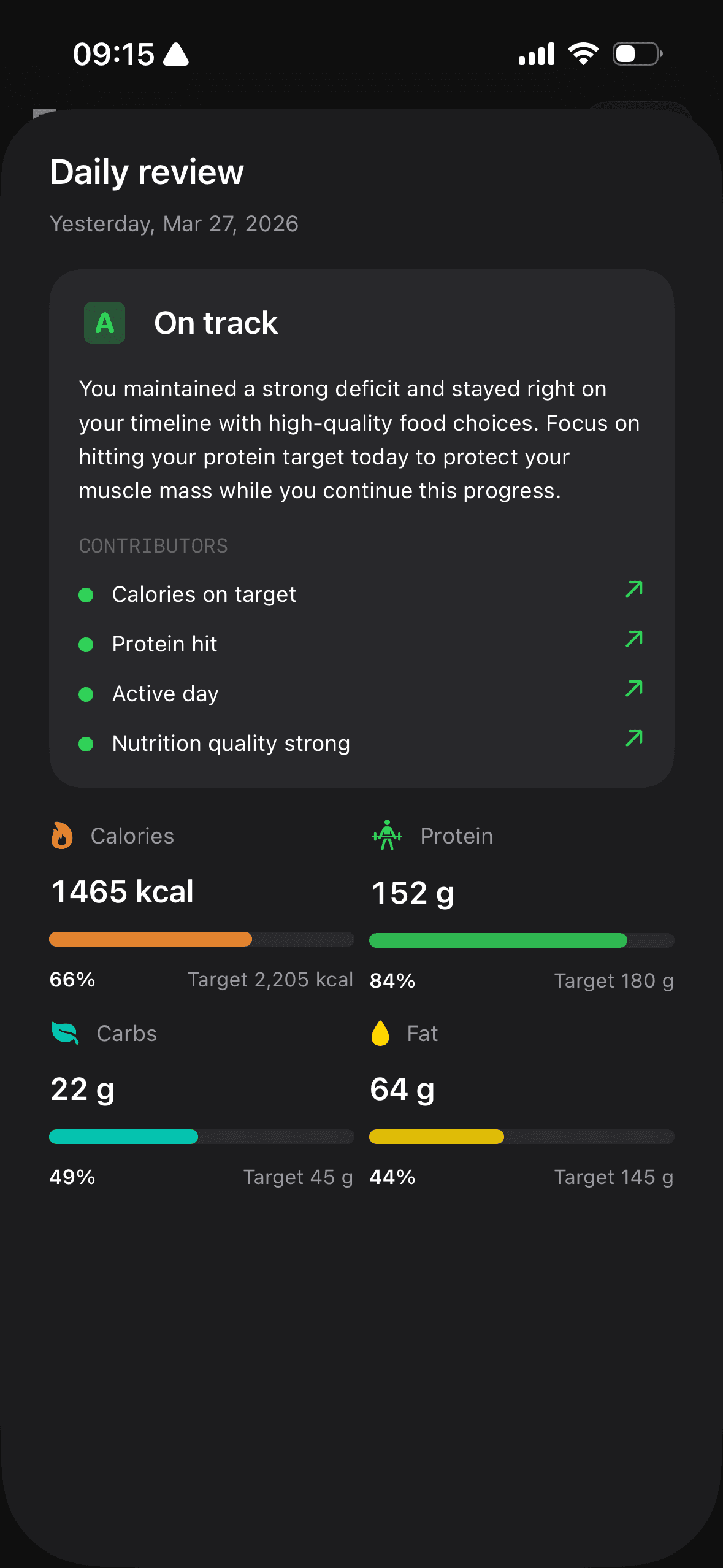
Yesterday, read first thing
Fuel sends Daily Review in the morning with yesterday's recap, so the first coffee of the day is also the first correction.
05The Sunday reset
Sunday is fifteen minutes of operating-system maintenance for the week ahead. Do it on the same couch at the same time.
- Open Fuel. Run Weekly Review and read the summary.
- Pick next week's two breakfasts and two lunches. Save them as reusable meals.
- Pick four dinner formats and write the proteins you will buy.
- Shop the list. If you do not buy it, do not plan it.
- Pre-cook one protein and one grain. Two hours on Sunday buys three hours of calm on Wednesday.
- Decide one thing to fix this week. Just one.
Start in Fuel
Run the Sunday reset inside Fuel
Open Weekly Review, lock next week's defaults, and save them so the whole week logs in seconds.
06What to do after a missed day
Most routines do not die from a bad day. They die from the reaction to a bad day. Write these three recoveries down and reach for the one that fits.
One bad meal. Log it honestly. Keep the next meal on plan. The day is not over.
One bad day. Open Fuel the next morning. Eat the planned breakfast. Hit the protein floor at lunch. Do not add cardio, do not skip meals, do not start a new plan. The next meal is the fix.
One bad weekend. Return to the anchor week on Monday without apology. No compensation, no restriction, no reset message. Open Weekly Review on Sunday and look for the one pattern that keeps breaking.
The rule under all three is the same. The next meal is the fix, and the week continues from the next planned meal rather than from a fresh start on the first of the month.
07Keep the routine through travel and social meals
Real life is the test. Decide these rules now so you do not negotiate at the moment of decision.
- Restaurant night. Before you order, open Eat Out from the Calories detail on Today. Fuel scans the menu, reads every item, and ranks the options that fit your remaining calories, macros, diet rules, and goal for the day, so the best order is already chosen before the waiter arrives. Photo-log the meal afterward with AI food logging. Put the fork down when you feel comfortably full.
- Takeout night. Order from the same two or three places. Build saved meals for your usual orders so logging is instant.
- Travel day. Pack a shaker, whey, and two bars. Aim for two real meals plus a supplement. Log one photo per meal, move on.
- Alcohol night. Eat a protein-forward meal first. Log drinks by count. The goal is awareness.
- Sick day. Skip the plan. Hydrate, rest, eat when hungry. Resume the anchor week the next day you feel functional.
- Forgot to log a meal. Add it from memory within 24 hours. Approximate beats empty.
08Nutrition targets for this goal
Routine-friendly nutrition runs on three anchors that rarely change. A protein floor, a vegetable floor, and a plate template.
- Protein floor: 0.7 to 1.0 g per pound of goal body weight per day, split across three to four meals. Calculate yours below.
- Vegetable floor: two cups of cooked or raw vegetables at lunch and dinner. Fiber, volume, and micronutrients handled in one rule.
- Plate template: palm of protein, fist of vegetables, cupped hand of carbs, thumb of fats. Works without a scale.
Protein
Protein Calculator
Find exactly how much protein you need each day based on your weight, body composition, and goal.
Daily target
Per lb bodyweight
3 meals
4 meals
5 meals
6 meals
Calories
To hit 150g today, you could eat
Targets based on grams per kg of lean body mass using current literature. Individual needs vary by training intensity, age, and total caloric intake.
The fastest upgrades are almost always a protein-forward breakfast, a repeatable lunch, and a short list of dinner defaults. Meal Prep, Food Logging, and Mindful Eating are the glossary pages that matter for this phase.
09Progress markers that matter
Routine progress shows up as less chaos well before it shows up on the scale. Use these targets so you know whether the system is actually installed.
| Signal | What to look for | Target |
|---|---|---|
| Logging rate | Meals captured with little effort | 80 percent of meals, 6 days a week |
| Meal repetition | Same breakfasts and lunches recurring | 2 or more repeat meals per week |
| Protein floor hit | Daily protein target reached | 5 days out of 7 |
| Weekend drift | Saturday and Sunday calories versus weekday average | Within 20 percent |
| Recovery speed | Time from a miss to the next on-plan meal | The very next meal |
| Decision fatigue | Food choices that feel automatic | Most weekday meals |
A stable routine usually improves body composition before you run a harder calorie target. The reason is simple. Random overeating drops once the week has a shape.
10Mistakes that stall this goal
- Too much variety. A new recipe every night turns every night into a decision. Rotate four dinner formats, swap the protein.
- Logging only the good days. The tired evenings are the data. Saved meals and photo logging exist for exactly those nights.
- Compensating after a miss. Skipped meals and extra cardio after a bad day create the next bad day. The next meal is the fix.
- Shopping without a plan. Groceries without a dinner list become a fridge of ingredients and no meals. Shop the anchor week.
- Starting over every Monday. A routine compounds. Every reset costs the progress of the previous attempt. Resume, do not restart.
11Week one checklist
Do these seven things in the next seven days.
- Pick two breakfasts and two lunches. Save them in Fuel as reusable meals.
- Pick four dinner formats and the proteins you will buy.
- Shop the list. Pre-cook one protein and one grain on Sunday.
- Log every meal for seven days, even the ones you wish you had not eaten.
- Read Daily Review every morning with your coffee and act on the one thing it flags.
- Write down your miss protocol and keep it where you can see it.
- Run Weekly Review next Sunday, then choose one thing to fix.
Start the anchor week
Install the routine before chasing a harder goal
Open Fuel, save your two breakfasts and two lunches, run the Sunday reset, and hold the anchor week for fourteen days before changing a thing.
12Move from routine to a specific goal
If the anchor week is holding for two full weeks, use the picker to choose the next phase rather than guessing.
13FAQ
How many meals need to be consistent
Breakfast and lunch do most of the work. Two of each, repeated across the week, is usually enough.
Do I need to log forever
No. Log every meal for the first month. After that, keep logging on phases that need tighter control and on any week where the pattern starts drifting.
What should I do after a bad weekend
Resume the next planned meal. No compensation, no punishment, no restart. Run Weekly Review on Sunday and look for the pattern that broke the weekend.
What if I cannot cook
You do not have to cook. Pick two assembly breakfasts, two deli-counter lunches, and a rotation of two or three takeout orders saved as meals in Fuel.
What if my schedule changes every week
Build the anchor week around your fixed points. Meetings and sleep are often more reliable than you think. For the rest, rely on photo logging and saved meals so the plan survives a moved lunch.
How long before this feels automatic
Most people get there in three to six weeks of honest logging. The first two weeks feel effortful. By week four, the defaults and the daily review usually run without thinking.
What if I miss the Sunday reset
Do it Monday morning. Fifteen minutes of planning on a Monday beats five unplanned evenings that week.
When do I move on to a harder goal
When the anchor week holds for two consecutive weeks, logging is above 80 percent, and protein clears the floor five days out of seven. Then go to Lose Weight, Get Leaner and Stronger, or Build Muscle.