Muscle is built in a 10 to 16 week block that holds three things steady: a small daily surplus, 30 to 50 g of protein at every meal, and training that climbs every week. Do that and body weight rises 2 to 4 kg with the lifts, most of it landing in the shoulders, chest, arms, and legs you train. Miss any one of the three for a month and the phase stalls.
The phase runs on four numbers: calories, protein, carbs around training, and a weekly rate of gain. Lock them first. The example day, the adjustment rules, and the stall diagnostics all line up around those four.
01Muscle-gain calorie and protein targets
| Target | Number | Notes |
|---|---|---|
| Calories | Maintenance + 150 to 300 kcal | Calculate maintenance below, then add the surplus |
| Protein | 1.6 to 2.2 g per kg body weight daily | Spread across 3 to 5 meals |
| Carbs, training day | 4 to 6 g per kg body weight | Weight heavier around the session |
| Carbs, rest day | 3 to 4 g per kg body weight | Lower anchor to leave room for fat |
| Fat | 0.6 to 1.0 g per kg body weight | Keep above 0.6 g/kg for hormones and satiety |
| Rate of gain | 0.25 to 0.5% of body weight per week | An 80 kg lifter gains 200 to 400 g per week |
| Phase length | 10 to 16 weeks | Then reassess and cut or hold |
Set maintenance first. The surplus is meaningless until that number is honest.
Energy
TDEE Calculator
Find your Total Daily Energy Expenditure: the calories your body actually burns each day.
Your TDEE
Basal Metabolic Rate
Lose fast
Lose
Maintain
Gain
Gain fast
Weekly total
BMR
Activity
Per meal
Per snack
Calculated using the Mifflin-St Jeor equation. TDEE is an estimate. Track your intake and adjust based on real results.
Protein
Protein Calculator
Find exactly how much protein you need each day based on your weight, body composition, and goal.
Daily target
Per lb bodyweight
3 meals
4 meals
5 meals
6 meals
Calories
To hit 150g today, you could eat
Targets based on grams per kg of lean body mass using current literature. Individual needs vary by training intensity, age, and total caloric intake.
02Priorities that drive this goal
| Lever | Action | Why it matters |
|---|---|---|
| Progressive overload | Add reps, load, or quality on a planned progression every session | The surplus only turns into muscle when training asks for it |
| Protein distribution | 3 to 5 feedings of 30 to 50 g protein each | Sustains muscle protein synthesis across the day |
| Carb placement | Put at least half of training-day carbs in the pre and post meals | Supports output, training volume, and recovery |
| Sleep floor | 7.5 hours minimum on training days | Recovery decides whether the surplus becomes tissue |
| Weekly review | Same day and time every week, check weight trend and training log | Adjusts the phase before drift compounds |
03Set up the phase in Fuel
- Set the plan. Open Nutrition Planning, enter body weight, choose muscle gain, and lock the calorie and macro targets from above.
- Save 3 to 5 repeat meals. In Recipe Library, save one breakfast, two lunches, one rest-day dinner, and one training-day dinner. These are the anchors that make the week repeatable.
- Build pre and post templates. Save a pre-workout meal at 25 to 30 g protein and 50 to 60 g carbs. Save a post-workout meal at 40 to 50 g protein and 60 to 100 g carbs. Duplicate them on every training day.
- Pick the weekly review. Set a recurring slot in Weekly Review to check body weight trend, protein adherence, and training output in one view.
- Watch the mid-week signal. Open Energy Dashboard on day three or four to catch low-intake days before they become the pattern.
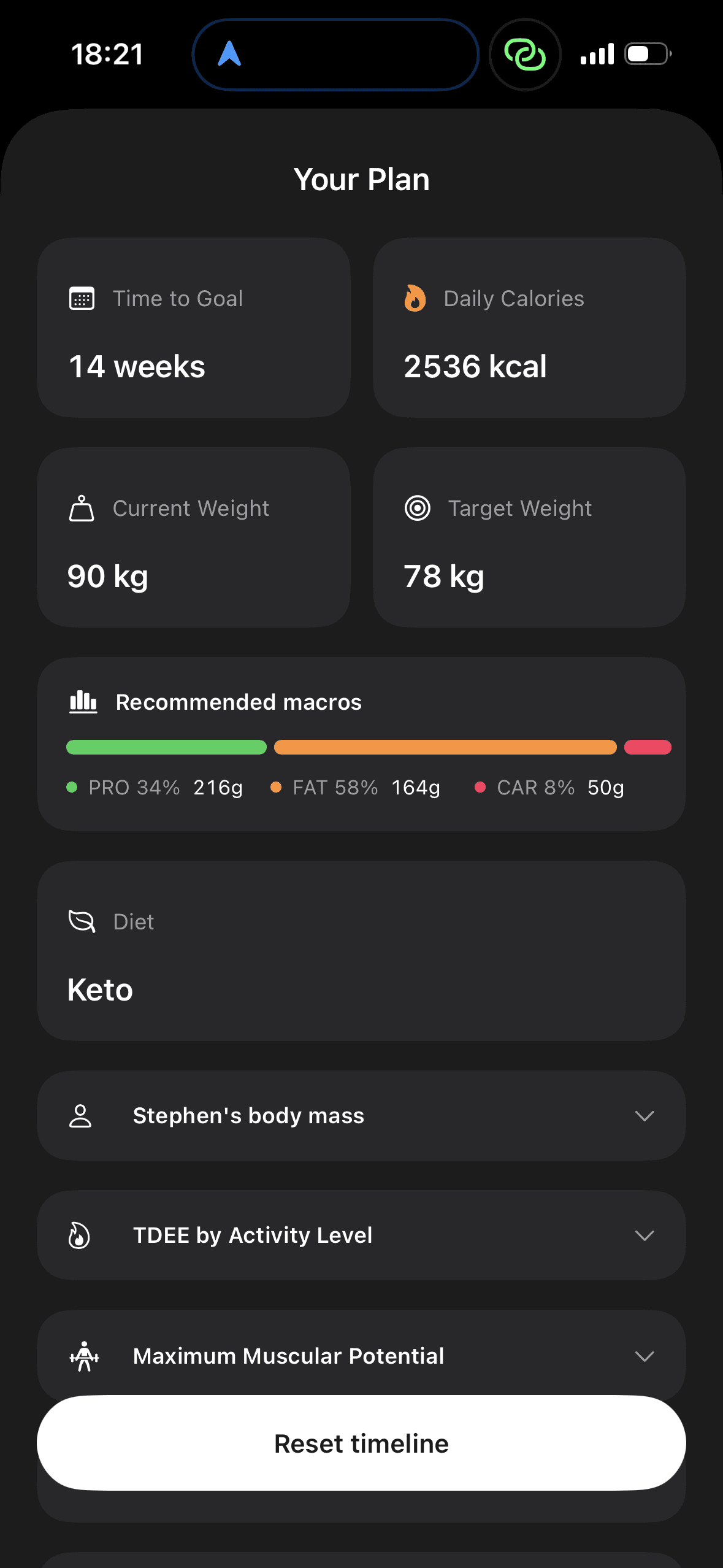
Lock the surplus before the week starts
Set maintenance and the surplus on day zero so every logged meal is measured against the phase target.
04How to hit your protein
Daily total matters, and so does meal-level dose. Each feeding needs roughly 0.4 g per kg body weight, or about 30 to 50 g of high-quality protein, to trigger muscle protein synthesis. Spreading 180 g across four meals of 45 g works. Packing 140 g into one dinner and grazing the rest of the day does not.
Anchor breakfast first. Most lifters hit dinner and coast until then, which leaves 16 hours without an MPS signal. A 35 to 45 g breakfast reshapes the whole day. Leucine Threshold and Protein Timing cover the mechanism if you want it.
05An example training day
For an 85 kg lifter targeting 2,800 kcal, 180 g protein, 350 g carbs, and 80 g fat.
| Meal | What | Protein | Carbs | Fat | kcal |
|---|---|---|---|---|---|
| Breakfast | Oats with whey, banana, peanut butter | 35 g | 75 g | 15 g | 575 |
| Lunch | Chicken, rice, vegetables, olive oil | 45 g | 80 g | 15 g | 635 |
| Pre-workout, 60 to 90 min out | Greek yogurt with berries and honey | 25 g | 60 g | 5 g | 385 |
| Post-workout, within 60 min | Whey shake with a bagel and jam | 30 g | 75 g | 5 g | 465 |
| Dinner | Salmon, potatoes, salad | 45 g | 60 g | 30 g | 690 |
| Total | 180 | 350 | 70 | 2,750 |
Save these five meals in Fuel as the default training-day template. Swap the proteins and starches to match preferences, but keep the macro shape.
06Training day vs rest day
Rest days drop carbs by about 100 g and hold protein and fat constant. Drop the pre and post-workout meals. Dinner can carry a higher-fat protein and more vegetables if appetite is lower.
For the 85 kg lifter above, a rest day sits near 2,400 kcal with 180 g protein, 250 g carbs, and 80 g fat. Protein does not drop on rest days because MPS signaling runs every day.
07The first four weeks
Before the two-week decision table kicks in, these are the signals that tell you the phase is working.
| Signal | What you should see by week 4 |
|---|---|
| Body weight trend | Slow upward drift on the seven-day average, not the daily scale |
| Gym log | More reps, more load, or cleaner reps at the same load |
| Photos and measurements | Gradual fill in shoulders, chest, arms, and legs you train |
| Recovery | Hard sessions feel recoverable the next day, not crushing |
| Appetite | You can hit intake without force-feeding every meal |
Some fat gain is normal. Beginners and returners can add muscle with very little fat gain. Advanced lifters usually carry a little extra through the phase, and the ratio improves with a smaller surplus, better sleep, and more training age.
08Check and adjust every two weeks
| Two-week signal | Action |
|---|---|
| Body weight rose 0.25 to 0.5% per week | Hold targets. The phase is working. |
| Body weight rose less than 0.25% per week | Add 150 kcal per day to training-day carbs, hold two more weeks, recheck. |
| Body weight rose more than 0.75% per week | Hold calories. Recheck in two weeks. Fat gain is running ahead of muscle. |
| Body weight flat and lifts flat | Audit sleep and session quality for one week. If still flat, add 150 kcal. |
| Body weight up and lifts flat or down | Check sleep, program structure, and recovery. Food is not the bottleneck. |
Pull the trend and adherence in Weekly Review so the decision is based on a two-week average, not one weigh-in.
09When the phase stalls
Most stalls trace to one of four patterns. Walk them in order before changing the calorie target.
- Weekends erase the surplus. Friday and Saturday land 600 to 800 kcal higher than weekdays, the reader cuts Sunday to compensate, and the weekly average flattens. Fix: log seven days honestly and trust the weekly average, not any single day.
- Sleep slipped below 7 hours. Training output and recovery both fall, and the surplus shows up as fat rather than tissue. Fix: protect sleep for two weeks before raising calories.
- Surplus is too large. Fast scale climb with flat lift progress means food is running ahead of the program. Fix: hold calories, wait two weeks, recheck the lift log.
- Training does not climb. Food without progressive overload is just food. Add reps, load, or a quality variable every week. A high-volume plan on low carbohydrate intake often feels like bad genetics when the real problem is fuel and work that do not match.
10When to end the phase
Stop and reassess when any of these hits:
- Body fat has drifted past the level you want to cut from.
- Lifts have been flat for three straight weeks at a correct surplus.
- The 10 to 16 week window you set at the start is up.
- A planned event, race, shoot, or season requires a different phase.
- For concerns about feeling insufficiently muscular despite progress, pause physique-focused changes and seek clinical assessment before choosing another phase. See Muscle Dysmorphia.
For the other stop conditions, move to Get Leaner and Stronger for a recomposition window, or run a short cut if body fat is the priority.
Start the phase
Set up week one in Fuel
Enter maintenance, add the surplus, save your repeat meals, and pick the weekly review day.
11Guides that pair with this goal
- Macro setup: How to Count Macros for Muscle Gain
- Meal-level protein dosing: Leucine Threshold
- Batch cooking for a surplus: Meal-Prep Systems for Fat Loss, Muscle Gain, and Performance
- Creatine decision: The Complete Guide to Creatine (2026), and Creatine for Women for the female-specific angle
- Training principle: Progressive Overload
- Diet pattern: High-Protein Diet
- If execution is the gap: Build a Routine That Sticks
- If the body never feels muscular enough regardless of progress: When Being Muscular Never Feels Like Enough