Hit your daily protein target, then split it across three or four meals that each contain a real serving of protein. For many lifters that means around 30 to 40 grams per meal, and the exact split matters less than the total. A big dinner still counts. A 20 gram breakfast still counts. The per-meal question comes second.
Most conflicting advice comes from studies that measure different things. Tracer studies measure muscle protein synthesis over hours or days. Training trials measure lean mass over weeks or months. Appetite trials measure hunger and snacking. One meal pattern can lead on one endpoint and tie on another.
01Start with your daily protein target
The daily total does most of the work. A 2018 meta-analysis of 49 resistance-training trials found that the benefit of added protein for fat-free mass leveled off near 1.6 g/kg/day, with the upper confidence limit near 2.2 g/kg/day.1 The Importance of Protein covers how to set that number, and How to Count Macros for Muscle Gain places it inside a full calorie and macro plan.
Once you have the number, divide it. A 75 kg lifter eating 1.6 g/kg needs 120 g a day. Three meals put 40 g on each plate. Four meals put 30 g on each. The research does not pick a winner between those two plans, and both fit within the cited 20 to 40 g serving range.2
If your daily total falls short on most days, fix that before you rearrange a single meal.
02What leucine does in a meal
Leucine is the essential amino acid that most strongly signals muscle to start building protein. Its rise after a protein-rich meal helps activate mTORC1, a pathway involved in muscle protein synthesis. Dose-response studies on whey and egg protein led to a planning figure of roughly 2 to 3 g of leucine per meal, which younger adults get from about 20 to 30 g of high-quality protein.2
Treat that range as a dimmer more than a switch. A meal with 1.5 g of leucine still supplies amino acids that muscle uses, and the response rises with dose instead of flipping on at a fixed line. Leucine also cannot build muscle by itself. Muscle needs every essential amino acid to make new protein, which is why complete foods such as meat, fish, eggs, dairy, and soy carry the plan. Protein powder is a convenience for days when a full meal is hard to arrange.
Age can shift the useful range upward. Older muscle responds less to the same dose, a pattern called anabolic resistance, so 30 to 40 g per meal is a common planning range for older adults.3
Build each main meal around a complete protein food and you can stop counting leucine grams.
03Why 30 grams is not a ceiling
Absorption and muscle use are separate questions. Your gut can absorb the amino acids from far more than 30 g of protein, and a larger meal takes longer to digest. The 30 g figure came from studies that measured muscle protein synthesis for a few hours after one serving of fast-digesting protein, then hardened into a supposed limit on how much the body can use.
Trommelen and colleagues tested that limit in 2023. Thirty-six young, recreationally active men did a whole-body lifting session and then drank 0, 25, or 100 g of milk protein. The 100 g dose produced a larger anabolic response that was sustained throughout the 12-hour observation window.4
That result should change how you feel about a big dinner. A 60 or 70 g evening meal is not wasted protein. The study compared one 100 g dose with one 25 g dose, not one 100 g meal with four 25 g meals, and it measured a single recovery period in young men instead of months of training. It shows that a large dose keeps working. It does not show that you should eat 100 g at once.
If your schedule puts most of your protein at dinner, keep that dinner and look at whether your earlier meals are low enough to matter.
04What even protein intake changes
Most even-distribution advice comes from small, short studies. Mamerow and colleagues found about 25 percent higher 24-hour muscle protein synthesis in eight adults eating roughly 30 g at each meal instead of 11, 16, and 63 g.5 In another acute trial, four 20 g servings after leg exercise produced more synthesis than the tested smaller, more frequent or larger, less frequent doses.6 Neither result predicts 25 percent more muscle over a training block.
A 2025 trial by Askow and colleagues complicates the picture. Forty young, active adults ate controlled maintenance diets for nine days while lifting. One pattern placed 10, 30, and 60 percent of daily protein across three meals. The other placed 20 percent at each of five eating occasions. Myofibrillar protein synthesis did not differ statistically.7 That does not prove equivalence, and daily protein was only about 1.1 to 1.2 g/kg.
Longer trials measured lean mass and found no clear advantage. In 41 adults with overweight, body composition changed similarly after 16 weeks of dieting and lifting with either a 10/20/60 g or 30/30/30 g pattern.8 A separate 16-week trial in women also found no distribution effect on fat-free mass.9 In 26 young men training for 12 weeks, total lean soft tissue favored a higher-protein breakfast numerically, but the between-group result was P=.06 and arm and leg lean mass did not differ.10
Appetite is a different outcome. A second report from the same women's trial found that the even group valued energy-dense snacks less and ate less of them in a lab test.11 The test lunches contained different amounts of protein, so the result cannot isolate a chronic distribution effect. The two reports count as one trial.
| Study | Who and how long | Comparison | Endpoint | Result |
|---|---|---|---|---|
| Mamerow 20145 | 8 adults, 7 days per pattern | About 30/30/30 g vs 11/16/63 g | 24-hour muscle protein synthesis | About 25% higher with even intake |
| Areta 20136 | 24 trained men, 12 hours | 80 g whey as 8×10, 4×20, or 2×40 g | 12-hour myofibrillar synthesis | 4×20 g highest |
| Askow 20257 | 40 young, active adults, 9 days | 10/30/60% vs five 20% feedings | Daily myofibrillar synthesis | No statistically detected difference |
| Hudson 20178 | 41 adults with overweight, 16 weeks dieting | 10/20/60 g vs 30/30/30 g | Body composition | No difference |
| De Leon 20249 | Women with overweight or obesity, 16 weeks dieting | Even vs dinner-heavy | Fat-free mass | No difference |
| Yasuda 202010 | 26 young men, 12 weeks training | Higher vs lower breakfast protein | DXA lean soft tissue | Trend toward higher breakfast, P=.06 |
| De Leon 202611 | Same trial as De Leon 2024 | Even vs dinner-heavy | Snack value and intake in a lab | Lower with even intake |
Even intake came out ahead in two small, short synthesis studies, has not produced a detectable lean-mass difference over months, and may help with snacking during a diet. If your current pattern hits your total and your hunger is under control, the evidence does not demand a change. If evening snacking is wrecking a cut, a larger breakfast or lunch is the experiment to run first.
05Choose a meal pattern you can keep
Go back to the 120 g target. Three 40 g meals could be eggs with Greek yogurt in the morning, a chicken and rice bowl at lunch, and salmon at dinner. Four 30 g meals shrink that lunch and add cottage cheese or a protein shake in the afternoon. Choose by which plan survives a busy Tuesday.
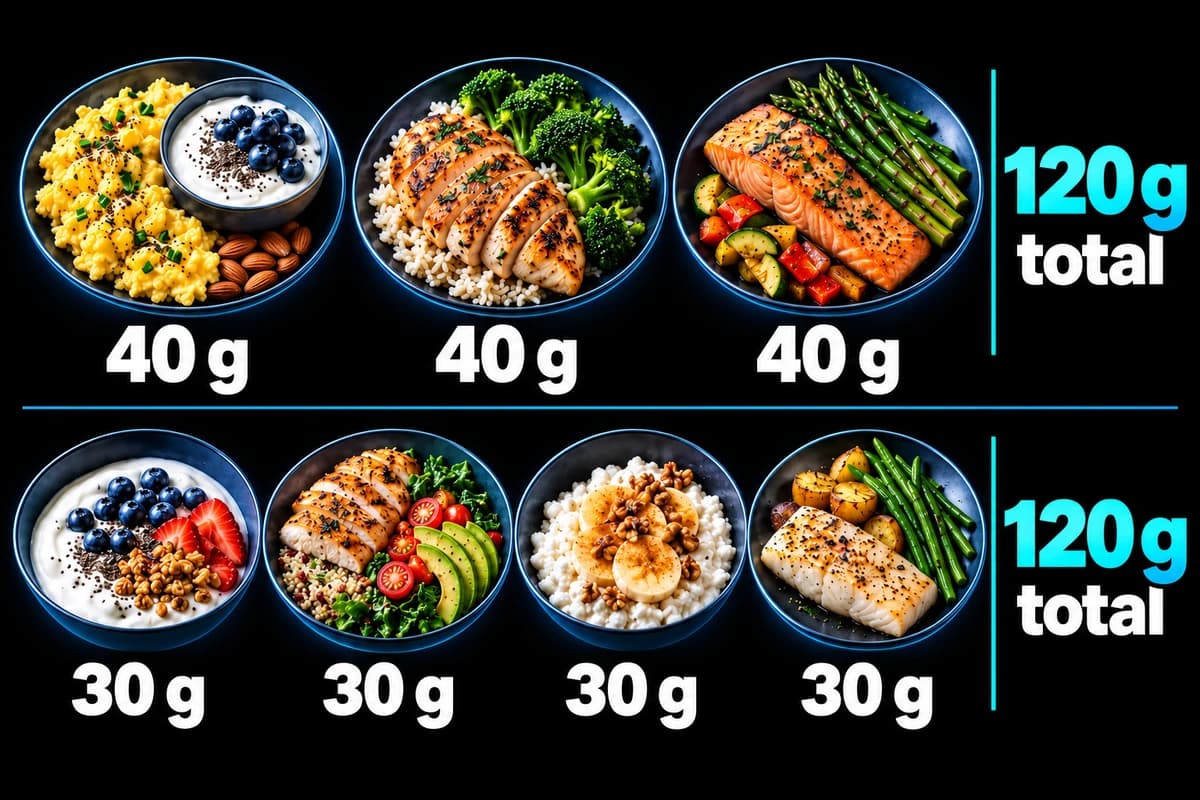
Both patterns deliver 120 g. This is a planning example, not a tested head-to-head result.
A common pattern is 10 g at breakfast, 40 g at lunch, and 70 g at dinner. As a planning example, moving 20 g from dinner to breakfast gives 30, 40, and 50 g. No study has tested that exact swap. It may help when mornings are thin and evenings are heavy. The High-Protein Breakfast Problem has five-minute options.
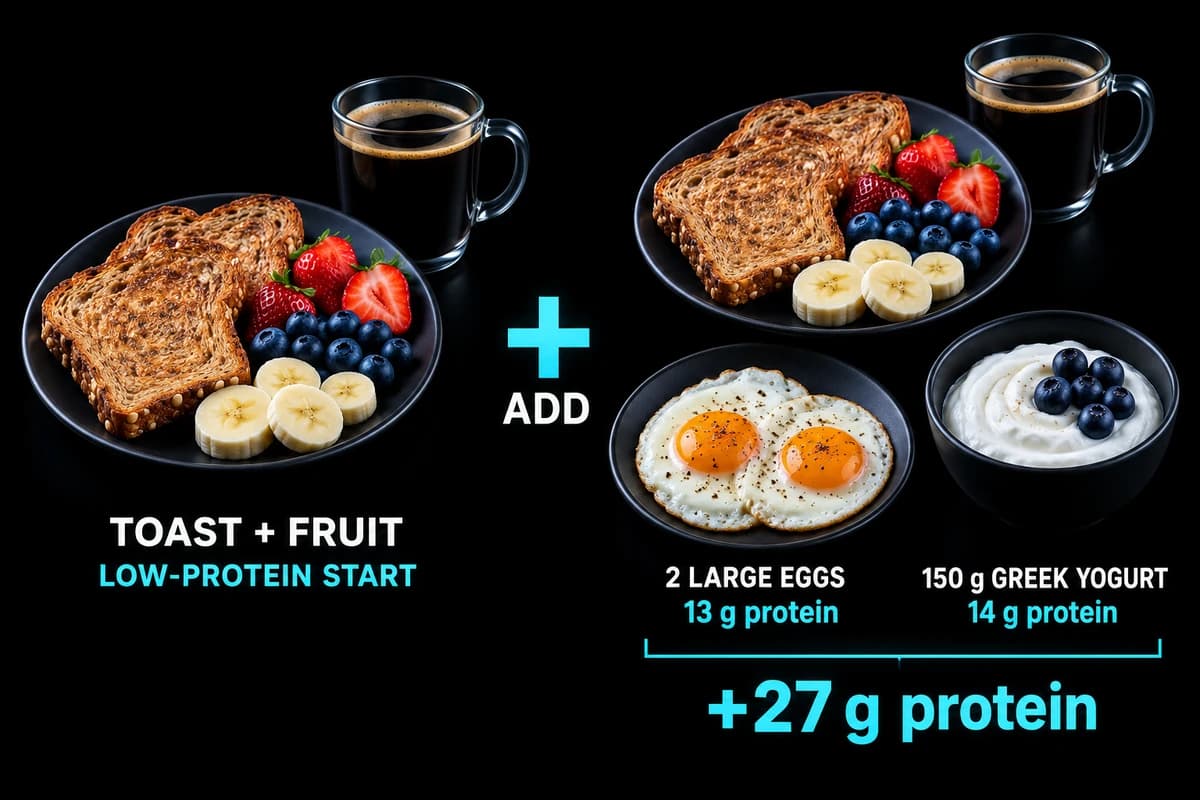
Two large eggs add about 13 g of protein, and a 150 g serving of plain Greek yogurt adds 14 g. That is about 27 g added without rebuilding the whole breakfast.
| Pattern | Breakfast | Lunch | Afternoon | Dinner | Fits |
|---|---|---|---|---|---|
| Three even meals | 40 g | 40 g | none | 40 g | People who dislike snacking |
| Four even meals | 30 g | 30 g | 30 g | 30 g | Afternoon training or smaller appetites |
| Adjusted dinner-heavy day | 30 g | 40 g | none | 50 g | People who want a big family dinner |
People who train in the evening can treat protein before bed as one of those meals. Pre-sleep protein covers when that extra evening serving earns its place.
The best split is the one you can repeat on a workday without thinking about it.
06Make plant-based meals count
Plant proteins often carry less leucine per gram than whey and some are digested less completely.12 A slightly larger serving can close the gap. Aim for 30 to 40 g of protein per meal, using tofu, tempeh, edamame, seitan paired with legumes, or plant protein powder when food volume gets hard to manage.
The Askow trial also compared vegan and omnivorous diets at matched protein and found similar myofibrillar synthesis over nine days.7 That is short-term evidence, and it fits a 12-week training study in young, previously untrained men where habitual vegans and omnivores, both eating about 1.6 g/kg/day, gained comparable lean mass and strength.13 How to Hit Your Protein Target on a Plant-Based Diet works through the food choices and portion sizes.
On a plant-based diet, plan one extra protein-containing meal or a larger serving at each meal before you consider adding free leucine.
07When to give meal timing more attention
For most healthy adults who hit their total, meal timing is a small adjustment. A solid serving at each meal deserves more attention with older age, low appetite, a calorie deficit, or twice-daily training. Three or four modest servings may also be easier to finish than one large plate. Protein timing and protein distribution explain both ideas in more detail.
If none of those describe you, spend your effort on the daily number and let the meals fall where your life puts them. Come back to the split when hunger, age, or training volume gives you a reason.
Footnotes
Morton RW, Murphy KT, McKellar SR, et al. A systematic review, meta-analysis and meta-regression of the effect of protein supplementation on resistance training-induced gains in muscle mass and strength in healthy adults. Br J Sports Med. 2018, 52(6), 376-384. PubMed
Back to textJäger R, Kerksick CM, Campbell BI, et al. International Society of Sports Nutrition position stand. Protein and exercise. J Int Soc Sports Nutr. 2017, 14, 20. PubMed
Back to textBack to text 2Breen L, Phillips SM. Skeletal muscle protein metabolism in the elderly. Interventions to counteract the anabolic resistance of ageing. Nutr Metab (Lond). 2011, 8, 68. PubMed
Back to textTrommelen J, van Lieshout GAA, Nyakayiru J, et al. The anabolic response to protein ingestion during recovery from exercise has no upper limit in magnitude and duration in vivo in humans. Cell Rep Med. 2023, 4(12), 101324. PMC
Back to textMamerow MM, Mettler JA, English KL, et al. Dietary protein distribution positively influences 24-h muscle protein synthesis in healthy adults. J Nutr. 2014, 144(6), 876-880. PMC
Back to textBack to text 2Areta JL, Burke LM, Ross ML, et al. Timing and distribution of protein ingestion during prolonged recovery from resistance exercise alters myofibrillar protein synthesis. J Physiol. 2013, 591(9), 2319-2331. PubMed
Back to textBack to text 2Askow AT, Barnes TM, Zupancic Z, et al. Impact of vegan diets on resistance exercise-mediated myofibrillar protein synthesis in healthy young males and females. A randomized controlled trial. Med Sci Sports Exerc. 2025, 57(9), 1923-1934. PubMed
Back to textBack to text 2Back to text 3Hudson JL, Kim JE, Paddon-Jones D, Campbell WW. Within-day protein distribution does not influence body composition responses during weight loss in resistance-training adults who are overweight. Am J Clin Nutr. 2017, 106(5), 1190-1196. PubMed
Back to textBack to text 2De Leon A, Roemmich JN, Casperson SL. Daily dietary protein distribution does not influence changes in body composition during weight loss in women of reproductive years with overweight or obesity. A randomized controlled trial. J Nutr. 2024, 154(4), 1347-1355. PubMed
Back to textBack to text 2Yasuda J, Tomita T, Arimitsu T, Fujita S. Evenly distributed protein intake over 3 meals augments resistance exercise-induced muscle hypertrophy in healthy young men. J Nutr. 2020, 150(7), 1845-1851. PubMed
Back to textBack to text 2De Leon A, Roemmich JN, Casperson SL. Evenly distributing daily dietary protein across three meals reduces women's snack food reinforcement and intake of energy-dense snack foods during weight loss. A randomized controlled trial. J Acad Nutr Diet. 2026, 126(9), 156391. PubMed
Back to textBack to text 2van Vliet S, Burd NA, van Loon LJC. The skeletal muscle anabolic response to plant- versus animal-based protein consumption. J Nutr. 2015, 145(9), 1981-1991. PubMed
Back to textHevia-Larraín V, Gualano B, Longobardi I, et al. High-protein plant-based diet versus a protein-matched omnivorous diet to support resistance training adaptations. A comparison between habitual vegans and omnivores. Sports Med. 2021, 51(6), 1317-1330. PubMed
Back to text