Your calorie target is a hypothesis, not a number. Every TDEE calculator hands you a confident-looking figure, and on average that first guess is off by 15 to 25 percent for any individual. The calculators are fine. Your body is just one sample, and a sample of one needs measurement to reveal itself. The good news is that two to three weeks of honest logging plus a weight trend will recalibrate your real maintenance more accurately than any equation, and it will keep doing that for the rest of your life.
Calorie counting is a measurement instrument. You set a starting bet, you collect data, you adjust on a fixed cadence, and you repeat across diet phases. The skill you are building is Bayesian self-experimentation in the kitchen. Once you see it that way, "what if my number is wrong" stops being a fear and becomes the point of the exercise.
The path is to set the first bet, read the trend, adjust on a fixed schedule, and graduate from tight tracking to a lighter rhythm you can carry for years. Flexible dieting is the macro-aware version of the same idea. Fuel is built around the loop.
01Intake and weight trend loops
Calorie counting works on two timescales at once. Treat them separately and the work gets simpler.
| Loop | Cadence | What you do | What it answers |
|---|---|---|---|
| Inner loop (the data) | Daily and weekly | Log intake, take morning weights, read the 7-day trend, adjust 100 to 200 kcal if needed | "Is my current target still correct?" |
| Outer loop (the plan) | Every 8 to 12 weeks | Move between cut, maintenance, and reverse or surplus phases | "What is my body composition goal?" |
| Lifetime loop | Quarterly to yearly | Spot-check your habits, reset templates, decide when to count tightly and when to coast | "Is the system still serving me?" |
Most people fail at calorie counting because they collapse all three loops into a single "diet" with no clear end and no clear adjustment rule. The two-loop system gives you a stopping criterion at every level.
02Calories still set weight change
Your body uses energy every day for basic function and movement. When your average intake is higher than your average expenditure, weight tends to drift up. When your average intake is lower, weight tends to drift down. That sentence is the entire law of conservation of energy applied to your kitchen. Reducing measurement error and reading the signal cleanly is the real work from here.
The useful part of calorie counting is the feedback. You learn which meals keep you full, which snacks slip in unnoticed, and which habits actually move the needle. The number on the app is a proxy. The trend on the scale is the truth.
03How many calories should I eat?
Pick a starting point. Treat it as a bet, then update it with data.
The two equations worth knowing are Mifflin-St Jeor and Katch-McArdle. Mifflin-St Jeor uses height, weight, age, and sex. Katch-McArdle uses lean body mass, so it tends to be more accurate if you actually know your body fat percentage from a DEXA or a careful caliper read.
| Equation | Formula (kcal/day at rest) | When to use it |
|---|---|---|
| Mifflin-St Jeor | Men: 10 x weight (kg) + 6.25 x height (cm) - 5 x age + 5 | Default for most adults, validated to within 10% for many |
| Mifflin-St Jeor | Women: 10 x weight (kg) + 6.25 x height (cm) - 5 x age - 161 | Default for most adults, validated to within 10% for many |
| Katch-McArdle | 370 + (21.6 x lean body mass in kg) | Athletes and lean lifters who know their body fat percent |
Both equations give you BMR, which is what you would burn lying still all day. To estimate total daily expenditure (TDEE), multiply BMR by an activity factor.
| Activity level | Multiplier | What it looks like |
|---|---|---|
| Sedentary | 1.2 | Desk job, almost no structured movement |
| Lightly active | 1.375 | Light exercise 1 to 3 days per week, or a job on your feet |
| Moderately active | 1.55 | Moderate exercise 3 to 5 days per week |
| Very active | 1.725 | Hard exercise 6 to 7 days per week |
| Extremely active | 1.9 | Twice-daily training, manual labor, or competitive athletes |
So a 35-year-old man at 80 kg and 178 cm with a desk job and three lifting sessions per week lands at roughly (10 x 80) + (6.25 x 178) - (5 x 35) + 5 = 1,742 kcal BMR, then 1,742 x 1.55 = 2,700 kcal TDEE.
That is the bet. Write it down. Now go test it.
04Adaptive TDEE in plain English
After three to four weeks of logged intake plus weight trend, you can replace any calculator with one equation.
Adjusted maintenance = average daily intake - (weekly weight change in kg x 7,700 / 7)
The 7,700 figure is the rough kcal value of a kilogram of body mass change. If you logged 2,400 kcal/day on average and your trend weight dropped 0.4 kg in a week, your real maintenance was about 2,400 - (-0.4 x 7,700 / 7) = 2,400 + 440 = 2,840 kcal. Your "calculator" was off by 440 kcal/day, and now you know it. Set your next bet accordingly.
This single equation outperforms any TDEE estimator, because it uses your actual food and your actual scale, not a population average. Recompute it whenever you have a clean two to three weeks of data.
05A worked first month
Walking through one full month turns the rules into a template you can reuse for your own first cycle.
| Week | What you do | What you should see |
|---|---|---|
| Week 1 | Eat at your calculator estimate, log honestly, weigh in daily | Logging accuracy climbing, weight bouncing 0.5 to 1.5 kg day to day |
| Week 2 | Keep target the same, refine portions on top five offenders, log weekends harder | A clean 7-day trend weight emerges, snacks stop hiding |
| Week 3 | Run the adaptive TDEE equation, decide whether your current target matches goal pace | Real maintenance comes into focus, often 200 to 500 kcal off the calculator |
| Week 4 | Adjust by 100 to 200 kcal if needed, hold for a full week | Trend either continues at the new pace or signals another small change |
After four weeks you have a baseline you trust and a portion library that fits your real meals. From here, every change you make is informed by your own data.
06How wrong calorie estimates usually are
The honest answer is that everyone is working with noisy inputs. The calorie figure on a label, on a menu, and in your head are all approximate. Knowing the error bar makes the data easier to read.
| Source of error | Typical magnitude | What it implies |
|---|---|---|
| Packaged food labels | FDA allows up to 20% over the stated value before a product is misbranded | Labels lean optimistic, especially on snack and bakery items |
| Self-reported intake | Doubly-labeled-water studies show 10 to 50% under-counting depending on method | Most people under-log, often without knowing it |
| Restaurant meals | Adults under-estimate by about 175 to 500 kcal per meal in fast-food studies | Sit-down meals can be even worse, multiply menu numbers |
| Daily expenditure variation | NEAT can swing 100 to 400 kcal/day on its own | Two "identical" days can burn very different amounts |
| Scale weight | Daily fluctuations of 1 to 2 kg from food, sodium, and water | Single weigh-ins are noise, the 7-day average is the signal |
Stack these and your real error bar on any single day is roughly plus or minus 15 to 20 percent. That sounds bad until you remember the fix is built in. Chase the trend, not the day. Two weeks of consistent logging cancels out a lot of noise. Three weeks cancels out even more.
07Read the trend, not the day
Body weight on any given morning depends on glycogen, sodium, sleep, the previous evening's meal, and where you are in the menstrual cycle. None of that has anything to do with fat balance. The fix is a rolling average.
| Window | What it tells you | What to do with it |
|---|---|---|
| Single morning | Almost nothing about fat change | Log it, then ignore it |
| 7-day average | Short-term direction, still influenced by water shifts | Compare week to week, look for direction |
| 14 to 21 days | Reliable read on actual fat or lean mass change | This is the window for adjusting your target |
| Month over month | Strategic check on the diet phase as a whole | Decide whether to extend, cut harder, or pivot |
A worked example. You weigh in every morning for two weeks. Week one trend lands at 82.1 kg, week two trend at 81.6 kg. That is a 0.5 kg drop, around 3,850 kcal of negative balance over seven days, or about 550 kcal per day under maintenance. If your goal pace was 0.5 kg per week, you are on plan. If your goal was 0.25 kg per week, you are dieting harder than intended and you can add 200 to 300 kcal back without losing progress.
The rule is simple. Wait two to three weeks before changing your target. Anything faster is reading noise.
Tools that compute this for you include the Hacker's Diet web tool, Libra on Android, and Happy Scale on iOS. Fuel does the same calculation natively.
08Macros first, calories second
Calories steer weight change. Macros steer hunger, recovery, and body composition. Most people find calorie counting easier when they anchor the day around protein and fiber.
| Anchor | Why it helps | Thermic effect of food | Practical starting point |
|---|---|---|---|
| Protein | Highest satiety, supports muscle retention in a deficit | 20 to 30% | A clear protein source at every meal |
| Fiber and produce | Volume for fewer calories, slows the meal down, supports gut health | Carbs 5 to 10% | A produce item at most meals, plus a high-fiber carb most days |
| Planned fats | Improves flavor and satisfaction, easy to over-pour | Fat 0 to 3% | Measure oils and dressings, do not free-pour |
If hunger is the main obstacle rather than the tracking itself, the Volumetrics diet is a strategy for fitting more food weight into the same calorie target. In a year-long trial, adding water-rich foods to reduced-fat counseling lowered reported hunger compared with reduced-fat counseling alone.
The thermic effect column matters because protein meals do a small amount of the work for you. About 20 to 30 percent of the calories in protein are spent digesting it. The same is not true for fat. A 600 kcal high-protein dinner and a 600 kcal high-fat dinner do not cost the body the same.
09Protein targets by goal
The research consensus is now well-established. Aim higher in a deficit, slightly lower at maintenance, and stay high enough during a building phase to actually convert calories into muscle.
| Goal | Protein target | Notes |
|---|---|---|
| Fat loss | 1.6 to 2.2 g/kg/day | Higher end if lean and lifting hard, helps preserve muscle in a deficit |
| Maintenance | 1.4 to 1.8 g/kg/day | Enough to keep what you have, easier to hit without overshooting kcal |
| Muscle gain | 1.6 to 2.0 g/kg/day | Total kcal matter as much as protein here, do not confuse the two |
| Older adults (over 60) | 1.6 to 2.0 g/kg/day | Higher floor to offset anabolic resistance with age |
For an 80 kg lifter in a fat-loss phase, that is roughly 130 to 175 g of protein per day. Distribute it across three to five meals of 30 to 50 g each. There is no measurable benefit above about 2.4 g/kg/day for body composition, so do not chase numbers higher than that.
10Log accurately without living in the app
You do not need perfect tracking to benefit. The point is to reduce blind spots on the items that carry the most calories per bite.
| High impact to measure | Why it matters | Low friction option |
|---|---|---|
| Cooking oils, butter, dressings | Small volumes, big calorie load | Use a teaspoon measure, log a standard amount you repeat |
| Nuts, nut butters, granola | Easy to over-serve by 50 to 100 percent | Pre-portion into small containers |
| Restaurant meals | Portions and added fats are unpredictable | Log a conservative estimate, focus on weekly averages |
| Liquid calories | Forgotten constantly, never filling | Track anything with calories that you drink |
| Bites, licks, tastes (BLTs) | Cooking and kid plates add 100 to 300 kcal | Decide before you cook whether you are tasting or eating |
A "tight tracking" phase of two to four weeks builds the calibration you need. After that, saved meals and templates carry most of the load.
11Restaurant playbook
Restaurants are designed to make food feel light and look small. The kitchen is rewarded for flavor, which means oil, butter, and sugar. Use multipliers, not menu numbers.
| Setting | Practical multiplier on stated kcal | Notes |
|---|---|---|
| Fast-food chains | About 1.0 to 1.1x menu values | Chain calorie postings tend to be reasonably accurate |
| Sit-down chains | About 1.2 to 1.3x menu values | Watch added butter on steaks, oil in sauces |
| Independent sit-down | About 1.3 to 1.5x your best guess | Almost always more oil and butter than you would use at home |
| Tapas and shared plates | Count by your hand, not the dish | Order pre-meal protein, stop counting bites |
Three rules carry most of the work. Log the oil explicitly, even if it is invisible in the dish. Double the dressing on salads. Order protein first, then build the rest of the plate. If you eat out fewer than two times a week, a generous estimate inside Fuel will keep your weekly average honest. If you eat out more than that, switch to ordering the same handful of items so your error bar shrinks.
12Alcohol calories and tracking
Alcohol is 7 kcal per gram, which lands it between carbs and fat. The calories are real and the mixers usually exceed them. There is also a metabolic side. Alcohol suppresses fat oxidation while it is being metabolized, with controlled studies showing roughly a 30 percent drop in lipid oxidation on drinking days.
| Drink | Approximate calories | Notes |
|---|---|---|
| Light beer, 12 oz | 100 to 110 kcal | Easiest "fits the budget" option |
| Regular beer, 12 oz | 150 to 170 kcal | Add 50 to 100 if it is a craft IPA |
| Wine, 5 oz pour | 120 to 150 kcal | Restaurant pours run 6 to 8 oz, log it that way |
| Spirit, 1.5 oz neat | About 100 kcal | The mixer is often the bigger problem |
| Margarita or daiquiri | 250 to 500 kcal | Sugar plus alcohol, log generously |
The rule is log it, do not double-tax it. Counting drinks once is fine. Counting them and then skipping food to "make room" tends to set up a hungry, undisciplined evening that costs more than the drinks did. Plan a lighter day around social events, eat a high-protein meal beforehand, and accept the trend will move slower in weeks with multiple drinking nights.
13Fiber tracking and net carbs
Count total calories from the label. Do not subtract fiber for energy-balance purposes. Fiber does have a small fermentation cost in the gut and is technically less than 4 kcal/g, but the difference is rounding error against label noise.
Sugar alcohols are messier. Erythritol passes through largely unabsorbed and contributes near zero calories. Maltitol contributes roughly 2 to 3 kcal/g and behaves more like sugar. If a "net carb" label looks too good to be true on a high-volume snack food, treat the total carb number as your real cost.
14NEAT drop and adaptive burn
When you eat less for a sustained period, the body compensates. Resting metabolic rate drifts down by about 5 to 10 percent beyond what weight loss alone predicts. Non-exercise activity (NEAT) drops too, often invisibly, with research estimating 100 to 400 kcal/day of unconscious downshift across a deficit. You fidget less, take the elevator more, sit longer, and skip the optional walk.
This is why steps matter as a leading indicator. Step count is a cheap proxy for NEAT, and it falls before the trend on the scale catches up. If your step average drops by 1,500 a day during a cut, you have already lost roughly 50 to 100 kcal of daily expenditure without changing anything else.
| Symptom | What is happening | Lever to pull |
|---|---|---|
| Steps trending down two weeks running | NEAT compensation | Set a daily floor, walk after meals |
| Lifts feel heavier, sleep worse | Adaptation plus accumulated fatigue | Take a maintenance break, sleep 8 hours, deload |
| Trend flattens but logs look identical | Metabolic adaptation, real intake creep, or both | Audit measurements first, then add a maintenance week |
Adaptation is not a bug. It is the body matching expenditure to a lower input. The fix is not to crash harder. The fix is to spend planned time at maintenance so the body re-anchors before you cut again.
15The plateau decision tree
Two weeks of a flat 7-day trend is the official "plateau" signal. Less than that and you are reading noise. Check measurement drift and NEAT first — most plateaus resolve at one of those two.
| Branch | Quick check | Action |
|---|---|---|
| (a) Measurement drift | Are you eyeballing oils, nut butters, or rice instead of weighing | Re-weigh for one week on the top five offenders |
| (b) NEAT drop | Has your daily step average fallen 1,000 or more from baseline | Set a step floor, add a 15-minute walk after lunch and dinner |
| (c) Sleep and stress | Are you under 7 hours of sleep or in a high-stress stretch | Treat sleep as the intervention for one week before cutting calories |
| (d) Weekend creep | Do Saturdays and Sundays look honest in your log | Log weekends with the same care as weekdays for two full cycles |
| (e) Deficit truly too small | All four above are clean, trend is still flat | Reduce intake by 100 to 200 kcal per day, hold for two weeks, reassess |
The order matters. Cutting calories before checking measurement and NEAT just digs a deeper hole the next time the trend stalls.
16Cut maintain and reverse phases
Calorie counting is cyclical, not permanent. Most people who succeed long term move between phases with intention.
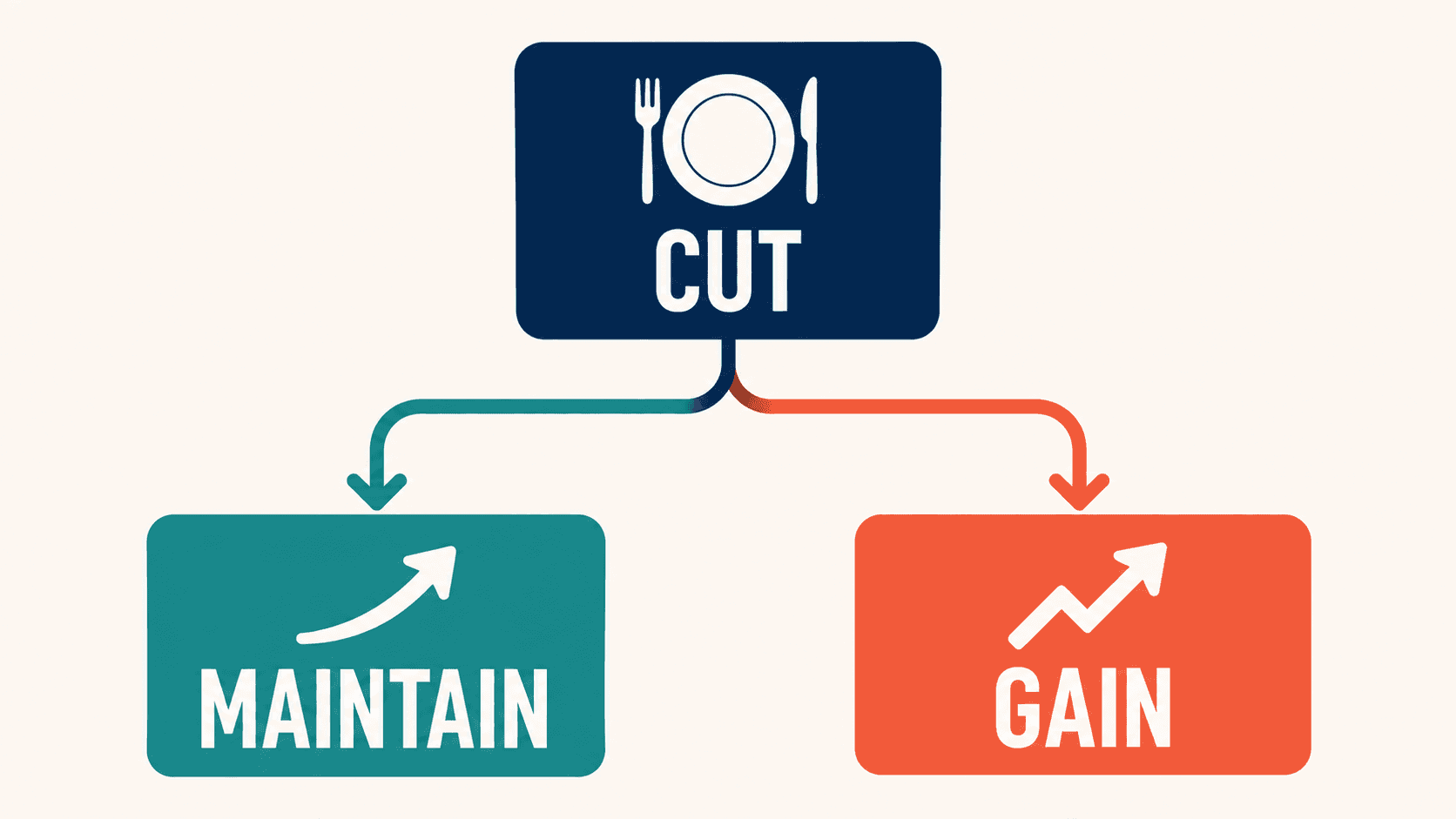
| Phase | Typical length | What you do | Why it exists |
|---|---|---|---|
| Cut | 8 to 12 weeks | Moderate deficit, high protein, weight trend down | Drop body fat without trashing recovery |
| Maintenance | 4 to 8 weeks | Eat at adaptive maintenance, weight trend flat | Let hormones, NEAT, and habits reset |
| Reverse or surplus | 6 to 16 weeks | Slow calorie increase, slight weight uptick, strength up | Build muscle or transition out of a long deficit |
| Mini-cut | 3 to 5 weeks | Aggressive deficit, very high protein, used sparingly | Quick reset after a creep in body fat |
Plan the next phase before the current one ends. The most reliable predictor of regain is finishing a cut with no plan for what comes next. Maintenance is a phase, not a failure to keep dieting.
17Exit calorie counting without rebound
Tight tracking is a season, not a sentence. Once you have calibrated, scale down the work.
| Stage | What you log | Why it works |
|---|---|---|
| Stage 1, calibration phase | Everything, weighed where possible, for 2 to 4 weeks | Builds the portion library you will use forever |
| Stage 2, meal templates | Log saved meals, weigh oils and proteins | Decision fatigue drops, accuracy holds |
| Stage 3, protein and oils | Log protein and added fats only, eyeball the rest | Captures the high-leverage items, frees mental load |
| Stage 4, untracked breakfasts | Same breakfast daily, log lunch and dinner only | Removes a friction point from the morning |
| Stage 5, anchor-plate eyeball | Build plates by structure, weigh once a month | Habit-based eating with a periodic accuracy audit |
| Stage 6, quarterly spot-check | Tight log for one week per quarter | Catches drift before it compounds |
Most readers will live in Stage 3 or 4 for years. That is the goal. The log was a teacher. After enough lessons, you graduate.
18Track this approach in Fuel for calorie counting
Fuel works best when your routine is simple. Set a daily calorie target, decide on one or two macro anchors, and log consistently enough to learn.
| In Fuel | What to set up | Why it helps |
|---|---|---|
| Daily calorie target | One number you can repeat most days | Consistency beats constant recalculation |
| Protein target | A realistic grams-per-day goal | Makes meals more satisfying and supports body composition |
| Meal templates | Two to five go-to breakfasts and lunches | Reduces decision fatigue and improves tracking accuracy |
| Trend weight | Daily morning weigh-in, app reads the trend | Filters out daily noise so you can see the real signal |
| Adaptive TDEE | Auto-recalculated maintenance every week | Replaces calculator guesses with your actual data |
| Weekly review | Look at weekly averages, not single days | Weight change responds to patterns |
If you miss a day, do not try to make up for it with punishment. Return to your normal target and keep collecting data.
19Why calorie counting fails long term
The same three patterns end most calorie-counting attempts.
| Failure mode | What it looks like | Counter-habit |
|---|---|---|
| Perfectionism | One missed day turns into a missed week, then a quit | Define "done" as logged, not perfect, three of four days is a good week |
| Weekend reset | Five clean days, two big ones, weekly average flat | Pre-decide one social meal, log everything else with the same care |
| No review ritual | Tons of data, no decisions made from it | Sunday 10-minute review, look at weekly average, set the next bet |
The review is the actual product of calorie counting. Without it, you are just journaling.
20Myths worth retiring
A handful of beliefs survive long past their evidence. Knowing they are wrong saves time and prevents bad decisions.
| Myth | Reality |
|---|---|
| "Eating after 8 pm makes you gain fat" | Total daily energy decides direction, not the clock on the wall |
| "Small meals all day rev the metabolism" | Meal frequency does not change daily energy expenditure in any meaningful way |
| "Carbs at night spike fat storage" | Carbs at night are fine, evening protein and total kcal are what matter |
| "Sweat equals fat loss" | Sweat is water and salt, the scale will rebound when you rehydrate |
| "Muscle weighs more than fat" | A pound is a pound, muscle is just denser, so you can look smaller at the same weight |
| "I have a slow metabolism" | True clinical cases are rare, the more common story is under-counting and a low NEAT |
| "Fasted cardio burns more fat" | Mild edge in fat oxidation during the session, no measured advantage in long-term body composition |
| "Cleanses reset your system" | Your liver and kidneys do that already, no juice required |
If a popular claim contradicts what the evidence shows, ask for the trial that backs it up before changing your plan.
21Water and sodium noise on the scale
Most "weight gained overnight" is salt and glycogen, not fat. A high-carb or high-sodium meal can park 1 to 2 kg of water in your body for 24 to 48 hours. That is normal. The 7-day average exists to absorb exactly this kind of noise.
Three habits make the trend cleaner. Weigh yourself at the same time each morning, after the bathroom, before food or drink. Drink enough water that thirst is rarely a question, around 30 to 40 ml per kg of bodyweight is a reasonable floor. Watch for the obvious water-weight days, which are usually the day after a salty restaurant meal or a long flight.
If your trend looks like it jumped 1 kg overnight, do not adjust anything. Two more days of weigh-ins will pull it back to reality.
22A sample day you can scale
Treat the structure as fixed and the specific foods as swappable, then adjust portions to match your calorie target.
| Meal | Example | What to notice |
|---|---|---|
| Breakfast | Greek yogurt, berries, oats, and a measured drizzle of honey | Protein plus fiber makes mornings easier |
| Lunch | Big salad with chicken or tofu, beans, olive oil and vinegar dressing, fruit | Volume food, protein, and a planned fat |
| Snack | Cottage cheese or edamame, plus an apple | A protein snack prevents snack creep later |
| Dinner | Salmon or lean meat, roasted vegetables, potatoes or rice, side salad | A balanced plate helps consistency |
| Optional treat | Chocolate square or a small dessert | Planned treats make flexible dieting easier to hold |
23When calorie counting is not the right tool
If tracking numbers reliably worsens your relationship with food, that matters. Calorie counting is a tool, and it works better for some people than others.
Watch for these signs. Numbers make you anxious or cause you to skip meals rather than eat within them. You find yourself eating less just to see a lower number, regardless of hunger. Tracking triggers all-or-nothing thinking, where any "bad" day derails the week. You have a history of restrictive eating or a diagnosed eating disorder.
If any of those are true, you can still make meaningful progress. Portion-based methods, plate-building habits, and consistent meal routines get most of the same benefit without the log. For many people, keeping protein and produce at every meal is enough structure to move the needle.
24FAQ
Do I count exercise calories?
No, or at most 50 percent of what your watch reports. Wearable estimates run high, and double-counting is the fastest way to wipe out a deficit. Set your activity multiplier honestly and treat training as part of baseline.
Do I eat back my steps?
No. Steps are part of NEAT, which is already baked into your activity multiplier. If your steps drop and stay down, that is a signal to walk more, not to add calories.
Should I weigh food cooked or raw?
Raw when you can. Cooked weights vary with how dry or moist the food ends up, while raw is consistent. If a meal arrives cooked, log a cooked weight using a database entry that matches that state, and stay consistent within your own meals.
What about cheat days?
One higher day fits a weekly average without much drama. The trouble starts when one day stretches into a weekend. Plan it, log it loosely, and return to normal the next morning.
How long should my first calibration phase be?
Two to four weeks. Long enough to see a real trend, short enough that the work feels finite. After that, the system gets lighter.
Should I track when I am sick or traveling?
Light tracking, or none. Calorie counting is meant to make life better, not run during a fever or a five-day trip. Eat reasonably, return to logging when you are home.
25Start this diet plan this week
Pick a starting target using Mifflin-St Jeor and an honest activity multiplier. Set a protein anchor in grams per day. Log for 14 days, then run the adaptive TDEE equation. Adjust by 100 to 200 kcal if the trend disagrees with your goal. Repeat. The longer you do this, the smaller the calories-as-chore part becomes, and the more of it turns into a measurement instrument that just runs in the background of your life.