A hybrid week stacks heavy lifting, intervals, long endurance, and easy aerobic work inside the same seven days, and a single fixed daily target gets every one of them wrong. The number that fuels a heavy lower-body session over-fuels the rest day that follows it. The number that covers a 2-hour ride is roughly double what a 60-minute easy spin needs. Run that mismatch for a month and the body responds by sparing glycogen and trimming lean mass. Glycogen runs short on demanding days, lean mass slips on the days that should be banking it, and the training plan stops producing what the work suggests it should.
The fix is to plan the week as the unit and match fuel to what each day actually costs. The Copenhagen consensus statements on optimizing elite-athlete performance, developed from the November 2024 conference and published in 2025, make the point explicitly. Athletes should scale energy, carbohydrate, and fluid intake to the demands of specific training sessions rather than running a single fixed daily number.1 That shift is how you keep both engines training at once.
01Hybrid training splits one recovery budget two ways
Hybrid training means pursuing strength and endurance adaptations at the same time. Strength, hypertrophy, and the high-intensity end of the aerobic system all want to live in the same training week, and each one has its own fueling logic. The interference effect is real and usually overstated. Wilson and colleagues' 2012 meta-analysis found that endurance training reduced hypertrophy and strength gains modestly when frequency and duration rose, with running producing larger interference than cycling.2 Concurrent training works when fuel is matched to the day, recovery is protected, and any deficit is small enough that the body still sees the energy needed to support both jobs.
The athletes who fail at hybrid training usually fail on the food side first. A week of under-fueled long rides plus aggressive lifting reads to the body like a chronic shortage, and the body responds by sparing glycogen, suppressing protein synthesis, and trimming the lean mass it cannot afford to maintain.
02Where the week usually breaks
Two patterns account for most failed hybrid weeks.
The first is the under-fueled long endurance day. The athlete cuts breakfast or shorts the pre-ride meal, runs out of fuel by the 2-hour mark, finishes flat, and never quite refills before the next lifting session. The second is the over-fueled rest day. Appetite from the long day catches up the next morning and the athlete eats like a hard training day on a day that asked nothing of them. Across a month, those two patterns produce the same outcome. Training stays steady while body composition stalls, and the lifts begin to slip first.
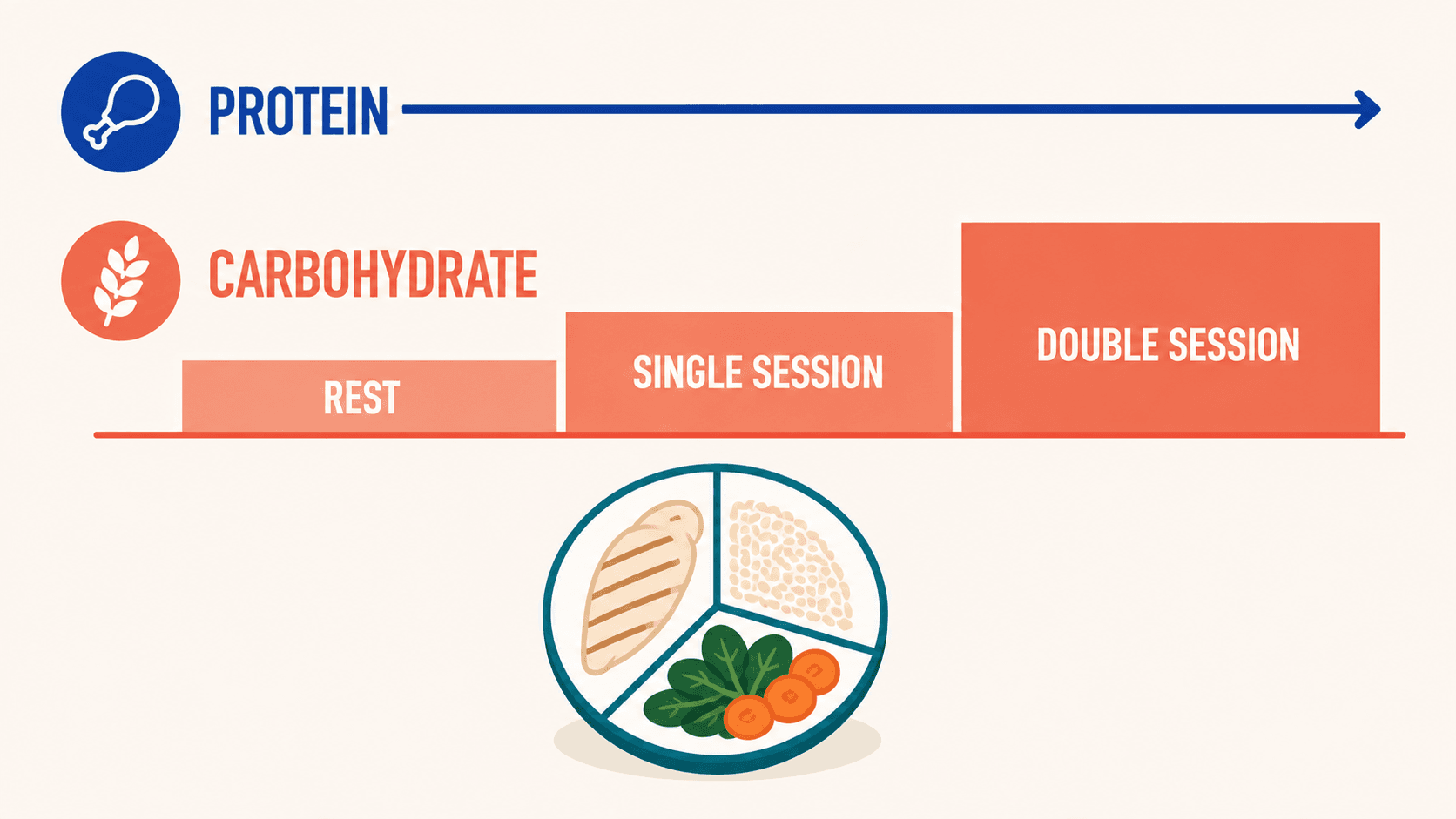
The fix in both cases is the same. Move carbohydrate toward the days and the windows that earned it. Hold protein steady across all days. Use the rest day as the day where the deficit lands cleanly. The day-type targets that follow are the practical version of that rule.
03Day-type fueling at a glance
The cleanest way to run the week is to set protein once, set carbohydrate by day type, and let fat fill the rest. The carbohydrate ranges below assume a 75 kg athlete and align with the periodization model in Carbohydrate Periodization and the endurance targets in Endurance Athlete Fueling.
| Day type | Session profile | Carbohydrate target | Example for 75 kg | In-session fuel |
|---|---|---|---|---|
| Heavy lifting | 60 to 90 min, compound work, 3 to 5 sets near top loads | 4 to 6 g/kg | 300 to 450 g | None required |
| Intervals | 30 to 60 min hard, threshold or VO2-max work | 5 to 7 g/kg | 375 to 525 g | 30 to 60 g/hr if over 60 min |
| Long endurance | 90 to 180 min steady, moderate effort | 7 to 10 g/kg | 525 to 750 g | 60 to 90 g/hr after 90 min |
| Easy Zone 2 | 45 to 90 min low intensity, conversation pace | 3 to 5 g/kg | 225 to 375 g | None required |
| Rest day | Walking only, mobility, light recovery | 3 g/kg | 225 g | None |
| Double day | Lift plus run or ride in the same 24 hours | 8 to 10 g/kg | 600 to 750 g | Match the longer session |
Those numbers move with body weight and training duration. A 60-minute Zone 2 ride is not the same fuel cost as a 3-hour Zone 2 ride. The athlete who handles this scaling well is the one with a wide swing between fat and carbohydrate oxidation across intensities, the trait covered in Metabolic Flexibility, What It Is, How to Measure It, and How to Train It.
04Heavy lifting days
A heavy lower-body session burns less total energy than most athletes assume and pulls hard on muscle glycogen in the working fibers. A 75 kg lifter doing 4 to 6 working sets of squats and a posterior-chain accessory can deplete roughly 30 percent of the glycogen in the active vastus and hamstring muscles in 60 minutes, with most of the loss in the type II fibers doing the heavy work. Total daily calories are the wrong target on these days. The lever that matters is carbohydrate availability in the hours before the lift and protein dose in the meal after.
The pre-session meal is the lever most lifters underuse. A meal eaten 2 to 3 hours before training that delivers 1 to 2 g/kg of carbohydrate plus 30 to 40 g of complete protein gives you full glycogen for the working sets and amino acids in the bloodstream during the session. The post-session meal does most of the recovery work. The leucine threshold for a single feeding sits at roughly 2.5 to 3 g of leucine, which lines up with 30 to 40 g of high-quality protein. The full meal-by-meal architecture is in Leucine Threshold, How Much Protein Per Meal Actually Matters.
If you are also dieting, the preservation logic from Strength Training Minimum Effective Dose During a Cut applies. Protect intensity and frequency before you cut accessories. The lifting signal has to remain recognizable.
05Interval days
Threshold and VO2-max work draws hard on glycogen because the muscle cannot oxidize fat fast enough at those intensities. The session is short, and it is glycolytic, and walking into it on low carbohydrate is the fastest way to turn a sharp interval workout into a flat, perceived-effort grind.
Pre-session, treat intervals like a half-distance hard run. A meal 2 to 3 hours out with 1 to 1.5 g/kg of carbohydrate is enough for a 45-minute session. If the workout exceeds 60 minutes or includes long repeated efforts, plan 30 to 60 g of in-session carbohydrate from a sports drink or a single gel. Exogenous carbohydrate during exercise spares muscle glycogen and improves repeated high-intensity output.3
Sodium also matters more on interval training days than most lifters expect because sweat losses can reach 800 to 1500 mg per hour even in cooler conditions. The decision framework lives in Sodium Loading for Endurance Racing, and the broader practice in Hydration.
06Long endurance days
A 2-hour endurance session is the most fuel-expensive day in a normal hybrid week. At moderate to hard steady-state intensities, total carbohydrate oxidation can climb quickly, and a trained athlete may carry roughly 400 to 500 g of muscle glycogen before the session starts.4 The amount pulled from working muscle depends on intensity, training status, liver glucose output, fat oxidation, and in-session carbohydrate. The practical point is simpler than the arithmetic. The pre, in-session, and post decisions are all in play.
Pre-session, eat 2 to 3 g/kg of carbohydrate 3 to 4 hours out from familiar, low-fiber foods. In-session, follow a practiced fueling plan rather than improvising. Sessions over 90 minutes benefit from 60 to 90 g/hr of carbohydrate from a glucose-fructose mix that uses both SGLT1 and GLUT5 transport pathways for higher absorption. The full protocol sits in How to Fuel at 90 to 120 Grams of Carbohydrate Per Hour Without Wrecking Your Gut, and the gut tolerance work that has to happen first is in Gut Training for Race Nutrition.
Post-session is where hybrid athletes most often under-eat. Glycogen resynthesis can run at roughly 5 to 8 mmol/kg wet muscle weight per hour in the first 4 hours after exercise when carbohydrate intake is adequate.4 Eating 1.0 to 1.2 g/kg of carbohydrate within an hour of finishing a long ride or run sets up the next training day. Skipping that meal because appetite is suppressed leaves you starting the next day with partially depleted stores, and the pattern compounds across the week.
07Easy Zone 2 days
This is the day type lifters most often over-fuel. An hour of conversational running or riding burns 400 to 700 kcal depending on body weight and pace, and the muscle glycogen cost is small because fat oxidation is doing most of the work. A 3 to 5 g/kg carbohydrate target is enough.
The point of Zone 2 is to extend the aerobic base without taxing recovery, and the metabolic response only works if the energy demand is matched. Eating like a long ride on a Zone 2 day is how recreational hybrid athletes accidentally hold onto body fat across a season of consistent training. The heart rate zones framework helps separate genuine Zone 2 from the gray-zone work that lifters often mistake for easy aerobic training.
08Rest days
A true rest day with walking only and no structured session does not need 5 g/kg of carbohydrate. Drop carbohydrate to 3 g/kg or below, hold protein at 1.8 to 2.2 g/kg, and let fat fill the gap. Recovery does not require eating like a training day. Glycogen resynthesis takes 24 to 48 hours with adequate carbohydrate, which means the meal that fills your stores is usually the one you ate the night before, and not the one you eat on the rest day itself.
If you are running a deficit, rest days are where the deficit lands cleanly. The math from Apple Watch-Based Calorie Targets makes this visible. A fixed daily target puts the deficit on the wrong days. A demand-driven target puts it on the days that earned it.
09Double days
A morning lift followed by an afternoon ride, or an early run before a lifting session, asks the most of recovery. The order matters more than most athletes realize. Robineau and colleagues compared recovery durations of 0, 6, and 24 hours between strength and endurance bouts in amateur rugby players. Strength gains were largest with 24-hour separation, partly preserved at 6 hours, and most attenuated when the two sessions were stacked back-to-back.5 If both have to live on the same day, separate them by at least 6 hours, eat between them, and keep the lower-priority session at lower volume.
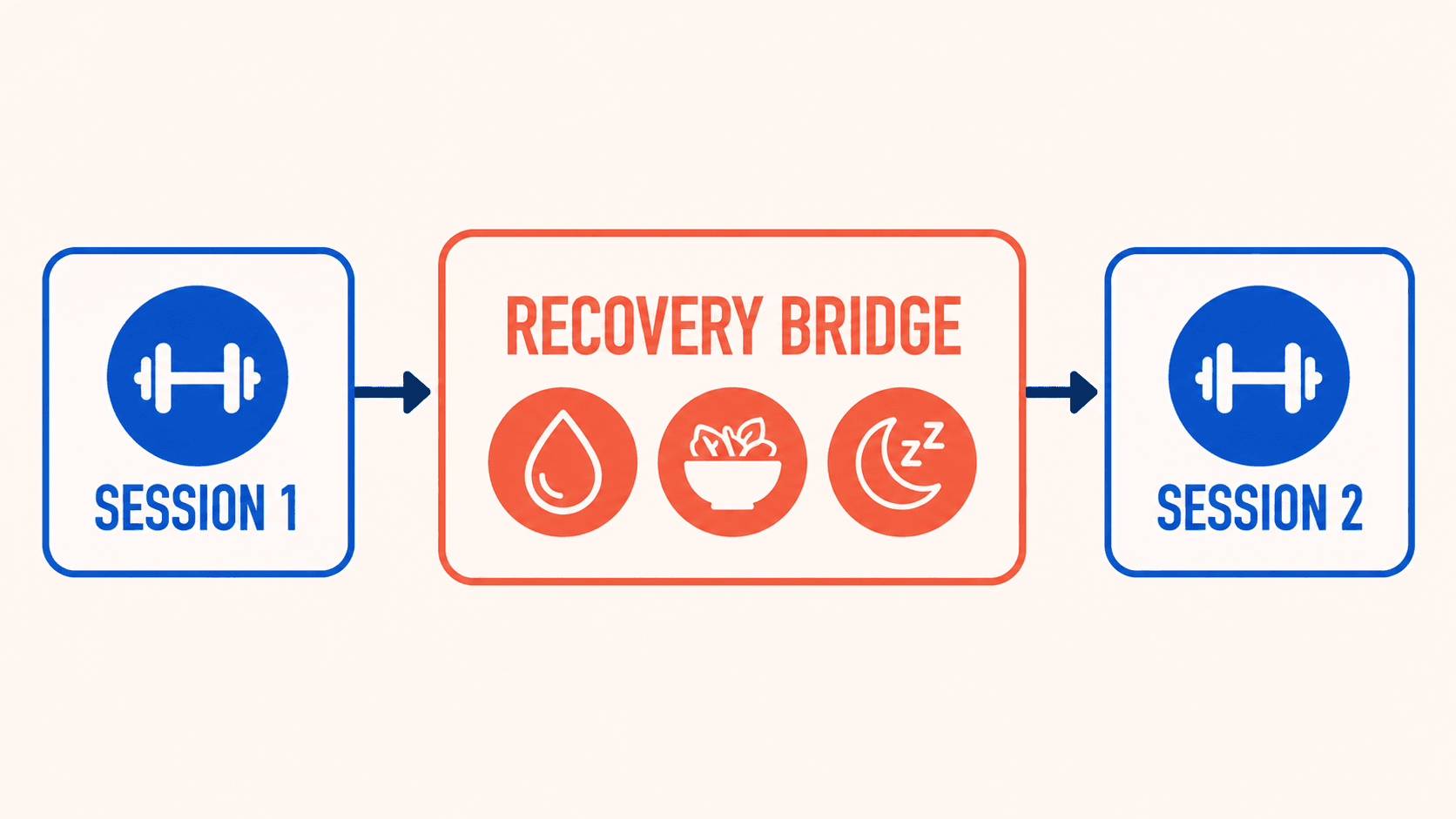
Carbohydrate target on a double day climbs to 8 to 10 g/kg. Protein stays the same and distribution gets tighter. A working scaffold for a 75 kg athlete:
| Window | Food target | Why |
|---|---|---|
| 2 to 3 hr before session 1 | 1 to 2 g/kg carbs, 30 to 40 g protein | Full glycogen for the first job |
| Within 30 min after session 1 | 1.0 to 1.2 g/kg carbs, 30 to 40 g protein | Begin glycogen resynthesis and start the recovery clock |
| 60 to 90 min before session 2 | 0.5 to 1.0 g/kg carbs, optional protein | Top off circulating glucose without sitting heavy |
| During session 2 if over 90 min | 60 to 90 g/hr carbs | Spare what is left of muscle glycogen |
| Within 60 min after session 2 | 1.0 to 1.2 g/kg carbs, 30 to 40 g protein | Restore stores before sleep |
| Final meal of the day | Mixed plate with remaining carbs, fat, and a protein dose | Hit the daily macros and support overnight protein synthesis |
The mistake to avoid is trying to bank meals. Eating 6 g/kg in the evening because you missed it earlier does not undo the morning shortfall. Glycogen resynthesis is most efficient in the first 4 hours after exercise, and the post-session protein dose only matters if it actually arrives close to the session.
10The protein floor for hybrid athletes
Protein during a hybrid week is a different conversation from protein for a pure lifter. Endurance training increases amino acid oxidation, eccentric damage from running breaks down myofibrillar protein, and a deficit (if you are running one) raises requirements further. The ISSN position stand on protein and exercise recommends 1.4 to 2.0 g/kg/day for most exercising individuals, with 2.3 to 3.1 g/kg/day for resistance-trained subjects in a hypocaloric phase.6
A recreational hybrid athlete who lifts 2 to 4 times per week and runs or rides 2 to 4 times per week can land the daily target inside a narrow band. Hold 1.6 to 2.0 g/kg in a normal maintenance week, push to 1.8 to 2.2 g/kg during a modest cut or a heavy endurance block, and run 2.0 to 2.4 g/kg for older lifters and athletes returning from injury where anabolic resistance raises the per-meal threshold needed to drive a strong synthesis response. Across all phases, spread the dose over at least four feedings of 30 to 45 g each, and put one within 60 minutes of the harder session of the day.
11Carbohydrate placement inside the day
Total carbohydrate matters, and so does where it lands. The window 2 to 3 hours before a hard session and the window within 4 hours after it are the two most useful carbohydrate placements in a hybrid week. Carbohydrate eaten at those times feeds the session and refills the store. Carbohydrate eaten at midnight, far from any training stimulus, mostly fills the energy budget without adding performance.
A workable rule for the week:
- Put 30 to 40 percent of the day's carbohydrate around the day's main session.
- Put another 20 to 30 percent in the next meal after.
- Spread the rest across the remaining meals at lower density.
- On rest days, drop the around-session emphasis and run a flat distribution.
This is the practical version of the carb cycling idea applied at the meal level rather than the day level. The day matters first. Placement inside the day is the second-order optimization.
12Deficit sizing for hybrid athletes
Most recreational hybrid athletes who land on this article are not bulking. They want to get leaner or hold a stable composition while they train. The ceiling for clean concurrent training sits below the ceiling for a pure lifter because both engines are pulling on recovery at once.
For recomposition while training hybrid, run a 100 to 250 kcal deficit below dynamic maintenance, which often works out to 0.1 to 0.3 percent body weight per week and lets technical lifts and endurance paces hold. For a modest cut where training quality is still the priority, a 250 to 400 kcal deficit often pushes loss toward 0.3 to 0.5 percent per week and is the practical ceiling for athletes who want both engines to keep training cleanly. Pushing the deficit to 400 to 600 kcal raises the odds that lift quality and run paces fall before the scale outcome is worth the trade. Deficits above 600 kcal sit outside the workable range for most hybrid training blocks.
Areta and colleagues found that resting muscle protein synthesis fell 27 percent after 5 days of energy deficit in trained men, and resistance exercise plus protein restored synthesis to baseline.7 The size of the deficit decides whether training rescues that drop or compounds it. A deeper deficit on top of high training volume is how athletes drift into low energy availability, and the IOC consensus on Relative Energy Deficiency in Sport treats energy availability below 30 kcal/kg of fat-free mass per day as an important historical risk marker in women while noting that thresholds differ by sex, context, and study design.8 The female endurance version of that problem, with menstrual changes and ferritin drift, is covered in Low Energy Availability in Female Endurance Athletes. The broader recomposition logic sits in Fat Loss and Muscle Preservation.
13Recovery signals worth watching
The hybrid athlete usually notices the run tank before the lift tank because endurance discomfort is acute and subjective. The lift signal is more reliable. Strength is the first thing to drift when energy availability is too low for too long, and a 5 percent decline in top-set weights across two weeks is a clearer signal than a vague sense of heavy legs.
A short list of the signals worth watching, with the first adjustment for each. Top sets down 5 percent over two weeks usually means energy or recovery is short, and the first move is adding 200 to 300 kcal around training, mostly carbohydrate. Easy Zone 2 heart rate drifting up at the same pace points to an under-recovered aerobic system, and the response is reducing volume for a week, holding intensity, and getting at least seven hours of sleep. Morning resting heart rate up 5 or more bpm points to high sympathetic load and accumulating recovery debt, which calls for cutting one hard session and prioritizing sleep. Persistent flat appetite on training days is the early signature of an under-fueling pattern, and the fix is front-loading carbohydrate around training and using lower-volume protein options like whey when food feels heavy. Sleep onset slipping and wake-ups rising point to cortisol or under-fueling pressure, and Sleep and Fat Loss walks through the food-side levers first. Two consecutive flat hard sessions usually mean the week outran the food, and the move there is a deload week or a refeed before the next hard block.
If two of these signals show up at once, treat the food side as the first lever and the training plan as the second. Cutting volume can patch recovery for a week. The under-fueled pattern that produced the recovery debt is still there the week after unless food changes too.
14Match intake to day type across the week
The hybrid athlete who keeps both engines training year after year is rarely the one running the most aggressive plan. They are the ones who match each day's intake to that day's training cost. Demanding days get fed for what they cost. Easy days get fed for what they cost. The deficit, if there is one, lands on the days that earned it. Keep the week in that conversation and the body stops reading the program as an emergency. The framework for setting a demand-driven target on Apple Watch sits in Apple Watch-Based Calorie Targets, and the wider framing of training-driven nutrition is in Improve Performance.
Footnotes
Bangsbo J, Krustrup P, Hellsten Y, et al. Consensus Statements: Optimizing Performance of the Elite Athlete. Scandinavian Journal of Medicine and Science in Sports. 2025, 35(8):e70112. PMC
Back to textWilson JM, Marin PJ, Rhea MR, Wilson SM, Loenneke JP, Anderson JC. Concurrent training: a meta-analysis examining interference of aerobic and resistance exercises. Journal of Strength and Conditioning Research. 2012.
Back to textStellingwerff T, Cox GR. Systematic review: carbohydrate supplementation on exercise performance or capacity of varying durations. Applied Physiology, Nutrition, and Metabolism. 2014.
Back to textBurke LM, Hawley JA, Wong SHS, Jeukendrup AE. Carbohydrates for training and competition. Journal of Sports Sciences. 2011.
Back to textBack to text 2Robineau J, Babault N, Piscione J, Lacome M, Bigard AX. Specific Training Effects of Concurrent Aerobic and Strength Exercises Depend on Recovery Duration. Journal of Strength and Conditioning Research. 2016.
Back to textJäger R, Kerksick CM, Campbell BI, et al. International Society of Sports Nutrition Position Stand: protein and exercise. Journal of the International Society of Sports Nutrition. 2017.
Back to textAreta JL, Burke LM, Camera DM, et al. Reduced resting skeletal muscle protein synthesis is rescued by resistance exercise and protein ingestion following short-term energy deficit. American Journal of Physiology Endocrinology and Metabolism. 2014.
Back to textMountjoy M, Ackerman KE, Bailey DM, et al. 2023 International Olympic Committee's (IOC) consensus statement on Relative Energy Deficiency in Sport (REDs). British Journal of Sports Medicine. 2023.
Back to text