Putting on scale weight only takes food. Putting on muscle takes a training plan that keeps asking more of you, plus enough food and sleep to answer it.
A generous bulk can push the scale up for months while your squat stays where it was, and much of that gain can be fat. Your lifting program and training log drive the plan. Fuel sets calorie and protein targets, records your meals and weigh-ins, and reviews the week. A scale, a tape measure, a repeatable grocery run, and a steady bedtime carry the rest.
01Build the plan around progressive strength training
Muscle grows in response to training that challenges it. Extra food can support that work, and it can't direct itself into muscle without it. So the first decision is the program, and the second is how you'll prove it's progressing.
Pick a plan that fits your current experience. That can come from a coach, a gym program, or a published beginner or intermediate routine whose first weeks look manageable today. If you are returning after a long break, start lighter than your old numbers and let them come back over a few weeks.
Volume is the training variable with the clearest link to growth. The American College of Sports Medicine's 2026 position stand pooled 137 systematic reviews covering more than 30,000 healthy adults. It found more muscle growth with higher weekly volume, around 10 or more hard sets per muscle, and diminishing returns as volume climbed.1 A 2026 meta-regression of 67 studies found the same upward relationship with diminishing returns and no clear plateau in the range it modeled. Few of those trials tested more than about 25 weekly sets.2 Treat 10 sets as a direction to build toward. A beginner can grow well on less, and more sets help only when you recover from them and keep improving.
Frequency mostly spreads that work across the week. Hitting each muscle twice a week makes a sensible volume easier to recover from, though the ACSM overview found little independent effect of frequency once weekly volume was accounted for.1 Sets should be hard enough to count. They don't have to end at failure. A 2024 meta-regression suggested that training closer to failure may help growth, especially with lighter loads, and it did not establish failure as a requirement.3
This example week uses three full-body sessions on nonconsecutive days. It shows a workable shape to adapt with your coach or program, and it isn't a prescription.
| Day | Example session |
|---|---|
| Monday | Squat, bench press, dumbbell row, calf raise |
| Wednesday | Romanian deadlift, overhead press, lat pulldown, split squat |
| Friday | Leg press or goblet squat, incline dumbbell press, chest-supported row, hip thrust |
Start with two work sets per exercise. Leave about one to three reps in reserve on most sets, which is a common way to manage fatigue, though no study has pinned down one best number. When you reach the top of your rep range with clean technique, add a little load next session. When progress stalls for a couple of weeks and you are recovering well, add a set to the lifts for the muscles you most want to grow. If a movement hurts or you can't perform it safely, swap it or get a qualified trainer to check your form.
02Record every session in a training log
Your training log shows whether the training stimulus is progressing. A notebook, a spreadsheet, or a lifting app all work. Write down the exercise, each set's weight and reps, and roughly how many reps you had left. After a month, compare that training record with weight and measurements. Stronger lifts are a useful signal, rather than a measurement of muscle gained.
Fuel records the energy side of the session. From Today, tap the center + and choose Log Workout. The form records workout type, perceived effort from 1 to 10, duration, and an estimated calorie value. Apple Watch workouts can arrive through Apple Health instead, so log each session once to avoid doubled activity totals. Log Workout doesn't record exercises, sets, reps, or weights, which is why the training log stays separate. Workout logging covers the details.
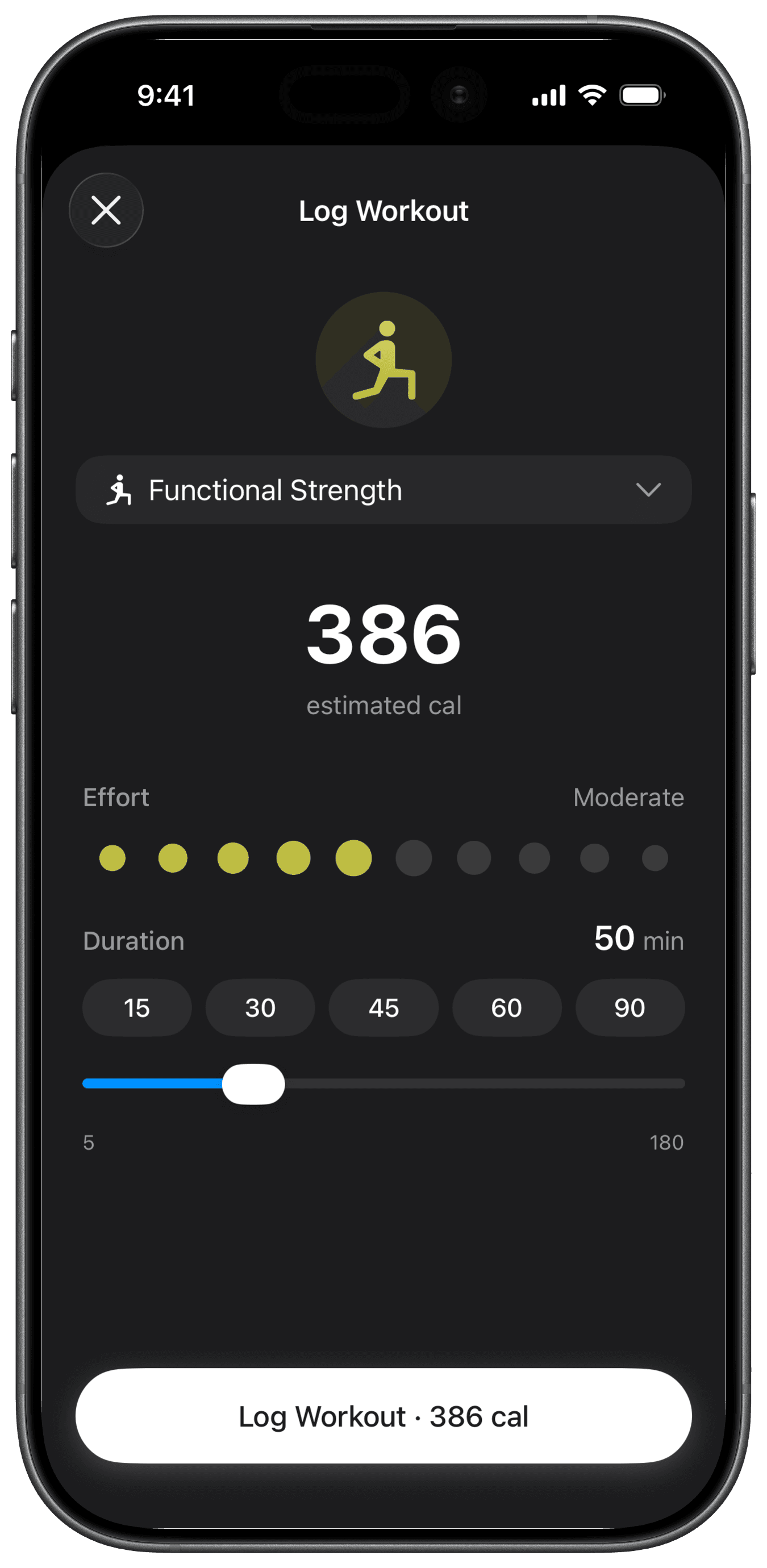
This unsaved form shows a 50-minute Functional Strength session at moderate effort, with an estimate of 386 calories. Enter the session you completed and tap Log Workout to save it. The duration and calorie estimate here are examples, and the estimate doesn't tell you whether your lifts progressed.
03Choose maintenance or a small surplus to start
A surplus isn't mandatory. Muscle gain can happen near maintenance and sometimes during a deficit. In a 2026 randomized trial, 30 resistance-trained adults with about 1.5 years of training spent 10 weeks on a supervised maintenance diet, a moderate deficit, or no nutrition guidance. Both supervised groups gained about 1 kg of fat-free mass on DXA, and the deficit group also lost fat.4 The study was small, mostly male, and short, and participants ate about 2.5 g/kg of protein under supervision. It shows recomposition can happen without a surplus, and it can't promise it will happen for you.
A deficit is a different matter. A 2022 meta-regression of resistance-training studies found that energy deficits reduced average lean-mass gains, while strength held up better.5 If maximizing muscle growth is the priority, maintenance or a modest surplus is usually a more supportive starting point than a deficit.
Bigger surpluses mostly add fat. In a 2023 eight-week trial, trained lifters ate at estimated maintenance, 5% above, or 15% above. Skinfolds rose more clearly with the larger surplus than measured muscle thickness did.6 Only 17 people finished, so the result is a warning rather than a verdict. A 2013 trial in 39 elite athletes found that guided weight gain added more body weight and far more fat than eating to appetite, with no extra lean mass.7
A modest surplus is a reasonable choice for an experienced lifter whose weight is stable, whose protein is adequate, and who wants the scale to move. For a rough pace, a 2019 narrative review of natural bodybuilders suggested gaining 0.25 to 0.5% of body weight per week for novice and intermediate lifters, and less for advanced ones.8 That range is practitioner advice. No trial has shown it to be optimal. For an 80 kg lifter it works out to 0.2 to 0.4 kg a week, and plenty of people build muscle while gaining less.
04Set up Build Muscle in Fuel
Fuel's Build Muscle goal creates a calorie surplus and macro targets tied to a goal weight. Set it up during onboarding or change it later.
- During onboarding choose Build Muscle, or open You, tap your profile card to open Personal Details, then go to Goals > Goal Type.
- Set a desired weight above your current weight. After onboarding, use Personal Details > Coaching Plan > Update goal weight.
- Choose Plan calories for a fixed daily target or Dynamic calories for a target that follows your recent burn and activity. After onboarding, Personal Details > Nutrition > Dynamic calories switches between them.
- Open Your Plan under Coaching Plan in Personal Details to check calories, macros, and the projection.
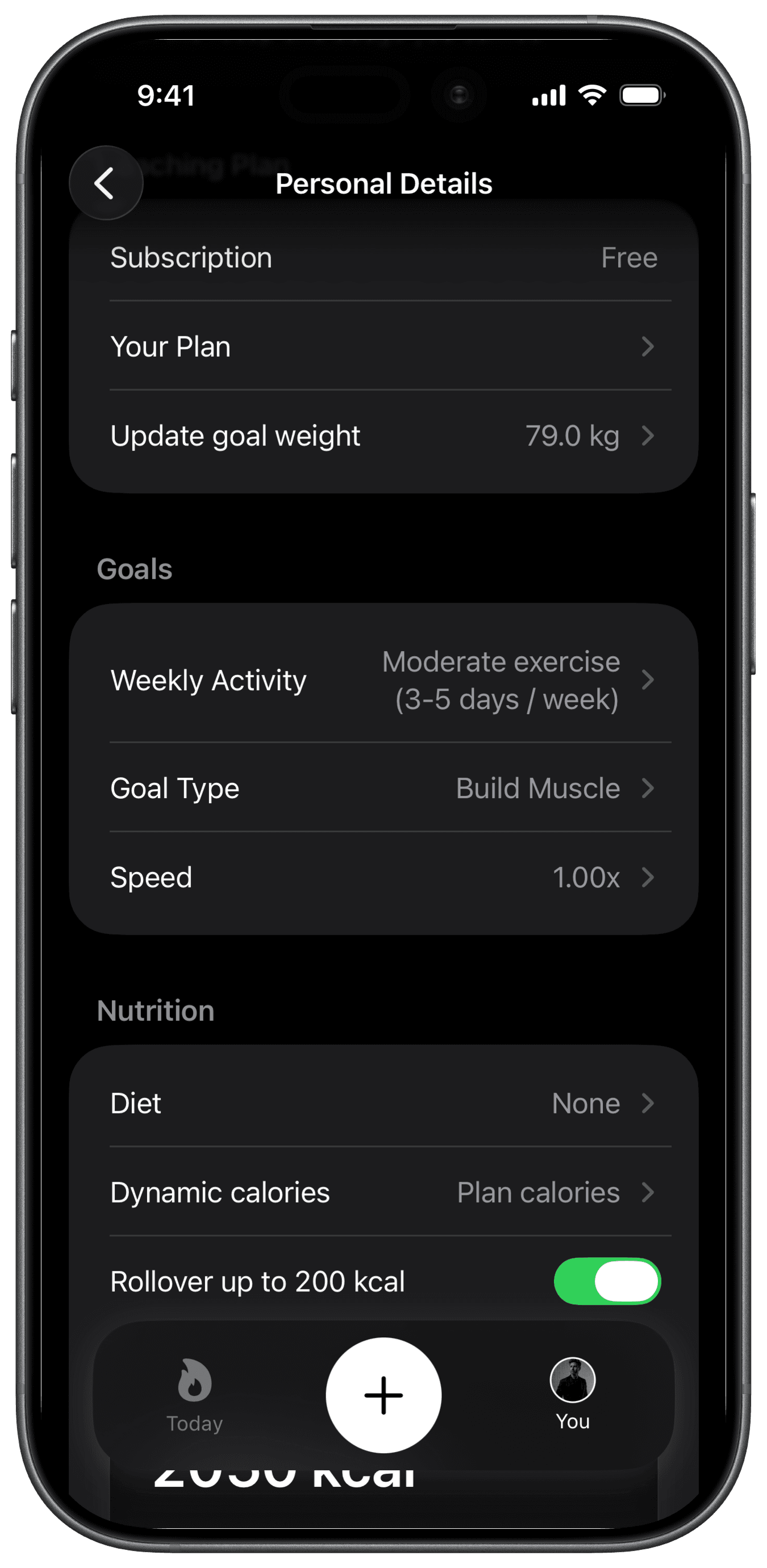
The example profile uses Build Muscle, a 79 kg goal weight, Moderate exercise (3–5 days / week), and Speed 1.00x. The calorie fragment at the bottom belongs to the preferences preview; check Your Plan for this profile's actual target.
The goal weight sets the direction. Build Muscle expects a goal above your current weight. If the two numbers point the other way, the goal name alone won't give you a surplus.
Fuel starts from your estimated maintenance and adds a default of 300 kcal a day, multiplied by the pace you pick. Pace runs from 1× to 2×, so the ordinary range is 300 to 600 kcal above maintenance. That default is a product starting point. It isn't a scientifically optimal surplus, and the research above gives no reason to push toward the top of it. If you want a smaller surplus, choose the slowest pace and trim calories directly with Adjusting Macronutrients. If you want to start at maintenance, the Maintain goal fits that phase better.
Your Plan projects a date for your goal weight from calorie balance, at about 7,700 kcal per kilogram. It forecasts body weight. It has no model of how much of that weight will be muscle.
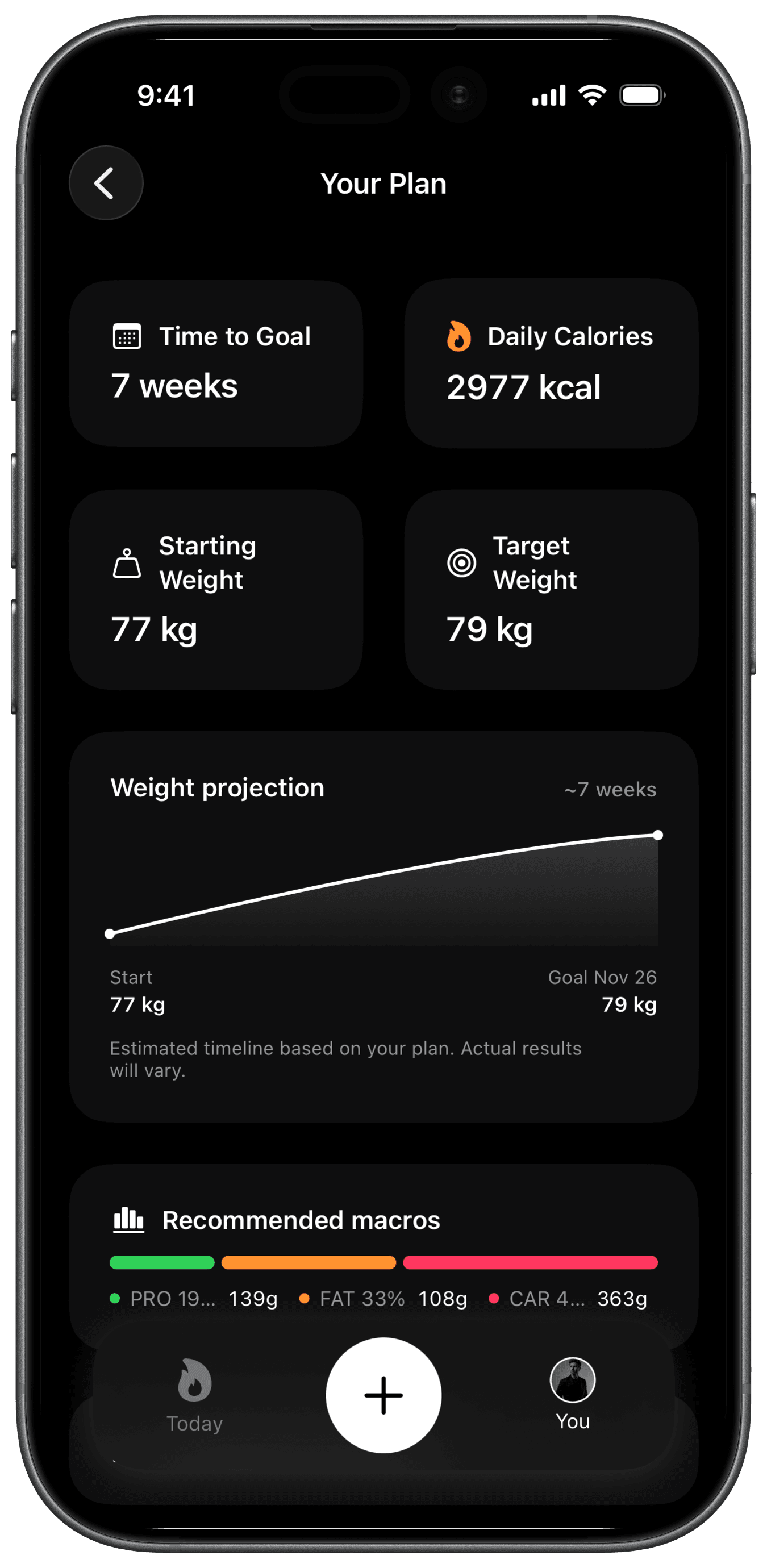
This demo plan shows 2,977 kcal, 139 g protein, 363 g carbohydrate, and 108 g fat, with a projected move from 77 to 79 kg by November 26. Those are this profile's targets, rather than numbers to copy. The upward line is a body-weight forecast, and the screen labels its timeline as an estimate; it doesn't show measured muscle gain.
Your calorie mode decides what happens on training days. In Plan calories mode, a logged workout doesn't raise the target. In Dynamic calories mode, activity running ahead of your recent baseline can raise that day's calorie goal while the surplus stays in place. There is no second workout bonus stacked on top. Dynamic Calories explains the calculation.
05Set protein at a level you can hit every day
Fuel's Build Muscle plan anchors protein to body weight. It starts at 1.8 g/kg a day, rises to 2.0 g/kg at four or more weekly workouts, and reaches 2.2 g/kg at six or more, based on the Weekly Activity setting in your profile rather than workout logs. Your diet preference then splits the remaining calories between carbs and fat.
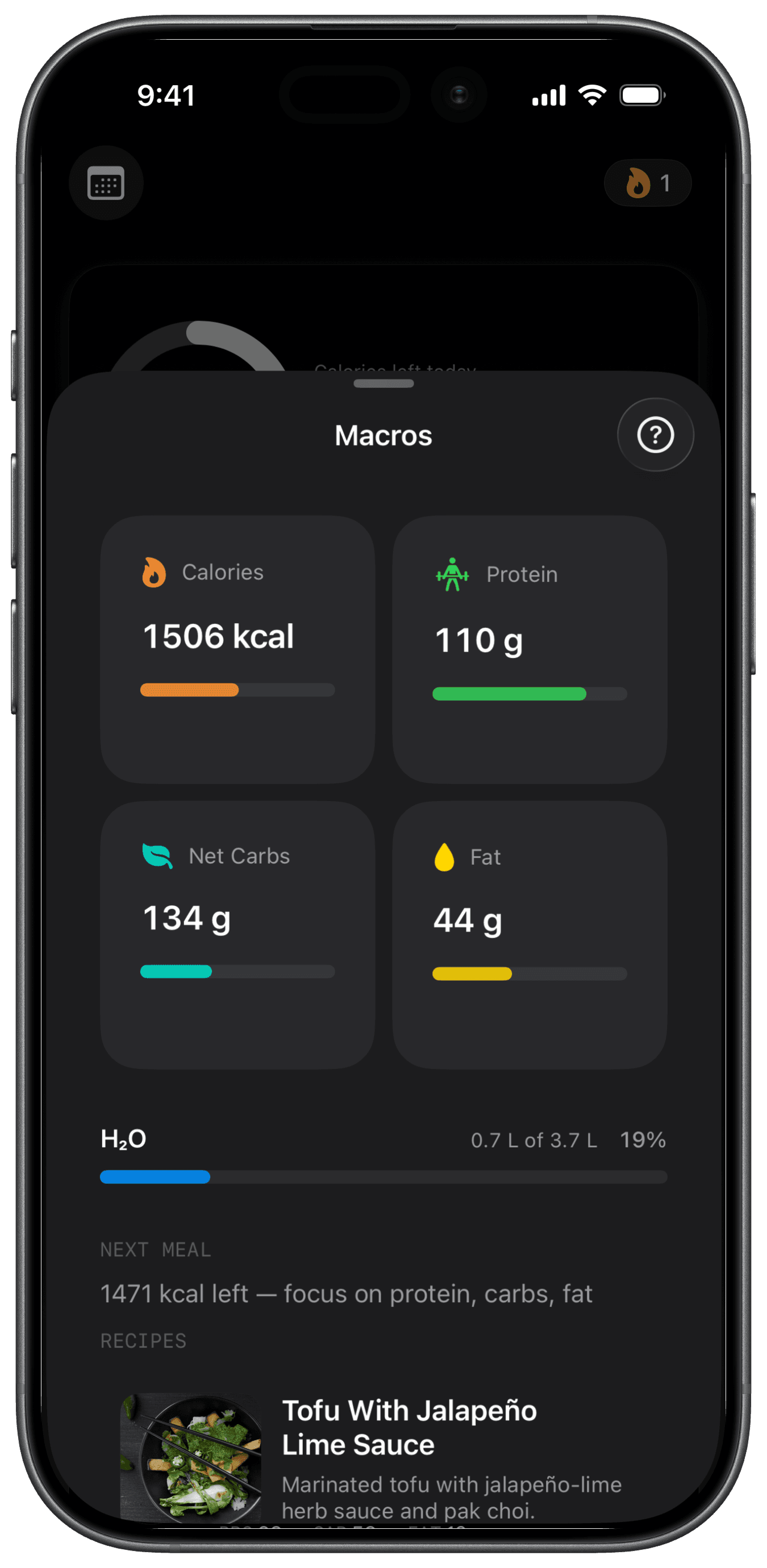
The demo meal log has reached 1,506 kcal and 110 g protein, alongside 134 g net carbs and 44 g fat. The sheet shows 1,471 kcal left against the example 2,977 kcal plan. Use your own logged totals to decide what the remaining meals need to contribute; a partly completed day isn't a reason to change the plan.
Those targets sit at the generous end of the evidence. A 2018 meta-analysis of 49 studies and 1,863 healthy adults in resistance-training programs found that extra protein added modest gains, with the benefit leveling off around 1.6 g/kg a day on average. The uncertainty around that breakpoint ran from about 1.0 to 2.2 g/kg.9 The International Society of Sports Nutrition gives 1.4 to 2.0 g/kg for most exercising adults.10 Around 1.6 g/kg is a practical central target. Fuel's higher number is fine if you hit it comfortably. It isn't required for gains, and you can lower it in Adjusting Macronutrients if it crowds out foods you train well on.
For an 80 kg lifter, 1.6 g/kg is 128 g a day. Spread over four meals, that averages 32 g each. Protein eaten later in the day isn't wasted, and a narrow post-workout window isn't necessary. The ISSN suggests spacing doses every three to four hours, mostly on the basis of short-term synthesis studies.10 If three bigger meals get you to the daily total, three meals is fine. The most useful change for many people is adding protein to a light breakfast.
06Use carbohydrate to fuel the session
Carbohydrate helps you train. It hasn't been shown to build muscle on its own. A 2026 meta-analysis of 11 randomized trials found no significant difference in muscle growth between higher and lower carbohydrate intakes when protein was matched, with low certainty in the evidence.11 A 2022 meta-analysis of 21 short-term studies found carbohydrate increased the volume people completed in a session, with larger effects in sessions longer than 45 minutes and after an overnight fast of eight hours or more.12
So a meal or snack with carbohydrate before a long, fasted, or high-volume session makes sense if it sits well. For an ordinary hour of lifting after normal meals, eat as usual. No fixed pre- or post-workout gram target is required. Your saved carb target in Fuel stays the same on training days. Fuel won't add carbs automatically, so if a lifting day needs more carbohydrate, plan the meals accordingly and check that your saved targets still fit your overall intake.
07A sample training day with prep and logging
Take a 70 kg lifter whose weight has held steady on about 2,400 kcal a day. They decide to test 2,550 kcal as a small surplus. One workable split is 130 g protein, 350 g carbohydrate, and 70 g fat, which adds up to 2,550 kcal at 4, 4, and 9 kcal per gram. The protein works out to about 1.86 g/kg, which suits someone who likes protein-heavy meals. The figures below are planning targets. Your log will show what the real portions delivered.
| Meal | Example | Approximate macros |
|---|---|---|
| Breakfast | Oats, milk or soy milk, Greek yogurt or tofu, fruit | 30 g protein, 75 g carbs, 15 g fat |
| Lunch | Rice, chicken, tofu, or beans, vegetables, oil | 25 g protein, 75 g carbs, 15 g fat |
| Before training | Yogurt or soy yogurt with banana and cereal | 25 g protein, 60 g carbs, 5 g fat |
| After training | Bagel with eggs, tuna, tempeh, or another familiar protein | 30 g protein, 80 g carbs, 10 g fat |
| Dinner | Potatoes, salmon, tofu, or beans, greens, olive oil | 20 g protein, 60 g carbs, 25 g fat |
| Total | 130 g protein, 350 g carbs, 70 g fat, 2,550 kcal |
The pre-training snack and the bagel are there for convenience and appetite. A shake isn't required, and neither is a deadline after the last set.
The day works because most of it is prepared in advance. Buy the same staples each week. On Sunday, cook a batch of rice and potatoes and portion a couple of protein foods for lunches. A kitchen scale for the oats, rice, and olive oil makes the first two weeks of logs far more accurate, and after that you can eyeball portions you've already weighed.
Log each meal in Fuel as you eat it. Once breakfast and lunch repeat, they take seconds from your saved and recent foods. By mid-afternoon, check the protein and calorie totals on Today. If you're well short, the snack and dinner have to carry more. Log weekends too, since two unlogged days can hide or erase a small surplus.
Sustained tracking at this level needs Pro. Free allows seven food entries per configured week, enough to try the workflow and too few for a complete routine. Weight and workout entries don't count toward that allowance. Free and Pro lists the current limits.
08Weigh in and measure under the same conditions
Daily scale weight swings with water, glycogen, salt, and gut content. If weighing is useful to you, use similar conditions, such as on waking after the bathroom and before food. Compare repeated readings over a few weeks rather than one morning. Log each reading in You > Weight.
A rising average shows that mass is going up. It can't show how much is muscle. For extra context, measure your waist once a week at the same spot, and take progress photos in consistent light if you find them useful. On the Weight screen, Add body measurements opens a sheet where you can record the values you have.
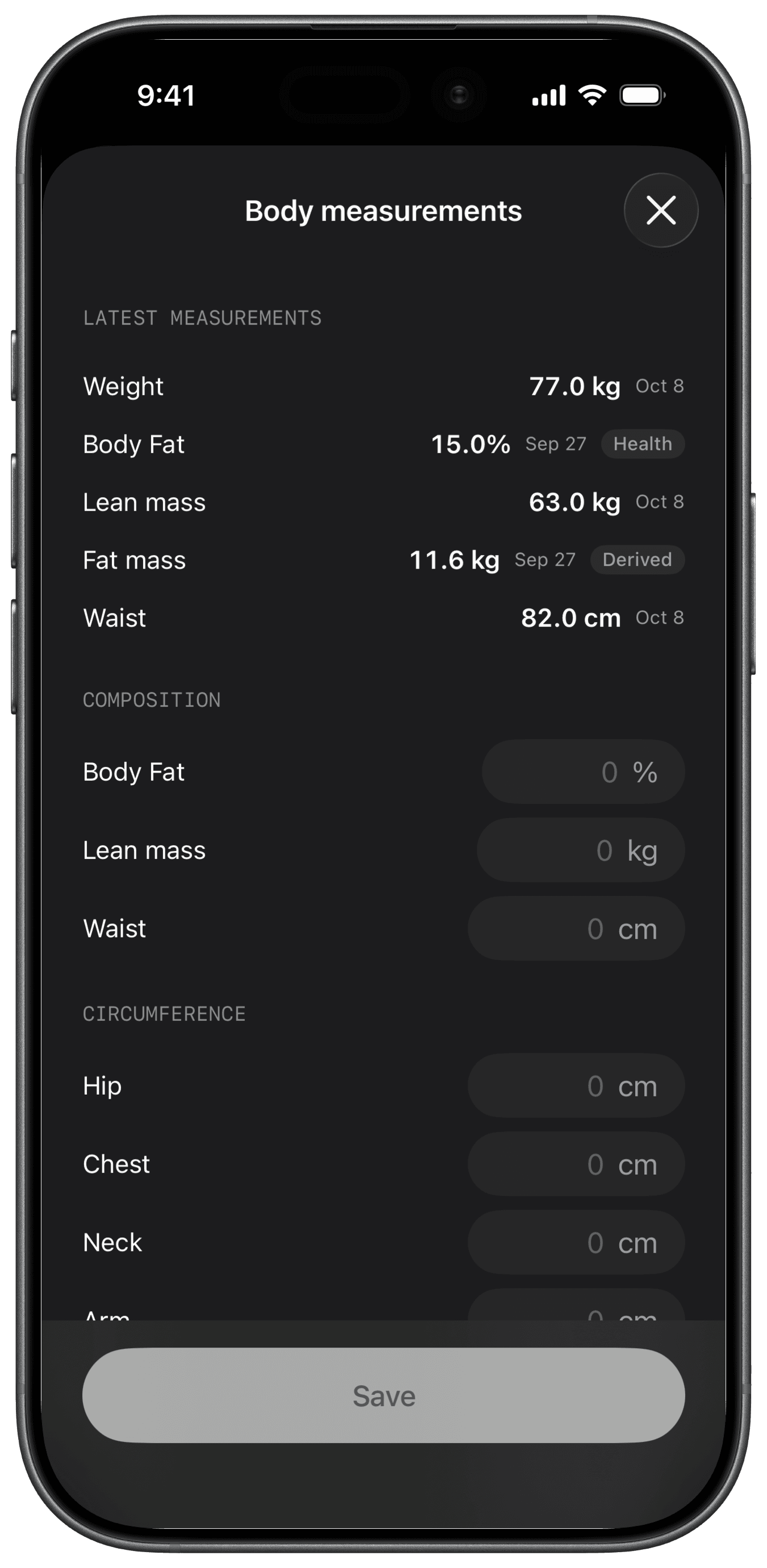
The saved example entries show 63 kg lean mass and an 82 cm waist dated October 8. They illustrate where recorded values appear, rather than results achieved with the plan. The zero placeholders below are unfilled inputs, and the older body-fat and derived fat-mass values carry their own dates and source labels.
The sheet has Composition fields for body-fat percentage, lean mass, and waist, and Circumference fields for hip, chest, neck, arm, thigh, and calf. Only the fields you fill are saved. Lean mass that Fuel calculates from weight and body-fat percentage is an estimate built from those two inputs. It isn't a measurement of muscle growth. Fuel keeps progress photos in a separate gallery and doesn't estimate body fat from them.
When measurement data exists, You > Trends > Reports can show Body Change Evidence for the current phase, labeled by whether it came from recorded measurements, derived values, or weight alone. Body measurements and progress photos and Reports explain the labels.
09Review the trend every two weeks before changing calories
One week of scale data is noisy. Give each target about two weeks before you judge it, which is a coaching convention and not a tested optimum. In the 2023 surplus trial, researchers had lifters weigh in every morning and average two stable weeks before the intervention began.6 That's a sensible template for your own baseline.
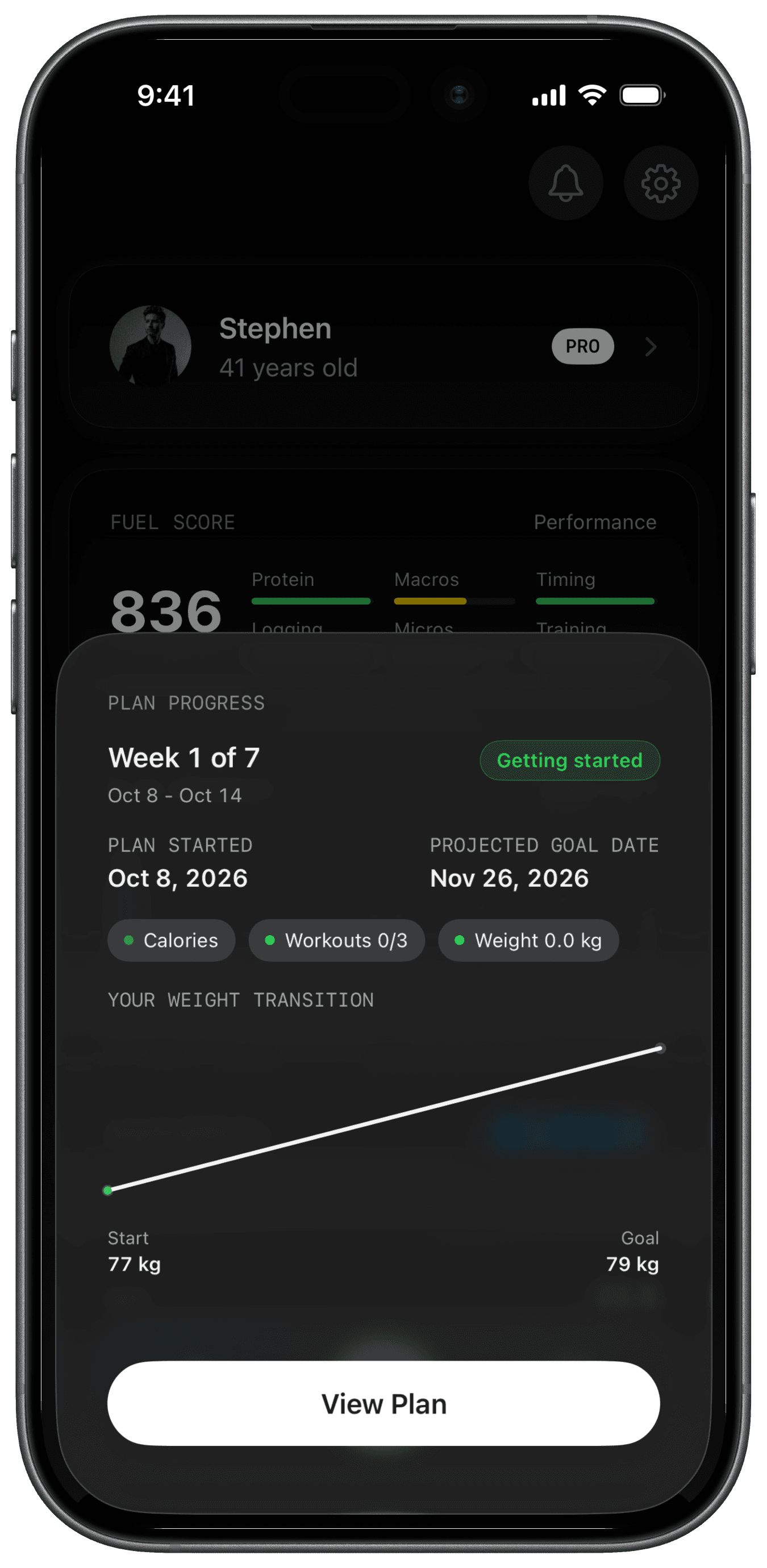
Plan Progress shows the current plan's place in the timeline. This example is Week 1 of 7, with a November 26 projected goal date, 0/3 workouts, and 0.0 kg weight change. Its upward 77-to-79 kg line describes the plan; use repeated weigh-ins and your lifting log to judge what actually changes.
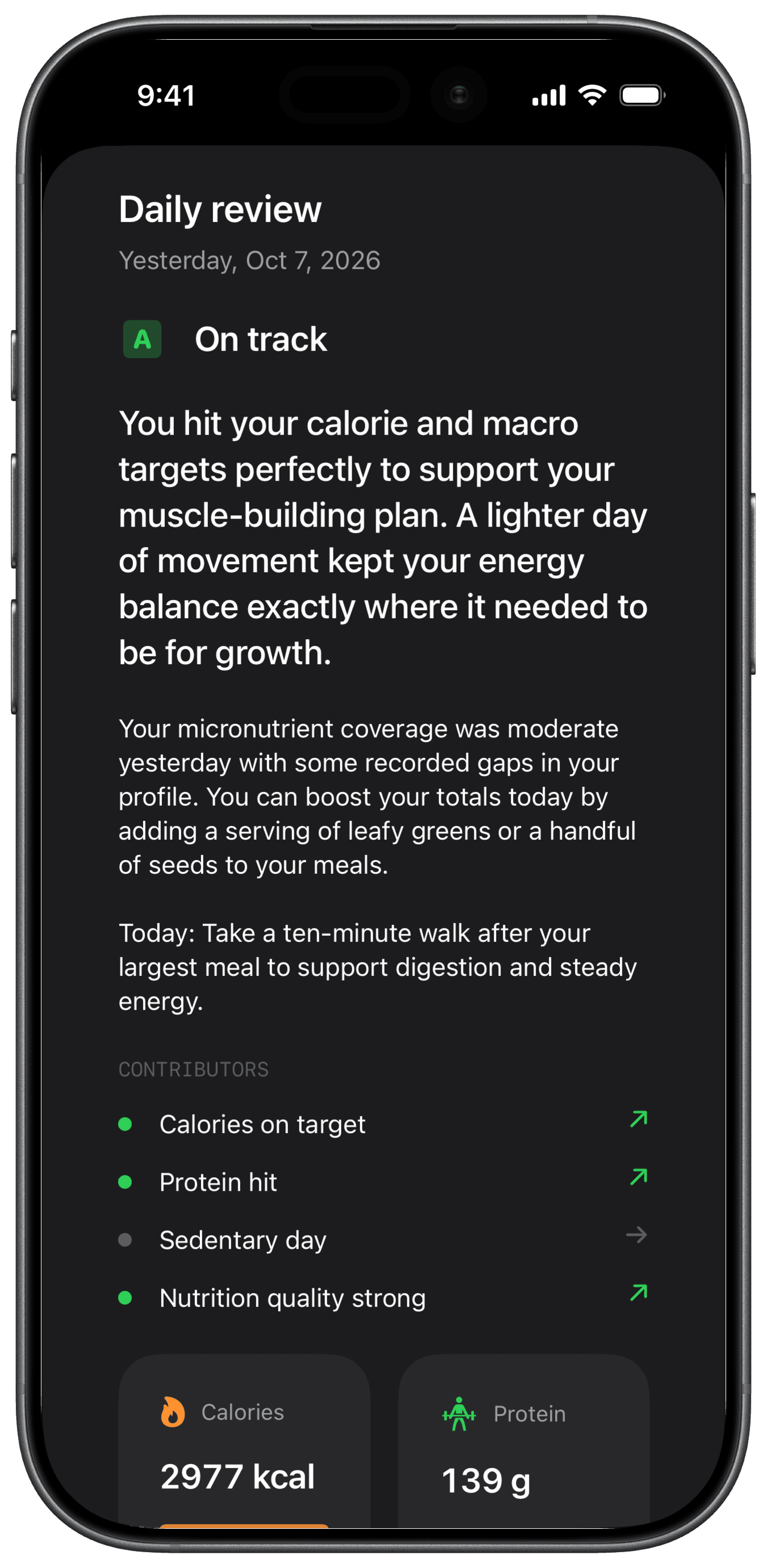
The Daily review summarizes yesterday. In this example it marks October 7 A — On track, with 2,977 kcal and 139 g protein, and calls out calories on target and protein hit. Use it to spot a missed meal or a repeated gap before planning today. One day's grade doesn't establish that you're gaining muscle.
Fuel's Weekly review card on Today opens the previous full week. Depending on the available data and generated review, it can include a scorecard, next-week targets, meal ideas, and a training and recovery section, and it reads your logged food, activity, weigh-ins, and plan targets together. The Today review entry requires Pro. Open the review with your training log beside it. The review sees food and weight, and your log sees whether you got stronger. Judge the two weeks on both, then change one thing. As a practical coaching example, small steps of 100 to 150 kcal a day keep the next review readable. That is not a validated optimum.
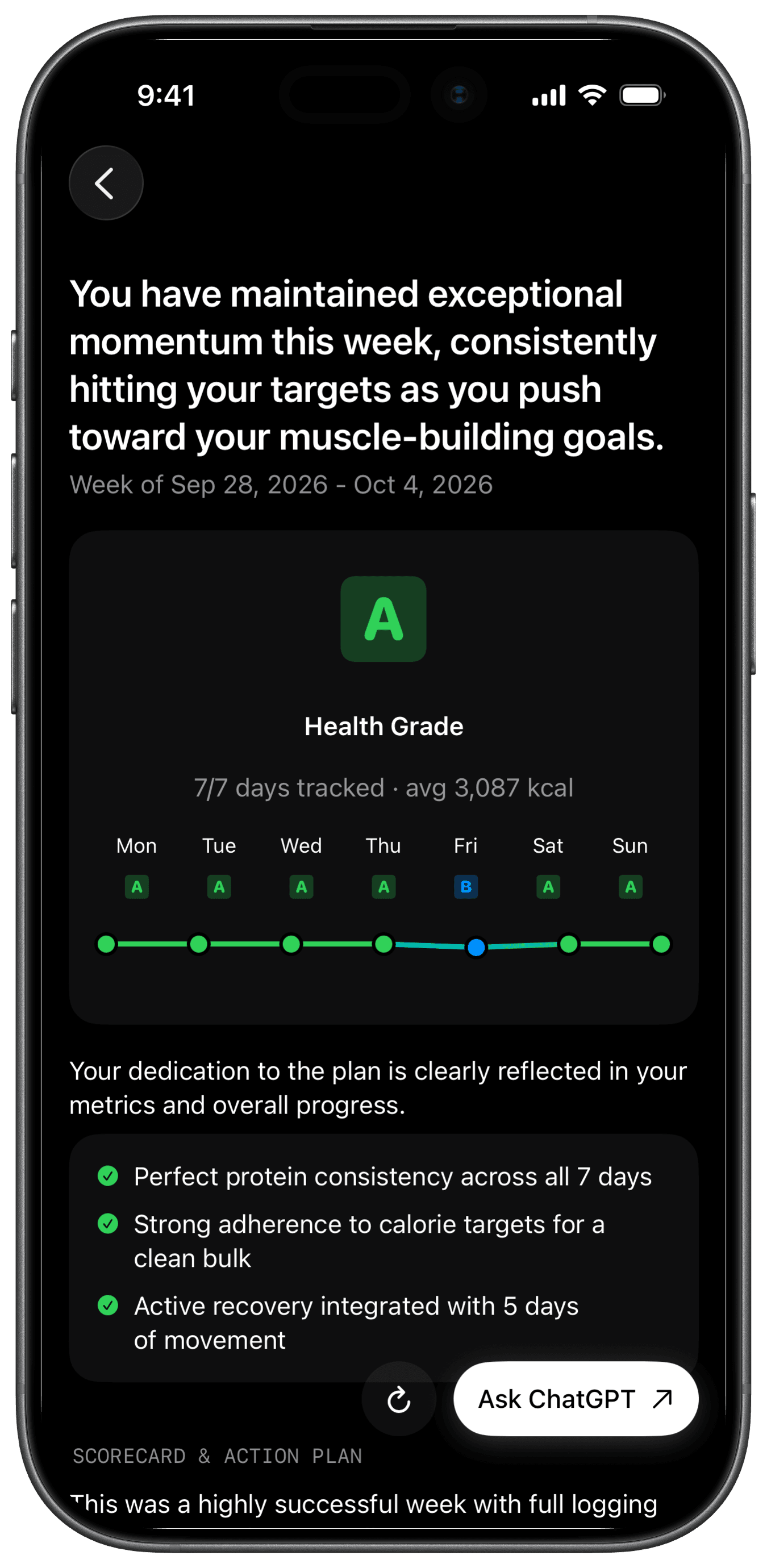
This populated example reviews September 28 to October 4, with an A Health Grade, 7/7 days tracked, and an average of 3,087 kcal. Its highlights identify protein consistency and calorie-target adherence. The weekly average describes this demo log; judge your own intake alongside the weight trend and training performance before deciding whether to adjust.
Weight is flat and your lifts keep climbing. Hold the plan. Training is working. If you're new or returning, this may be recomposition and there's no reason to force the scale. If weight gain is still the goal after a few weeks, add a small step.
Weight is flat and your log says you're in a surplus. Check the log before adding food. Check portion sizes, food estimates, and whether the days you logged represent the whole week. A busier job or more daily steps can also change your needs. If the log is complete, two weeks of stable weight at your logged average gives you a working maintenance estimate. Calculator figures are only starting guesses. Set the surplus from the number your own weight produced.
Weight is rising fast, your waist is growing, and the lifts barely move. Confirm you weighed under the same conditions each morning. Then reduce the surplus or return near maintenance, and look hard at the training.
Weight is rising and performance is stalling or falling. Extra food can't fix a program that stopped progressing, poor technique, accumulated fatigue, short sleep, or pain. Audit those before changing calories.
You feel flat, sore for days, or constantly hungry. Check that you've hit the calorie target on most days, then check sleep. If both are fine, trim a set or two before adding food. If appetite is the problem, lean on regular meals, easy energy-dense foods such as milk, granola, nut butter, and dried fruit, and recipes you can repeat without thinking.
Your logs have gaps. Ignore that fortnight's calorie read. Missing meals make intake look lower than it was. Log fully for the next two weeks before you change anything.
10Protect sleep and know when a bulk is the wrong tool
Sleep is part of recovery. In a 2020 study, 24 healthy young men had lower muscle protein synthesis after five nights of four hours in bed than after five nights of eight hours.13 That small, short, all-male study doesn't set an ideal sleep duration, and it suggests short nights can constrain recovery. It did not measure long-term muscle gain. Keep a regular bedtime on training nights and treat persistent poor sleep as something to fix before you add food or sets.
A bulk is the wrong tool in some situations. If you're carrying more body fat and want to look leaner, a maintenance phase with hard training and adequate protein may serve you better, and lose weight with Fuel covers a slower cut that protects muscle. If you want to train for performance without deliberately changing weight, read fitness nutrition with Fuel. If you have a history of disordered eating, a medical condition, or medication that affects appetite or weight, set targets with a registered dietitian or your doctor.
Watch for persistent fatigue, repeated bone-stress injuries, missed or changed periods, low libido, frequent illness, or falling mood and training. The IOC's 2023 consensus on Relative Energy Deficiency in Sport links these signs with low energy availability in women and men.14 They call for an assessment by a sports medicine doctor or sports dietitian, and a macro tweak won't resolve them.
11Your next training day
Before your next session, write the lifts, sets, target reps, and last session's loads in your training log. Eat the meal you planned, lift, and record every set. Log each meal in Fuel and check protein by mid-afternoon. Prep tomorrow's lunch tonight. If you use weight feedback, record consistent weigh-ins over the next two weeks, then review them with your food and training logs. If your lifts are improving and recovery is good, you have a reason to keep the routine steady while you watch the longer trend.
Footnotes
American College of Sports Medicine. Resistance training prescription position stand. 2026. Overview of 137 systematic reviews of randomized trials in healthy adults aged 18 and older, with training blocks of 6 to 52 weeks. The overview estimates marked diminishing returns around 18 to 20 weekly sets, which newer meta-regression data don't clearly confirm.
Back to textBack to text 2Pelland JC, et al. Meta-regression of resistance-training volume, frequency, muscle size, and strength. Sports Medicine, 2026. 67 studies and 2,058 participants, 79% male, mean age about 25. It cannot set an individual's best volume.
Back to textRobinson ZP, et al. Meta-regressions of proximity to failure and resistance-training outcomes. 2024. Exploratory models based on estimated reps in reserve. The best individual reps-in-reserve target remains uncertain.
Back to textVargas-Molina S, et al. Maintenance diet, moderate deficit, or control during resistance training. European Journal of Applied Physiology, 2026. 30 adults aged 18 to 35, 26 men and 4 women. The supervised groups received nutrition guidance and the control group did not, and the trial did not test a surplus.
Back to textMurphy C, Koehler K. Energy deficiency and resistance-training gains in lean mass and strength, meta-analysis and meta-regression. Scandinavian Journal of Medicine and Science in Sports, 2022. A study-level model across heterogeneous, mostly short trials. It does not set an individual threshold.
Back to textHelms ER, et al. Small and large energy surpluses in resistance-trained lifters. Sports Medicine Open, 2023. 21 enrolled and 17 completed, two of them women, training three days a week for eight weeks. Severely underpowered after attrition, with maintenance and surplus both estimated.
Back to textBack to text 2Garthe I, et al. Nutritional intervention, body composition, and performance in elite athletes. European Journal of Sport Science, 2013. 39 young elite athletes over 8 to 12 weeks, with four extra strength sessions a week. Group results do not set a surplus for ordinary adults.
Back to textIraki J, et al. Off-season nutrition for natural bodybuilders, a narrative review. Sports, 2019. Practitioner synthesis that predates the controlled surplus trials. The gain rate is a heuristic.
Back to textMorton RW, et al. Protein supplementation and resistance-training gains in healthy adults, meta-analysis and meta-regression. British Journal of Sports Medicine, 2018. The 95% confidence interval for the breakpoint was 1.03 to 2.20 g/kg a day. Ages, diets, and training status varied across studies.
Back to textJäger R, et al. International Society of Sports Nutrition position stand on protein and exercise. Journal of the International Society of Sports Nutrition, 2017. Per-meal spacing advice rests partly on acute synthesis studies, and long-term hypertrophy evidence on distribution is limited and mixed.
Back to textBack to text 2Henselmans M, et al. Higher versus lower carbohydrate intake during resistance training, meta-analysis. Sports Medicine, 2026. 11 randomized trials in healthy adults with protein matched. GRADE certainty was low because of imprecision and moderate risk of bias.
Back to textKing A, et al. Carbohydrate feeding and resistance-exercise session volume, meta-analysis. Sports Medicine, 2022. 21 acute crossover studies in 226 healthy participants. Session volume is a short-term proxy and not a measure of muscle growth.
Back to textSaner NJ, et al. Sleep restriction and myofibrillar protein synthesis in healthy young men. Journal of Physiology, 2020. 24 men, five nights per condition. No long-term muscle or performance outcome was measured.
Back to textMountjoy M, et al. 2023 International Olympic Committee consensus statement on Relative Energy Deficiency in Sport. British Journal of Sports Medicine, 2023. Expert consensus. Its clinical assessment tool is not a self-diagnosis calculator.
Back to text