A calorie deficit you can repeat for three months will take you further than a perfect plan you drop after three weeks. Weight comes off when an energy deficit lasts long enough to change body mass, and the deficits that last are built from meals you already like, a strength habit you keep and a weekly check that tells you when to hold steady.
Fuel handles the targets, the food log, the weigh-ins and the weekly review. Your groceries, your kitchen routine, a simple strength program, daily walking and, when it's needed, a clinician or dietitian handle the rest.
01Who this weight-loss plan is for
This guide is for adults who want to lose weight gradually and keep their strength, energy and ordinary life while they do it. The aim is steady progress you can live with. No single calorie deficit or weekly rate suits everyone, and no app can guarantee a result.
Two groups should change the approach before starting. If your BMI is 30 or higher, the US Preventive Services Task Force recommends that clinicians offer or refer adults to intensive programs that combine diet, activity, self-monitoring and regular sessions over one to two years.1 Fuel can run alongside that kind of program. It can't stand in for one. If you are pregnant or breastfeeding, under 18, underweight, recovering from an eating disorder, or managing a condition or medication that affects appetite, blood sugar or weight, talk to a clinician or registered dietitian before you set a deficit.
If an event date is driving the goal, Train for an event with Fuel is the better starting point. Everyone else should write down what success includes besides a lower number. Lifting the same weights in month three. Sleeping well. Eating dinner with your family without cooking a separate meal. Those answers become the checks you run every week.
02Why the eating pattern you can repeat beats the ideal diet
Weight changes gradually after an intake change, and as body mass drops, the energy you need to maintain it drops too. The energy-balance model from Kevin Hall's group at the NIH, which sits behind the NIDDK Body Weight Planner, shows why a fixed calories-per-pound timeline overpromises as the weeks go on.2 Expect your first target to need a second look later.
The macro split matters far less than the deficit. In the DIETFITS trial, 609 adults were randomized to a healthy low-fat or healthy low-carbohydrate diet with 22 group sessions over a year. Among the 481 who finished, average loss was 5.3 kg and 6.0 kg, a gap too small to call.3 Genotype and baseline insulin secretion didn't predict who would do better on which diet. The 2013 NHLBI expert panel review found comparable losses across calorie-reduced diets with different fat and carbohydrate levels.4
So pick the pattern you'd happily eat on a tired Tuesday. In Fuel, your diet preference decides how the calories left after protein are split between carbs and fat, so a vegetarian, keto or balanced eater each gets targets shaped to that pattern.
03How to set up a weight-loss plan in Fuel
New users set the direction during onboarding.
- Enter your current weight.
- Choose Lose Fat as your goal.
- Enter a desired weight below your current weight.
- Choose your activity level and diet preference.
- Set your pace.
- Review the plan, then choose Plan calories or Dynamic calories.
Fuel reads the direction from the two weights. Lose Fat with a desired weight equal to or above your current weight won't produce a loss plan. If you already use Fuel, change the goal under You > Personal Details > Goals > Goal Type and set a lower target under You > Personal Details > Coaching Plan > Update goal weight. Your targets live under You > Personal Details > Coaching Plan > Your Plan.
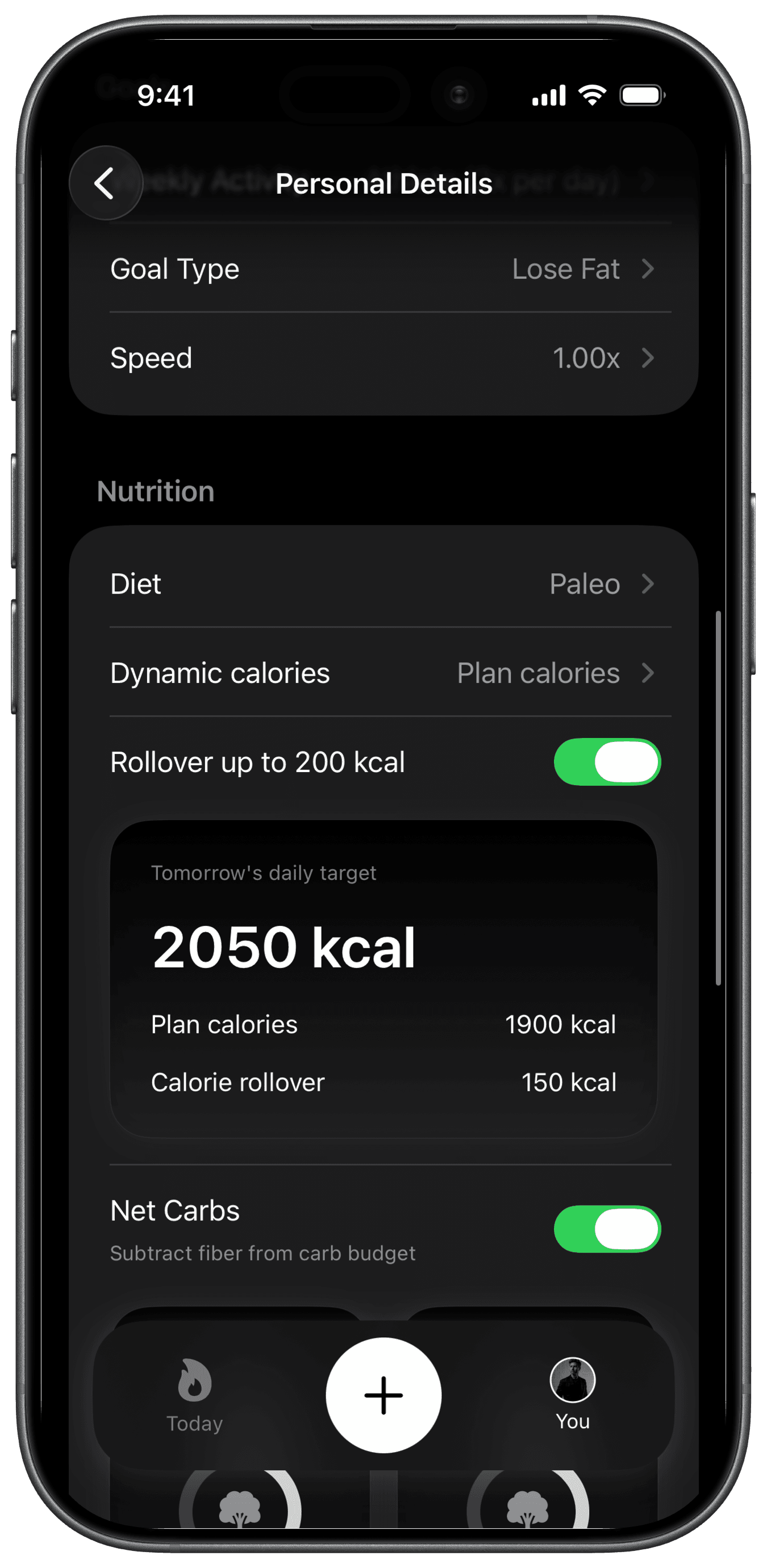
The example settings show Lose Fat at Speed 1.00x. The calorie and rollover values in the preferences preview explain how that option works; check Your Plan for the actual calorie target.
Fuel estimates your maintenance calories from recent Apple Health energy when it has enough data, and from a resting estimate plus your activity level when it doesn't. It then subtracts a loss adjustment that starts at 500 kcal a day at the slowest pace and scales up to 1,000 kcal a day at the fastest. Trials in adults with overweight or obesity often prescribed deficits of 500 to 750 kcal a day inside supervised programs,4 and a smaller, older or less active person may find even 500 a large share of daily needs. A faster pace means a larger deficit, more hunger and more strain on training.
Whatever pace the slider shows, treat it as your choice. I'd start at the slowest pace unless you have a clear reason to go faster. If two weeks of reasonably complete logs show that even this target leaves you hungry and flat, raise calories a little in You > Adjust Macronutrients. Calories move in 5 kcal steps there, and a direct edit marks the plan as custom.
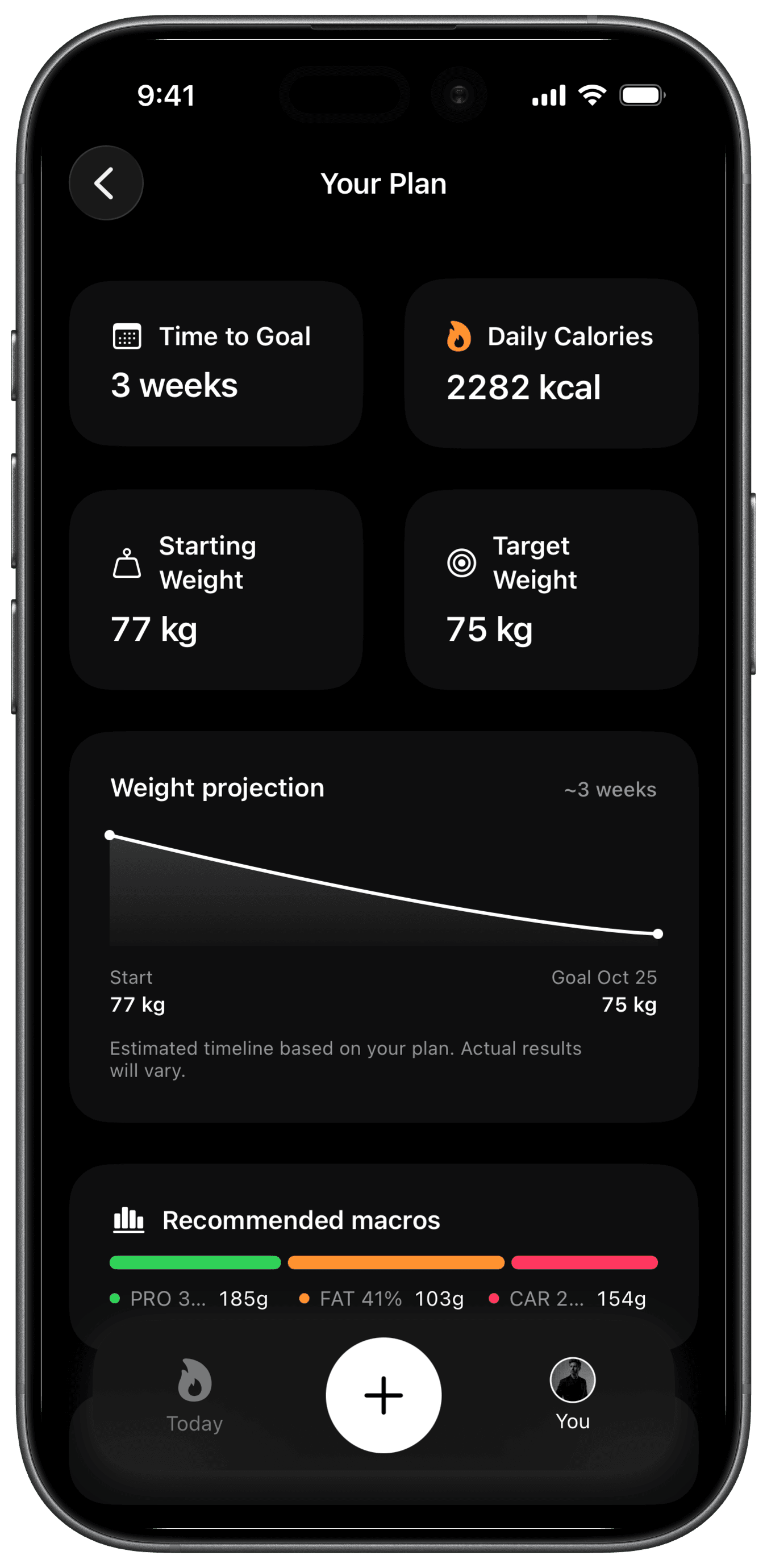
This demo plan shows 2,282 kcal and 185 g protein, with a starting weight of 77 kg and a displayed goal of 75 kg. The three-week projection estimates October 25 as the goal date. These numbers show where things sit on the screen and aren't a target to copy. Your projected goal date is an estimate built from plan calories and estimated maintenance, and it will move as real weigh-ins arrive. Nutrition planning explains each field.
Protein is the target most people notice first. For a loss plan, Fuel sets protein from body weight and training frequency, 2.2 g per kg by default and more if you train often. Treat that as a planning anchor for meals. The research doesn't make it a minimum everyone needs. In the NHLBI review, diets with 25% and 15% of energy from protein produced equivalent weight loss when both created a deficit.4 A 2020 systematic review of 1,079 adults with overweight or obesity found higher protein improved fullness in six of ten studies, and its authors rated that evidence low.5 The often-quoted 2.4 g per kg result comes from 40 young men training six days a week on a severe four-week deficit.6 A protein food at each meal is the habit worth building. If Fuel's number is routinely out of reach, lower it in Adjust Macronutrients, then review and rebalance the calorie target. Editing protein recalculates calories from the saved macro grams.
04Plan calories or dynamic calories for weight loss
Plan calories keeps your daily target fixed regardless of activity. If rollover is enabled, unused calories can still raise it. Dynamic calories starts from your recent burn over the previous 14 completed days of Apple Health energy data, then unlocks more calories when your activity runs ahead of its usual pace. It keeps your plan's deficit in place as the target rises. There's no separate workout bonus because workout energy already counts on the activity side.
Dynamic calories responds to recorded burn and activity. Weigh-ins don't feed it, so it can't spot a stall or fix one. When it raises your calorie target, your saved protein, carb and fat grams stay where they were.
I'd start most people on Plan calories for the first month. A fixed number is easier to learn, and a watch estimate can't loosen it on a busy day. Choose Dynamic calories if your activity swings a lot between days and you wear an Apple Watch consistently. You can switch later under You > Personal Details > Dynamic calories or You > Preferences > Dynamic calories.
05Build meals you can repeat for weeks
Most weight loss is decided at the grocery store and the stove, well before anything reaches a food log. Keep breakfast and lunch familiar, plan dinner ahead of your busiest evening, and choose one prep task you can repeat each week, such as a pot of grains or beans, a tray of roasted vegetables, or portioned yogurt and fruit.
A satisfying day usually has a clear protein food at each meal, produce or another filling side, and planned portions of the calorie-dense extras. Here is one illustration built from ordinary foods.
- Breakfast, eggs or tofu with toast and fruit
- Lunch, a rice, grain or potato bowl with beans, chicken, fish or tofu and plenty of vegetables
- Snack, yogurt or fruit if hunger shows up in the afternoon
- Dinner, a flexible meal with room for a food you love
Volume helps. A year-long trial randomized 97 women with obesity to cut fat alone or cut fat while adding water-rich fruit and vegetables. The produce group lost 7.9 kg against 6.4 kg and reported less hunger, though only 71 women finished.7 Soup, beans, fruit, salad and potatoes all make a plate bigger without adding much energy.
When hunger bites, notice when it arrives and what came before it. Try a more filling version of that meal, add a protein food or a water-rich side, or move the meal earlier. Try those fixes before you cut calories again.
06How to log food in Fuel without chasing perfect numbers
Logging makes your intake visible so the weekly review has something real to read. In a 2019 trial, 105 adults with a BMI of 25 to 45 used a commercial app alongside a calorie target, reminders and weekly lessons, and lost about 2.4 to 2.8 kg in 12 weeks.8 The loss occurred during a combined intervention. With no untreated control, the trial cannot isolate what the app contributed. Treat Fuel's log the same way.
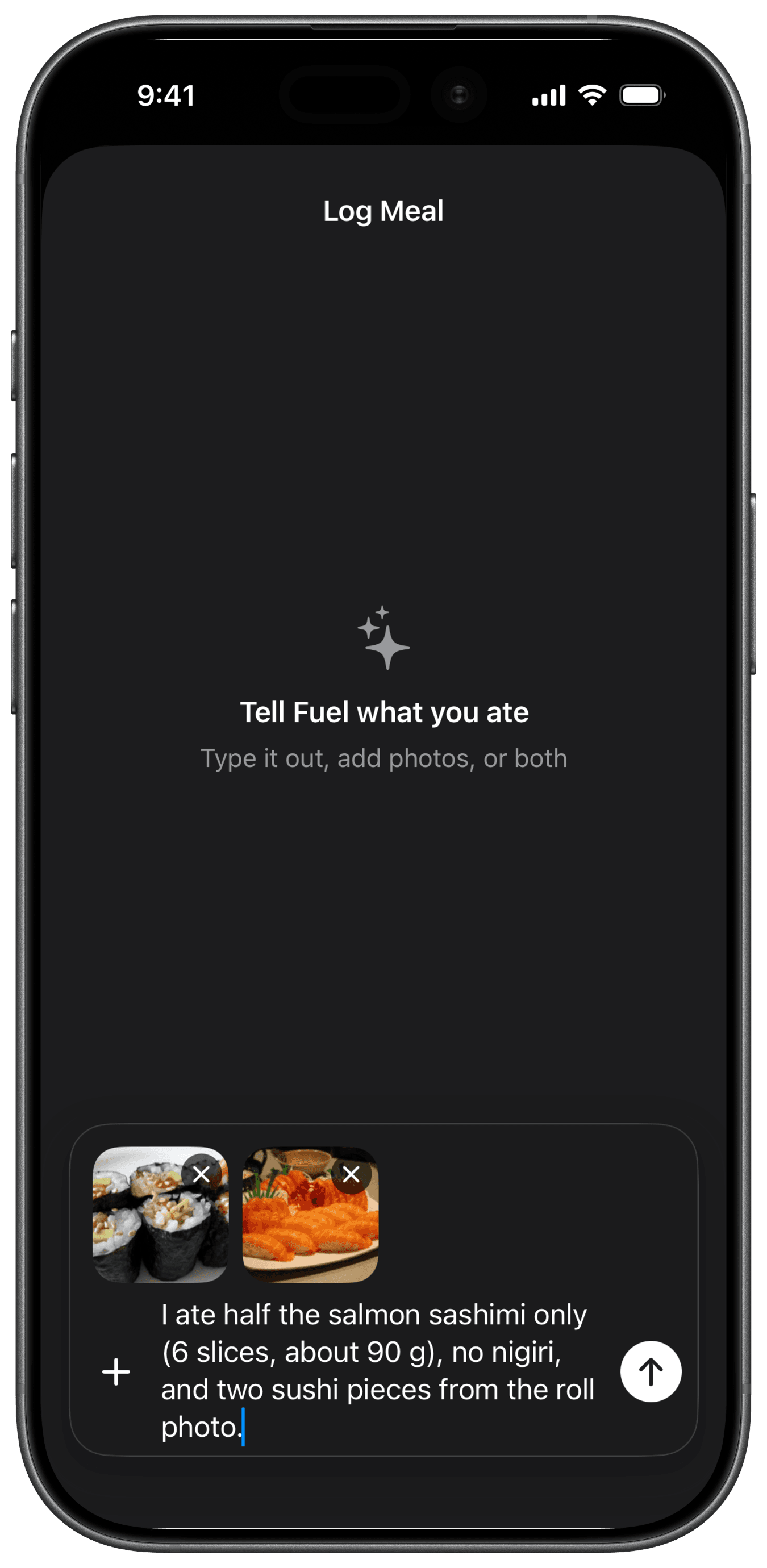
This shared Log Meal capture was taken on October 3; it illustrates the logging workflow rather than a newly captured loss-specific meal. Fuel accepts a typed description, a meal photo or a Food Library lookup. Typed and photo analyses have a review step. Recent and Favorite foods, and Food Library quick-add, can log directly.
- Tap the center + button to open Log Meal.
- Type the meal in What did you have?, or use the camera or photo-library controls. Food Library has a separate search and portion workflow.
- Tap the submit arrow to analyze the meal.
- Check the portion Fuel recognized and correct the size, cooking oil, sauce or drinks.
- Tap Log Food.
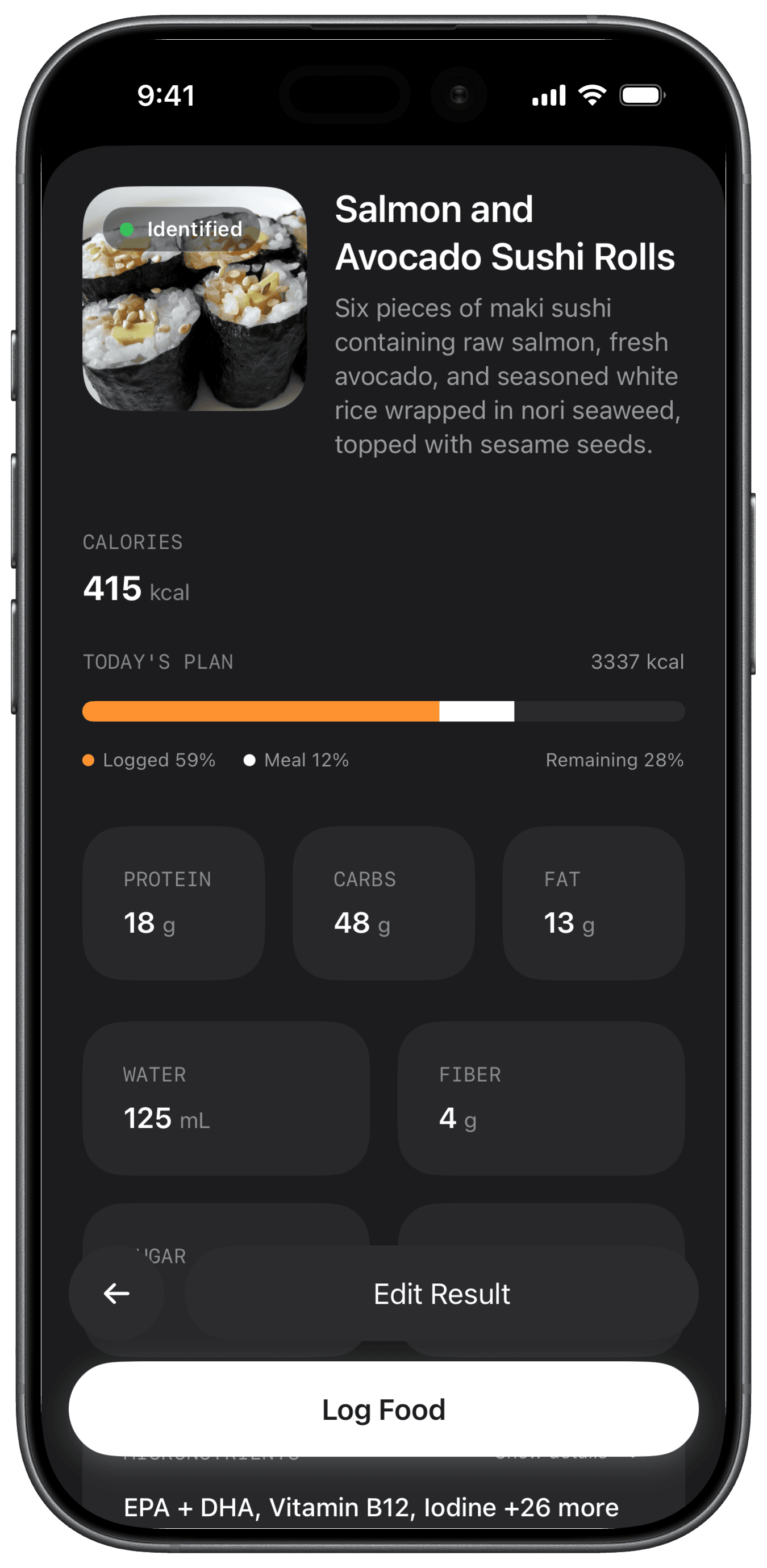
This shared October 3 analysis capture shows the review step before saving. Check the recognized foods and portions against what you ate; the displayed nutrition is an example estimate.
Photo and text results are estimates, and restaurant meals carry the widest error because you can't see the oil or the real portion. A kitchen scale helps for a week or two with the handful of calorie-dense foods that are easy to misjudge, such as cooking oil, nut butter, granola, cheese and cooked rice or pasta. Once your eye is calibrated, go back to estimating. When a portion matches a meal you've logged before, tap it under Recent or Favorites in Log Meal. Food logging covers the other entry paths.
A day with an unlogged dinner is an incomplete day. When you review the week, count it as unknown and resist reading it as a low-calorie win. A rough entry for a meal out gives the review far more to work with than a blank.
A full daily log needs Fuel Pro. Free allows seven saved food entries per configured week, which covers a day or two of this routine. Ongoing Weekly Reviews, Plan progress, and the weight, calorie and macro charts in Trends also require Pro. The Weight screen is available on Free. Free and Pro lists the current limits.
07Keep two strength sessions in your week
Adding strength training to a diet barely changes how much weight comes off, and it shifts more of that loss toward fat. A 2025 meta-analysis of 25 randomized trials in adults aged 18 to 65 with overweight or obesity compared diet alone with diet plus resistance exercise. Total weight loss was similar. The resistance groups kept more fat-free mass, with moderate-certainty evidence, lost more fat, with high certainty, and gained strength, with low certainty.9 It won't make muscle loss zero. It's still the best reason to keep lifting while the scale is your main goal.
If you already follow a program, keep it and expect some lifts to stall during the deficit. If you're starting out, two full-body sessions a week is a reasonable starter example. Pick five movements you can do safely, such as a squat or leg press, a hip hinge like a Romanian deadlift, a push-up or dumbbell press, a row and a loaded carry. Use weights you could lift a few more times at the end of each set. Record the movements and loads in a notebook or the workout app you already use. Numbers that fall across several weeks are a reason to review the deficit alongside sleep, fatigue and the training program.
The World Health Organization recommends that adults aged 18 to 64 get 150 to 300 minutes of moderate activity or 75 to 150 minutes of vigorous activity each week, plus muscle strengthening on at least two days, for general health.10 Treat that as a destination. If you're mostly sitting now, a ten-minute walk after lunch is a fine start, and you can add minutes as it gets easy. Walking, cycling, sport and daily movement help your health and your mood. They aren't a debt you pay off for food.
08How to weigh in and read your weight trend in Fuel
Open You > Weight, enter the reading and tap Update. Weigh on the same scale after waking and using the bathroom, before food or drink. Daily weigh-ins settle the signal faster. A few mornings a week, or one weekly weigh-in at a consistent time, also works. If weighing starts to feel like a verdict on you, stop and use a tape measure at the waist, the fit of your clothes and your strength log instead.
Scale weight moves from day to day with water, sodium, glycogen, gut contents, travel and training soreness. In one study of 42 women measured twice a week across a cycle, weight averaged about 0.45 kg higher during menstruation than in the first week, matched by a similar rise in extracellular water.11 Your pattern may differ. No single reading should change your plan.
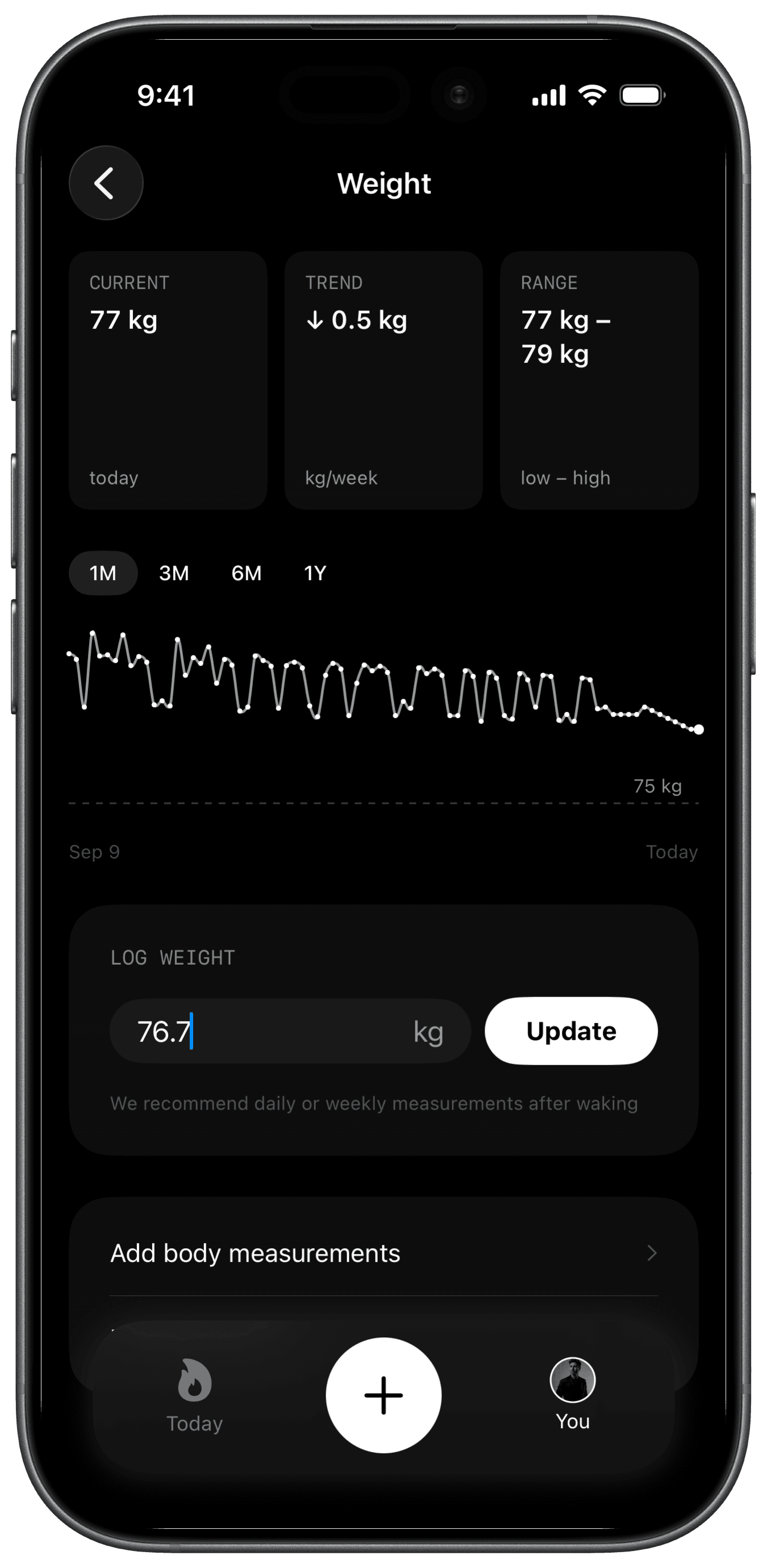
The chart uses synthetic demonstration readings to illustrate the display, rather than a person's weight-loss results. Its current-weight tile rounds to 77 kg and its displayed rate is 0.5 kg per week; neither is an outcome to expect from this guide.
The Weight screen offers 1M, 3M, 6M and 1Y ranges. Its weekly rate takes the first and last readings in the range and divides the change by the weeks between them. A heavy first morning or a light last one can tilt that rate, so read the shape of the chart along with the number. For a steadier read, average your own weigh-ins for each week and compare this week's average with last week's. The Weight screen doesn't calculate that average for you, so keep it in a note or a spreadsheet. Weigh-ins and weight trend covers Apple Health scales and Shortcuts.
09A sample week with Fuel and everything else
One hypothetical adult with a loss plan already set might run the week like this. Their calorie and protein targets are left out because they belong to that person.
| Day | Coach action | Where Fuel fits |
|---|---|---|
| Monday | Review last week and choose one change. Shop from a short list and cook a batch of grains or beans | Open Weekly review on Today and check targets in Your Plan |
| Tuesday | Normal meals and the first strength session | Log each meal from Log Meal |
| Wednesday | Weigh in if you've chosen to. If Tuesday evening was hungry, add a filling side to dinner | Enter the reading in You > Weight |
| Thursday | Second strength session or your usual sport, with an easy day around it | Keep lift numbers in your training log |
| Friday | Plan the meal out, order something you'll enjoy and log it with drinks as well as you can | A rough restaurant entry keeps the week readable |
| Saturday | A long walk or active errands, and one relaxed meal | Log the meals and let Apple Health record the walk |
| Sunday | Write next week's shopping list and book the strength sessions in your calendar | Nothing to do in the app |
10How to run a weekly review before changing calories
Pick one fixed slot at the start of your week and review once. Open the Weekly review card on Today. It covers your previous full week and, when the data supports it, summarizes logged days, calories and macros, activity, weight and goal progress, then suggests next-week targets and a short action plan. You > Plan progress shows the current plan week, its status and the projected goal date. Weekly Review and Plan progress explain each section.
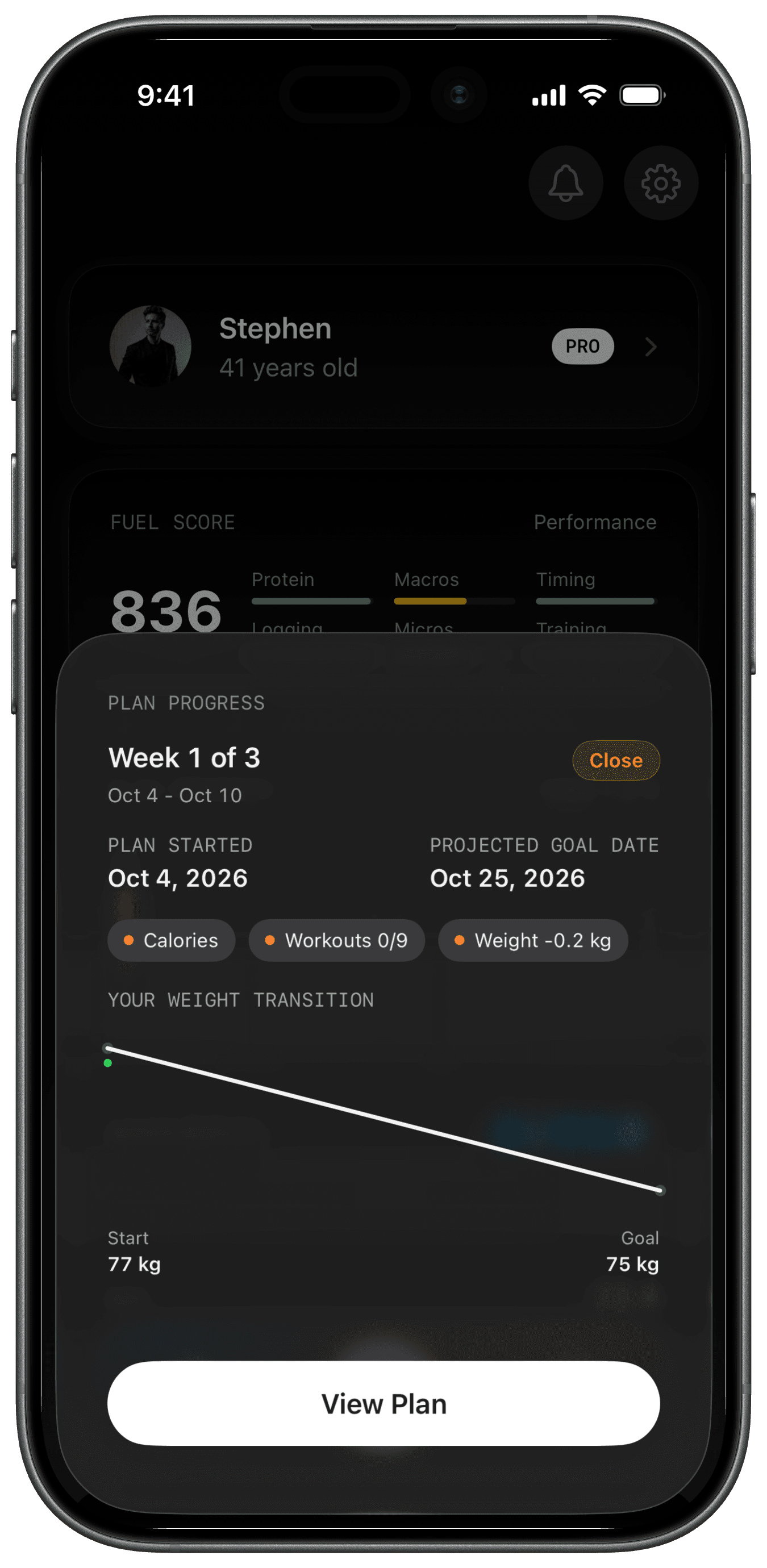
This demo is in its current plan week, October 4–10, with a displayed 0.2 kg decrease from the 77 kg start toward 75 kg. Plan Progress puts the current week against the estimated timeline; use the completed Weekly Review to judge the routine across a full week.
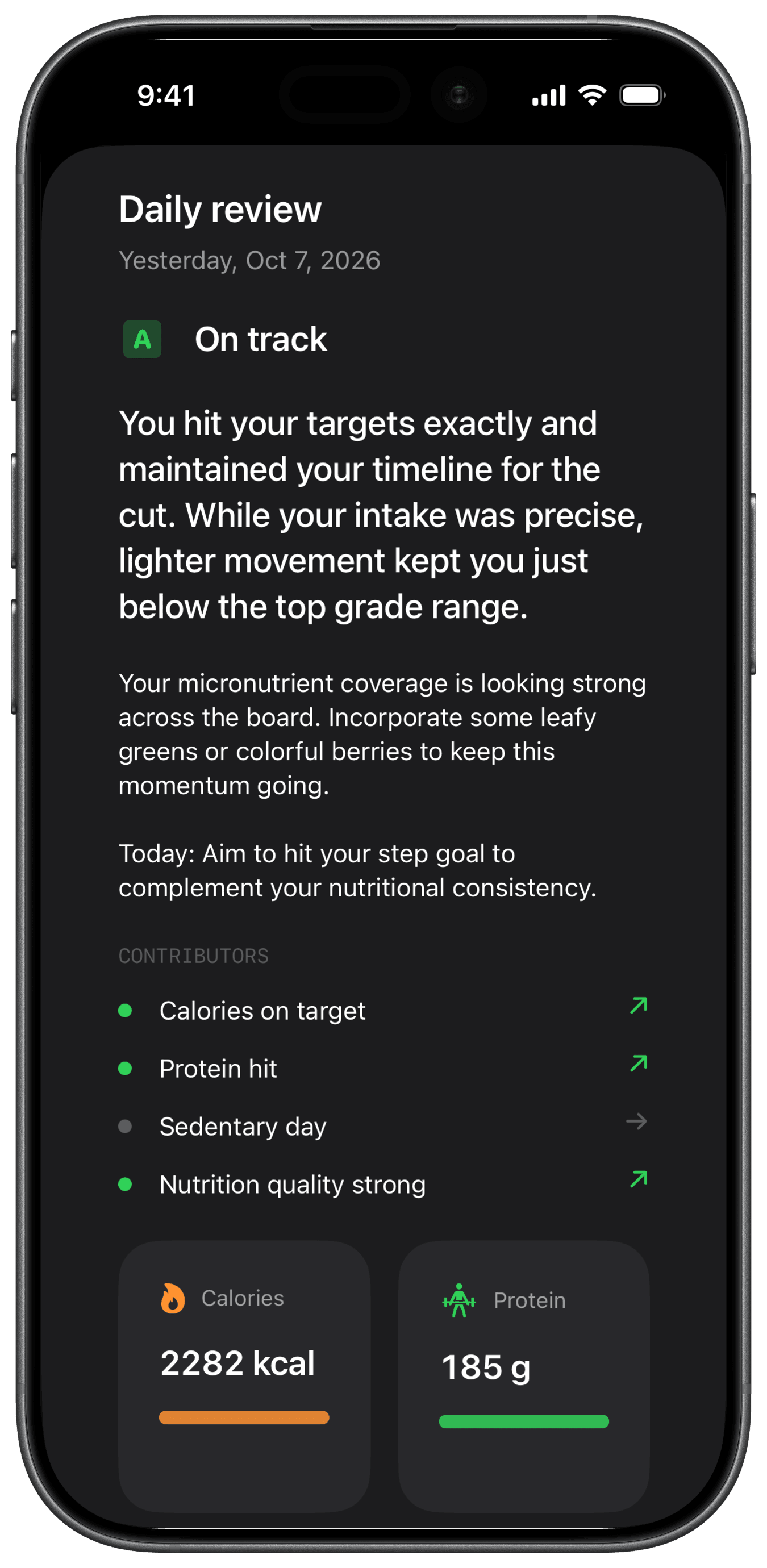
The Daily Review checks yesterday's log. This populated demo shows 2,282 kcal against a 2,282 kcal target and 185 g protein, with coaching to reach today's step goal. Use a daily suggestion to notice a missed habit, then let the weekly pattern guide any calorie change.
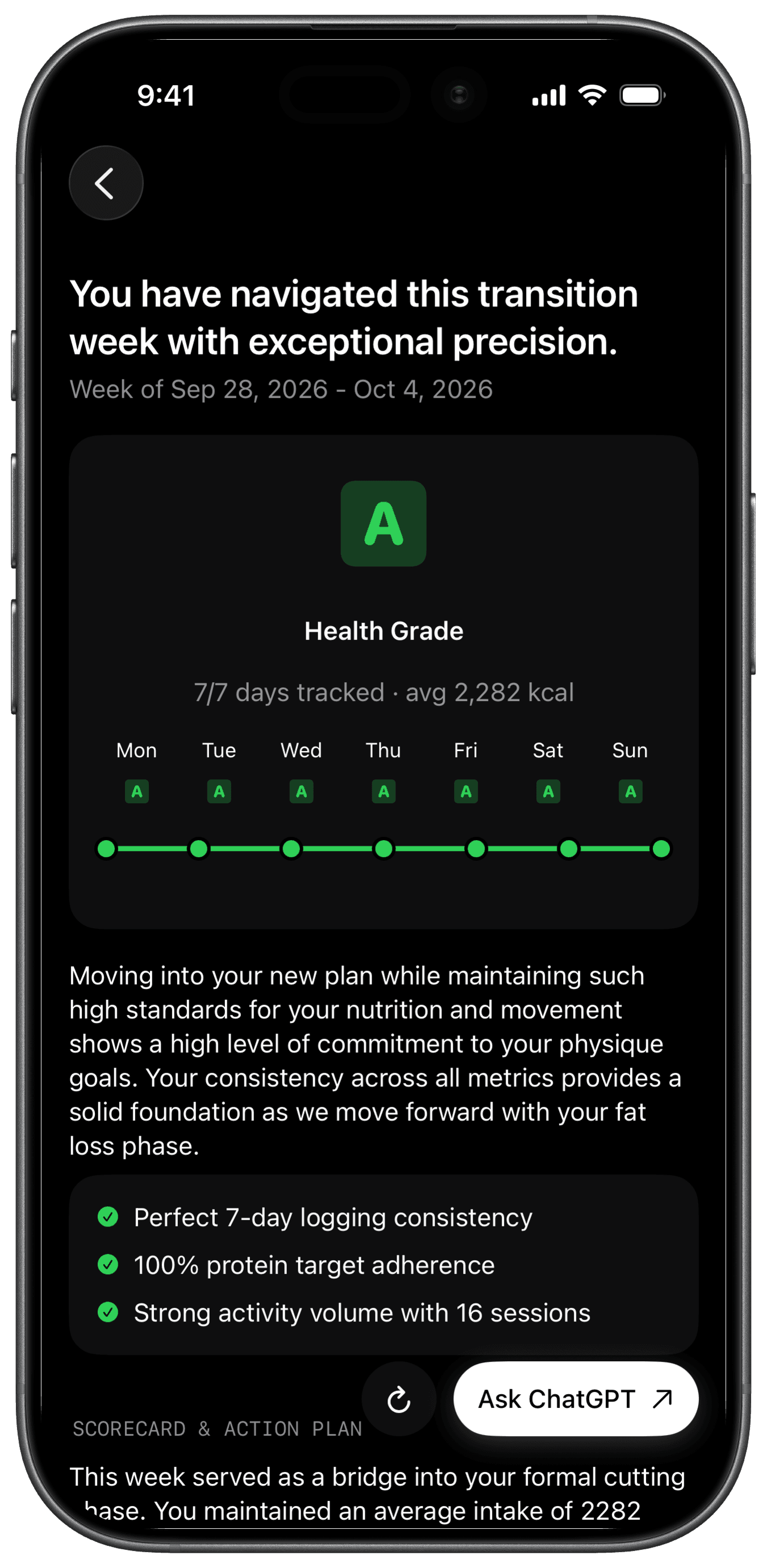
The populated demo review shows seven tracked days, an average intake of 2,282 kcal and 100% protein target adherence. Those figures illustrate the review with demonstration records; your own coverage and trend decide how much confidence to place in its advice.
Read coverage first. Count the days with a complete log and the number of weigh-ins. A thin week gives a thin answer, and the right move is to collect a better week before changing anything. Then look at the weight trend, hunger, sleep, training numbers and whatever made the week hard. Choose at most one change for the coming week.
Use Fuel's records to review a flat stretch before changing targets. Two things usually happen together. Energy needs fall as weight comes off, and intake creeps up in ways that are hard to see. A 2014 modeling study using CALERIE and other data sets found that on-and-off adherence could produce an apparent plateau by about six months, and that metabolic adaptation alone didn't explain when it appeared.12 A model can't tell you what happened in your week, so audit without blame. Check weekends, drinks, cooking oils, restaurant portions, snacks between logged meals and whether your step count fell.
Wait for two to three weeks of flat trend with good records before changing calories. That window is a coaching habit that gives water swings time to wash out, and nobody has tested it as the ideal interval. One practical coaching example is a change of about 100 to 150 kcal a day, small enough that you can see what the change did. That size is sensible and also untested as an optimum. Make the change in You > Adjust Macronutrients or add a daily walk, and change one thing at a time.
| What you see | What to do next |
|---|---|
| One high reading after a salty meal, travel, hard training or around your period | Keep the plan and keep weighing. Judge the next weekly average |
| Trend moving down, hunger manageable and lifts holding | Change nothing and repeat the week |
| Flat for a week, or too few weigh-ins to judge | Hold calories. Weigh more consistently or add a waist measurement |
| Flat for two to three weeks with several days unlogged | Fix the log and the routine first. Check weekends, drinks, oils and meals out |
| Flat for two to three weeks with good records and steady activity | Make one small change, about 100 to 150 kcal a day or a daily walk, then reassess |
| Loss faster than you planned with rising hunger, poor sleep, fatigue or falling lifts | Ease the deficit by adding food back or moving to a slower pace |
| Weighing or logging brings distress, compulsive checking, or cycles of restricting and bingeing | Stop collecting more data. Use other progress markers and get support from a clinician or registered dietitian |
When you're hungry, tired or losing strength, another cut rarely fixes it. In a study of 50 adults after a 10-week very-low-energy diet, appetite rose and appetite-related hormones still differed from baseline 62 weeks after the start.13 That diet was far more severe than this plan, and group averages can't predict your hunger. It does explain why appetite pushes back as you lose, though it did not test remedies. Reviewing meal timing or easing the deficit are coaching options to consider. Symptoms that persist, and any medical concern, belong with a clinician.
11When to stop losing weight and move to maintenance
Stop the deficit when you reach your goal, when you decide your current weight is good enough, or when the cost to sleep, training, mood or relationships outweighs the next kilogram. Each one is a legitimate place to stop. Switch to Maintain, review the working calorie estimate against your longer weight trend, keep the strength sessions and the weekly review, and recognize that appetite may remain elevated for a while.13 The Hall model and the NIDDK planner treat reaching a goal and holding it as two phases of one plan.2 Fitness nutrition with Fuel covers eating and training at maintenance, and Gain muscle with Fuel picks up if building strength becomes the next goal.
12Put the first week on your calendar
Open your calendar before you open the app. Book a grocery trip and one prep hour. Book two strength sessions at times you would actually keep. Choose your weigh-in mornings. Then book a 20-minute review for the start of next week and a trend reassessment two to three weeks out. Keep the routine steady while you gather useful records, and review sooner if hunger, fatigue or distress calls for a change.
Footnotes
US Preventive Services Task Force, recommendation on behavioral weight-loss interventions for adults with obesity. Applies to adults with a BMI of 30 or higher. Effective programs commonly aimed for at least 5% loss, combined diet and activity change, ran one to two years and usually offered at least 12 sessions in the first year. It describes clinical obesity care and doesn't apply to every adult trying to lose a few kilograms.
Back to textHall et al., dynamic energy-balance model, The Lancet, 2011, and NIDDK's Body Weight Planner research page. A mathematical model of adult weight and energy balance. It assumes the specified behavior change happens and can't account for one person's adherence, illness, medication or daily fluid shifts.
Back to textBack to text 2Gardner et al., DIETFITS randomized trial, JAMA, 2018. Adults aged 18 to 50 without diabetes and with a BMI of 28 to 40. The 12-month between-group difference was 0.7 kg, with a 95% confidence interval of −0.2 to 1.6 kg. One large trial of two healthy patterns, so it doesn't rank every diet for every population.
Back to textNHLBI Obesity Expert Panel, systematic evidence review on managing overweight and obesity in adults, 2013. Covers adults with overweight or obesity in structured weight-loss programs. The 500 to 750 kcal deficits were trial prescriptions and don't set a personal minimum or show what a smaller, older, highly active or medically complex person can tolerate. The report graded the 25% versus 15% protein comparison as high-strength evidence.
Back to textBack to text 2Back to text 3de Carvalho et al., systematic review of protein intake and appetite, 2020. Ten studies compared higher protein, above 1.2 g per kg or above 25% of energy, with normal protein. Four of the six positive studies lasted 10 to 12 weeks. Protocols varied, risk of bias was high and the authors rated the evidence low.
Back to textLongland et al., randomized trial of higher protein during an energy deficit, American Journal of Clinical Nutrition, 2016. Forty young men with overweight ate provided food at about a 40% deficit for four weeks with resistance and interval training six days a week. The 2.4 g per kg group gained 1.2 kg of lean mass and lost 4.8 kg of fat, against 0.1 kg and 3.5 kg at 1.2 g per kg. Small, short and far from typical conditions.
Back to textRolls et al., one-year energy-density trial, 2007. Ninety-seven women with obesity were randomized and 71 completed. An older single-sex study with attrition, so it shows one workable approach and doesn't make produce compulsory or sufficient on its own.
Back to textGoalTracker app self-monitoring trial, 2019, and the USPSTF intervention summary. Participants had a 5% goal, a tailored calorie target, reminders and weekly behavior lessons. Starting with food logging or weight logging first made no difference to loss. The trial had no untreated comparison group.
Back to textBinmahfoz et al., systematic review and meta-analysis of resistance exercise during diet-induced weight loss, 2025. Twenty-five randomized trials in adults aged 18 to 65 with a BMI of 25 or higher. The evidence supports adding resistance work and doesn't define a best split, dose or guaranteed muscle gain.
Back to textWorld Health Organization, physical activity recommendations for adults. General health guidance for adults aged 18 to 64. It sets a weekly target for health and isn't a weight-loss prescription or a required starting level.
Back to textKanellakis et al., body mass and body composition across the menstrual cycle, 2023. Extracellular water rose about 0.47 kg during menstruation with no other significant body-composition change. A small study, and individual cycles differ.
Back to textThomas et al., model of weight plateaus and intermittent adherence, 2014. Compared model predictions with observed data sets including CALERIE. A model can't show that any one person's flat trend comes from adherence, and energy needs also fall as weight drops.
Back to textSumithran et al., appetite and hormone changes after weight loss, New England Journal of Medicine, 2011. Fifty adults with overweight or obesity lost an average of 13.5 kg on a 10-week very-low-energy diet. The diet was far more restrictive than this plan, and group averages don't predict one person's appetite.
Back to textBack to text 2