A half marathon or a 100 km sportive changes your week long before it changes your plate. The long run creeps from 60 minutes to two hours, a hard midweek session appears, and you keep eating the way you did when you ran three easy loops a week.
The first sign is usually a flat Saturday, a ravenous Sunday evening, or a stomach that rebels at the first gel. Build your food routine alongside the training block. Fuel carries the daily record, the calorie plan, and the weekly review. Your training plan, watch, calendar, and a few familiar sports foods carry the rest.
01Start with the event, the date, and the training you can absorb
Write three things down before you touch any app. The event and its expected duration, the date, and what you can do comfortably today. A runner who currently manages 25 km a week at easy pace and wants a half marathon in 12 weeks needs a different plan from someone already running 50 km. A cyclist training for a four-hour sportive needs long rides that build toward that time in the saddle.
Pick a training plan that starts where you are. That can come from a coach, a club, or a published plan for your distance whose first weeks look like your current weeks. Put it on a real calendar with the long session on the day you actually have time.
Progression should follow your starting load, how you recover, and any recurring niggles. The popular 10% weekly mileage cap sounds precise, and a 2018 systematic review found no evidence validating it as a universal rule. The randomized comparison it reviewed put novice runners preparing for a 4-mile event on either a gradual plan averaging about 10% weekly increases or a faster plan averaging about 24%, and injury rates were almost identical at 20.8% and 20.3%.1 That trial involved novices and a short race, so it doesn't prove big jumps are safe. It means you should judge progress by how your body responds, and ask a coach or physiotherapist when pain changes how you move.
This example build week for a recreational runner shows the rhythm of easy, hard, long, and rest days. It is an illustration to adapt, and your plan should set the actual sessions.
| Day | Example session | Food emphasis |
|---|---|---|
| Monday | 40 minutes easy | Normal meals |
| Tuesday | 45 minutes easy with strides | Normal meals |
| Wednesday | Intervals, about 60 minutes including warm-up | Carbohydrate in the meal before and after |
| Thursday | 40 minutes easy | Normal meals |
| Friday | Rest | Normal meals |
| Saturday | Long run, building from 75 to 120 minutes | Pre-run meal, practise fuel during, substantial meal after |
| Sunday | Rest or gentle cross-training | Normal meals, protein and carbohydrate spread out |
02Keep the calorie deficit out of your hardest weeks
Heavy preparation is a poor time to diet. The IOC's 2023 consensus on Relative Energy Deficiency in Sport links problematic low energy availability in both female and male athletes to consequences for health and performance.2 No single calorie number diagnoses low energy availability, and the consensus is not a trial of dieting during a race block. It is still a strong reason to treat adequate fueling as the default when volume or intensity peaks.
If you want to lose weight before an event, do most of it before the heavy block starts, or work with a sports dietitian who can see both your training and your intake. The rest of this guide assumes you want to arrive at the start line at roughly the weight you are today, trained and well fed.
03Set up Maintain for a training block
Maintain is the Fuel goal for weight-neutral performance work. It supports a weight-neutral nutrition plan, with optional higher planned targets on training days.
- Open You > Personal Details > Goal Type and choose Maintain.
- Open You > Personal Details > Coaching Plan > Maintain.
- Under Training schedule, choose the preset closest to your usual week.
- Turn on Automatic training-day fueling if you want planned training days to get higher calorie targets.
- To let recorded activity raise a day's target, open You > Personal Details > Dynamic calories and choose Dynamic calories rather than Plan calories.
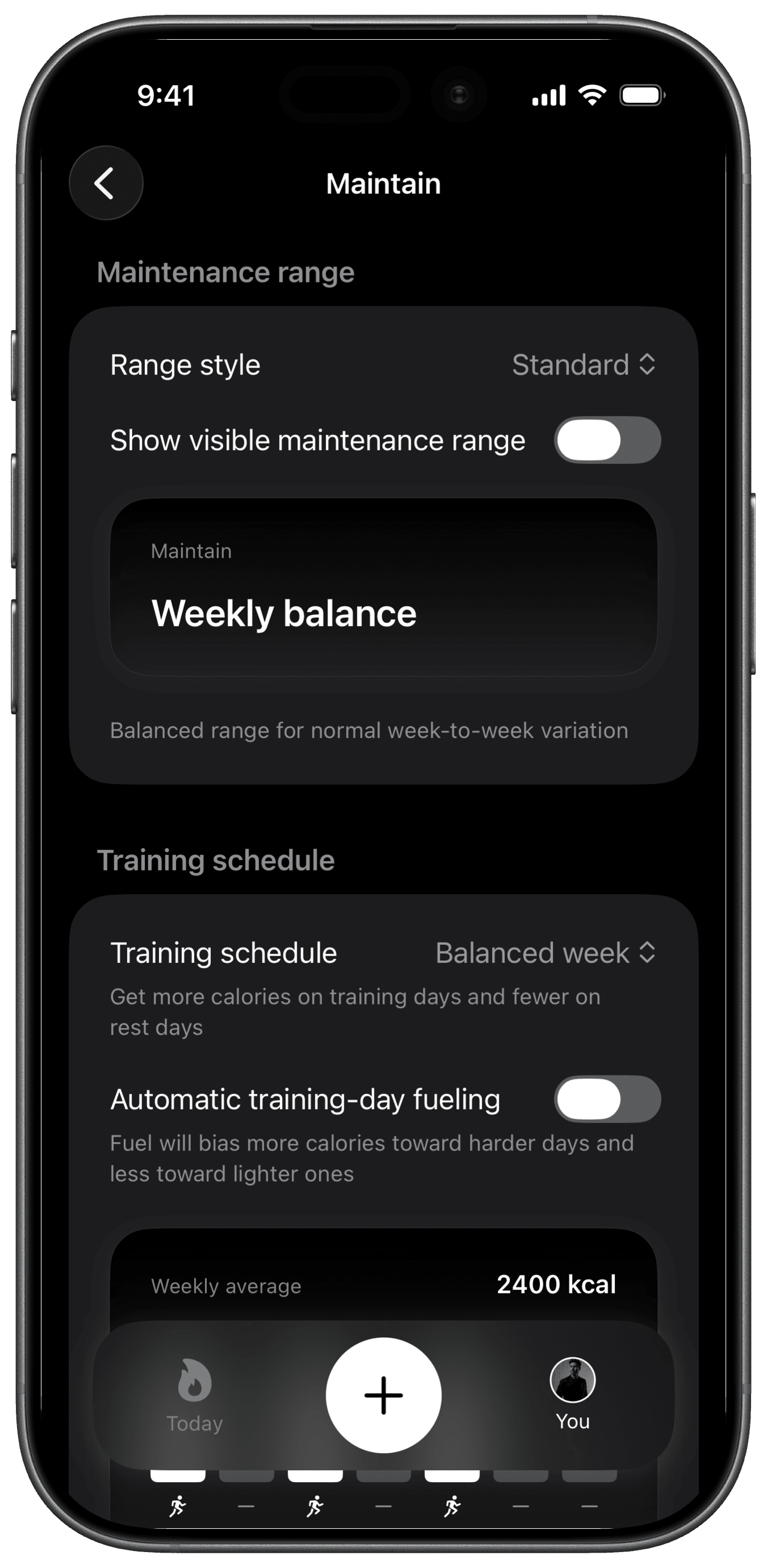
The example settings have Show maintenance range and Automatic training-day fueling switched off. Balanced week is selected, and the 2,400 kcal weekly-average graphic is an educational preview rather than the account’s actual calorie target. Enable the optional switches only when they suit how you want to manage your training block.
The presets are fixed patterns. Balanced week marks Monday, Wednesday, and Friday. Training-focused week marks Monday, Tuesday, Thursday, and Saturday plus a hard session on Wednesday. Lighter training week marks Tuesday and Saturday. The example week above lines up closely with Training-focused week. If your long session falls on Sunday, the settings screen currently has no custom schedule editor, so pick the nearest preset or turn automatic fueling off and let Dynamic Calories respond to what you actually do.
The schedule is a calorie template. It tells Fuel which days get more of the planned weekly allowance. It doesn't know whether Wednesday is intervals or an easy jog, and it doesn't record that you trained. Automatic training-day fueling moves calories from rest days to training days while the seven planned targets still average your plan calories. It adds no calories to the week.
Dynamic Calories works separately. When your Apple Watch or a logged workout shows activity running ahead of your recent burn baseline, Fuel can unlock extra calories for that day, and those additions can raise the week's total. There is no separate workout bonus stacked on top, because workout energy already sits inside the activity calculation.
Read the daily calorie breakdown as an energy estimate. It tells you roughly how much food the day can hold. It can't tell you how many grams of carbohydrate to take per hour on the bike or whether your energy availability is adequate. Fuel's recommended macros under Your Plan are daily targets too. They don't turn into a race-day fueling plan on their own.
04When Prepare for Event fits
Fuel also has a goal called Prepare for Event. It builds a calorie and macro plan toward a body-weight target by a date. You choose an event type from Wedding, Vacation, Competition, Reunion, Photo Shoot, or Other, and set a date between 14 and 365 days away. Fuel then spreads the weight-change adjustment across phases named Ramp, Push, and Peak Week, and shows the countdown under Your Plan.
To follow that setup, open You > Personal Details > Goal Type > Prepare for Event, then choose Competition when that matches your event.
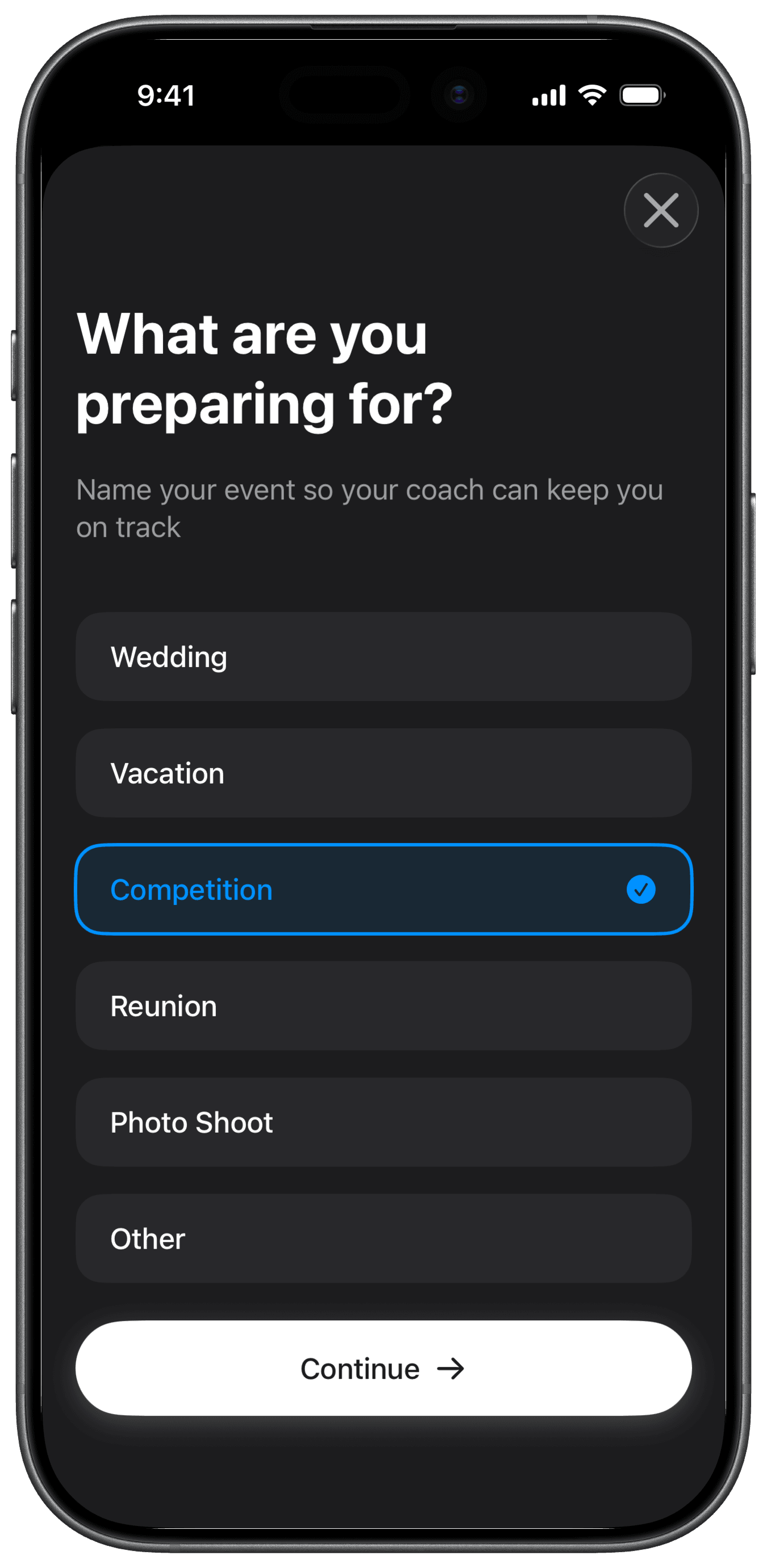
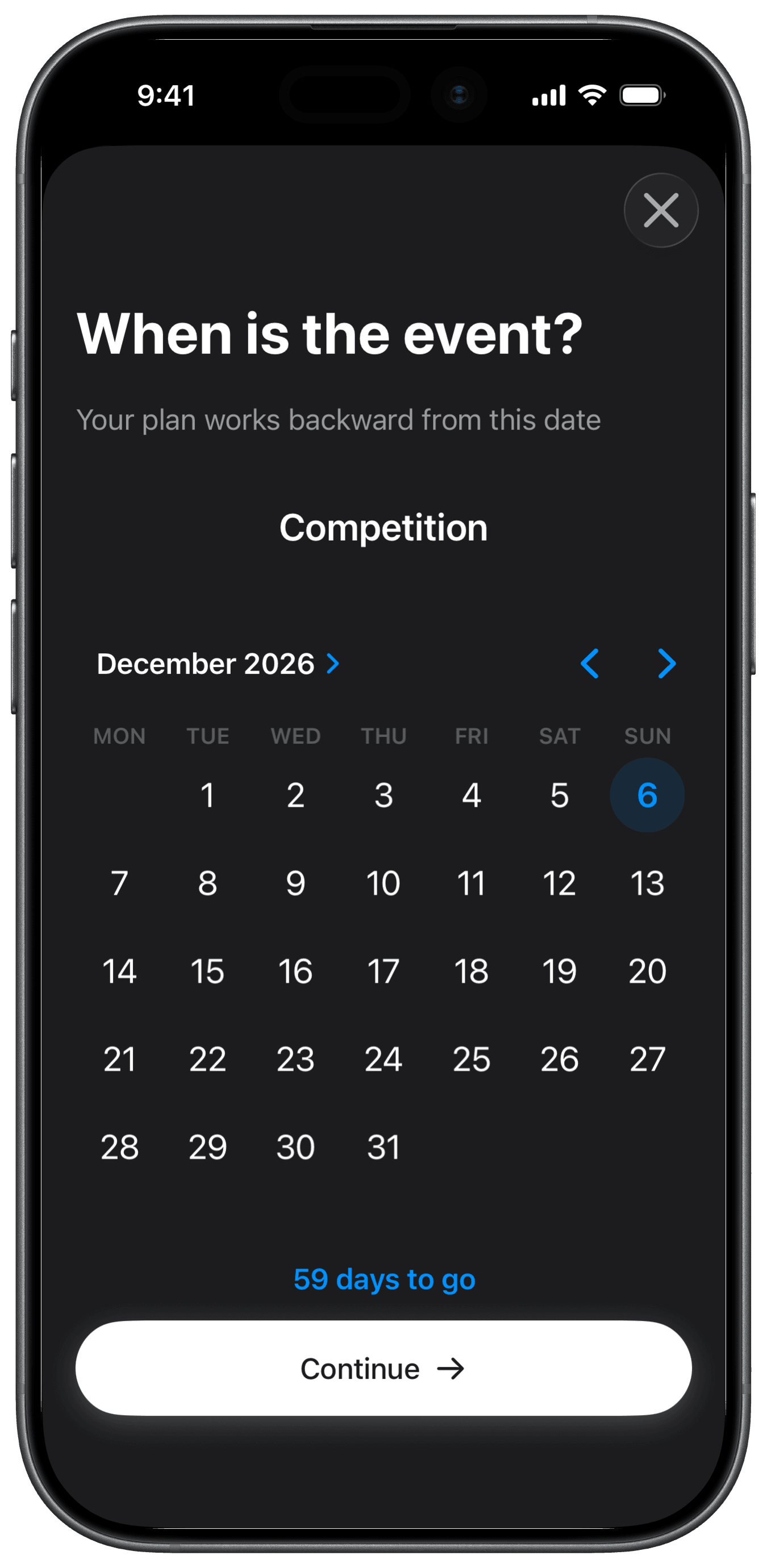
Continue to the date picker and select your event date. The example below uses December 6, 2026, which was 59 days away when captured on October 8.
After completing setup, check Your Plan for the saved date, countdown, weight projection, and nutrition targets before using them to guide daily meals.
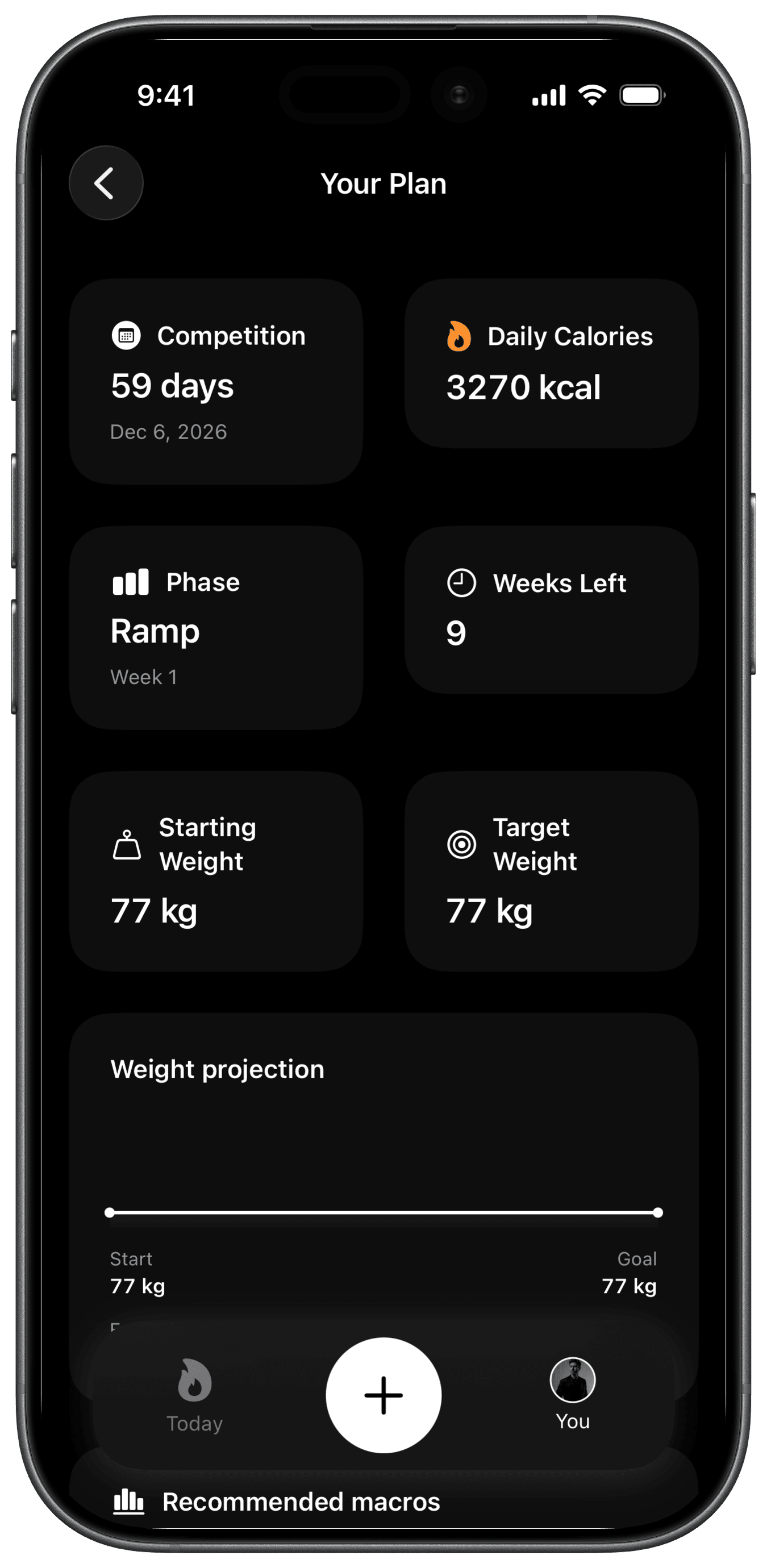
This demonstration shows Ramp Week 1 of 9, a starting weight of 77.1 kg and target of 77 kg, with 3,270 kcal and 139 g protein. Its nearly flat weight projection keeps the example close to weight-neutral preparation. These are the demonstration account’s daily targets, not a prescription for your body or training load.
Prepare for Event can help organize a dated body-weight goal alongside nutrition tracking. If that weight change overlaps hard training, plan it with a sports dietitian. The Competition label doesn't create a training plan. Peak Week is Fuel's name for the last phase of the calorie plan, and it has nothing to do with a taper or carbohydrate loading. If your goal is to race well at your current weight, Maintain is the better fit. The Prepare for Event help page covers setup.
05Match daily carbohydrate to the work
Carbohydrate is the nutrient that moves most with training. The 2016 joint position of the Academy of Nutrition and Dietetics, Dietitians of Canada, and the American College of Sports Medicine gives planning bands tied to workload.3 Around 3 to 5 g/kg a day suits light or skill-based activity. About 5 to 7 g/kg fits a moderate program of roughly an hour a day. Endurance work at moderate to high intensity for 1 to 3 hours a day sits around 6 to 10 g/kg.
Those bands are consensus ranges drawn from many studies across sports. They are calibration aids for your hard days, and they aren't daily quotas. A rest day in the middle of a build can sit near the bottom of your range, and the long-run day can sit near the top.4
Protein needs less adjustment. The International Society of Sports Nutrition gives 1.4 to 2.0 g/kg a day for most exercising people, and discusses servings around 0.25 g/kg or 20 to 40 g in the muscle-protein-synthesis literature.5 Those serving references depend on factors including age and the exercise stimulus. Much of the timing research comes from resistance training, and extra protein has not reliably improved endurance performance when carbohydrate is already adequate. Spread protein through the day and don't let it crowd out the carbohydrate your long session needs.
06A worked hard day for a 70 kg cyclist
Take a 70 kg recreational cyclist with a demanding two-hour ride in the morning and no second hard session that day. Aiming for 7 g/kg puts the day at about 490 g of carbohydrate, inside the 6 to 10 g/kg band for this kind of work. Protein at about 1.4 g/kg lands near 100 g.
The figures below are planning targets for each eating occasion. Real portions vary, so your log will show what the food actually delivered. A kitchen scale for the oats and pasta makes the log far more accurate on the days you want to compare.
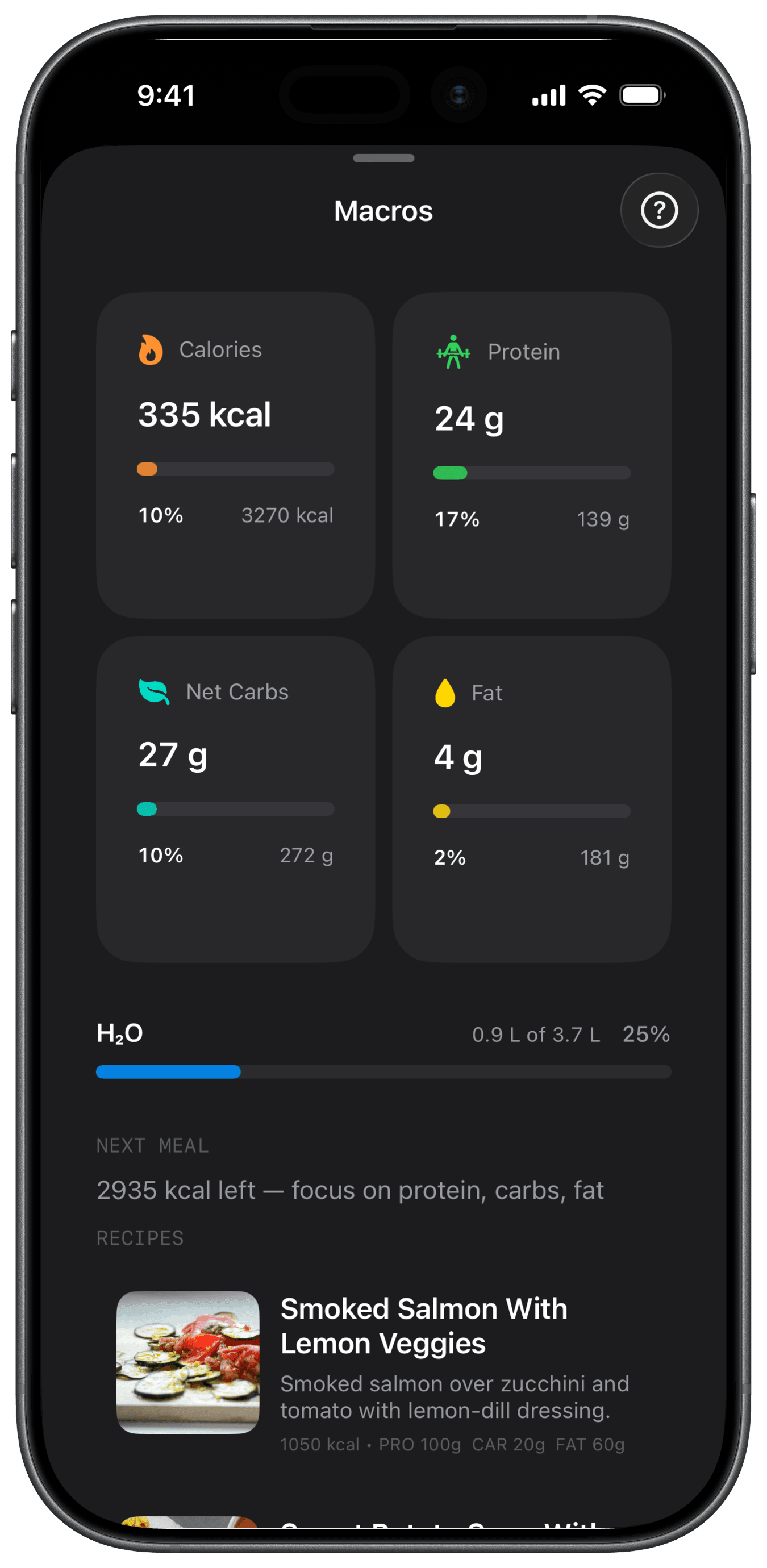
The screenshot uses a separate 77 kg demonstration profile, rather than the 70 kg cyclist’s meal plan below. Its sheet shows 335 kcal logged, including 24 g protein and 27 g net carbohydrate, against a 3,270 kcal daily plan. That leaves 2,935 kcal for the whole day. Compare the totals with the food you actually logged and the session-specific targets you chose; a partly logged day cannot establish whether you have eaten enough.
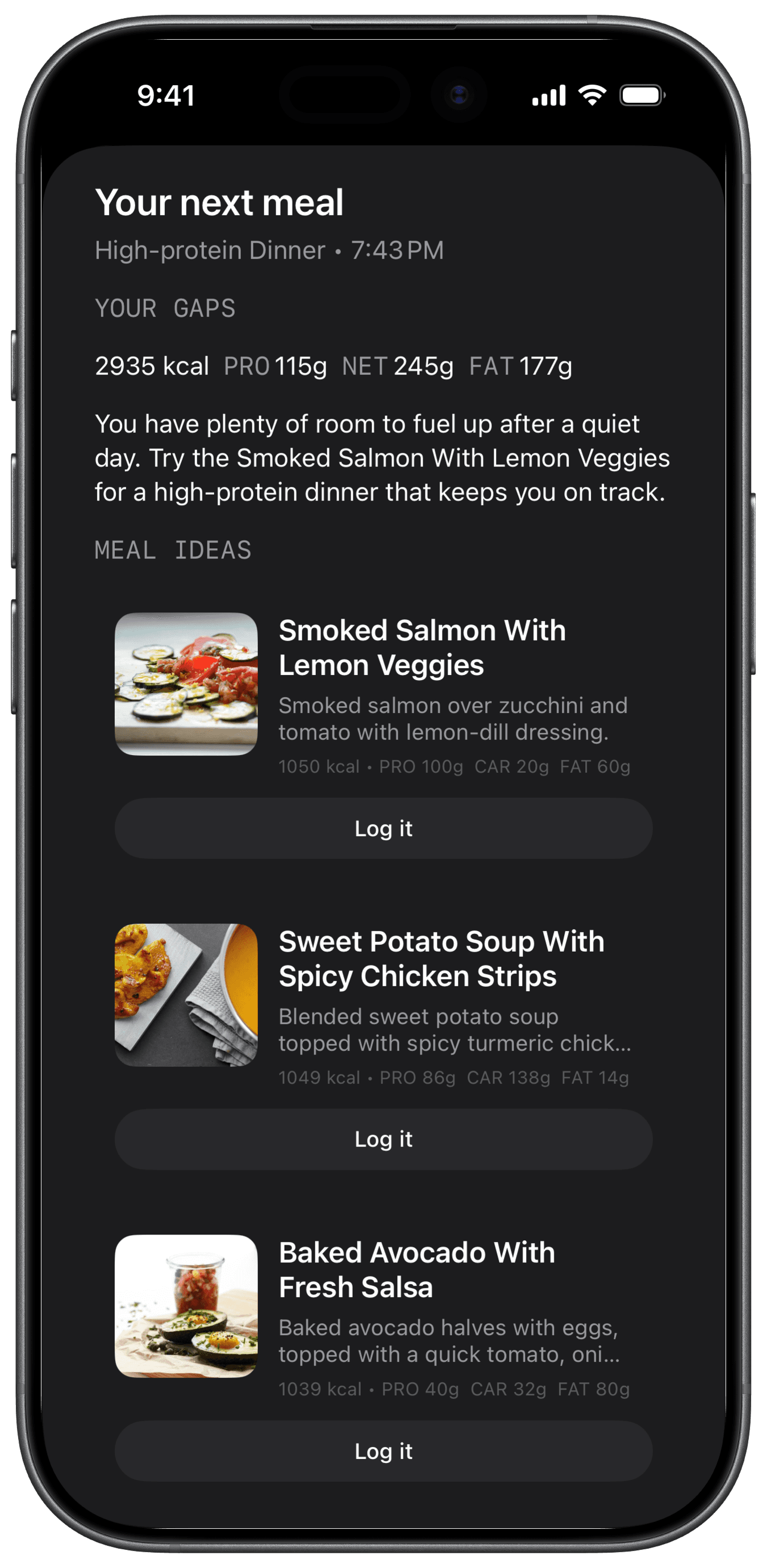
The dinner suggestion uses that same log, with 2,935 kcal left and a 115 g protein gap for the day. The remaining calories are a whole-day balance, not an instruction to eat a 2,935 kcal dinner. Use the food ideas to choose a suitable meal, then keep your planned pre-session and during-session carbohydrate separate from the app’s daily recommendation.
| Timing | Example food | Planning target |
|---|---|---|
| 2 to 3 hours before | Oats with banana, toast, yogurt | About 90 g carbohydrate, 20 g protein |
| During the ride | Familiar sports drink and chews at 45 g an hour | About 90 g carbohydrate |
| After the ride | Rice or potatoes, a protein food, fruit | About 110 g carbohydrate, 30 g protein |
| Afternoon | Sandwich and fruit, or yogurt with cereal | About 70 g carbohydrate, 20 g protein |
| Dinner | Pasta or another starch with protein and vegetables | About 130 g carbohydrate, 30 g protein |
The pre-ride meal works out to about 1.3 g/kg, inside the joint position's 1 to 4 g/kg range for the one to four hours before a session longer than an hour.3 Make it smaller if you eat closer to the start.
Use Fuel to compare your logged intake with the targets you chose for the session. Its saved macro targets do not automatically rise to the athlete ranges above. Check them under Your Plan, and use Adjusting Macronutrients when your ongoing plan needs a change. On the morning of the ride, Coach Day Plan can lay out breakfast, lunch, and dinner ideas from your calorie and macro targets before you log anything. Photograph the nutrition label on the drink mix or chews, check the serving size in the proposed entry, and log the meals with photos or text. Check your logged carbohydrate totals by mid-afternoon. If you are well short after lunch, the afternoon snack and dinner have to carry more, and next-meal coaching works from what is already in your log. Once a day like this works, keep the meal and portion notes so you can repeat it. Recent food entries can make familiar meals quicker to log. For new meal ideas, choose recipes from Fuel's Meal Catalog, covered in Recipe Library. Full recipe details and direct logging there require Pro.
07Rehearse the long session you will race
Your long run or ride is the dress rehearsal for event day. Session fueling depends on duration. The joint position suggests about 30 to 60 g of carbohydrate an hour for one to two and a half hours of demanding exercise, and up to 90 g an hour for events longer than about two and a half hours, using mixed glucose and fructose sources at the top end.3 Easy runs under an hour need no gel. Save sports food for sessions long or hard enough to warrant it.
Start at the lower end of the band, around 30 g an hour, on a 90-minute long run. Hold that for two or three long sessions. If it sits well, move to 45 g. A cyclist heading toward a three-hour sportive with good tolerance can build gradually toward the upper band. Running jostles the gut more than riding does, so runners often need longer to reach the same intake.
In a 2017 randomized trial, 25 endurance runners did two weeks of repeated gut challenges during exercise. The groups practising with carbohydrate food or gels had self-reported gastrointestinal symptom ratings fall by 60% and 63% on their second challenge, and their distance-test performance rose 4.3% to 5.2%. The placebo group's performance fell 2.1%.6 It was a small, short study using a demanding 90 g an hour protocol, so it supports rehearsal as a habit. It doesn't set your target or your timeline. Use the exact products, timing, and carrying method you plan to use on the day, and change one thing at a time. For the step-by-step version, read gut training for race nutrition.
08Recover fast only when the next session is close
Most training days need a normal meal after the session with carbohydrate and protein, and nothing more urgent. The joint position reserves aggressive refueling for tight turnarounds. If fewer than eight hours separate the finish of one demanding session and the start of the next, it recommends 1 to 1.2 g/kg of carbohydrate an hour for the first four hours, then a return to normal daily needs.3 For our 70 kg cyclist that means 70 to 84 g an hour, which applies when the turnaround is genuinely under eight hours, rather than an ordinary next-day session.
09Drink to thirst and learn your own sweat losses
Sweat rates vary too widely for a universal drinking schedule. The National Athletic Trainers' Association position statement says most active people can avoid fluid problems by drinking to thirst alongside normal meals, and that measuring losses in representative sessions can guide an individual plan.7 If weighing is comfortable for you, compare body mass before and after a representative session using the same scale and minimal dry clothing. Account for fluid consumed and any urine passed, then divide estimated fluid loss by session duration. Record the weather and repeat in similar conditions. A higher finishing weight can signal overdrinking when you started normally hydrated, rather than a reason to force more fluid.
That test gives you an estimate for one type of day. It isn't a medical test. Hot events and courses with few aid stations need more planning, and the IOC's 2022 consensus on sport in the heat is a good reference if your event falls in summer.8 For turning losses into a drinking plan, read how to measure sweat rate.
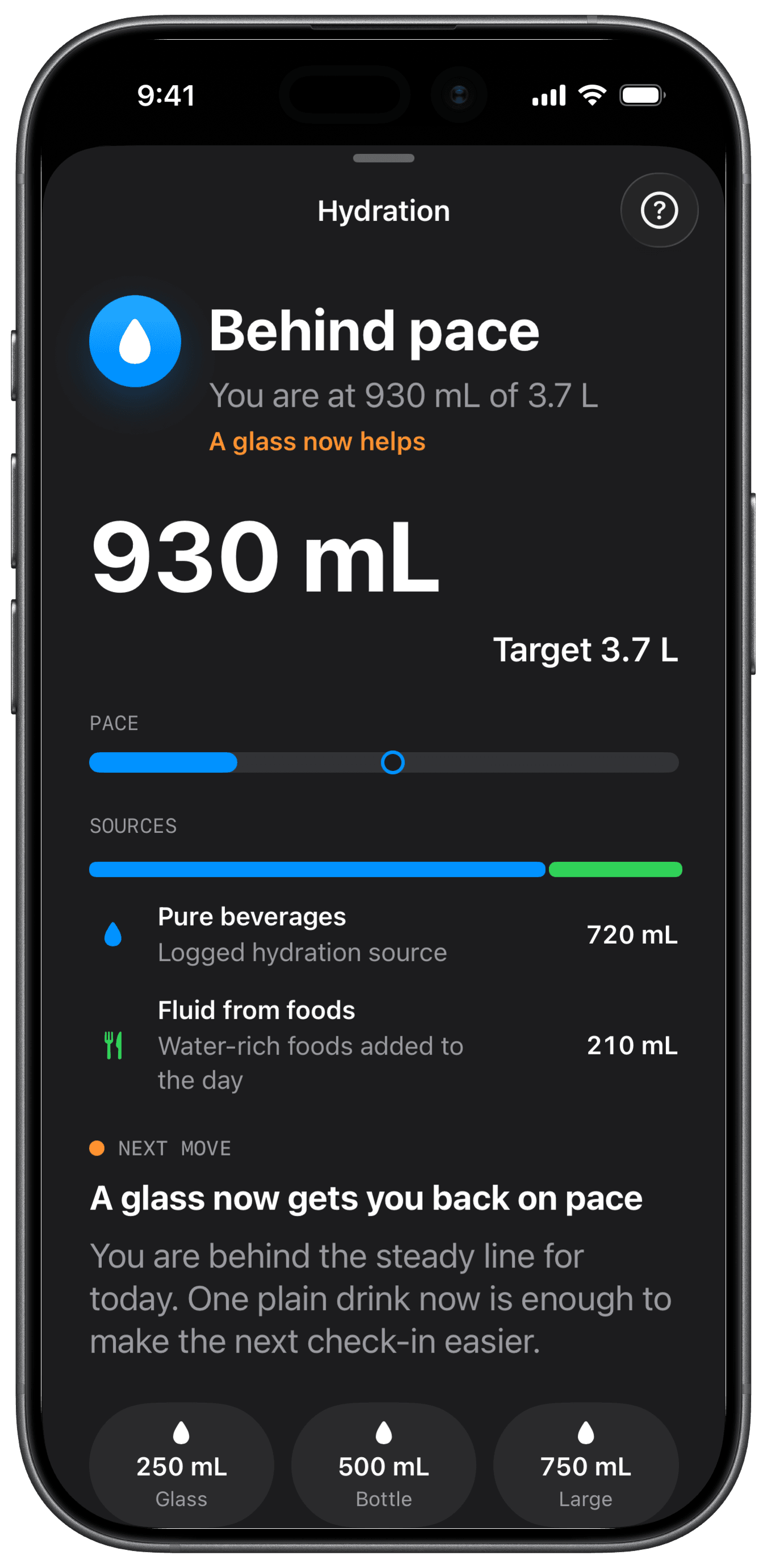
The example has 930 mL logged toward a 3.7 L daily target: 720 mL from beverages and 210 mL from food. Its Behind pace message and suggestion to have a glass concern daily logging. Neither the logged amount nor the target tells you how much sweat to replace during a run.
Fuel's hydration card tracks your daily fluid, caffeine, and food moisture against a general target. It adds an estimated 500 mL per recorded workout hour, capped at 2 L of automatic additions a day. Fuel treats that as a coaching heuristic. It is a useful nudge to drink on training days, and your sweat test still decides what goes in your bottles.
10What to log in Fuel and what to record in your training log
Each tool should hold the data it handles well. Fuel holds food, drinks, sports foods eaten during the session, and workouts. Your watch app or training log holds the performance side.
In Fuel, log every meal and snack on your long-session day and your hardest midweek day, including the gels and drink mix you took on the move. Let Apple Watch workouts sync through Apple Health, or log sessions manually with workout type, duration, and effort when you trained without the watch. Log the same session only once, since duplicates inflate your activity totals.
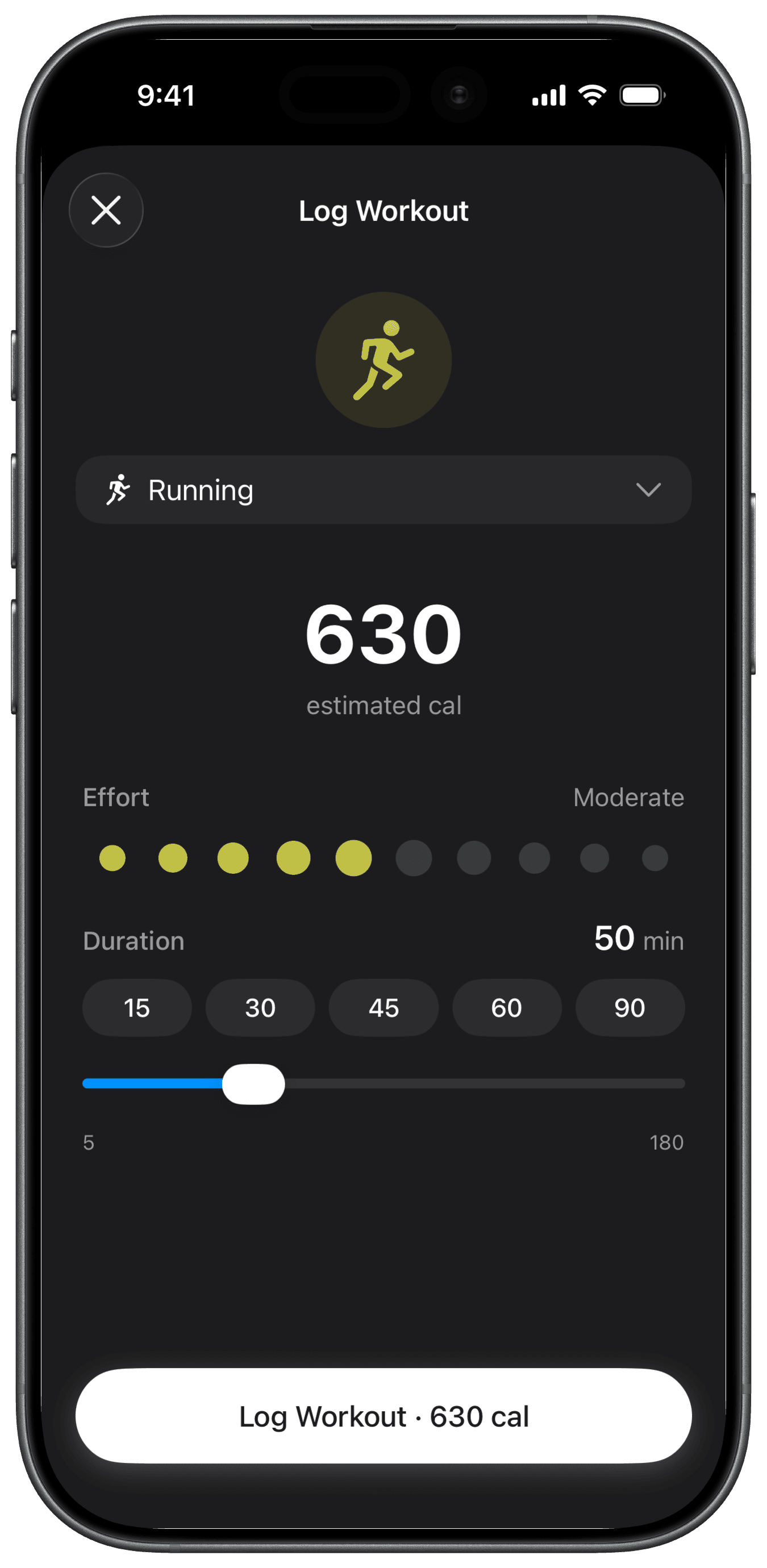
This is an unsaved Running entry form, with 50 minutes at moderate effort and an estimated 630 kcal. Check the type, duration, and effort against the session you actually completed before saving. The estimate is not a measured energy cost or a prescribed workout, and a form on screen does not prove the session has been saved.
In your training log, record duration, pace or power at a familiar effort, how hard the session felt, gut comfort on a simple 0 to 10 scale, the weather, and how you slept and recovered the next day. That last column is the one people skip, and it is often the most useful. A long run at your usual pace that felt harder than last week tells you more than any single number in either app.
11Use the daily review to check yesterday’s food
Open Coach’s Daily Review after a fully logged training day. Use it to check the calorie and protein totals, then compare its food suggestions with how the session and recovery felt in your training log.
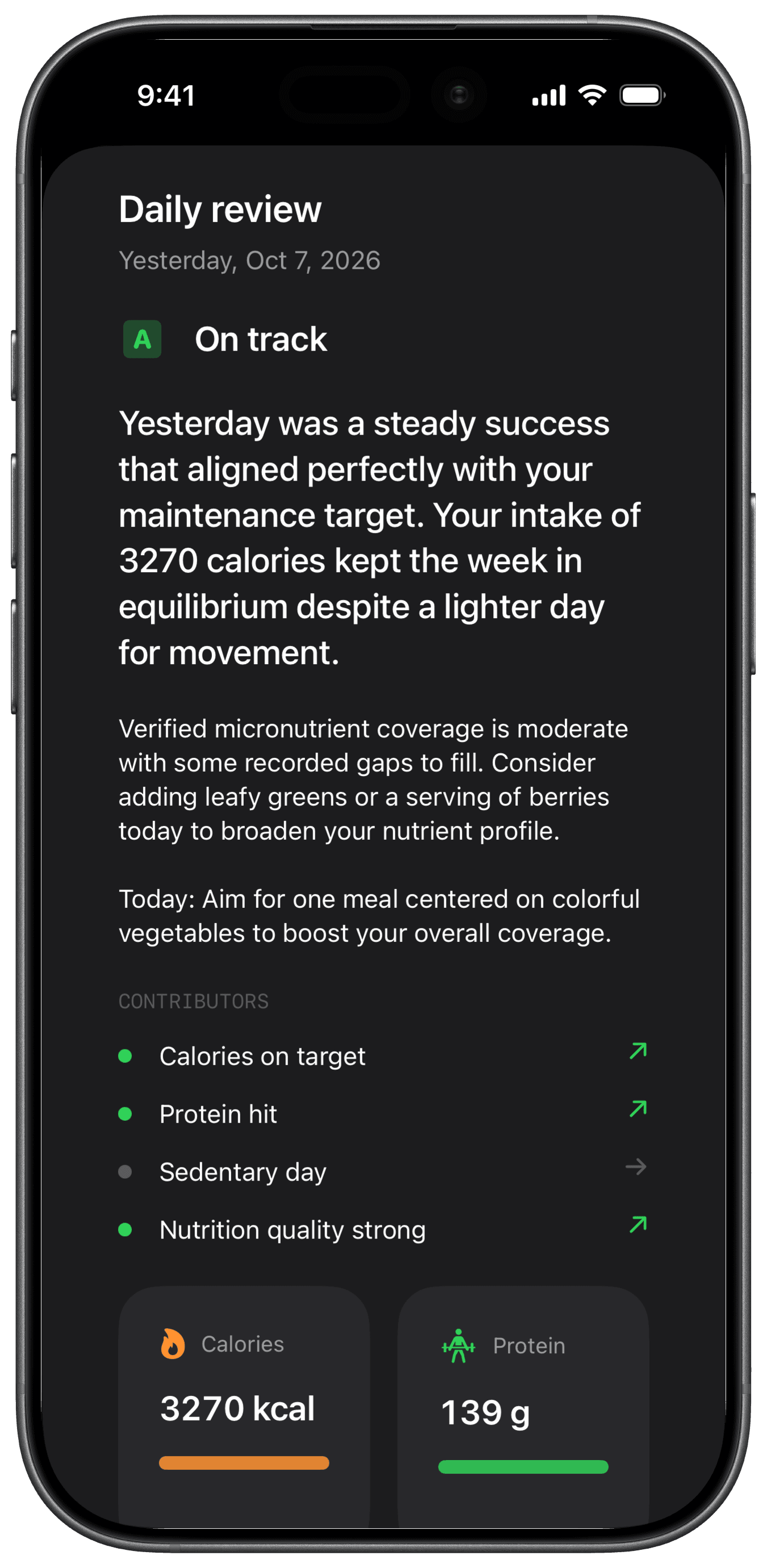
The demonstration day is graded A / On track at 3,270 kcal and 139 g protein. The review describes equilibrium and a lighter movement day; it does not supply the next session in your training program. An on-target food log is one piece of the recovery picture. Fatigue, hunger, sleep, and performance still need your attention and, when needed, your coach’s judgment.
12Review the week against how training went
Once a week, put the two records side by side. Fuel's Weekly Review summarizes your calories, macros, logged days, and activity, and for Maintain it reads how intake matched your training-day and rest-day allocations. Your training log shows whether the long session held its pace and how you felt. Judge the week on both. A strong grade on a week when every long run fell apart still calls for a change.
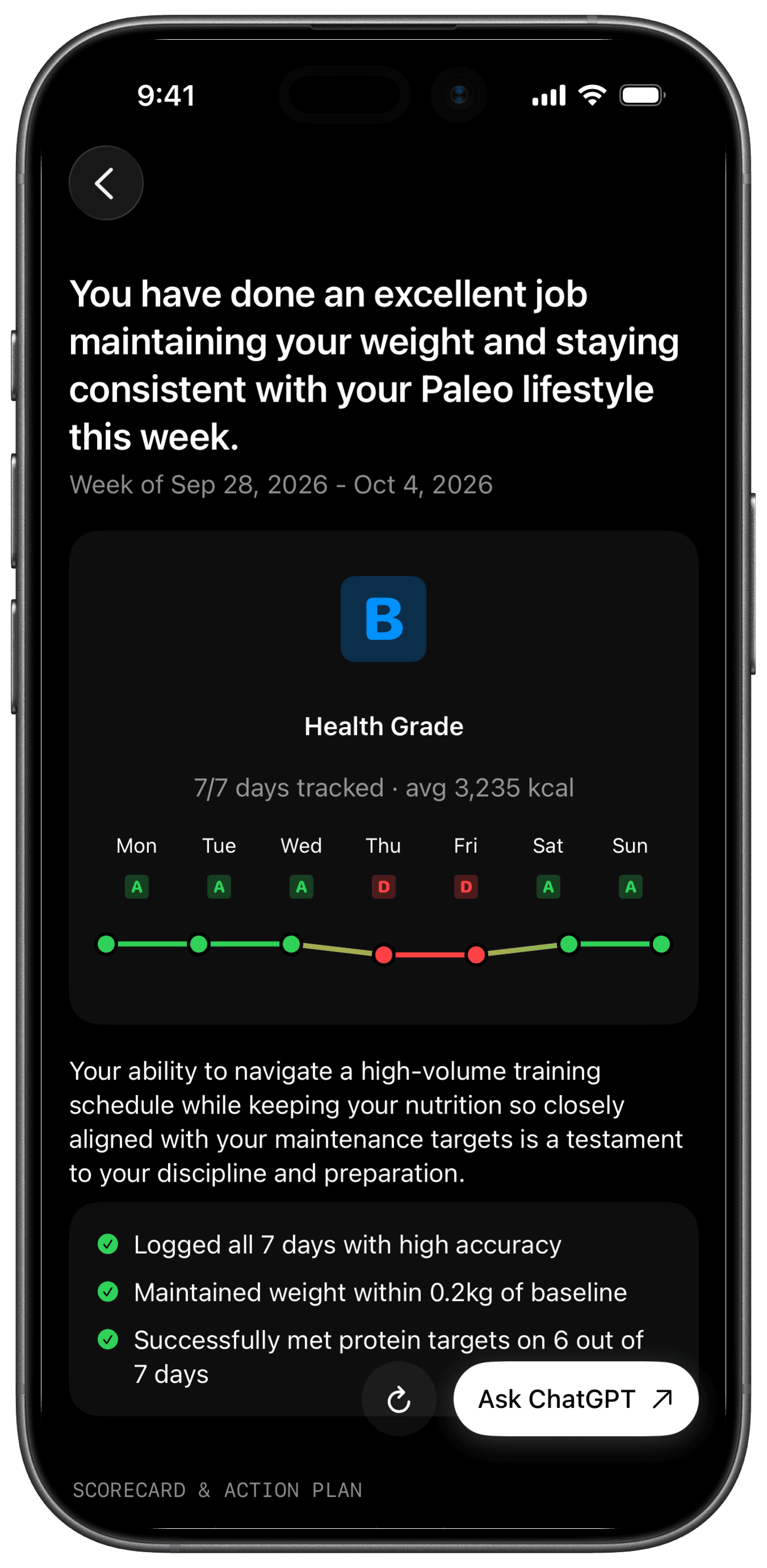
This example review shows seven tracked days, a B grade, average intake of 3,235 kcal, and a 0.2 kg weight decrease. It discusses maintenance, training volume, and recovery, with two days graded D. Use those observations to inspect particular days alongside your training log. The review is evidence of weekly nutrition and weight tracking; it does not establish the saved event date or create a race gel schedule. Your Plan is where the example’s December 6 event date is shown.
Your stomach turned during the long session. Check the log for the pre-session meal size, fiber, and timing, then look at what you took during the session. Change one variable for next week. Eat 30 minutes earlier, take the same carbohydrate in smaller, more frequent doses, or drop back to your last comfortable rate and rebuild. Repeated severe symptoms deserve a conversation with a sports dietitian or doctor.
You were starving the evening after the long run. Look at carbohydrate on that day in Fuel. It is often well below the rest of the week because the long session ate into breakfast and lunch never caught up. Add carbohydrate to the pre-session meal and the first meal afterward. If you use Dynamic Calories, check that the workout reached Fuel. If Automatic training-day fueling marks a different day as your long day, the target may sit lower than the work.
Your logs were patchy. Ignore the grade for that week. Missing meals make intake look lower and remaining room look larger than it really is. Commit to fully logging the long-session day and the hard midweek day next week, even if the easy days stay loose. Two complete key days tell you more than seven partial ones.
Sustained tracking at this level needs Pro in practice. Free allows seven food entries per configured week. Ongoing Weekly Review access requires Pro, so the complete routine described here is best followed with Pro. Workout, water, and weight entries don't count toward that allowance. Free and Pro lists the current limits.
13Taper and event week
Most endurance plans reduce training before the race. A 2023 meta-analysis of 14 studies and 174 athletes aged 17 to 32, mostly runners and cyclists, found better time-trial and time-to-exhaustion results after tapering. The subgroups that did best cut training volume by 41% to 60%, kept intensity and frequency, and tapered for no more than 21 days.9 The evidence base is small and mixed, so treat a roughly two-week taper as a sensible starting point for your plan. It is not a formula every race requires.
Keep eating normal meals through the taper. Training volume falls and appetite may dip a little. Save any diet for after the race.
Carbohydrate loading only makes sense for longer events. The joint position recommends 10 to 12 g/kg a day for 36 to 48 hours before events lasting longer than 90 minutes.3 The Brazilian Sports Nutrition Association guideline uses a wider 8 to 12 g/kg for 24 to 48 hours and notes that clinical studies are scarce.10 For an event you expect to finish within about 90 minutes, ordinary carbohydrate-containing meals are usually a more practical starting point than a full loading protocol. If you do load, rehearse it before a long training session first, choose lower-fiber foods if your gut is sensitive, and treat it as a two-day event plan. Your everyday macros stay the same. The full breakdown lives in the race-week nutrition plan.
14Your next long session
Before your next long run or ride, write down what you will eat beforehand and when, what you will take during the session and how much an hour, and what you will drink. Log all of it in Fuel as you go. Afterward, record pace or power, gut comfort, weather, and how you feel the next morning in your training log. Then change one thing the following week. Enough of those rehearsals and race morning becomes a routine you have already run.
Footnotes
Damsted C, Glad S, Nielsen RO, Sørensen H, Malisoux L. Is there evidence for an association between changes in training load and running-related injuries? A systematic review. International Journal of Sports Physical Therapy, 2018. The 10% comparison involved novice runners training for a 4-mile event, with 52 of 250 and 48 of 236 injured. It does not establish a safe replacement percentage.
Back to textMountjoy M, et al. 2023 International Olympic Committee's consensus statement on Relative Energy Deficiency in Sport. British Journal of Sports Medicine, 2023. Expert consensus across heterogeneous studies. It does not test planned dieting during a specific running or cycling block.
Back to textThomas DT, Erdman KA, Burke LM. Nutrition and athletic performance, joint position statement of the Academy of Nutrition and Dietetics, Dietitians of Canada, and the American College of Sports Medicine. Journal of the Academy of Nutrition and Dietetics, 2016. Consensus ranges across sports, to be adjusted for actual training, body size, and tolerance.
Back to textBack to text 2Back to text 3Back to text 4Back to text 5Burke LM, Hawley JA, Wong SH, Jeukendrup AE. Carbohydrates for training and competition. Journal of Sports Sciences, 2011. Expert review supporting daily carbohydrate matched to training load.
Back to textJäger R, et al. International Society of Sports Nutrition position stand on protein and exercise. Journal of the International Society of Sports Nutrition, 2017. Endurance-specific protein studies are relatively few, and much of the per-meal evidence comes from resistance exercise.
Back to textCosta RJS, et al. Gut-training during exercise in endurance runners. Applied Physiology, Nutrition, and Metabolism, 2017. Randomized trial of 25 runners over two weeks using a 90 g an hour glucose and fructose challenge.
Back to textMcDermott BP, et al. National Athletic Trainers' Association position statement on fluid replacement for the physically active. Journal of Athletic Training, 2017. Sweat rates vary with heat, humidity, pace, clothing, body size, and acclimation, so no single intake rate fits every session.
Back to textRacinais S, et al. IOC consensus statement on recommendations and regulations for sport events in the heat. British Journal of Sports Medicine, 2022. Observations from elite events are not universal targets for recreational athletes.
Back to textWang et al. Effects of tapering on performance in endurance athletes, a systematic review and meta-analysis. PLOS ONE, 2023. Time-trial distances ranged from 800 m to 40 km. VO2max and movement economy did not improve, and the authors note that sport-specific recommendations remain difficult.
Back to textBrazilian Sports Nutrition Association. Clinical practice guideline for sports nutrition. 2025. The carbohydrate-loading section notes scarce clinical studies and greatest relevance for events longer than 90 minutes.
Back to text