A runner shows up to a spring marathon after a textbook training block. She tapered well, hit every long run, and felt ready. Then race week happened. She ate "clean" through Friday, skipped real carbohydrate loading because the food volume felt excessive, drank a liter of plain water at 5 a.m. because a friend said to, and swapped her usual oatmeal for a hotel buffet egg scramble because her stomach felt off. By mile 18 she was light-headed, cramping, and 12 minutes off pace. Nothing failed during the race. Everything failed before it.
Race-week nutrition comes down to four controllable variables: enough glycogen, enough fluid, enough sodium, and a breakfast you have already tested under training stress. Nail those four and race morning becomes the calmest part of the whole block.
01Start with the event you are actually doing
A 10K, marathon, half-Ironman, and Ironman each place different demands on your fuel stores. The right race-week plan starts with event duration, intensity, climate, and your likely carbohydrate intake during the race.
Quick decision guide. Find your expected finish time below and use it to decide how aggressively to plan.
- Under 90 minutes. Glycogen stress is moderate. Eat normally through race week. Focus on a controlled pre-race meal and adequate hydration. Full carbohydrate loading is unnecessary. Start with breakfast and fluid planning below.
- 90 minutes to 3 hours. Glycogen stress is high. You need a structured loading window, a rehearsed breakfast, and a basic fluid plan. Start with the loading window and breakfast below.
- 3 to 6 hours. Glycogen and hydration stress are both very high. Add a sodium plan, an aid-station script with specific products and timing, and gut-tested race nutrition. Read every section below and build from the half-Ironman example plan.
- 6 hours and beyond. Total intake stress is extreme. Layer everything above with pacing-aware intake targets, backup feeding plans, and fluid and sodium guardrails that account for changing conditions across the day. Read every section below and build from the ultrarunner example plan.
HYROX finishes cluster around the 90 minute line, so the loading decision depends on your own clock. The HYROX race nutrition by finish time guide sets pre-race carbohydrate, Roxzone feeds, and fluid by expected finish time.
Burke and colleagues have shown for years that carbohydrate availability should match the work demand, with longer events requiring both higher pre-race glycogen and higher during-race carbohydrate delivery.12 A race-week plan is where those targets become an actual schedule.
02The loading window is shorter than most people think
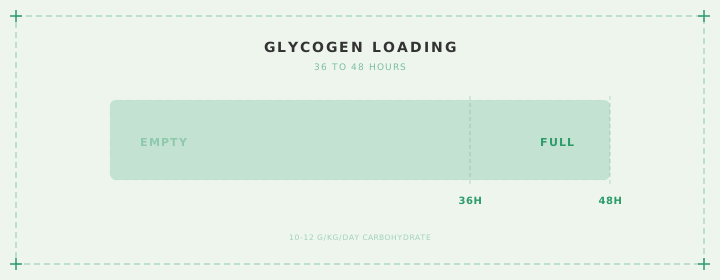
You do not need a mythical week of pasta dinners. The old protocol of depleting glycogen with exhaustive exercise before loading has also been retired. Modern research shows that 36 to 48 hours of high carbohydrate intake paired with a taper or reduced training volume produces the same storage levels without the misery of a depletion phase.13
The classic target is 10 to 12 g of carbohydrate per kilogram of body mass per day across that final 36 to 48 hours.13 For a 70 kg athlete, that is 700 to 840 g per day. The execution math, the day-by-day plate, and the six mistakes that wreck an otherwise good load sit in the 36-hour marathon carb load protocol.
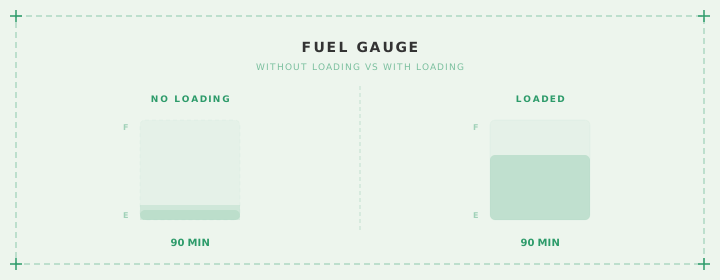
Why that number matters: trained muscle and liver hold roughly 400 to 500 g of glycogen when fully loaded. At marathon pace, that covers roughly 90 to 120 minutes of running before stores drop to critical levels. That threshold is the wall. Loading exists to push it as far out as your event demands.
The number looks absurd until you stop trying to hit it with clean-eating instincts and start using low-fiber, easy-digesting foods on purpose.
| Body mass | 10 g/kg/day | 12 g/kg/day |
|---|---|---|
| 55 kg | 550 g | 660 g |
| 65 kg | 650 g | 780 g |
| 75 kg | 750 g | 900 g |
| 85 kg | 850 g | 1,020 g |
This is where athletes get tripped up by food volume. If you try to load with vegetables, dense whole grains, and lean protein at every meal, you usually get full long before glycogen stores are topped up. Low-fiber starches, sports drinks, rice, potatoes, bread, cereal, pancakes, bagels, applesauce, pretzels, and juice are often the better tools for two days. Health halo foods can wait until after the race.
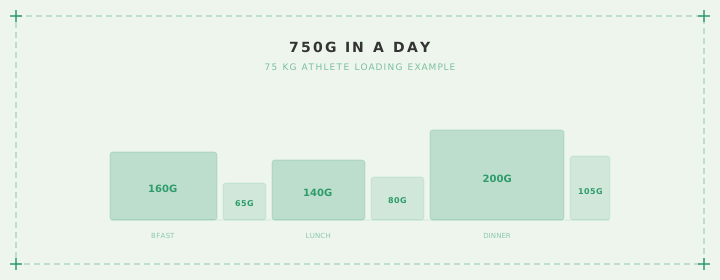
What 750 g of carbohydrate actually looks like in a day
Screenshot it, print it, or copy it into your race-week note. A sample loading day for a 75 kg athlete targeting 10 g/kg, intentionally simple and low-fiber.
| Meal | Foods | Carbohydrate |
|---|---|---|
| Breakfast | 2 large bagels with honey and jam, 500 ml orange juice | 160 g |
| Snack | 2 bananas, 1 sports drink (500 ml) | 65 g |
| Lunch | Large bowl of white rice (300 g cooked) with chicken and teriyaki sauce, bread roll | 140 g |
| Snack | 4 rice cakes with jam, 500 ml sports drink | 80 g |
| Dinner | Large pasta serving (250 g dry) with marinara and a small chicken breast, white bread | 200 g |
| Evening snack | Applesauce, pretzels, small sports drink | 105 g |
| Total | 750 g |
The food choices look monotonous. That is the point. Two days of boring, easy-digesting meals buy you full glycogen stores without the gut distress that comes from trying to hit these numbers with fibrous whole foods.
Expect the scale to climb 1 to 3 kg during the loading window. Each gram of stored glycogen binds roughly 3 g of water, so the weight gain is almost entirely retained fluid and fuel. It will be gone by the finish line.
03Protein stays in the plan
Carbohydrate loading does not mean protein disappears. Keep protein steady at about 1.6 to 2.2 g/kg/day during race week, then let carbohydrate expansion come mostly from trimming fat and fiber rather than cutting protein into the floor.4
That matters for two reasons. First, your taper does not stop muscle repair. Second, very low protein race-week eating tends to turn into unstable appetite, snack grazing, and a harder time getting back on routine after the event. If you need the larger frame, Endurance Athlete Fueling covers the daily energy model and Leucine Threshold covers why weak protein feedings are easy to misread as adequate recovery.
04Lower fiber on purpose
The day before a race is not the time to chase your usual fiber total. Lower-residue eating reduces stool bulk and lowers the chance that a perfect fueling plan gets ruined by bathroom urgency or gut pressure.
| Keep in | Pull back |
|---|---|
| White rice, sourdough, bagels, oats you already tolerate, potatoes without heavy skins | Giant salads, bran cereals, large bean servings, high-fiber wraps |
| Bananas, applesauce, canned fruit, low-fiber sports foods | Large dried-fruit servings, high-FODMAP experiments, huge smoothie bowls |
| Familiar dairy if you tolerate it | Late dairy experiments if lactose is uncertain |
Athletes with a history of race-day GI symptoms may need the sharper version of this idea. The Gut Training for Race Nutrition guide covers when a short low-FODMAP approach is worth using and when it is just unnecessary restriction. Athletes with celiac disease can build the same low-fiber loading days from rice, potatoes, and oats labeled gluten-free if tolerated, and gluten-free fueling for athletes shows a full long-session day.
05Fluid and sodium should be written together
Water and sodium are one topic. Sodium helps retain fluid and supports the sodium-glucose cotransport process that moves carbohydrate and water across the intestine. Overdrinking plain water without sodium is one of the main drivers of exercise-associated hyponatremia.56 Most athletes do not need heroic sodium loading. They need a steady plan that fits climate, sweat rate, and race duration.
| Situation | Practical race-week move | Why it works |
|---|---|---|
| Cool weather, modest sweater | Drink normally to thirst and salt meals normally | Prevents panic drinking and keeps the plan simple |
| Warm race, salty sweater, long event | Add sodium-rich foods or drinks across the final 24 h and use sodium in pre-race fluids | Expands plasma volume more reliably than plain water alone6 |
| Multi-hour event with heavy sweat loss | Build an hourly sodium target from training data, then carry the same product mix into race day | Prevents last-minute guessing |
| Athlete with prior bloating from aggressive drinking | Cap the urge to force fluids and use body-mass change from rehearsal sessions to guide intake | Avoids overhydration risk |
How to estimate your sweat rate
You can collect useful sweat-rate data from any training session longer than 60 minutes. The process takes two minutes of setup. For the error sources, the 2% finish budget, and the cases where the number says drink less, see Measure Sweat Rate and Turn It Into a Drinking Plan.
- Weigh yourself in minimal clothing before the session.
- Track every gram of fluid you drink during the session, and collect or measure any urine you pass.
- Weigh yourself again in the same clothing immediately after.
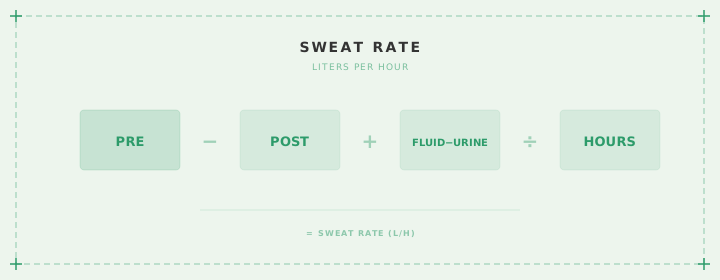
- Calculate: (pre-exercise weight − post-exercise weight + fluid consumed − urine output) ÷ exercise hours = sweat rate in liters per hour.
Run this test in conditions that resemble race day as closely as possible. A cold morning treadmill run will underestimate losses for a warm outdoor marathon. Two or three tests in similar conditions give you a reliable range. If the resulting sweat rate is above about 1.5 L/h and you notice white salt residue on your kit, you are likely a heavier sodium loser and should plan toward the upper end of the Sodium Intake guidance.
McCubbin's 2025 review on sodium intake for athletes makes the central point clearly. The health and performance issue is the relationship between sodium and water, not sodium in isolation.6 The review ties specific sodium replacement to fluid balance and to whether you can replace more than 70% of your fluid losses. It does not set one hourly sodium target for every hot session.6 Use the site's Sodium Intake page as a practical starting range. Race week is where you decide which part of that range is yours based on your own sweat data.
If you are deciding whether to add extra sodium before the gun rather than only during the race, use Sodium Loading for Endurance Racing. That guide separates pre-race loading from hourly replacement and shows when the added fluid-retention benefit is worth the GI tradeoff. Athletes who already have a sodium plan and still dump the preload as urine can look at Glycerol Hyperhydration for Endurance Racing.
06The night-before meal needs one job
Dinner the night before should top off glycogen and avoid drama. It does not need to be inspirational.
| Good dinner pattern | Why it works |
|---|---|
| Large rice or pasta base with a moderate lean protein serving and a low-fiber sauce | High carbohydrate without much chewing fatigue |
| Potatoes plus bread plus a small protein serving | Easy way to raise total carbohydrate without too much fat |
| Familiar restaurant order with simple ingredients | Useful for travel if you order predictably |
The common failure pattern is obvious. Huge fat load, large vegetable volume, dessert because the race is tomorrow, and a meal so late that sleep gets worse. If sleep hygiene already becomes fragile before races, early dinner and familiar food help more than any supplement stack.
If race week includes a long-haul flight, use travel and jet lag nutrition for athletes to shift meal timing, caffeine, and sleep anchors before you try to optimize the race menu.
07Pre-race breakfast is a practiced carb dose
The pre-race meal should usually land 3 to 4 hours before the start, with roughly 1 to 4 g/kg carbohydrate depending on race duration, start time, and what you have rehearsed.24 The smaller end fits nervous stomachs and shorter events. The larger end fits long races with early starts and fully tested tolerance.
| Athlete size | Smaller breakfast 1.5 g/kg | Larger breakfast 3 g/kg |
|---|---|---|
| 60 kg | 90 g carbohydrate | 180 g carbohydrate |
| 70 kg | 105 g carbohydrate | 210 g carbohydrate |
| 80 kg | 120 g carbohydrate | 240 g carbohydrate |
Examples that usually work include bagels with honey, oatmeal plus banana plus sports drink, pancakes and syrup, rice with eggs, or toast plus jam and yogurt if dairy is already safe for you. The right breakfast is the one that has already survived your longest rehearsal.
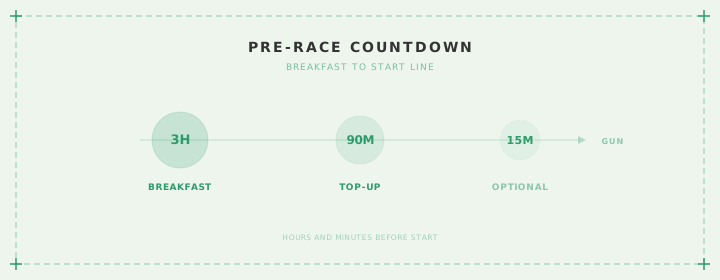
The pre-start countdown
The hours between breakfast and the gun are where plans go quiet and nerves fill the gap. A simple countdown removes the guesswork.
- 3 to 4 hours before start. Eat your rehearsed breakfast. This is the main fueling event of the morning.
- 90 minutes before start. If the gap between breakfast and the gun is long, take a small top-up of 20 to 30 g carbohydrate. Half a banana or a few sips of sports drink is enough.
- 15 minutes before start. Optional final top-up if you have practiced it. A single gel or a few swigs of sports drink. Skip this entirely if it has ever caused stomach distress in training.
The goal is steady carbohydrate availability from the moment you wake up through the first kilometers. Rehearse this countdown at least once during a long training session so nothing on race morning feels unfamiliar.
08Caffeine only works if the rest of the plan is stable
Caffeine helps endurance performance, but only when it does not wreck the gut or spike anxiety past the point of usefulness. The supported range remains about 3 to 6 mg/kg taken about 60 minutes before exercise, with some athletes using smaller top-ups later in the event.48
If you are caffeine-sensitive, do not turn race week into a chemistry trial because someone faster than you takes 400 mg. Caffeine covers the evidence and the sleep tradeoffs. For race week, the useful rule is smaller and tested beats larger and theoretical. The CYP1A2 genotype, dose-by-modality, and 14-day calibration piece is the place to read before settling on a race-day dose.
09Your course map decides your hourly plan
A race-week plan is incomplete until it accounts for aid stations, bottle handoffs, course temperature, and how often you can actually eat.
| Course question | What to write down before race day |
|---|---|
| How many aid stations are there | Exact spacing in minutes or kilometers |
| What carbohydrate is on course | Brand, grams per serving, fructose mix, caffeine content |
| What fluid is on course | Water, sports drink, both, or uncertain |
| What will you carry | Gel count, bottle volume, flask concentration |
| What if you miss one feed | Backup gel or alternate aid-station target |
This sounds obvious. It still gets skipped constantly. Athletes say they are aiming for 75 g of carbohydrate per hour, then discover their course setup only allows a gel every 35 minutes and inconsistent water access. If that sounds familiar, fix it in training first with carbohydrate periodization and gut training, not on the freeway drive to the race. Athletes targeting 90 g/h or more should also read Fueling at 90 to 120 Grams of Carbs per Hour for serving counts and rehearsal rules.
One practical trick that pays for itself immediately: set a repeating alarm on your watch every 25 to 30 minutes. When it fires, eat or drink. This removes the mental load of tracking intake during the race and catches the drift that happens when focus shifts to pacing and terrain.
Common race foods by carbohydrate content
Knowing the carbohydrate per serving lets you map your hourly target onto the actual products in your pocket and on the course.
| Food | Typical serving | Carbohydrate |
|---|---|---|
| Gel | 1 packet | 20 to 25 g |
| Banana | 1 medium | 25 to 30 g |
| Sports drink | 500 ml | 30 to 36 g |
| Energy chew pack | 1 sleeve | 24 to 28 g |
| Rice ball | 1 fist-sized | 30 to 40 g |
| Dates | 2 large | 30 to 35 g |
| Cola (flat) | 330 ml can | 35 g |
If your hourly target is 60 g, that is two gels and a few sips of sports drink, or one gel plus a banana at an aid station. Working backward from these numbers makes your aid-station plan concrete instead of aspirational.
10Three race-week plans
Build a written script for your specific race. Here are three examples that show how the same principles scale across different body sizes, events, and conditions.
70 kg marathoner, 3 h 20 min goal, mild weather
| Time point | Plan |
|---|---|
| 48 to 36 h out | 700 to 840 g carbohydrate per day, 115 to 140 g protein, lower fiber than usual |
| Day before | Continue high carbohydrate intake, salt meals normally, sip fluids through the day, avoid forced overdrinking |
| 3.5 h before start | Breakfast with 140 to 180 g carbohydrate, moderate fluid, familiar sodium source |
| 60 min before | Optional caffeine (3 to 4 mg/kg = 210 to 280 mg) if rehearsed |
| 15 min before | Small carbohydrate top-up if practiced |
| During race | 60 to 75 g carbohydrate per hour, fluid guided by thirst and heat, sodium matched to sweat profile |
| After finish | Rehydrate based on losses, then resume mixed meals with carbohydrate, protein, and sodium |
58 kg female half-Ironman athlete, 5 h 30 min goal, warm weather
| Time point | Plan |
|---|---|
| 48 to 36 h out | 580 to 700 g carbohydrate per day, 95 to 125 g protein, low fiber, extra sodium with meals |
| Day before | High carbohydrate, add electrolyte drink between meals, early familiar dinner |
| 3 h before start | Breakfast with 115 to 145 g carbohydrate (bagels and banana, rehearsed), 500 ml fluid with sodium |
| T1 and T2 | Pre-staged nutrition bottles on the bike, gel flask on the run |
| During bike | 70 to 80 g carbohydrate per hour from bottles and bars, 500 to 700 mg sodium per hour given warm conditions |
| During run | 60 to 70 g carbohydrate per hour from gels and course aid stations, match sodium to bike plan |
| After finish | Sodium-rich broth or recovery drink within 30 min, then mixed meals over the evening |
85 kg ultrarunner, 100 km, 12 hour goal, mixed terrain
Ultra planning diverges from shorter races in one critical way: you will stop wanting to eat. Somewhere around hour 5 or 6, sweet gels become repulsive, your appetite drops, and the temptation is to just stop fueling. The plan below accounts for that by splitting the race into two phases with different food strategies and building in savory fallbacks from the start.
| Time point | Plan |
|---|---|
| 48 to 36 h out | 850 to 1,020 g carbohydrate per day, 140 to 185 g protein, minimal fiber |
| Day before | High carbohydrate plus sodium-rich meals, measured fluid intake, pack drop bags with portioned nutrition |
| 3.5 h before start | Breakfast with 170 to 250 g carbohydrate (large oatmeal, bagels, juice), 500 to 750 ml fluid with sodium |
| During (hours 1-6) | 60 to 80 g carbohydrate per hour, mix of gels, bars, and real food (rice balls, potatoes), sodium per plan |
| During (hours 6-12) | Adjust to 50 to 70 g carbohydrate per hour if appetite drops, rotate to savory options (broth, mashed potatoes, flat cola, boiled potatoes), maintain sodium |
| Aid stations | Pre-identified which stations carry your products, backup gels for any station you might miss |
| After finish | Gradual refeeding starting with broth and simple carbohydrates, protein within 2 hours, resume normal eating next day |
A note on palate fatigue for longer events: after 5 to 6 hours of sweet gels and sports drinks, many athletes lose the ability to stomach another sugary serving. This is predictable and should be planned for. Pack savory alternatives in your drop bags or special-needs bottles before race day. Broth, salted potatoes, plain rice, and flat cola are common fallbacks that keep calories moving in when sweetness becomes intolerable.
Each script is boring on paper. That is the point. Race-week nutrition works best when it feels almost administrative. Build your own version using the targets from this guide, then rehearse the breakfast and during-race feeding at least twice in training before committing to it on race day.
Write this plan down and bring it to the start line. Then be willing to adjust based on what you feel, what the weather does, and what your gut tells you at the halfway mark. A good script gives you a default to follow and a clear baseline to deviate from when conditions shift. The goal is a plan you trust enough to follow and flexible enough to adapt.
11The mistakes that cost the most time
| Mistake | What it causes | Better move |
|---|---|---|
| Eating clean to the point of underloading | Low glycogen on the start line | Use low-fiber starches on purpose for 36 to 48 h |
| Drinking far above thirst | Bloating, bathroom stops, hyponatremia risk | Use rehearsal data and sodium-containing fluids when needed |
| Copying a heavy-sweater sodium plan | Puffy hands, gut distress, inaccurate intake | Build from your own training data |
| Skipping breakfast because nerves are high | Early fade and aggressive late-race fueling | Use a rehearsed smaller breakfast instead of none |
| Using on-course nutrition you never tested | Nausea, reflux, intake collapse | Match training products to race products weeks out |
| Treating race week as taper plus cheat meals | Fiber, fat, and alcohol replace useful carbohydrate | Keep the mission narrow until the event is over |
12Write a race-week fueling script before race day
The runner who fell apart at mile 18 of her spring marathon did not blow up because she was unfit. She blew up because she walked into race week without a written plan. Do not repeat her mistake.
Open a note right now and fill in every line. Any blank is the part of your plan that still needs work.
- Your body weight in kilograms.
- Your loading target in grams of carbohydrate per day for the final 48 hours (body weight × 10 to 12).
- Your pre-race breakfast with exact foods and gram totals, already rehearsed in training.
- Your sweat rate in liters per hour from a recent training test in race-similar conditions.
- The exact products you will carry on race day, what is on course, and your hourly intake target.
Fill this in before taper week starts. Then rehearse the full sequence in your next long session, breakfast included, with the same foods, the same fluids, and the same timing you plan to use on race morning.
You will show up to the start line with a script instead of a guess.
Footnotes
Burke LM, Hawley JA, Wong SHS, Jeukendrup AE. Carbohydrates for training and competition. J Sports Sci. 2011;29 Suppl 1:S17-S27.
Back to textBack to text 2Back to text 3Jeukendrup AE. A step towards personalized sports nutrition. Sports Med. 2014;44 Suppl 1:S25-S33.
Back to textBack to text 2Burke LM, Castell LM, Casa DJ, et al. International Association of Athletics Federations consensus statement 2019. Nutrition for athletics. Int J Sport Nutr Exerc Metab. 2019;29(2):73-84.
Back to textBack to text 2Kerksick CM, Arent S, Schoenfeld BJ, et al. International society of sports nutrition position stand. Nutrient timing. J Int Soc Sports Nutr. 2017;14:33.
Back to textBack to text 2Back to text 3Hew-Butler T, Rosner MH, Fowkes-Godek S, et al. Statement of the Third International Exercise-Associated Hyponatremia Consensus Development Conference. Clin J Sport Med. 2015;25(4):303-320.
Back to textMcCubbin AJ. Sodium intake for athletes before, during and after exercise: review and recommendations. Performance Nutrition. 2025;1:11.
Back to textBack to text 2Back to text 3Back to text 4Spriet LL. Exercise and sport performance with low doses of caffeine. Sports Med. 2014;44 Suppl 2:S175-S184.
Back to text