Your squat stalled three weeks ago. Your bench is trending down. The scale is dropping fast, people are complimenting the weight loss, and your appetite is so quiet that you forgot to eat lunch twice this week. The medication is doing exactly what it was prescribed to do. The question is whether you are doing your part.
The default GLP-1 outcome for a man who trains is not dramatic muscle wasting. It is something quieter and harder to spot. Fat loss and lean-mass loss happening at the same time because the appetite suppression that makes the deficit easy is the same force that quietly kills your protein intake, your session quality, and eventually your lean tissue. By the time you notice, you have already lost months of work. That is the tradeoff nobody explains clearly enough.
Most GLP-1 content online is written for sedentary patients. It tells you to eat protein and lift weights, which is correct and useless. What a man who already trains actually needs is a protein floor tied to his body weight and training status, a meal architecture that survives the worst appetite days, a rate-of-loss guardrail that protects his lifts, a training program designed for a pharmacologically assisted cut, and a monitoring system that catches problems before the mirror does.
If you are still sorting through the broader peptide landscape and need to separate GLP-1 receptor agonists from growth hormone secretagogues, collagen supplements, and research-only compounds, start with Peptides for Body Recomposition as the evidence and decision framework. If you need the foundational nutrition setup for GLP-1 therapy before the training-specific playbook, read the GLP-1 diet guide. If your real question is how the semaglutide brands split in practice, use Ozempic and Wegovy: Training and Nutrition Plan for Lifters for the brand-specific meal-tolerance and titration-week setup. From here, the focus shifts to the execution layer: the protein floor, the training system, and the monitoring that keeps them both on track.
01Why GLP-1 Recomposition Fails for Lifters
The failure mode nobody warns you about
The internet version of this topic usually starts with a scare statistic about lean-mass loss. That framing misses the point. The problem is not that GLP-1 medications are muscle-destroying drugs. The problem is that they make the conditions for muscle loss feel comfortable instead of alarming.
In a normal calorie deficit, under-eating comes with clear warning signals. Hunger climbs. Energy drops. Food thoughts get louder. You know you are restricting because your body reminds you constantly. On a GLP-1 medication, those signals quiet down. You can eat 1,200 calories for weeks and feel fine. You can skip a meal and not notice. You can walk into the gym after two low-protein days and only realize something is wrong when the bar feels twenty pounds heavier than it should.
That is the failure mode. Not a dramatic collapse. A slow, comfortable slide where the scale rewards you, the compliments come in, and the training log is the only thing telling the truth.
Lean-mass loss in trials
The first thing to understand is that lean-mass loss during weight loss is not unique to GLP-1 therapy. It happens in every calorie deficit, every bariatric surgery outcome, and every drug-assisted weight-loss trial. The question is always the ratio, not the existence.
In the STEP 1 trial, adults with overweight or obesity without diabetes received semaglutide 2.4 mg weekly or placebo alongside a lifestyle intervention. At 68 weeks, the semaglutide group achieved a mean weight loss of 14.9 percent compared to 2.4 percent with placebo. The body-composition sub-analysis showed that semaglutide reduced fat mass by approximately 8.4 kg and lean mass by approximately 5.3 kg.1 That lean-mass number is the one that concerns lifters. It is also the number that changes meaning with context, because the trial population was not resistance-trained and the lifestyle intervention did not include a structured progressive-overload program.
A 2025 systematic review and network meta-analysis in Metabolism summarizing 22 randomized trials and 2,258 participants estimated that about 25 percent of total weight loss on obesity medications including semaglutide and tirzepatide was attributable to lean tissue.2 A 2024 review in Diabetes, Obesity and Metabolism described broad heterogeneity across trials, with lean mass accounting for about 15 percent of total weight lost in some studies and 40 to 60 percent in others.3
Those numbers sound worse than they are if you read them lazily, and more serious than they look if you read them carelessly. A quarter of total weight loss coming from lean tissue is not ideal. It is also not proof that a quarter of your weight loss came from functional skeletal muscle. Lean mass includes muscle, organs, body water, connective tissue, and glycogen-associated water. A drop in lean mass during rapid weight loss does not automatically mean an equal drop in contractile muscle or physical function.3
The 2026 SEMALEAN study adds important context. In 106 adults with obesity treated with semaglutide 2.4 mg for 12 months, mean weight loss reached 13 percent, lean mass dropped by about 3 kg at 7 months and then stabilized, handgrip strength improved by 4.5 kg, and the prevalence of sarcopenic obesity fell from 49 percent to 33 percent.4 That does not erase the risk. It does show why muscle function and body-composition context matter more than a single lean-mass number in isolation.
The most honest summary of the current evidence for lifters is this. GLP-1 therapy causes weight loss. A meaningful fraction of that weight loss comes from lean tissue. The proportion varies widely depending on age, starting composition, rate of loss, protein intake, resistance training, and measurement method. The medication does not create a brand-new muscle-loss mechanism. It creates a powerful appetite-suppressed version of the same muscle-retention problem that exists in every calorie deficit. The difference is that the appetite suppression can make the problem invisible for weeks.
For the complete evidence review and the full data from every major trial, read how to preserve muscle on GLP-1 medications.
The four drivers that stack against you
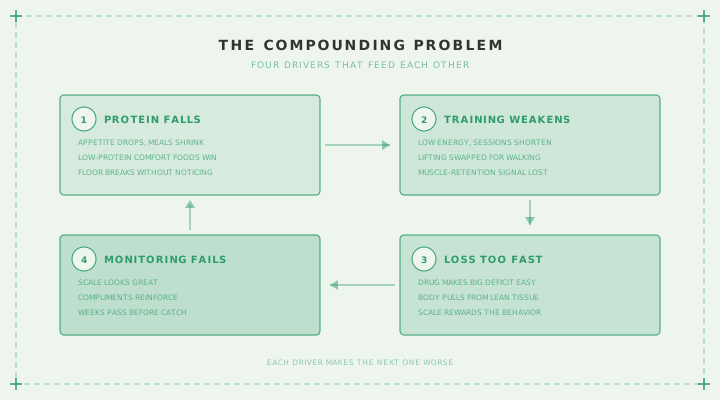
Most of the lean-mass risk on GLP-1 therapy comes from four pathways that compound each other. Understanding them as a system matters because fixing one while ignoring the others does not solve the problem.
| Driver | What it does | Why it gets worse on GLP-1s |
|---|---|---|
| Protein intake falls | Fewer amino acids available for muscle repair and synthesis | Appetite suppression makes low protein easy to sustain for weeks without noticing |
| Training stimulus weakens | Muscle has less reason to be retained during a deficit | Low energy and nausea make people train less hard or skip sessions entirely |
| Rate of loss gets too fast | The body pulls more from lean compartments during aggressive deficits | The drug makes large deficits feel comfortable rather than alarming |
| Monitoring gets lazy | Early warning signs are missed | People assume the plan is working if the scale is moving |
The first driver is the one that matters most. Protein intake on GLP-1 therapy drops because appetite drops. Meals get smaller. Meals get skipped. The foods that feel tolerable on low-appetite days tend to be low-protein comfort foods, not the lean protein sources that protect lean mass. Over the course of weeks, the daily protein average slides below the floor needed for muscle protein synthesis, and the lifter does not feel hungry enough to notice the shortfall.
The second driver is the one that lifters underestimate. When calories are low and energy is flat, the natural response is to train lighter, cut sessions short, or replace lifting with steps. Every one of those responses removes the mechanical-tension signal that tells the body to hold onto muscle tissue. Protein without training is less effective. Training without protein is less effective. Neither alone does the full job.
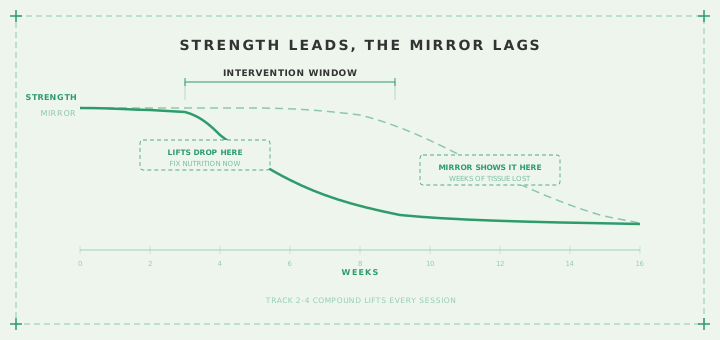
The third and fourth drivers are the ones that make the problem invisible. The scale drops fast, which feels like success. Friends and family notice, which reinforces the behavior. The mirror is slow and unreliable at small magnitudes. By the time training performance has clearly degraded, the lifter has been under-fueling for weeks and the tissue loss has already happened.
Why lifters are a different population than the trials studied
Nearly all GLP-1 body-composition data comes from sedentary or lightly active adults with overweight or obesity. That population has different baseline muscle, different training history, different protein habits, and different responses to a calorie deficit than a man who has been lifting for years.
Trained muscle has different retention characteristics under mechanical load. A man with a meaningful strength base who continues resistance training during a deficit has more physiological leverage to shift the weight-loss ratio toward fat and away from muscle than a sedentary trial participant who walks and eats a generic low-calorie diet. That is the good news.
The bad news is that most lifters on GLP-1 therapy are not deliberately pulling any of the levers that protect their advantage. They are not hitting a protein floor. They are not programming their training for a pharmacologically assisted cut. They are not monitoring the metrics that catch lean-mass loss early. They are coasting on the appetite suppression and assuming the drug will produce a good outcome on its own.
The drug produces weight loss. Whether that weight loss is mostly fat or a messy mix of fat and muscle depends almost entirely on what the lifter does around the prescription.
Who is most at risk among men who train
Not every lifter on a GLP-1 faces the same level of lean-mass risk. The risk increases with specific combinations of factors that compound each other.
| Higher-risk profile | Why the risk is elevated | What changes in the plan |
|---|---|---|
| Lifter over 40 with more than 15 years of training | Anabolic resistance means muscle is harder to keep and harder to rebuild once lost | Protein floor moves to the higher end. Per-meal leucine target moves to 3 to 4 g. Strength monitoring becomes the primary metric |
| Lifter on tirzepatide or retatrutide with severe appetite suppression | Stronger drugs create larger deficits more easily. More days per week below the protein floor | Pre-build liquid protein rescue meals. Tighten rate-of-loss guardrail to 0.5 to 0.8% per week |
| Lifter who was already lean (below 18% body fat) before starting GLP-1 | Lower body-fat starting point means the body has less stored energy to draw from and pulls more from lean compartments | Smaller deficit. Slower rate of loss. More aggressive protein target. Consider whether the medication is the right tool |
| Lifter with a history of stop-start GLP-1 cycles | Weight regain after discontinuation may favor fat regain over muscle regain, creating a worse ratio each cycle | Build the off-ramp plan before starting. Commit to the full protocol, not just the prescription |
| Endurance athlete using GLP-1 for weight loss during a training block | Appetite suppression collides with high fueling demands from endurance training. Recovery cost is already elevated | Protect carbohydrate around key sessions. Maintain at least 2 resistance sessions per week even during endurance phases. The full fueling, hydration, and load-management plan is in Endurance Training on a GLP-1 |
| Lifter who reduced training to 1 to 2 easy sessions per week after starting the medication | The mechanical-tension signal that tells the body to keep muscle is too weak to offset the deficit | Restore training frequency and intensity before continuing the cut. No amount of protein fixes a missing training signal |
The highest-risk scenario is a man over 40 on a high-dose tirzepatide who has reduced his training from four hard sessions to two light ones, whose protein has drifted from 170 grams to 90 grams, and whose scale is dropping 2 pounds per week. Every protection layer has failed simultaneously, and the medication is making it feel like a success because the weight is coming off and hunger is not a problem. That man is losing meaningful muscle tissue every week, and by the time his training log makes the problem undeniable, he may have lost months of progress that will take longer to rebuild than the cut itself.
02Hit 1.6g/kg protein as the floor
Setting the floor that protects your lifts
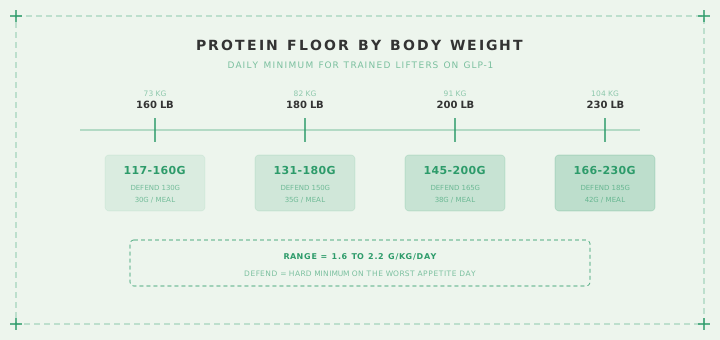
The protein floor is the daily minimum protein intake below which lean-mass protection becomes unreliable during a GLP-1-assisted cut. It is not a range to aim for when convenient. It is a hard minimum that you do not drop below, even on the days when nothing sounds good and the thought of eating another chicken breast makes you want to skip the meal entirely.
The distinction between a floor and a range matters. A range says "aim for 1.2 to 2.2 g/kg and you will be somewhere useful." A floor says "do not go below this number, and here is the rescue plan for the days when you cannot eat." The floor gives you something to defend. The range gives you something to drift inside until the low end stops protecting anything.
The 2025 multi-society advisory on nutritional priorities during GLP-1 therapy recommends protein intake of 1.2 to 1.6 g/kg adjusted body weight per day with strength training as the baseline muscle-preservation floor for people using these medications.5 That is a good starting range for the average patient. It is not the full answer for a man who lifts.
The sports-nutrition literature for energy-restricted conditions pushes the useful range upward. Meta-analysis and deficit-era trials continue to support higher intakes for lean-mass retention in trained populations, often landing around 1.6 to 2.2 g/kg and sometimes higher during aggressive cuts.67 The medication-specific advisory gives the clinical floor. Training status decides how far above it you should be.
Where the floor sits by context
| Context | Daily protein floor | Per-meal target | Why the floor shifts |
|---|---|---|---|
| General adult on GLP-1 | 1.2 to 1.6 g/kg/day | 25 to 35 g across 3 to 4 meals | Multi-society advisory baseline for people using these medications |
| Trained lifter in a deficit | 1.6 to 2.2 g/kg/day | 30 to 45 g across 3 to 4 meals | Deficit upregulates protein oxidation. Training raises the payoff from adequate protein |
| Lifter over 40 on GLP-1 | 1.6 to 2.0 g/kg/day | 35 to 45 g across 3 to 4 meals | Anabolic resistance and drug-induced appetite suppression create a double problem |
| Aggressive cut or strong suppression | Top of range + liquid protein backup | 30 to 50 g across 4 feedings | Margin for error disappears when meals shrink and appetite is unpredictable |
For a 180-pound (82 kg) trained male lifter, the floor lands at roughly 130 to 180 grams of protein per day, with 150 grams as a practical daily minimum to defend. For a 200-pound (91 kg) lifter, the floor is roughly 145 to 200 grams, with 165 grams as the practical minimum. These numbers require planning. They do not happen by accident on days when appetite is suppressed.
The leucine threshold problem on GLP-1s
The daily total is half the job. Distribution across meals is the other half, and it is the half that breaks most often on GLP-1 therapy.
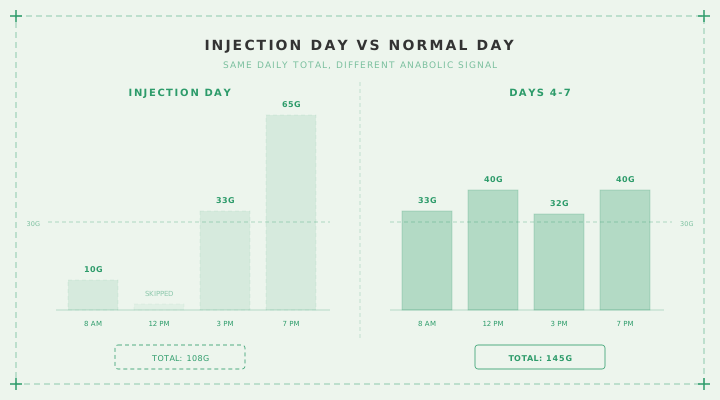
When appetite is suppressed, meal size shrinks. When meal size shrinks, per-meal protein drops. When per-meal protein drops below a threshold, the anabolic signal from that meal weakens even though the daily total might look adequate if you manage a larger dinner later.
That threshold is driven by leucine, the branched-chain amino acid that activates mTORC1 and starts muscle protein synthesis. For most active younger men, the useful target is about 2 to 3 grams of leucine per meal, which usually comes with roughly 25 to 40 grams of a high-quality protein source. For men over 40, anabolic resistance raises the target to 3 to 4 grams of leucine and roughly 30 to 45 grams of protein per feeding.8
This is where GLP-1 appetite suppression does the most subtle damage. A man who eats 160 grams of protein in a day but gets 20 grams at breakfast, 15 grams at lunch, and 125 grams at dinner is not driving three strong anabolic pulses. He is driving one decent pulse and wasting two feeding opportunities. The leucine threshold article covers the full science. The practical rule is simpler. Every meal needs to clear 30 grams of protein for a trained man, and getting there at breakfast and lunch is the hardest part on a GLP-1.
| Body weight | Per-meal protein floor | Number of daily feedings | Leucine target per meal |
|---|---|---|---|
| 70 kg (154 lb) | 25 to 35 g | 3 to 4 | 2 to 3 g |
| 82 kg (180 lb) | 30 to 40 g | 3 to 4 | 2.5 to 3.5 g |
| 91 kg (200 lb) | 35 to 45 g | 4 | 3 to 4 g |
| 105 kg (230 lb) | 40 to 50 g | 4 | 3 to 4 g |
Liquid protein deserves more respect in this context than it gets in normal meal-planning advice. A shake is not nutritionally superior to a chicken breast. It is mechanically easier to finish when appetite is low, and that makes it one of the most effective tools a lifter on GLP-1 has. Greek yogurt, whey isolate, casein, milk-based smoothies, and cottage cheese all solve the same problem. They raise protein distribution without forcing a large meal volume.
Mapping protein pacing to the GLP-1 injection cycle
This is the structural gap that no current guide addresses. Weekly injectable GLP-1 medications like semaglutide and tirzepatide do not suppress appetite uniformly across the week. The pharmacokinetic curve creates a predictable pattern that you can plan around once you recognize it.
For most men on a weekly injection, appetite suppression is strongest in the 24 to 72 hours after the dose. That window is when food interest drops the furthest, meal size tolerance is lowest, and GI side effects like nausea are most likely to interfere with eating. By days 4 and 5, the drug effect is still active but appetite has usually returned somewhat. By days 6 and 7, hunger is closest to normal baseline before the next injection. The symptom-by-symptom playbook for nausea, constipation, reflux, and early satiety lives in Eating Through GLP-1 Side Effects.
That pattern means different days need different feeding strategies.
| Days post-injection | Appetite level | Protein strategy | Meal architecture |
|---|---|---|---|
| Day 0 to 1 (injection day and next day) | Lowest | Pre-plan all meals. Default to liquid protein and small-volume, protein-dense foods | 2 small solid meals + 1 to 2 shakes. Do not wait for hunger to tell you to eat |
| Day 2 to 3 | Low | Continue planned meals. Protein-first ordering at every meal | 3 moderate meals with protein decided first, plus 1 shake if needed |
| Day 4 to 5 | Returning | Prioritize the largest protein meals here. This is the best window for solid food | 3 full meals with protein targets hit through food, plus pre/post-training nutrition |
| Day 6 to 7 | Closest to normal | Use these days to hit the protein ceiling, not just the floor. Train hard | 3 to 4 full meals with the highest daily protein totals of the week |
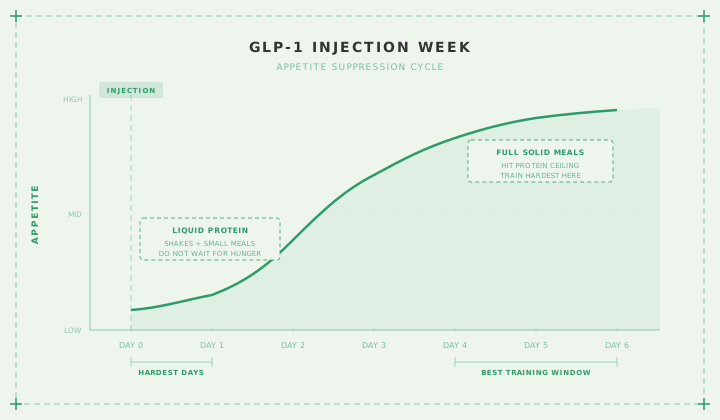
This weekly rhythm changes how you should think about training scheduling as well. If you have flexibility in when you train, putting your hardest sessions on days 4 through 7, when appetite and energy are higher, gives you a better fueling window around the training that matters most. Light or recovery sessions can go on days 1 through 3 when eating is hardest.
The practical move is to build two meal templates. One for high-suppression days (injection day and the day after) and one for moderate or normal days (days 4 through 7). Having both templates written down before you need them eliminates the decision fatigue that leads to missed meals on the worst appetite days.
The low-appetite meal toolkit
The meals that save your protein floor are not the ones you enjoy most. They are the ones you can finish when nothing sounds good.
| Meal or snack | Protein | Calories | Why it works on GLP-1 |
|---|---|---|---|
| Whey isolate shake with milk | 35 to 40 g | 250 to 300 | Low volume, fast to consume, tolerable when appetite is gone |
| Greek yogurt (200 g) with protein granola | 30 to 35 g | 280 to 320 | Creamy texture is easier than solid food on nausea days |
| Cottage cheese (250 g) with fruit | 28 to 32 g | 250 to 300 | High protein density, no cooking required |
| Two eggs plus two egg whites scrambled | 25 to 28 g | 200 to 240 | Small portion, fast to prepare, mild flavor |
| Deli turkey or chicken breast roll-ups (150 g) | 30 to 35 g | 180 to 220 | No cooking, portable, high protein per bite |
| Protein smoothie (whey, banana, milk, peanut butter) | 35 to 40 g | 350 to 400 | Drinkable, calorie-dense, works as a meal replacement |
| Canned tuna or salmon on toast | 28 to 32 g | 250 to 300 | Minimal prep, shelf-stable protein source |
| Casein shake before bed | 25 to 30 g | 150 to 180 | Slow-digesting, counts toward daily total, easy to finish |
| Edamame (200 g shelled) | 22 to 25 g | 240 to 260 | Snackable, high protein for a plant source, no cooking |
| Bone broth with added whey or collagen plus chicken | 25 to 30 g | 180 to 220 | Warm, sippable, gentle on GI side effects |
One important note on collagen. Collagen peptides are not a substitute for complete protein sources when building toward your daily floor. Collagen is low in leucine and does not drive muscle protein synthesis the way whey, casein, eggs, meat, fish, or soy do. If you use collagen for connective-tissue support, count it separately from your muscle-protein targets. Do not let a collagen shake fool your tracker into showing a green number that your muscles cannot actually use.
If you need exact meals that solve this on bad appetite days, use Meal Templates for Low Appetite Days: High-Protein, Low-Volume Options. That page turns the protein floor into repeatable shake, bowl, roll, and soup structures you can actually clear.
What 150 grams of protein actually looks like on a GLP-1
For a 180-pound lifter targeting 150 grams as a daily floor, here is a realistic day built for moderate appetite suppression.
| Meal | Foods | Protein | Notes |
|---|---|---|---|
| Breakfast (8 AM) | Greek yogurt (200 g), protein granola (40 g), berries | 33 g | Small volume, protein-first, tolerable on low appetite |
| Lunch (12:30 PM) | Chicken or salmon bowl with rice, vegetables, light sauce | 40 g | Largest solid meal when appetite allows |
| Pre-training shake (3:30 PM) | Whey isolate with banana and milk | 32 g | Drinkable, easy to finish, provides carbs for the session |
| Dinner (7 PM) | Lean protein (fish, chicken, lean beef) with roasted vegetables and small starch | 38 g | Protein source served first before sides |
| Optional pre-bed | Casein shake or cottage cheese if daily total is short | 20 to 25 g | Insurance policy for the floor |
| Daily total | 143 to 168 g | Floor defended |
On high-suppression days (injection day and the day after), this architecture might need to shift. Replace the solid lunch with a shake. Replace the chicken bowl with a smaller protein-dense meal. The goal is the same. The food forms change to match what you can actually finish.
03Semaglutide vs. Tirzepatide for Recomposition
Choosing the right medication for a lifter's goals
Men who train often ask which GLP-1 medication is better for body recomposition. The honest answer is that neither drug is optimized for lifters. Both are designed and tested for weight management in populations that mostly do not resistance train. The question is which pharmacological profile creates conditions that a lifter can work with most effectively.
Semaglutide recomposition profile
Semaglutide is the most extensively studied GLP-1 receptor agonist for weight management. The STEP clinical trial program provides the primary evidence base.
For lifters, the key features of the semaglutide profile are these. Appetite suppression is strong but manageable for most trained men. The titration period from 0.25 mg up to the maintenance dose of 2.4 mg typically takes 16 to 20 weeks, and the most challenging appetite changes arrive during the later dose escalation. Most men can maintain a functional meal architecture on semaglutide with three solid meals and one planned protein snack or shake per day. The rate-of-loss guardrail that protects training quality is 0.5 to 1.0 percent of body weight per week.
The STEP 1 DXA data showed that fat mass fell more than lean mass in both absolute and proportional terms, and lean mass as a percentage of total body weight actually increased because fat was lost faster.1 That matters for framing. The drug does not selectively target muscle. It creates weight loss, and the fraction that comes from lean tissue depends on the plan around it.
The SELECT trial added cardiovascular outcome data. Semaglutide 2.4 mg reduced the risk of major adverse cardiovascular events by 20 percent in adults with overweight or obesity and established cardiovascular disease, without diabetes.9 That trial matters because it moves semaglutide beyond a weight-loss-only framing and into a cardiovascular risk reduction tool, which changes the clinical discussion for men who have both body-composition goals and cardiometabolic risk.
The practical profile for lifters on semaglutide is that the protein floor is achievable with deliberate meal planning, GI side effects are usually manageable during titration, and the rate of weight loss is typically in a range where strength can be maintained if training and nutrition are set up correctly.
Tirzepatide recomposition profile
Tirzepatide is a dual GIP and GLP-1 receptor agonist. The co-agonism appears to produce greater weight loss than GLP-1 receptor agonism alone, and the SURMOUNT program confirmed this with substantially larger weight-loss numbers than the STEP program.
SURMOUNT-1 showed mean weight reductions of 15.0 percent at 5 mg, 19.5 percent at 10 mg, and 20.9 percent at 15 mg, versus 3.1 percent with placebo at 72 weeks.10 SURMOUNT-5 compared tirzepatide head-to-head against semaglutide 2.4 mg and showed greater weight loss with tirzepatide, though the trial was not primarily designed to answer the body-composition question with the granularity that lifters want.11
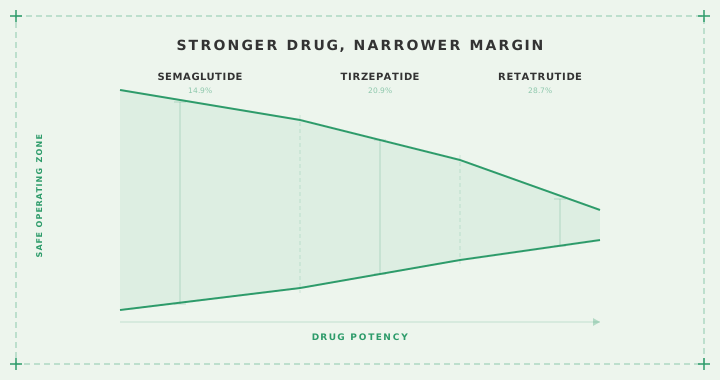
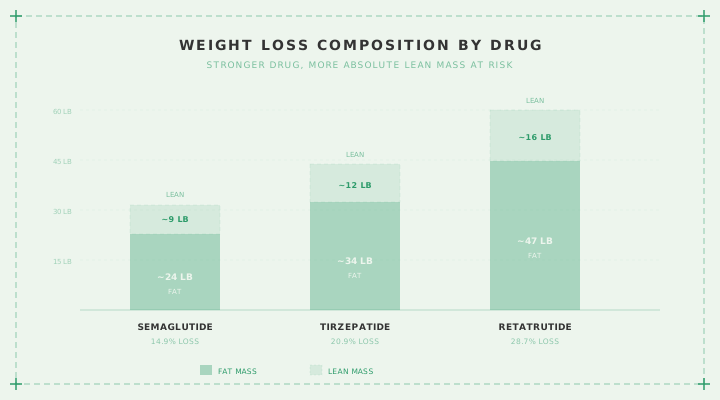
For lifters, the practical differences from semaglutide are real. Appetite suppression is typically stronger, which means the protein floor is harder to reach on more days per week. GI side effects during dose escalation can be more pronounced, which affects training quality during the titration phase. The rate of weight loss is often faster, which means the rate-of-loss guardrail needs to be tighter to protect lean mass. More total weight loss means more absolute lean mass at risk, even if the proportional ratio is similar.
SURMOUNT-2 showed substantial weight loss even in adults with type 2 diabetes, with the 15 mg arm producing a mean reduction of 14.7 percent at 72 weeks.12 For a lifter with type 2 diabetes who has struggled to lose fat on previous approaches, tirzepatide represents a strong option, but the lean-mass protection rules apply with more urgency because metabolic disease increases the importance of preserving muscle tissue as a glucose-disposal organ.
Head-to-head decision framework for lifters
| Variable | Semaglutide | Tirzepatide |
|---|---|---|
| Appetite suppression intensity | Strong | Stronger |
| Protein floor achievability | Moderate effort with 3 meals + 1 snack | Higher effort, often needs liquid protein backup |
| Typical rate of loss | Moderate | Faster |
| Rate-of-loss guardrail for lifters | 0.5 to 1.0% body weight per week | 0.5 to 0.8% body weight per week |
| GI side effects during titration | Moderate | Can be more pronounced |
| Titration risk period | 4 to 8 weeks at higher doses | 4 to 12 weeks, longer escalation |
| Pre-workout nutrition importance | Important | Critical |
| Meal-structure rigidity required | Moderate | High |
| Cardiovascular outcome data | SELECT trial, 20% MACE reduction | Strong metabolic data, CV outcome trials ongoing |
The practical implication is the same for both medications, only more urgent on tirzepatide. Greater appetite suppression means greater risk of under-eating protein. Greater total weight loss means greater absolute lean-mass exposure. The drug is more powerful, but the protection protocol does not change. It just becomes less optional.
If you want the medication-specific field manual for dose escalation, session placement, and maintenance-dose adjustments, read Tirzepatide and Zepbound: Training and Nutrition Plan for Lifters.
Neither drug is inherently better for recomposition. Semaglutide gives more room for error because the appetite suppression is less extreme. Tirzepatide produces more aggressive results but requires tighter systems around protein, training nutrition, and monitoring. The choice is a conversation between the lifter and their prescribing physician, factoring in starting weight, metabolic health, GI tolerance, insurance coverage, and how much structure the lifter is willing to build around the prescription.
Dose titration: the highest-risk window for lifters
The titration phase is when most protein-floor failures and training-quality collapses begin. Understanding why helps you prepare.
Both semaglutide and tirzepatide are titrated upward over weeks to months. Semaglutide typically starts at 0.25 mg weekly and increases every 4 weeks through 0.5, 1.0, 1.7, and finally 2.4 mg. Tirzepatide starts at 2.5 mg and increases through 5.0, 7.5, 10.0, 12.5, and 15.0 mg. Each dose increase brings a new wave of appetite suppression and, often, a new round of GI side effects.
For lifters, each dose increase is a transition point where the meal architecture that worked at the previous dose may stop working. A man who was eating three solid meals at semaglutide 1.0 mg may find that at 1.7 mg, breakfast becomes impossible and lunch shrinks to half a plate. If he does not adjust the plan at each dose step, the protein floor breaks silently.
| Titration event | What typically changes | What to do before the increase |
|---|---|---|
| First dose increase | Appetite drops further. GI symptoms may appear or worsen | Have liquid protein options ready. Identify the meal that is most likely to get cut and plan the replacement |
| Mid-titration (semaglutide 1.0 to 1.7 mg or tirzepatide 5.0 to 7.5 mg) | This is often where the biggest appetite shift hits. The jump from manageable to strong suppression | Shift to the injection-day meal strategy for high-suppression days. Pre-plan all meals for the first 48 hours after each new dose |
| Final dose step (semaglutide 2.4 mg or tirzepatide 10.0 to 15.0 mg) | Appetite suppression is at its peak. The protein floor is hardest to reach | Use the low-appetite rescue plan on high-suppression days. Accept that some days will require three shakes and one meal |
The practical advice is simple. Before each dose increase, review your meal plan. Ask yourself whether each meal in the plan will still be tolerable at a higher level of appetite suppression. If the answer is no, swap the vulnerable meal for a smaller, denser, or liquid alternative before the increase arrives. Reactive adjustments cost protein days. Proactive adjustments protect them.
Where retatrutide fits in the comparison
Retatrutide is a triple agonist hitting GLP-1, GIP, and glucagon receptors, and it produces substantially more weight loss than either semaglutide or tirzepatide. The December 2025 TRIUMPH-4 Phase 3 results showed 28.7 percent body weight loss at the 12 mg dose over 68 weeks, which exceeds the best numbers from either approved drug.13 Retatrutide is not FDA-approved, and using it today means accepting supply-chain risk, dosing uncertainty, and the absence of manufacturing oversight.
04Retatrutide and the Bodybuilding Community
Eli Lilly's triple agonist hit 28.7 percent weight loss in the TRIUMPH-4 Phase 3 readout, the largest number ever reported in an obesity trial, and the bodybuilding community noticed before the press release finished loading. Lifters are already sourcing it from research peptide vendors and running it through cuts despite having no FDA approval, no standardized dosing, and no body-composition data from trained populations.
Why lifters are choosing retatrutide
Retatrutide has become the preferred incretin-class compound in bodybuilding and strength-sport communities despite having no FDA approval and no legitimate prescribing pathway. Understanding why requires looking at what the triple-agonist mechanism offers that semaglutide and tirzepatide do not, and then separating the parts of that story that are supported by evidence from the parts that are speculation running ahead of data.
The headline is the magnitude of fat loss. The TRIUMPH-4 Phase 3 results, announced by Eli Lilly in December 2025, showed an average absolute weight loss of 28.7 percent (approximately 71 pounds) at the 12 mg dose over 68 weeks.13 That is placebo-adjusted weight loss of 26.6 percent. For comparison, semaglutide at its highest dose in STEP 1 produced 14.9 percent weight loss. Tirzepatide at its highest dose in SURMOUNT-1 produced 20.9 percent. Retatrutide blew past both.
For a bodybuilder running a cutting phase, that difference in magnitude is the entire appeal. A man at 240 pounds and 25 percent body fat is looking at potentially losing 50 or more pounds of fat over a full treatment course while losing a smaller absolute amount of lean tissue than the scale drop would suggest. The community framing is simple: same lean-mass loss ratio as other drugs, but dramatically more total fat removed. That framing is roughly accurate based on the available data, with important caveats.
Triple-agonist mechanism for body composition
Retatrutide is a single continuous helical peptide that activates three receptor systems simultaneously. It is most potent at GIP receptors, moderately potent at GLP-1 receptors, and least potent at glucagon receptors. The GLP-1 and GIP components work similarly to tirzepatide by suppressing appetite, slowing gastric emptying, and improving glycemic control. The glucagon receptor component is what makes retatrutide mechanistically distinct.
Glucagon receptor agonism produces several effects that are theoretically relevant for body composition.
| Glucagon effect | Mechanism | Relevance for lifters |
|---|---|---|
| Increased lipolysis | Glucagon decreases lipogenesis and directly promotes fat mobilization from adipose tissue | May shift the energy source during a deficit further toward stored fat |
| Increased energy expenditure | Animal models show glucagon induces thermogenesis in brown adipose tissue | Could partially offset the metabolic adaptation that normally slows weight loss during a cut |
| Reduced liver fat | Glucagon receptor agonism eases oxidative stress in liver mitochondria | Relevant for metabolic health. Animal data showed retatrutide achieved lower inflammatory and fibrotic markers than tirzepatide or liraglutide |
| Glycemic counterbalance | Glucagon raises blood sugar, which would normally be a problem | The GLP-1 and GIP components provide insulinotropic effects that counterbalance this, allowing the metabolic benefits without dangerous glucose spikes |
The honest assessment of the glucagon component is this. The mechanistic reasoning for why triple agonism should produce better body-composition outcomes than dual agonism is plausible and supported by animal data. Mice receiving medications activating all three receptors produced more weight loss than those targeting one or two, with improvements in blood sugar handling, reductions in liver fat, and increased fat burning. Human-specific data isolating the glucagon component's contribution to energy expenditure and preferential fat oxidation is still limited. The overall clinical results suggest the triple mechanism works synergistically, but claims that glucagon specifically drives "preferential fat loss" in humans remain extrapolated from mechanism-of-action reasoning and animal models rather than proven in controlled human studies.
Body composition data
The definitive body-composition dataset for retatrutide comes from the Phase 2 DXA substudy published in The Lancet Diabetes and Endocrinology in 2025. The study enrolled 189 participants with type 2 diabetes, and 103 completed treatment with baseline and week 36 DXA scans.14
| Dose | Fat-mass reduction from baseline | Android (visceral) fat reduction | Approximate lean-mass fraction of total weight lost |
|---|---|---|---|
| 0.5 mg | 4.9% | Modest | Not clinically significant weight loss |
| 4 mg (pooled) | 15.2% | Moderate | Comparable to other obesity drugs |
| 8 mg (pooled) | 26.1% | Substantial | Approximately 25 to 35% of total loss |
| 12 mg | 23.2% | Up to 31.4% | Approximately 26% of total loss |
| Placebo | 4.5% | Minimal | Not applicable |
The authors concluded that a greater proportion of lean mass is not lost with retatrutide despite the overall increased weight loss. That conclusion is the foundation of the bodybuilding community's interest. At the 12 mg dose, approximately 74 percent of total weight lost was fat mass. For a man who loses 70 pounds on retatrutide, that translates to roughly 52 pounds of fat lost and 18 pounds of lean mass lost.
Those numbers need context for lifters. First, the study population was adults with type 2 diabetes, not resistance-trained men. The lean-mass retention in a sedentary diabetic population tells you the drug-specific floor, not what a trained man with a high-protein diet and structured lifting program can achieve. Second, lean mass is not the same as skeletal muscle. Water, glycogen, organ mass, and connective tissue are all counted. Third, there are no Phase 3 body-composition substudies reporting yet, though at least one clinical trial studying body composition and exercise to prevent muscle loss during these medications is active.
The practical interpretation for a lifter is this. Retatrutide does not appear to be worse for lean mass in ratio terms than semaglutide or tirzepatide. It produces dramatically more total fat loss. If you protect the lean-mass side with adequate protein and resistance training, the absolute body-composition outcome could be substantial. That is a real potential upside. It is also an untested potential upside in a trained population with no clinical trial to confirm it.
Risks the bodybuilding community is underweighting
Retatrutide is not FDA-approved. It is an investigational drug in Eli Lilly's TRIUMPH Phase 3 program. FDA approval is anticipated around 2027 at the earliest, pending the remaining six to seven TRIUMPH readouts expected through 2026.
The supply-chain problem is severe. The Alliance for Pharmacy Compounding has explicitly told its members not to compound retatrutide. It fails all three criteria for legal compounding: no USP or NF monograph, not a component of any approved drug, and not on any shortage list. The FDA issued over 50 warning letters to GLP-1 compounders in September 2025, explicitly citing retatrutide violations. Despite enforcement, grey-market supply continues through Discord communities, Chinese peptide synthesis labs, and reshippers, often paid in cryptocurrency with no medical oversight, no identity verification of the compound, and no guarantee of purity, potency, or sterility.18
A March 2026 investigation by WBUR and NPR documented the process. People join Discord communities found through Reddit where factory sales representatives provide menus of peptides including retatrutide. One journalist received a six-month supply for $150 within two weeks. That supply arrived with no independent verification that the vial contained retatrutide at the labeled dose, or retatrutide at all.
For lifters specifically, the risks compound in ways that the broader community discussions often minimize.
| Risk | Why it matters more for lifters | What the data shows |
|---|---|---|
| Dosing uncertainty | Training and nutrition plans are calibrated to expected appetite suppression. If the actual dose is 30 percent higher or lower than labeled, the plan breaks | Grey-market compounds frequently contain wrong amounts. Labeled doses differ from actual content |
| GI side effects at clinical doses | Nausea, diarrhea, and vomiting directly impair protein intake and training quality | TRIUMPH-4 reported nausea in 43% of the 12 mg group, diarrhea in 33%, and vomiting in 21% |
| Dysesthesia (new Phase 3 signal) | Tingling, burning, or numbness in the skin, reported in 20.9% at 12 mg. This was not seen in Phase 2 trials. The glucagon receptor component is suspected | No data on how dysesthesia interacts with heavy training, grip-dependent lifts, or other compounds commonly used in bodybuilding |
| Elevated resting heart rate | Retatrutide causes dose-dependent heart rate increases peaking around 24 weeks | Combined with stimulants, thyroid hormones, or clenbuterol, which are common in bodybuilding cutting protocols, the cardiac load could be significant |
| Pancreatitis and gallstone risk | Rapid weight loss increases gallstone formation. GLP-1 class drugs carry a pancreatitis warning | At least one documented case of acute necrotizing pancreatitis in a bodybuilder taking high-dose grey-market retatrutide |
| No polypharmacy data | The bodybuilding community routinely stacks retatrutide with testosterone, growth hormone, and other peptides | Zero formal drug interaction studies exist for retatrutide combined with anabolic steroids, growth hormone, or other peptides. The combination is entirely uncharted clinically |
| Discontinuation rate | 18.2% discontinued at 12 mg in TRIUMPH-4, with some citing "perceived excessive weight loss" | Bodybuilders targeting specific weight classes or body-fat levels may need to stop or reduce dose at points not studied in trials |
Anti-doping status
Retatrutide is prohibited under the 2026 WADA Prohibited List through multiple overlapping categories. Section S2.4 explicitly bans GLP-1 receptor agonists, listing semaglutide and tirzepatide as examples. WADA uses illustrative examples, not exhaustive lists, and retatrutide falls squarely under this category. Section S0 prohibits any substance not approved for human therapeutic use by any governmental regulatory health authority, which covers retatrutide independently. A Therapeutic Use Exemption is essentially impossible because WADA rarely grants TUEs for substances without regulatory approval. Tested athletes cannot use retatrutide under any circumstances. USADA has issued explicit warnings about incretin-class compounds.
Untested bodybuilders in organizations like the NPC or in non-tested powerlifting federations face no anti-doping consequence. Tested athletes in USAPL, IPF, CrossFit, WADA-affiliated sports, or any drug-tested federation are ineligible to use retatrutide.
Bodybuilding community protocols
The protocols circulating in forums and Discord communities follow a general pattern that is worth describing because it illustrates both the sophistication and the risk tolerance of this population.
The typical titration runs 0.5 mg weeks 1 through 4, 2 mg weeks 5 through 8, 4 mg weeks 9 through 12, 8 mg weeks 13 through 16, then 8 to 12 mg ongoing. The community consensus places the "sweet spot" for cutting at 4 to 8 mg weekly, with higher doses increasing side effects without proportional benefit for most users.
Community protocols describe stacking retatrutide with exogenous testosterone (considered essential by this population for males in a deep caloric deficit), growth hormone or GH fragment 176-191, tesamorelin, CJC-1295 and ipamorelin, and BPC-157 or TB-500 for recovery. The community consensus is to never combine retatrutide with semaglutide or tirzepatide because of overlapping GLP-1 receptor activation.
Side effects reported in community logs include nausea during titration (most common), elevated resting heart rate (approximately 10 bpm increase), reduced sleep quality, heart rate accelerating faster during cardio with reduced endurance capacity, increased sweating during training, and acid reflux when eating late.
The absence of medical oversight in these protocols is the central problem. A clinical trial has a monitoring infrastructure that catches adverse events early. A man injecting grey-market retatrutide purchased through a Discord channel with cryptocurrency has no monitoring infrastructure beyond his own subjective experience and whatever blood work he orders independently. The safety signals that emerged in TRIUMPH-4, particularly dysesthesia at a 20.9 percent incidence, were detected because the trial was designed to look for them. A bodybuilder experiencing tingling or burning sensations might attribute them to training, a pinched nerve, or another compound in the stack rather than recognizing a drug-specific adverse effect.
Protein floor on retatrutide
If the protein floor matters on semaglutide and matters more on tirzepatide, it matters most on retatrutide. The appetite suppression is the strongest in the incretin class. The total weight loss is the largest. The absolute amount of lean mass at risk is the highest. Every protection system described in this article becomes more urgent.
| Variable | Semaglutide | Tirzepatide | Retatrutide |
|---|---|---|---|
| Typical weight loss at highest dose | 14.9% (STEP 1) | 20.9% (SURMOUNT-1) | 28.7% (TRIUMPH-4) |
| Appetite suppression | Strong | Stronger | Strongest in class |
| Protein floor for trained lifters | 1.6 to 2.2 g/kg/day | 1.8 to 2.4 g/kg/day | 2.0 to 2.4 g/kg/day or higher |
| Liquid protein backup frequency | Some days | Most high-suppression days | Nearly daily at higher doses |
| Rate-of-loss guardrail | 0.5 to 1.0% BW/week | 0.5 to 0.8% BW/week | 0.5 to 0.7% BW/week when lean-mass protection matters |
| Meal-structure rigidity | Moderate | High | Very high. Default meals and pre-built rescue plans are essential |
| Regulatory status | FDA-approved for obesity | FDA-approved for obesity | Investigational. Not approved. Cannot be legally compounded |
The rate-of-loss guardrail deserves emphasis. A man on 12 mg retatrutide can lose weight at a rate that makes even an aggressive semaglutide cut look modest. Without a deliberate calorie floor and a tighter rate-of-loss target, the drug will produce a deficit large enough to degrade training quality and shift the weight-loss ratio toward more lean tissue. The community protocols that report stable lifting performance during retatrutide cuts almost universally include exogenous testosterone, which confounds any conclusion about the drug's lean-mass preservation properties in isolation.
The honest framing
Retatrutide is the most powerful weight-loss compound in the incretin class. The Phase 3 data exceeded analyst expectations. The body-composition ratio from Phase 2 suggests that the additional weight loss does not come disproportionately from lean mass. The glucagon receptor component provides a mechanistically plausible pathway for enhanced fat oxidation and energy expenditure. For a bodybuilder whose primary goal is maximal fat removal during a cutting phase, the appeal is obvious.
The other side of the framing is equally important. Retatrutide is not approved. The supply chain is unregulated and the FDA has issued over 50 warning letters to entities selling or compounding it. Phase 3 data revealed a new safety signal, dysesthesia, that was not seen in Phase 2, which means additional safety signals may still emerge. There are zero clinical trials studying retatrutide in resistance-trained populations, zero trials studying it in combination with the other compounds bodybuilders routinely use alongside it, and zero long-term safety data beyond 68 weeks.
Semaglutide and tirzepatide already provide strong, evidence-backed, legally prescribed options for the same recomposition goal with established safety profiles and real manufacturing oversight. The additional fat loss from retatrutide is real. Whether the additional risk from an unapproved compound obtained through an unregulated supply chain is worth that margin is a decision each lifter makes with their physician, if they involve one.
For the full evidence-tier framework that places retatrutide alongside approved drugs, growth hormone secretagogues, research peptides, and collagen, read Peptides for Body Recomposition.
05Training Programming for a GLP-1 Cut
The training strategy that gives muscle a reason to stay
Protein tells the body what building materials are available. Resistance training tells the body what to do with them. Without the mechanical-tension signal from lifting, protein alone cannot preserve lean mass during a calorie deficit. This is true in every cutting context. It is especially true on GLP-1 therapy because the appetite suppression makes it easy to drift into a low-calorie, low-activity pattern that looks like progress on the scale while the body quietly cannibalizes the tissue you most want to keep.
Walking is good for metabolic health, energy expenditure, and adherence. It is not the primary muscle-retention tool on these medications. A man who replaces his lifting sessions with 10,000 steps per day because the drug is making him feel tired is removing the one stimulus that protects the tissue he cares about. The correct response to training fatigue on a GLP-1 is to maintain intensity while reducing volume, improve pre-training nutrition, and audit sleep. The incorrect response is to swap resistance training for more cardio and steps.
The 2026 review in Current Obesity Reports made this explicit and argued that structured progressive resistance training should be built into obesity-pharmacotherapy care when lean-mass preservation matters.19 That recommendation should be treated as a baseline, not an aspirational add-on.
The core training principle: intensity over volume
The principle is simple. Intensity is the signal to retain muscle. Volume is the recovery cost. During a pharmacologically assisted deficit, recovery capacity drops because calories are lower and sleep may be disrupted by GI side effects. The adjustment should come from volume, not intensity.
In practical terms, that means keeping the loads on the bar as close to your pre-cut levels as possible. It means reducing sets before reducing weight. It means cutting accessory work before cutting compound movements. It means never replacing a hard set of squats with an easy circuit because you feel tired.
| What to keep | What to reduce first | What never to cut |
|---|---|---|
| Loads on anchor lifts (squat, bench, deadlift, press) | Accessory volume (isolation work, arms, abs) | Compound lifts with meaningful loads |
| Effort on working sets (RPE 7 to 9) | Junk volume (sets you add out of habit, not stimulus) | The training signal itself |
| 3 to 4 weekly sessions | Extra conditioning that competes with recovery | At least 2 hard lower-body sessions per week |
| Progressive overload tracking | Failure training and very high-fatigue techniques | Sleep and recovery support |
A 12-week GLP-1 cut training block
Most men on a GLP-1 medication will run a productive cut for 12 to 16 weeks before they either reach a body-composition milestone, need a maintenance phase, or decide to adjust the medication. This block is designed for a lifter with at least one year of consistent resistance-training experience who is titrating onto or already at a stable dose.
Phase 1: Ramp (Weeks 1 through 4)
The goal is to establish baseline performance, learn how the medication affects appetite and energy, and build the feeding rhythm.
| Variable | Target |
|---|---|
| Weekly sessions | 3 full-body or upper/lower sessions |
| Volume | Normal pre-cut volume. Do not reduce yet |
| Intensity | Moderate to hard. Establish baseline numbers on 2 to 4 anchor lifts |
| Monitoring focus | Daily weight, daily protein grams, training-log entries |
During the ramp phase, you are calibrating. You are learning which days post-injection are hardest for eating, how your energy changes across the week, and what your baseline strength numbers are before the deficit deepens. Do not cut volume preemptively. Wait until recovery data tells you to.
Phase 2: Main cut (Weeks 5 through 10)
The goal is to maintain or progress anchor-lift performance while the deficit does its work, managing fatigue through volume reduction rather than intensity reduction.
| Variable | Target |
|---|---|
| Weekly sessions | 3 to 4 sessions. Upper/lower or push/pull/legs depending on schedule |
| Volume | Reduce accessories by 20 to 30 percent from Phase 1 if recovery demands it. Keep compound volume stable |
| Intensity | Hard. RPE 7 to 9 on working sets. Do not drift into easy work |
| Key metric | Anchor-lift performance. If load or reps decline for 2 consecutive weeks, audit nutrition before changing the program |
This is the phase where the medication is doing its strongest work and the deficit is deepest. Protect training quality with pre-workout nutrition. Watch for the pattern of slow strength erosion that signals under-fueling. The correction is almost always more food around training, not less training.
Retatrutide adjustment
If you are using retatrutide at 8 mg or higher, tighten the rate-of-loss guardrail to 0.5 to 0.7 percent of body weight per week during this phase. The stronger appetite suppression makes it easier to drift into a deficit that is too large for muscle retention. Consider reducing accessories by 30 to 40 percent instead of 20 to 30, and prioritize pre-workout carbohydrate more aggressively. If anchor lifts decline for even one week, audit nutrition immediately rather than waiting for the standard two-week signal.
Phase 3: Consolidation (Weeks 11 through 12)
The goal is to test strength, deload if accumulated fatigue is high, and reassess targets for the next phase (continued cut, maintenance, or medication adjustment).
| Variable | Target |
|---|---|
| Weekly sessions | 3 sessions |
| Volume | Reduce total volume by 30 to 40 percent. Keep intensity on 2 to 3 key lifts |
| Intensity | Test anchor lifts at or near pre-cut levels. Use the results to inform next steps |
| Decision point | If strength is stable or improved, the cut protected lean mass well. If strength dropped substantially, the next phase should start with a maintenance-calorie period before continuing the deficit |
Anchor lifts and how to use them as guardrails
An anchor lift is a compound movement that you track consistently across the entire cut. It serves two purposes. First, it provides the mechanical-tension signal that tells your body to retain muscle. Second, it acts as an early-warning system for under-fueling and recovery problems.
Pick 2 to 4 compound lifts. Good options for most lifters include a squat variation, a horizontal press (bench or dumbbell press), a hip hinge (deadlift or Romanian deadlift), and a vertical or horizontal pull (overhead press, barbell row, or weighted pull-up). Track load and reps on these lifts every session.
| Anchor-lift pattern | What it usually means | What to do |
|---|---|---|
| Load and reps stable or improving | The cut is protecting lean mass well | Stay the course |
| Small decline on one lift for one week | Normal noise. Fatigue, sleep, or a bad day | Do nothing different. Reassess next session |
| Decline on 2 or more lifts for 2 consecutive weeks | Under-fueling, under-recovery, or both | Audit protein intake over the last 7 days. Check sleep. Check rate of loss. Raise calories if needed |
| Significant decline across all lifts for 3 or more weeks | The cut is too aggressive | Raise calories by 200 to 300 per day, add pre-workout nutrition, reduce volume, and reassess in 2 weeks |
The reason anchor lifts work better than the mirror or the scale as an early-warning system is speed. Strength changes show up weeks before visible body-composition changes. A man whose squat drops 10 pounds over three weeks is getting useful information that would take another month to appear in the mirror or on a DXA scan.
Session-level nutrition for lifters on GLP-1s
Training on a GLP-1 medication without pre-workout nutrition is one of the most common mistakes. The drug suppresses appetite. The lifter skips the pre-workout meal because he is not hungry. He trains with low glycogen and low amino-acid availability. The session quality drops. The mechanical-tension signal weakens. Lean-mass protection degrades.
The fix is to treat pre-workout and post-workout nutrition as non-negotiable, even on the lowest-appetite days.
| Session type | Pre-workout (60 to 90 min before) | Post-workout (within 2 hours) | Low-appetite fallback |
|---|---|---|---|
| Standard lifting day | 20 to 30 g carbs + 15 to 25 g protein | 30 to 40 g protein | Banana + small protein shake before. Full shake after |
| Hard lower-body or high-volume day | 30 to 50 g carbs + 20 to 30 g protein | 35 to 45 g protein + 30 to 50 g carbs | Rice cake with honey + protein shake before. Full meal after if tolerable |
| Low-appetite training day | 15 to 20 g fast carbs + any tolerable protein | 25 to 35 g protein even if appetite is poor | Sports drink + handful of deli turkey before. Whey shake after |
Carbohydrate around training deserves emphasis. Protein preserves tissue. Carbohydrate protects session quality. If you train with no usable glycogen, bar speed drops, rep quality drops, and the return on your protein investment drops with it. People on GLP-1 medications often under-eat both protein and carbohydrate, then try to solve the whole problem with more protein powder. That misses the mechanism. Muscle is preserved best when protein intake is adequate and training quality stays high enough to create repeated anabolic demand.
For the drug-specific training and protein execution layer, read protein targets and training strategy on semaglutide or retatrutide.
Sample exercise selection by training level
The anchor lifts and exercise selection should match the lifter's experience level. More advanced lifters can tolerate more exercise variety. Less experienced lifters benefit from simplicity during a pharmacologically assisted cut because cognitive bandwidth and motivation are already taxed.
Beginner to early intermediate (1 to 3 years of consistent lifting)
3 sessions per week, full-body.
| Session | Exercise 1 | Exercise 2 | Exercise 3 | Exercise 4 | Exercise 5 |
|---|---|---|---|---|---|
| A | Squat 3x6 to 8 | Bench press 3x6 to 8 | Barbell row 3x8 to 10 | Dumbbell overhead press 2x10 to 12 | Face pulls 2x15 |
| B | Romanian deadlift 3x8 to 10 | Incline dumbbell press 3x8 to 10 | Lat pulldown 3x8 to 10 | Leg press 2x10 to 12 | Bicep curls 2x12 to 15 |
| C | Deadlift 3x5 to 6 | Overhead press 3x6 to 8 | Chin-ups 3x6 to 10 | Leg curl 2x10 to 12 | Lateral raises 2x12 to 15 |
Anchor lifts to track: squat (Session A), bench press (Session A), deadlift (Session C). These three movements tell you everything you need to know about whether the cut is protecting your strength.
Intermediate to advanced (3 or more years of consistent lifting)
4 sessions per week, upper/lower split.
| Session | Focus | Key exercises | Working sets |
|---|---|---|---|
| Lower A | Squat emphasis | Back squat 4x4 to 6, Romanian deadlift 3x8 to 10, leg press 3x10 to 12, leg curl 2x10 to 12 | 12 to 14 total |
| Upper A | Press emphasis | Bench press 4x4 to 6, dumbbell row 3x8 to 10, overhead press 3x8 to 10, face pulls 2x15 | 12 to 14 total |
| Lower B | Hinge emphasis | Deadlift 3x3 to 5, front squat or goblet squat 3x8 to 10, walking lunge 2x10 to 12 each leg, calf raise 3x12 to 15 | 11 to 13 total |
| Upper B | Pull emphasis | Weighted chin-up 4x4 to 6, incline dumbbell press 3x8 to 10, cable row 3x10 to 12, lateral raise 2x12 to 15 | 12 to 14 total |
Anchor lifts to track: back squat (Lower A), bench press (Upper A), deadlift (Lower B), weighted chin-up (Upper B).
During Phase 2 of the cut (weeks 5 through 10), the first adjustment when fatigue rises is to drop the last 1 to 2 accessory exercises from each session. Keep the first 3 to 4 exercises and their loads intact. If fatigue is still high after removing accessories, reduce working sets on the secondary compound by one set before touching the anchor lift.
Men over 40
The same principles apply with two modifications. First, warm-up sets should increase by one to two sets to protect joints and reduce injury risk during a calorie deficit when recovery is compromised. Second, exercise selection may shift toward movements that load the target muscle while managing joint stress. A leg press may replace a barbell squat if the knee or lower back cannot tolerate heavy squatting in a deficit. A trap-bar deadlift may replace a conventional deadlift. The principle remains the same. Load the muscles. Create mechanical tension. Track the performance.
What to do when training feels flat
Training fatigue on a GLP-1 cut is common. The question is whether it signals a normal cost of dieting or a problem that needs correction. Here is the decision tree.
- Check protein intake over the last 3 to 5 days. If the average is below your floor, that is the most likely cause. Fix protein first.
- Check sleep. Disrupted sleep from GI side effects or general life stress degrades recovery faster than most people realize. If sleep has been poor, address it before changing training.
- Check pre-workout nutrition. If you have been training fasted or with minimal fuel because appetite was low, add a small pre-workout meal even if you are not hungry.
- If protein, sleep, and pre-workout nutrition are all adequate, check your rate of loss over the last 14 days. If you are losing more than 1 percent of body weight per week, the deficit is too aggressive. Raise calories by 100 to 250 per day, ideally around training windows.
- If rate of loss is fine and nutrition is adequate, reduce training volume by 15 to 20 percent. Keep intensity on anchor lifts. Reassess in one week. If you need the exact order for what to trim without deleting the muscle-retention signal, read Strength Training Minimum Effective Dose During a Cut.
- Do not add more cardio. Do not switch to a "lighter" program. Do not replace lifting with extra steps. Every one of those responses removes the muscle-retention signal while keeping the deficit.
06Rate-of-Loss Guardrails
When fast becomes a problem
The scale is the most reinforcing metric and the least useful one for determining whether a cut is going well. Fast weight loss feels like success. It gets compliments. It validates the decision to start the medication. It also correlates with higher lean-mass loss when it exceeds the rate the body can sustain while preferentially drawing from fat stores.
The general framework from fat loss and muscle preservation applies here with a GLP-1-specific adjustment. The medication makes large deficits feel comfortable. Without guardrails, many lifters drift into rates of loss that would feel miserable in a non-medicated cut but feel fine when appetite is pharmacologically suppressed.
The guardrail framework
| Rate of loss (14-day average) | Interpretation for a lifter | Action |
|---|---|---|
| 0.5 to 0.8% body weight per week | Productive zone for most lifters. Fat loss outpacing lean-mass loss | Stay the course. Continue monitoring anchor lifts |
| 0.8 to 1.0% body weight per week | Acceptable if strength is stable and protein floor is being hit consistently | Monitor closely. Tighten if strength starts to slip |
| Above 1.0% body weight per week for 2 or more weeks | Lean-mass risk is climbing. The deficit is likely too aggressive even if it feels manageable | Raise intake by 100 to 250 kcal per day around training. Do not wait for strength to collapse |
| Weight dropping fast and meals are being skipped regularly | Execution failure disguised as success | Rebuild meal structure before continuing the deficit. Add default meals and a calorie floor |
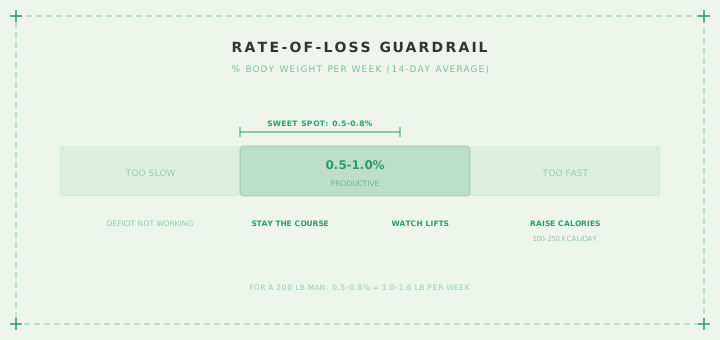
For a 200-pound man, 0.5 to 0.8 percent per week is 1.0 to 1.6 pounds. That feels slow compared to what the medication can produce. It is not slow. It is the rate at which body composition improves rather than just body weight declining. A man who loses 30 pounds in 12 weeks on a GLP-1 but loses 8 of those pounds from lean tissue has not achieved the same result as a man who loses 20 pounds in the same period with only 3 pounds from lean tissue. The second man is lighter, leaner, stronger, and metabolically better positioned for maintenance.
Why the drug makes fast loss feel fine
This is the same invisible-failure mechanism described above, applied to the rate-of-loss question specifically. The drug mutes the protest signals (hunger, food noise, meal-seeking behavior) that normally tell you the deficit has gone too far. A 200-pound man can eat 1,400 calories and feel satiated. The scale rewards the behavior. The training log is the only metric that catches the composition shift early, and only if you are tracking anchor lifts with real numbers.
The calorie floor
In addition to the protein floor, many lifters on GLP-1 therapy benefit from a calorie floor. This is a daily minimum calorie intake that you do not drop below, even on the worst appetite days.
A practical starting point for most male lifters is body weight in pounds multiplied by 10 to 12. For a 200-pound man, that is a calorie floor of 2,000 to 2,400 calories. Below that floor, you are not dieting. You are under-eating in a way that threatens training quality and lean mass even if the medication makes it feel comfortable.
When daily intake drops below the floor, the fix is not willpower. It is liquid calories and protein. Add a shake. Add a glass of milk. Add a protein smoothie. The floor exists to protect you from the days when the drug makes restriction too easy.
Setting your deficit by body-fat starting point
The rate-of-loss guardrail interacts with your starting body composition. Men with higher body fat can tolerate more aggressive deficits with less lean-mass cost because they have larger fat stores to draw from. As body fat decreases during the cut, the deficit should narrow.
| Starting body-fat estimate | Tolerable deficit on GLP-1 | Target rate of loss | Lean-mass risk level |
|---|---|---|---|
| Above 25% | 500 to 750 cal/day | 0.7 to 1.0% body weight per week | Lower. The body has substantial fat reserves to draw from |
| 18 to 25% | 350 to 500 cal/day | 0.5 to 0.8% body weight per week | Moderate. Protein floor and training become more important |
| Below 18% | 200 to 400 cal/day | 0.3 to 0.5% body weight per week | High. Every protection lever must be maximized. Consider whether the GLP-1 is the right tool at this body-fat level |
A man who starts at 28 percent body fat on semaglutide has more room to lose aggressively in the early weeks. A man who started at 22 percent or who has already lost 20 pounds and is now approaching 18 percent needs a smaller deficit and tighter monitoring. The medication does not automatically adjust the deficit to match your changing composition. You have to do that manually by watching the rate-of-loss trend and adjusting intake upward as you get leaner.
This is also where the distinction between body recomposition and weight loss becomes practical. Body recomposition, losing fat while preserving or gaining muscle, requires a narrower deficit and more precise nutrition than simple weight loss. The deeper into a cut you go and the leaner you get, the more the plan must shift from "lose weight" to "change composition." The medication helps with the appetite side. It does not make the precision side easier. If anything, it makes it harder because the appetite suppression can mask the signals that would normally tell you to eat more.
07Track weight lifts protein and waist weekly
The monitoring system that catches problems early
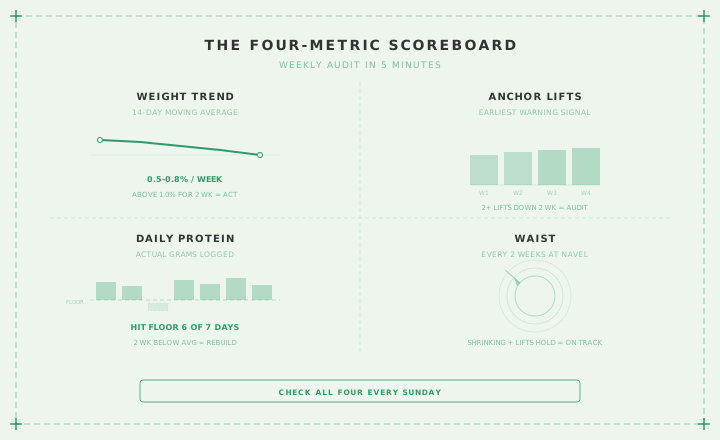
Most men on GLP-1 therapy monitor only the scale. That is the one signal least capable of telling you whether the composition of the loss is acceptable. A better system uses four metrics that together give you a complete picture of whether the cut is working or quietly failing.
Metric 1: 14-day weight trend
Weigh yourself daily, at the same time, under the same conditions. Ignore the daily number. Act on the 14-day moving average.
The daily number is noise. Water, sodium, bowel timing, and GLP-1 gastric-emptying effects create swings that have nothing to do with fat or muscle. The 14-day trend smooths those swings and shows you the real direction. A trend that shows 0.5 to 0.8 percent body weight loss per week means the deficit is productive. A trend above 1.0 percent per week for more than two weeks means the deficit is too aggressive. A flat or rising trend means the deficit is not working or maintenance has been reached.
Metric 2: Anchor-lift performance
This is the best early-warning system for under-fueling. It arrives weeks before the mirror changes and weeks before a DXA scan would catch the problem.
Track load and reps on 2 to 4 compound lifts every session. Use a simple format: exercise, weight, sets, reps. Compare week over week.
| Pattern | Interpretation | Response |
|---|---|---|
| Stable or improving over 4 or more weeks | Lean mass is likely being preserved. The cut is working | Continue |
| One bad session | Normal variation. Sleep, stress, hydration | No change needed |
| Two consecutive weeks of decline on 2 or more lifts | Under-fueling or under-recovery | Audit protein, pre-workout nutrition, sleep, and rate of loss |
| Three or more weeks of decline across all lifts | The cut is too aggressive for your current support structure | Raise calories, potentially to maintenance, and reassess before continuing |
Metric 3: Daily protein grams
Track actual protein intake, not estimates. Log food or use a tracking app like Fuel to get real numbers.
Flag any day below your floor. A single day below the floor happens. A week where the average is below the floor is a structural problem in your meal architecture. Two consecutive weeks below the floor means the cut is no longer protecting lean mass regardless of what the scale shows.
When the weekly protein average drops below the floor, the fix is not motivation. It is meal architecture. Add a default protein source to a meal that is consistently weak. Add a shake. Pre-prepare protein-dense foods that require no decision-making. The problem is almost always a missing system, not a missing effort.
Metric 4: Waist measurement
Measure your waist every two weeks under the same conditions. Same time of day, same location (at the navel, relaxed), same state (fasted or consistent timing relative to meals).
Waist measurement helps separate fat loss from total weight loss better than the scale. If your waist is shrinking while weight drops and strength holds, the cut is almost certainly working well. If weight drops but waist is stable and strength is declining, the loss may be coming from lean tissue more than fat. If waist and weight both rise, the deficit has stalled.
| 14-day weight trend | Waist trend | Strength trend | Interpretation |
|---|---|---|---|
| Down 0.5 to 0.8%/wk | Shrinking | Stable or up | Excellent. The cut is protecting lean mass |
| Down more than 1.0%/wk | Shrinking | Declining | Too fast. Fat is coming off but muscle is at risk |
| Down 0.5 to 0.8%/wk | Stable | Declining | Possible lean-mass loss. Audit protein and training |
| Flat or up | Stable or up | Declining | The plan is failing. Full audit needed |
Optional metrics for deeper tracking
These are useful but not required for most lifters.
A DXA scan every 8 to 12 weeks gives the most direct body-composition data but is expensive and infrequent. Useful for confirming trends, not catching early problems. Progress photos taken monthly with standardized lighting and positioning show whether the visual result matches the data. Step count and general activity deserve attention because a lifter whose step count drops by 3,000 per day over three weeks is losing energy expenditure that compounds over time. Handgrip strength is worth tracking for men over 40 as a simple, cheap functional signal that measures muscle capacity independent of body weight.
Use Fuel's Timeline to see training days, protein days, and intake patterns in one view. Use the weekly review feature to run a 5-minute audit every week: weight trend, protein average, anchor-lift trend, waist. That audit catches nearly every meaningful problem before it becomes expensive.
If you want the shorter execution page built specifically around keeping muscle while the scale is moving, read GLP-1 Muscle Retention Guide for Men. It covers the week-to-week operating decisions, age-band adjustments, and the dose-level meal planning that turn the system into a running plan.
08The Testosterone Question
GLP-1 therapy, testosterone, and lean-mass preservation in men
A March 2026 narrative review in Cureus examined testosterone replacement therapy as a potential strategy to preserve lean mass in men with persistently low serum testosterone receiving GLP-1 receptor agonists.15 The review identified a plausible biological pathway. Rapid weight loss can suppress testosterone via reduced energy availability and hypothalamic-pituitary-gonadal axis disruption. Men with persistently low serum testosterone on GLP-1 therapy may face compounded lean-mass risk because low testosterone reduces the anabolic environment at the same time that the calorie deficit and appetite suppression are already working against muscle preservation.
The review suggested that testosterone replacement therapy in clinically hypogonadal men on GLP-1 medications could represent a strategy to protect lean mass during treatment. That is a reasonable hypothesis supported by the known anabolic effects of testosterone and the known lean-mass risks of GLP-1-assisted weight loss. It is not a recommendation for all men on GLP-1 therapy to add testosterone.
When this conversation matters
This is a physician conversation, not a self-prescription conversation. The relevant context is clinical hypogonadism, not suboptimal gym performance.
| Situation | Why it matters | What to do |
|---|---|---|
| Strength regression that persists after fixing protein, sleep, and rate of loss | May signal low testosterone compounding the deficit effect | Get serum testosterone checked (total and free) through your clinician |
| Fatigue and low libido beyond what the deficit explains | Low testosterone symptoms overlap with under-fueling symptoms. Blood work separates them | Request a hormonal panel before assuming the problem is dietary |
| Men over 40 on aggressive GLP-1 cuts | Age-related testosterone decline plus aggressive weight loss plus GLP-1 appetite suppression is a triple problem | Proactive monitoring of testosterone during treatment is reasonable |
| Men with pre-existing low testosterone starting GLP-1 therapy | The medication does not fix low testosterone. The weight loss may improve it or may not | Discuss testosterone management as part of the treatment plan from the start |
What this does not mean
Testosterone replacement therapy is not a general recommendation for GLP-1 users. Supraphysiologic testosterone use is a categorically different conversation with different risks, different regulatory implications, and different evidence. If a man on GLP-1 therapy is losing strength despite doing everything right nutritionally and in the gym, low testosterone is a clinical question worth investigating with blood work, not a supplement to add based on feel.
The broader relationship between testosterone, energy availability, and recomposition in men is a topic that extends well beyond GLP-1 therapy.
Weight loss and testosterone
One complication worth naming is that obesity itself suppresses testosterone. Many men with overweight or obesity have lower testosterone than they would at a healthier body composition. Losing fat, including through GLP-1 therapy, can increase testosterone as metabolic health improves and adipose tissue decreases. Multiple studies have shown that substantial weight loss improves total and free testosterone in men with obesity.
That means GLP-1 therapy can both improve testosterone through fat loss and potentially suppress it through aggressive energy restriction. The net effect depends on the individual, the rate of loss, and the starting hormonal profile. A man whose testosterone was already low before starting GLP-1 therapy is in a different situation than a man whose testosterone was normal but suppressed by excess adiposity.
This dual dynamic is why blood work matters more than assumptions. A testosterone level measured at week 8 of an aggressive GLP-1 cut tells you something different from a measurement taken after weight has stabilized. Context and timing determine interpretation. If you are concerned about testosterone, test it. Do not guess based on symptoms that overlap heavily with normal dieting fatigue.
09Meal Architecture for GLP-1 Lifters
Building meals that survive appetite suppression
The meal architecture for a lifter on GLP-1 therapy serves a different purpose than a normal meal plan. In a normal cutting diet, the challenge is managing hunger. On a GLP-1, the challenge is eating enough of the right things when you are not hungry. The plan needs to be built for low motivation, not high willpower.
The protein-first ordering rule
At every meal, the protein source is decided first. This is not a preference. It is a structural rule that protects the floor even when appetite cuts the meal short.
Here is why it matters. When a man sits down to a meal on a GLP-1 medication, fullness can arrive after 40 to 60 percent of a normal portion. If he starts with vegetables and starches, he may feel full before touching the protein. If he starts with the protein source, he locks in the amino acids the muscle needs and fills remaining capacity with everything else.
The ordering is: protein first, plants and fiber second, starches and fats with whatever capacity remains. On days when appetite is strong enough for a full meal, the ordering barely matters. On suppressed-appetite days, it is the difference between hitting the floor and missing it by 20 grams.
Three-meal plus one-shake default day
This is the meal template that works for most trained men on GLP-1 therapy. It hits the protein floor, provides adequate carbohydrate for training, and does not require the appetite of someone eating without pharmacological support.
The following day is built for a 180-pound (82 kg) trained male lifter targeting 150 to 165 grams of protein daily.
| Meal | Foods | Protein | Calories |
|---|---|---|---|
| Breakfast (8:00 AM) | Greek yogurt (200 g) with mixed berries (100 g) and protein granola (40 g). Or two eggs plus two egg whites scrambled with one slice of whole-grain toast | 30 to 35 g | 300 to 350 |
| Lunch (12:30 PM) | Grilled chicken (150 g) or salmon (150 g) over rice (100 g cooked) with roasted vegetables and a light dressing. Or a large turkey and avocado wrap with edamame | 38 to 42 g | 450 to 550 |
| Training shake (3:30 PM) | Whey isolate (1 scoop) blended with a banana, 200 ml milk, and optional tablespoon of peanut butter | 30 to 35 g | 280 to 380 |
| Dinner (7:00 PM) | Lean protein source (fish, chicken thigh, lean beef, or tofu, 150 to 180 g) with roasted or steamed vegetables and a small starch. Protein source served first before sides | 35 to 42 g | 400 to 550 |
| Daily total | 133 to 154 g | 1,430 to 1,830 |
If the daily total falls short of the floor, add a pre-bed casein shake or 200 g of cottage cheese for another 25 to 30 g of protein. That pushes the daily total to 158 to 184 g and ensures the floor is defended.
How the template scales by body weight
The 180-pound template above is the middle of the range. A 160-pound man needs less total protein but the same meal structure. A 230-pound man needs substantially more protein and often an extra feeding to get there. Here is how the architecture changes.
| 160 lb (73 kg) | 180 lb (82 kg) | 230 lb (104 kg) | |
|---|---|---|---|
| Daily protein floor | 117 to 130 g | 131 to 150 g | 166 to 195 g |
| Breakfast protein | 25 to 30 g (Greek yogurt + granola or 2 eggs + toast) | 30 to 35 g (Greek yogurt + protein granola + berries) | 40 to 45 g (3 eggs + 2 egg whites + toast, or large yogurt bowl with double protein granola) |
| Lunch protein | 30 to 35 g (120 g chicken or fish over rice) | 38 to 42 g (150 g chicken or salmon bowl) | 45 to 50 g (200 g chicken or salmon bowl, or double-protein burrito bowl) |
| Training shake | 25 to 30 g (1 scoop whey + banana) | 30 to 35 g (1 scoop whey + banana + milk) | 40 to 45 g (1.5 scoops whey + banana + milk + PB) |
| Dinner protein | 30 to 35 g (130 g lean protein + vegetables + starch) | 35 to 42 g (150 to 180 g lean protein + sides) | 45 to 50 g (200 to 220 g lean protein + sides) |
| Pre-bed (if needed) | Usually not needed if other meals hit targets | Casein shake or cottage cheese, 25 to 30 g | Almost always needed. Casein shake or cottage cheese, 25 to 35 g |
| Daily total | 110 to 130 g from 3 meals + shake | 133 to 154 g from 3 meals + shake | 170 to 190 g from 4 meals + shake |
| Calorie floor | 1,600 to 1,920 | 1,800 to 2,160 | 2,300 to 2,760 |
| Key difference | Meals are smaller but the protein-to-calorie density must be higher. Less room for low-protein sides | The baseline template. Most men can hit the floor with moderate meal planning | Volume is the challenge. Even with appetite returning on days 4 through 7, fitting 190 g into meals requires deliberate stacking. A second shake or a pre-bed feeding is standard |
The 230-pound man on a GLP-1 faces the hardest version of this problem. His protein floor is 40 to 60 grams higher than the 180-pound lifter, but his appetite suppression is just as strong. That math only works if he uses liquid protein aggressively, treats the pre-bed feeding as non-negotiable, and builds every meal around the protein source first. On retatrutide at higher doses, this becomes even harder, and a 230-pound man may need two shakes per day in addition to solid meals to defend the floor consistently.
Low-appetite day rescue plan
On high-suppression days (typically days 0 to 2 after injection), the solid-food architecture may not be realistic. The rescue plan replaces one or two solid meals with liquid protein while still protecting the floor.
Rescue Template A: three shakes plus one meal
| Feeding | What | Protein |
|---|---|---|
| Morning shake | Whey + milk + banana | 33 g |
| Midday shake | Casein + Greek yogurt blended | 30 g |
| Small solid meal (whenever appetite allows) | Chicken breast, rice, vegetables (or equivalent) | 35 g |
| Evening shake | Whey + milk + peanut butter | 33 g |
| Daily total | 131 g |
Rescue Template B: two meals plus two shakes
| Feeding | What | Protein |
|---|---|---|
| Breakfast | Greek yogurt + berries + protein granola | 32 g |
| Midday shake | Whey isolate + milk | 30 g |
| Solid meal (afternoon or evening) | Lean protein + starch + vegetables | 38 g |
| Pre-bed shake | Casein + milk | 28 g |
| Daily total | 128 g |
These totals are below the ideal floor for a 180-pound lifter but above the critical minimum. On truly bad appetite days, the goal shifts from optimal to adequate. 130 grams of protein on a bad day is dramatically better than 60 grams because you could not bring yourself to eat.
Retatrutide rescue adjustment
At 8 to 12 mg retatrutide, the severe-suppression days may extend to 3 or 4 days per week instead of 1 or 2. When that happens, the rescue templates above become the default architecture rather than the backup. Build your week around liquid-dominant feeding with solid meals added when appetite allows, rather than assuming solid meals are the baseline with shakes as backup. For a 180-pound man on high-dose retatrutide, a realistic floor-defense week might include 3 to 4 days using Rescue Template A (three shakes plus one meal) and 3 to 4 days using the standard solid-food template. Accept that reality and plan for it rather than fighting it and missing the floor repeatedly.
Injection-day meal strategy
The day of injection and the day after are the two highest-risk days for protein-floor failure. Plan them before they arrive.
Before injection day, have the following ready.
Two pre-made protein shakes in the refrigerator. One for morning, one for whenever appetite allows. A batch of pre-cooked protein (chicken, ground turkey, hard-boiled eggs) that requires no cooking or decision-making. A simple written plan for what you will eat and when, regardless of appetite.
On injection day itself, eat on a schedule rather than waiting for hunger signals. Set reminders if needed. The medication is about to suppress the signal that normally tells you to eat. If you wait for that signal, you will wait all day.
Meal prep for the week
Decision fatigue compounds appetite suppression. When everything sounds unappealing and you also have to decide what to cook, the default outcome is skipping the meal.
The fix is a two-day prep approach that takes 90 minutes and covers most of the week.
On prep day 1 (Sunday or Monday), cook 1.5 to 2 kg of protein in bulk. Chicken breast, ground turkey, salmon, or a combination. Portion into containers with a scale. Each container should hold one meal's worth of protein (150 to 180 g cooked). Cook a batch of rice or potatoes. Wash and prep vegetables.
On prep day 2 (Wednesday or Thursday), refresh the protein supply if running low. Prep a second round of vegetables. Restock Greek yogurt, cottage cheese, and protein powder.
The goal is to make the protein-floor-hitting version of every meal the easiest option in your kitchen. If the prepped chicken container is faster than ordering delivery, you will eat the chicken. If it is not, you will not.
Hydration and fiber on GLP-1 therapy
Constipation is one of the most common and most underestimated side effects of GLP-1 medications. It affects training indirectly by causing bloating, discomfort, and reduced appetite for solid food, which further depresses protein intake. It also affects quality of life in ways that erode adherence over weeks.
The mechanism is straightforward. GLP-1 drugs slow gastric emptying. Reduced food intake means reduced fiber. Reduced fluid intake, which often accompanies reduced appetite, compounds the problem. The combination of slower gut motility, less fiber, and less water creates an environment where constipation becomes chronic rather than occasional.
The prevention protocol is simple and should be installed from day one.
| Habit | Target | Why it matters on GLP-1 |
|---|---|---|
| Water intake | 2.5 to 3.5 liters per day for an active male, more in hot climates or heavy training days | Dehydration worsens constipation and can impair training performance. The drug suppresses thirst cues alongside hunger cues |
| Fiber from food | 25 to 35 grams per day from vegetables, fruit, legumes, and whole grains | Fiber feeds gut motility. When total food volume drops, fiber drops with it unless you target it specifically |
| Fiber timing | Spread across meals rather than in one large dose | A sudden large fiber load on a GLP-1-slowed gut can cause bloating and gas. Gradual, consistent intake is better tolerated |
| Electrolytes | Adequate sodium, potassium, and magnesium through food or supplementation | Reduced food intake can lower electrolyte intake. Low magnesium in particular is associated with constipation and muscle cramping |
Drink water consistently across the day, not just at meals. Set a reminder if needed. The same appetite suppression that makes you forget to eat can make you forget to drink. Dehydration on a GLP-1 medication during a training program is a compounding problem. It reduces training performance, worsens GI side effects, and creates conditions where the body retains water erratically, making scale data noisy and harder to interpret.
If constipation persists despite adequate fiber and hydration, discuss it with your clinician. There are medical interventions beyond dietary changes that can help, and chronic untreated constipation can limit how effectively you can eat and train during the cut.
Eating out on GLP-1 therapy
Restaurant meals present a specific challenge. Portions are large, protein content is often poorly labeled, and the foods that sound appetizing when appetite is suppressed tend to be comfort foods rather than protein-dense options.
The practical approach is to treat restaurant meals like a protein-floor defense problem, not a social event where nutrition does not count.
Order the protein source first. Build the rest of the meal around it. Do not feel obligated to finish anything. On a GLP-1, leaving half a plate of food is normal and should not trigger guilt or waste anxiety. Take the rest home for a meal later when appetite may be better.
Good restaurant choices on a GLP-1 include grilled fish or chicken with a side vegetable, sushi with extra fish and less rice, poke bowls with extra protein, Greek restaurants (grilled meats, yogurt-based sides), and any place where you can order a plain protein source with a simple side. Poor choices include pasta-heavy Italian, all-you-can-eat buffets where decision fatigue and variety lead to poor protein-to-calorie ratios, and any meal where the protein source is hidden inside a heavy sauce or breading.
The best defense is to eat a planned protein meal before or after the restaurant visit and treat the restaurant meal as a social event with a modest protein contribution rather than the main protein delivery system for the day.
10Supplements That Actually Matter on a GLP-1 Cut
What is worth taking and what is noise
The supplement conversation on GLP-1 therapy is smaller and more straightforward than the internet makes it. Most supplements marketed for recomposition, fat loss, or muscle preservation do not have meaningful evidence in GLP-1-treated populations. A few have strong general evidence that applies regardless of medication status.
Creatine monohydrate
Creatine is the most well-supported sports supplement for strength and lean-mass retention during a calorie deficit. It works by increasing intramuscular phosphocreatine stores, which improves high-intensity exercise performance and may support lean-mass retention through better training quality and potentially through direct anabolic or anti-catabolic mechanisms.
For a man on a GLP-1 medication, creatine matters for two reasons. First, it supports the training quality that protects muscle. If creatine helps you get one more rep on a squat set during a session where energy is low, that rep contributes to the mechanical-tension signal that preserves lean tissue. Second, creatine is one of the few supplements with consistent evidence for lean-mass retention during energy restriction across multiple meta-analyses.
The practical dose is 3 to 5 grams per day. Loading protocols are optional and not necessary. Take it at any time of day, with or without food. Creatine causes a small amount of water retention (1 to 2 kg in the first week or two), which will show on the scale. This is intracellular water, not fat gain. It is not a reason to stop taking it. Evaluate your 14-day weight trend after the initial water-retention period stabilizes.
One common concern on GLP-1 therapy is whether creatine worsens GI side effects. There is no strong evidence that 3 to 5 grams of creatine monohydrate daily causes meaningful GI distress in most people. If you notice stomach discomfort, take it with a meal rather than on an empty stomach.
If you want the full decision guide on when creatine is worth it, how to handle the water-weight issue, and how to test it inside Fuel without misreading your cut, read Creatine While on GLP-1: Worth It for Fat Loss and Strength?.
Vitamin D
Vitamin D deficiency is common in adults with obesity and can worsen with calorie restriction and reduced sun exposure. Vitamin D plays a role in muscle function, immune health, and bone density. During a GLP-1-assisted cut where total food intake is low, vitamin D from dietary sources may be insufficient.
A blood test (25-hydroxyvitamin D) establishes your starting level. If deficient or insufficient, supplementation with 1,000 to 4,000 IU daily is typical, guided by your clinician. This is not a recomposition supplement in any direct sense. It is a coverage play for a nutrient that drops when food volume drops.
Omega-3 fatty acids
Omega-3 supplementation (EPA and DHA from fish oil or algae) has modest evidence for supporting muscle protein synthesis and reducing inflammation during calorie restriction. The effect size is small compared to protein and training. It is a reasonable addition for overall health but should not be treated as a lean-mass protection tool.
What does not matter
Fat burners, thermogenics, CLA, HMB at standard doses, BCAAs (if you are hitting your protein floor with complete protein sources), and testosterone boosters marketed as supplements rather than prescribed TRT are all either unsupported by evidence in this context or redundant with the plan described in this article. If your protein, training, rate of loss, and monitoring are set up correctly, no supplement fills a gap that those systems leave open. No GLP-1-specific outcome trial has established HMB for lean-mass preservation.20 The HMB evidence review explains why findings from bed rest and multi-nutrient clinical formulas do not transfer directly to medication-assisted weight loss.
The micronutrient side of the plan deserves its own treatment, because the protein floor is necessary and not sufficient. Calcium, vitamin D, iron, magnesium, potassium, and B12 are the gap profile to watch when total intake sits near 1,200 to 1,500 kcal per day, especially for older adults and higher-risk patients who also need separate bone-health screening. The density math, the food anchors, the supplement stack, and the lab audit are in The GLP-1 Micronutrient Floor. For men over 50 with any fracture risk factor, a prior fragility fracture, chronic glucocorticoid use, or a low-BMI trajectory, the baseline-DXA decision, the least significant change ceiling on follow-up scans, and the structured response when BMD declines on therapy is the parallel skeletal playbook in GLP-1 Medications and Bone Density: The DXA Monitoring Playbook.
11Plan the exit before you stop the drug
Planning the exit before you need it
The strongest GLP-1 withdrawal studies show a consistent pattern. Continued treatment maintains weight loss. Discontinuation leads to regain. The STEP 4 trial randomized participants who had lost weight on semaglutide to either continue the drug or switch to placebo. Those switched to placebo regained approximately two-thirds of the prior loss over 48 weeks.16 SURMOUNT-4 showed the same pattern with tirzepatide, with placebo participants regaining 14.0 percent from randomization.17
That regain happens because the drug was doing a substantial portion of the appetite-control work. When treatment stops, hunger returns, meal size drifts up, food reward signals strengthen, and the old intake pattern starts rebuilding. For a lifter, the situation has one advantage. If you built protein habits, training consistency, and monitoring systems during treatment, you have more behavioral infrastructure to work with when the medication leaves the plan. If you relied on the appetite suppression alone and changed nothing else, you are exposed.
The pre-stop checklist for lifters
Build the exit plan during the last month on treatment, when appetite is still manageable and you can install structure with less friction.
| Pre-stop task | Target | Why it matters |
|---|---|---|
| Lock the protein floor | 1.2 to 1.6 g/kg/day minimum, higher if you lift | Protein is the main dietary guardrail against fat-dominant regain |
| Confirm resistance training is stable | 3 to 4 weekly sessions with hard sets | Lifting gives regained calories somewhere useful to go |
| Audit real maintenance calories | Track intake and weight for 2 to 3 stable weeks | Most people do not know their actual maintenance after a large loss |
| Establish 3 to 5 default meals | Breakfast, lunch, dinner, and 2 fallback meals | When hunger rises, you need decisions already made |
| Set an action threshold | Example: intervene if 14-day average weight rises more than 2% from stop weight | Small regain is easier to stop than late regain |
| Discuss the plan with your clinician | Taper, direct stop, dose reduction, restart option, or alternative medication | A vague medication plan creates panic decisions later |
The full off-ramp protocol, including what to do in the first eight weeks off, how to manage the appetite rebound, and when another treatment path is smarter than white-knuckling, is covered in how to stop GLP-1s without rapid fat regain.
12When to Involve Your Clinician
The signals that mean this is not a nutrition problem
Some patterns during GLP-1 therapy indicate medical risk rather than a nutrition or training problem you can solve by adjusting meal structure or programming. Treat these as triggers to pause self-adjustments and get evaluated.
| Signal | What it can indicate | Next step |
|---|---|---|
| Severe, persistent abdominal pain with vomiting | Pancreatitis or gallbladder complication risk | Stop self-adjustments. Seek urgent clinical evaluation |
| Repeated dehydration or inability to keep fluids down | Electrolyte and kidney stress | Seek medical guidance. Stabilize hydration before training |
| Fainting, confusion, or severe weakness | Hypoglycemia or systemic stress, especially if using diabetes medications concurrently | Urgent evaluation |
| Strength regression that persists after fixing protein, sleep, pre-workout nutrition, and rate of loss for 3 or more weeks | Possible hormonal, metabolic, or medical issue beyond diet | Request comprehensive blood work including testosterone, thyroid, and metabolic panel |
| Severe nausea or GI distress that prevents you from hitting the protein floor for more than 2 weeks | The medication dose may be too aggressive for your current tolerance | Discuss dose adjustment or titration speed with your prescriber |
| Pregnancy planning | GLP-1 medications carry reproductive safety concerns | Clinician-led plan only. Stop self-adjusting |
The role of your physician in GLP-1 therapy extends beyond writing the prescription. Dose titration, side-effect management, metabolic monitoring, and discontinuation planning are all clinical decisions. A qualified provider should be able to explain their monitoring protocol, their approach to dose adjustment, and their strategy for what happens after treatment. If they cannot, that tells you something about the quality of care you are receiving. The best peptide advice from Huberman, Attia, Patrick, and Ferriss podcast roundup covers provider selection criteria in more detail.
13What a Successful 12-Week Cut Actually Looks Like
A composite progression from start to finish
This is a composite example, not a real case study, drawn from the patterns this protocol produces across a full cutting phase.
The lifter is 34 years old, 205 pounds, approximately 24 percent body fat, with 3 years of consistent lifting, starting semaglutide for the first time. Protein floor set at 160 grams. Anchor lifts at baseline: squat 275x5, bench 205x5, deadlift 335x5.
| Week | Weight (14-day avg) | Rate of loss | Protein avg | Squat | Bench | Deadlift | Key event or adjustment |
|---|---|---|---|---|---|---|---|
| 1 | 205.0 | Baseline | 148 g | 275x5 | 205x5 | 335x5 | First injection at 0.25 mg. Appetite barely changes. Sets baseline numbers |
| 2 | 204.2 | 0.4%/wk | 152 g | 275x5 | 205x5 | 335x5 | Protein below floor 3 days. Adds a morning shake on injection days |
| 3 | 203.1 | 0.5%/wk | 158 g | 275x5 | 205x6 | 340x5 | Dose increase to 0.5 mg. Slight nausea on injection day |
| 4 | 201.8 | 0.6%/wk | 161 g | 280x5 | 205x5 | 340x5 | Phase 1 complete. Protein floor holding. Strength stable or up |
| 5 | 200.4 | 0.7%/wk | 155 g | 275x5 | 205x5 | 335x5 | Dose to 1.0 mg. Appetite drops noticeably. Lunch shrinks |
| 6 | 198.6 | 0.9%/wk | 143 g | 275x5 | 200x5 | 335x5 | Protein below floor. Bench dips. Adds pre-bed casein shake |
| 7 | 197.2 | 0.7%/wk | 162 g | 275x5 | 205x5 | 335x5 | Fix worked. Protein restored. Bench recovers. Dose to 1.7 mg |
| 8 | 195.5 | 0.9%/wk | 158 g | 275x5 | 200x5 | 330x5 | Hardest week. GI side effects days 1 to 2. Switches to rescue template on injection days |
| 9 | 193.8 | 0.9%/wk | 163 g | 275x5 | 205x5 | 335x5 | Rescue template stabilizes protein. Drops 2 accessory exercises per session |
| 10 | 192.3 | 0.8%/wk | 160 g | 270x5 | 200x5 | 335x5 | Squat dips 5 lbs. Adds 30 g carbs pre-workout. Waist down 2.5 inches total |
| 11 | 191.0 | 0.7%/wk | 164 g | 275x5 | 205x5 | 335x5 | Consolidation phase. Reduces volume 35%. Squat recovers with better fueling |
| 12 | 189.8 | 0.6%/wk | 162 g | 275x5 | 205x5 | 340x5 | Final test. All anchor lifts at or above baseline |
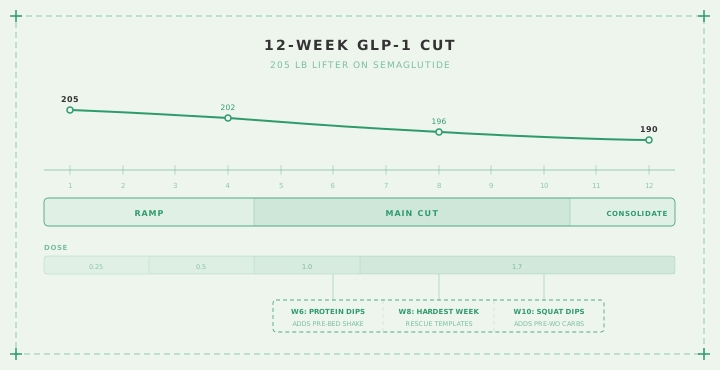
The result: 15.2 pounds lost in 12 weeks (0.7 percent body weight per week average). Waist down 2.5 inches. All anchor lifts preserved or improved. Protein floor held at 157 grams per day average, with the lowest week (143 grams, week 6) prompting an immediate correction.
The patterns to notice. The protein floor broke once (week 6) and was fixed within a week by adding a single pre-bed shake. Strength dipped twice (weeks 6 and 10) and both times the cause was nutritional, not programmatic. The lifter never changed his training program. He changed his food. The dose increases at weeks 5 and 7 were the highest-risk moments, and having rescue templates ready prevented multi-week failures.
Peter Attia made this point on The Drive when he described GLP-1 medications as tools that change the difficulty of dietary adherence without changing the requirements for a good outcome. The drug makes it easier to eat less. It does not make it easier to eat correctly. The 12-week progression above is the difference between those two things. The medication handled the deficit. The lifter handled the protein, the training, and the monitoring. Both did their jobs.
This is what 15 pounds of mostly-fat loss looks like. The scale moves steadily. The lifts hold. The adjustments are small, specific, and driven by data rather than emotion.
14Run the Sunday audit inside Fuel
The Sunday night audit that keeps the cut on track
The system here has four metrics, two meal templates, and a set of decision rules. Fuel turns that into a 5-minute weekly routine instead of a spreadsheet project.
- Check the weight trend. Open Fuel and look at your body-weight graph. The 14-day moving average is what matters. If it shows 0.5 to 0.8 percent loss per week, move on. If it shows above 1.0 percent for two or more weeks, calories need to come up before you check anything else. Connect Fuel to Apple Health so weight entries from your scale sync automatically.
- Check protein. Look at your daily protein totals for the past seven days. How many days were below your floor? Zero or one means the meal architecture is working. Three or more means you have a structural problem. Check macros by meal to see whether the gap is a specific meal (usually breakfast or lunch on injection days) or a general drift. That tells you whether you need a rescue template for specific days or a wholesale reset.
- Check the training log. Look at your anchor lifts over the last two weeks. Fuel's Timeline shows training days alongside protein and calorie data in one view. If anchor lifts are stable or up, the cut is protecting lean mass. If two or more lifts are down for two consecutive weeks, the cause is almost always in step 1 or step 2. Fix the nutrition before changing the program.
- Log the waist measurement. Every two weeks, record your waist at the navel. Compare it to the weight trend and the strength trend using the interpretation table in the scoreboard section above. Waist shrinking while weight drops and lifts hold is the signal that the cut is working.
The audit takes five minutes. Run it every Sunday or Monday using the weekly review feature. A problem caught at week 6 and fixed at week 7 costs almost nothing. The same problem left unnoticed until week 10 costs months of lean mass.
Open Fuel today, set a protein target of 1.6 g/kg or higher using the get leaner and stronger goal, and log your next three days with real food entries. That is the floor.
15Common GLP-1 cut mistakes that cost muscle
The same errors appear in almost every GLP-1 recomposition attempt that goes wrong. Naming them here saves time for the man who is about to make one.
Mistake 1: Treating the scale as the scoreboard
The scale shows whether a deficit exists. It cannot show whether the loss is fat or muscle. Use the four-metric scoreboard (weight trend, anchor lifts, protein grams, waist). A man who loses 25 pounds and never checks those four metrics may be celebrating a loss that was 30 to 40 percent lean tissue.
Mistake 2: Replacing lifting with walking
Walking is excellent for metabolic health, mood, energy expenditure, and adherence. It is not a muscle-retention stimulus. The man who drops from four lifting sessions to one and replaces the other three with long walks is removing the primary signal that tells his body to preserve muscle. The correct approach is to maintain lifting frequency and intensity while adding walking as a supplement to the plan, not as a replacement for the plan.
Mistake 3: Eating one meal per day because the drug makes it easy
Intermittent fasting works for some people in normal dietary conditions. On a GLP-1 medication, it often becomes an unintentional starvation pattern. The drug suppresses appetite so effectively that eating one meal per day feels natural rather than restrictive. The problem is that one meal rarely clears the protein floor, rarely provides adequate leucine distribution across the day, and rarely supports training quality. Three to four feedings with planned protein is the architecture that protects lean mass. One large dinner, no matter how protein-rich, does not create the same anabolic environment.
Mistake 4: Ignoring pre-workout nutrition because you are not hungry
"I train fasted because I am not hungry in the morning" is one of the most common statements from lifters on GLP-1 therapy. The medication makes fasted training feel normal. The training quality suffers anyway because glycogen is low and amino-acid availability is poor. The fix is a small pre-workout meal or shake 60 to 90 minutes before training, regardless of appetite. A banana and a half-scoop of whey is enough to change session quality meaningfully. The fact that you do not feel hungry does not mean your muscles do not need fuel.
Mistake 5: Counting collagen toward the protein floor
Collagen peptides have a role in connective-tissue support. They do not have a meaningful role in muscle protein synthesis because they are low in leucine and essential amino acids. A man who logs 40 grams of collagen as protein and counts it toward his daily floor is overstating his actual muscle-protein intake by a significant margin. Track collagen separately. Build the floor from complete protein sources: whey, casein, eggs, meat, fish, dairy, soy, and legumes paired with complementary grains.
Mistake 6: Not adjusting the plan at each dose increase
Each titration step brings a new level of appetite suppression and potentially new GI side effects. The meal plan that worked at semaglutide 0.5 mg may not survive at 1.7 mg. Lifters who do not reassess and adjust their feeding strategy at each dose step accumulate protein-floor failures over weeks without realizing the cause. Treat each dose increase as a checkpoint to review and update your meal architecture.
Mistake 7: Assuming the medication is permanent
Whether you plan to stay on the medication long-term or stop after reaching a goal, the behavioral systems you build during treatment determine what happens next. A man who achieves his body-composition target on a GLP-1 but built no protein habits, no meal defaults, and no monitoring routine is in a fragile position. The appetite will return when the drug leaves. The habits need to be there before it does.
Mistake 8: Waiting too long to raise calories when the cut is too aggressive
Pride and momentum make it hard to slow down when the scale is dropping fast. A man losing 1.5 percent of body weight per week for three consecutive weeks while his bench press drops 10 pounds and his squat drops 15 is watching lean-mass loss happen in real time. The correct response is to raise calories by 100 to 250 per day around training. The incorrect response is to push through because the scale number feels validating. The tissue you lose by waiting will cost more time to rebuild than the extra weeks a slower cut would have required.
16Where to go for the full evidence layer
Read the full evidence on lean-mass protection in how to preserve muscle on GLP-1 medications for every study, every trial number, and every guardrail behind the recommendations here.
Get the drug-specific execution layer from protein targets and training strategy on semaglutide or retatrutide for tighter per-meal protein numbers and session-level nutrition by medication.
Sort the broader peptide landscape using Peptides for Body Recomposition to separate approved obesity drugs from growth hormone secretagogues, collagen, and research-only compounds before making any peptide-related decisions.
Footnotes
Wilding JPH, et al. Once-weekly semaglutide in adults with overweight or obesity. N Engl J Med. 2021;384(11):989-1002. (STEP 1)
Back to textBack to text 2Karakasis P, Patoulias D, Fragakis N, Mantzoros CS. Effect of glucagon-like peptide-1 receptor agonists and co-agonists on body composition: Systematic review and network meta-analysis. Metabolism. 2025;164:156113. Included 22 randomized trials and 2,258 participants, with lean mass loss comprising approximately 25% of total weight loss. doi:10.1016/j.metabol.2024.156113.
Back to textNeeland IJ, Linge J, Birkenfeld AL. Changes in lean body mass with glucagon-like peptide-1-based therapies and mitigation strategies. Diabetes Obes Metab. 2024;26(S4):16-27. doi:10.1111/dom.15728.
Back to textBack to text 2Alissou M, et al. Impact of semaglutide on fat mass, lean mass and muscle function in patients with obesity: the SEMALEAN study. Diabetes Obes Metab. 2026. PubMed
Back to textMulti-society advisory panel. Nutritional priorities during GLP-1 receptor agonist therapy for obesity. Joint advisory statement. 2025.
Back to textMorton RW, et al. A systematic review, meta-analysis and meta-regression of the effect of protein supplementation on resistance training-induced gains in muscle mass and strength in healthy adults. Br J Sports Med. 2018;52(6):376-384.
Back to textHelms ER, et al. A systematic review of dietary protein during caloric restriction in resistance trained lean athletes: a case for higher intakes. Int J Sport Nutr Exerc Metab. 2014;24(2):127-138.
Back to textJager R, et al. International Society of Sports Nutrition position stand: protein and exercise. J Int Soc Sports Nutr. 2017;14:20.
Back to textLincoff AM, et al. Semaglutide and cardiovascular outcomes in obesity without diabetes. N Engl J Med. 2023;389(24):2221-2232. (SELECT)
Back to textJastreboff AM, et al. Tirzepatide once weekly for the treatment of obesity. N Engl J Med. 2022;387(3):205-216. (SURMOUNT-1)
Back to textFrías JP, et al. Tirzepatide as compared with semaglutide for the treatment of obesity. N Engl J Med. 2025;393(1):26-36. doi:10.1056/NEJMoa2416394. (SURMOUNT-5)
Back to textGarvey WT, et al. Tirzepatide once weekly for the treatment of obesity in people with type 2 diabetes. Lancet. 2023;402(10402):613-626. (SURMOUNT-2)
Back to textEli Lilly. Lilly's triple agonist retatrutide delivered weight loss of average 71.2 pounds in people with obesity and knee osteoarthritis (TRIUMPH-4). Press release, December 2025. Phase 2 data: Jastreboff AM, et al. Triple-hormone-receptor agonist retatrutide for obesity. N Engl J Med. 2023;389(6):514-526.
Back to textBack to text 2Rosenstock J, et al. Effects of retatrutide on body composition in people with type 2 diabetes: a substudy of a phase 2 trial. Lancet Diabetes Endocrinol. 2025.
Back to textTestosterone replacement therapy as a potential strategy to preserve lean mass in men with persistently low serum testosterone receiving GLP-1 receptor agonists: a narrative review. Cureus. 2026.
Back to textRubino D, et al. Effect of continued weekly subcutaneous semaglutide vs placebo on weight loss maintenance in adults with overweight or obesity. JAMA. 2021;325(14):1414-1425. (STEP 4)
Back to textAronne LJ, et al. Continued treatment with tirzepatide for maintenance of weight reduction in adults with obesity. JAMA. 2024;331(1):38-48. (SURMOUNT-4)
Back to textWBUR/NPR. Unregulated peptides: inside the Discord communities selling research chemicals as weight-loss drugs. March 2026. FDA. Concerns with unapproved GLP-1 drugs used for weight loss. 2025.
Back to textFeraco A, et al. Obesity medications and precision nutrition: synergistic interventions and integrated approach in obesity management. Curr Obes Rep. 2026;15:13.
Back to textŠantić R, Martinović L, Pavlović N, et al. Lean mass and musculoskeletal preservation in GLP-1-based obesity treatment: nutrition, exercise, supplementation, and monitoring strategies. Metabolites. 2026. PubMed
Back to text