Your appetite is quiet, the scale is dropping fast, and now creatine looks like a strange decision because the last thing you want on semaglutide or tirzepatide is extra water weight. That tension is real. But the part of a GLP-1 receptor agonist cut that often breaks first is not fat loss. It is training output. And training output is the thing that actually protects lean mass when food intake falls.
If you need the full medication setup before you make supplement decisions, start with Protein Targets and Training Strategy on Semaglutide or Retatrutide, the broader GLP-1 diet guide, and the detailed lifter version in How to Prevent Muscle Loss on GLP-1s: A Men's Protein Guide. This page is narrower. It answers one question: is creatine worth keeping when the medication is already doing the fat-loss work.
01Creatine supports strength not GLP-1 fat loss
Creatine does not make Wegovy or Zepbound work better as fat-loss drugs. The FDA prescribing information for both products already makes clear what these medications do: they reduce calorie intake and delay gastric emptying.78 Creatine does not change that mechanism. L-carnitine gets marketed on a similar fat-burning promise, and the trial evidence behind it is thinner than most labels suggest. This L-carnitine dose and evidence review walks through why oral doses rarely raise muscle carnitine enough to change fat oxidation.
What creatine can do is support the part of the plan that GLP-1 therapy stresses most. Low appetite makes it easier to miss protein, miss carbohydrate around training, and drift into sessions that feel flat. The creatine monohydrate literature is strong enough to say it improves high-intensity exercise capacity and helps increase lean body mass during training.12 The 2025 joint advisory on nutritional priorities during GLP-1 therapy points in the same direction on the medication side, placing protein sufficiency, strength training, and body-composition monitoring at the center of lean-mass protection.9
Where the evidence stops
This is the line worth drawing clearly. There is no randomized trial that directly tests creatine in people taking semaglutide or tirzepatide. A 2025 narrative review in PMC is the first academic paper to put creatine and GLP-1 in the same frame, and even that review explicitly states creatine "has not been studied in a GLP-1RA population."10
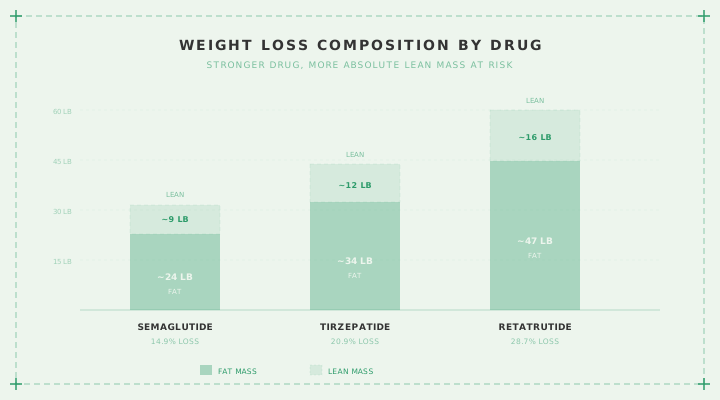
The GLP-1 evidence tells you that lean tissue can fall during successful weight loss. In the STEP 1 body-composition analysis, semaglutide 2.4 mg reduced fat mass by about 8.4 kg and lean mass by about 5.3 kg.3 In the 2025 SURMOUNT-1 substudy, tirzepatide reduced fat mass by 15.9 kg and lean mass by 5.6 kg, putting the lean-tissue fraction at roughly 26 percent of total weight lost.4 SEMALEAN then showed why reading body composition in isolation is incomplete. Lean mass fell, yet handgrip strength improved and the prevalence of sarcopenic obesity dropped from 49 percent to 33 percent.5
The creatine evidence tells you something different. In a meta-analysis of 12 studies in adults younger than 50, creatine supplementation combined with resistance training increased lean body mass by an average of 1.14 kg compared with resistance training alone.2 Standard dosing has not been shown to reduce kidney function in healthy adults despite small changes in serum creatinine.6
The usable conclusion is that creatine belongs in the "reasonable support, not direct proof" tier for GLP-1 users. Plenty of good training decisions work from indirect but coherent evidence rather than medication-specific trials. That tier is still enough for most lifters to justify a 14-day trial.
02Who should take creatine on GLP-1
The return on creatine depends entirely on what you are asking the cut to preserve.
| If this describes you | Best call | Why |
|---|---|---|
| You lift 3 to 4 times per week and want to keep strength during the cut | Usually worth a 14-day trial | The main return is better training quality when food intake is lower than normal |
| You train for HYROX, a hard 10K block, or another event with repeated hard efforts | Usually worth trying if your stomach tolerates it | Repeated high-output work is exactly where creatine tends to earn its keep |
| You only care about scale loss and you are not resistance training | Skip it and focus on protein, lifting, and rate of loss | Creatine does not increase fat loss and will only add weigh-in noise |
| You are about to increase your GLP-1 dose and already feel rough | Wait until food and fluids are stable | The immediate problem is tolerance and hydration, not a supplement stack |
| You keep reacting emotionally to every weigh-in | Do not add another source of early scale noise | Get your monitoring system working first, then reconsider |
| You have kidney disease, a single kidney, or active renal monitoring | Talk to your clinician first | Creatine changes lab interpretation and does not belong in self-experiment mode |
If your only goal is a lower number on the scale and you are not lifting, creatine is easy to skip. But if your goal is body recomposition, or you care whether your squat, sled work, intervals, and repeated hard efforts hold up across a medicated cut, creatine is worth the 14-day trial.
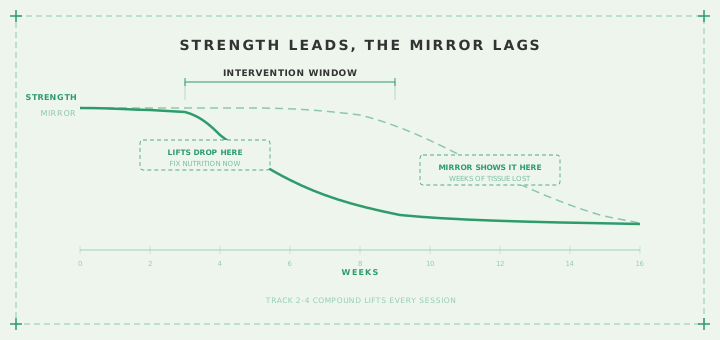
The downside of GLP-1 therapy for lifters is rarely that the drug stopped fat loss. The downside is usually one of these quiet problems.
| Problem during the cut | What usually caused it | Where creatine may help |
|---|---|---|
| Bar speed feels slow and sessions flatten out | Low intake and low phosphocreatine availability during repeated hard efforts | Small support for repeated high-output work |
| Lean mass trend looks soft even though body weight is dropping fast | Weight loss is outpacing the training signal | Helps the training side of the ratio, not the diet side |
| Pre-workout food is smaller than normal | Appetite suppression narrowed the fueling window | Makes more of limited training fuel |
| You want to keep mixed-modal or event training in the week | The drug solved hunger, but workout quality still needs support | Best fit when training quality still matters |
This is why creatine fits better with How to Preserve Muscle on GLP-1 Medications, Apple Watch-Based Calorie Targets, and the broader peptide roundup than with generic fat-loss supplement content. It supports training quality, which is what keeps lean mass from falling during the cut.
03The water-weight problem
The biggest practical downside for healthy users at 3 to 5 grams per day is interpretation.
Creatine often raises scale weight early because water shifts into muscle tissue. The long-running fear is that this means bloating or fat gain. The better reading is that most of the early change is intracellular water, not the sort of diffuse subcutaneous gain people worry about.1 That is good for training. It is inconvenient for people who are already judging a GLP-1 cut by each morning's weigh-in.
| What you see in the first 2 weeks | Better interpretation | What to do |
|---|---|---|
| Weight up 0.5 to 1.5 kg, waist flat, lifts stable or better | Likely water and glycogen-related storage, not fat | Do not cut calories because of week-one noise |
| Weight flat, lifts improve, recovery feels better | Creatine may be helping without much weigh-in noise | Stay consistent and keep tracking |
| Weight up, waist up, food logs got loose | This is not a creatine-only story | Audit intake before blaming the supplement |
| GI discomfort started right after loading | Dose or delivery issue, not proof creatine is a bad fit | Stop loading, split the dose, take it with a meal |
The rule is simple. Do not start creatine the same week you make a major calorie change, a medication dose jump, or a new training block. One new variable at a time.
04How to dose creatine when appetite is low
This is one place where standard creatine advice needs a GLP-1 adjustment.
Loading works, but it buys speed without a better long-run result. On semaglutide or tirzepatide, loading also gives you the two things you usually want least: more GI friction and more short-term scale noise. For most GLP-1 users, the better default is straight maintenance dosing.
| Goal | Better move on GLP-1 | Why |
|---|---|---|
| Start creatine with minimal friction | 3 to 5 g creatine monohydrate once daily | Lowest GI burden and the easiest habit to keep |
| Improve tolerance | Take it with a meal, yogurt bowl, or shake | Appetite is already low, so reduce one more reason to skip it |
| Avoid scale confusion | Skip loading | Slower saturation, less abrupt water gain |
| Reduce stomach discomfort | Split the dose into 2 smaller servings | Useful if one full dose feels heavy |
Timing around the injection cycle
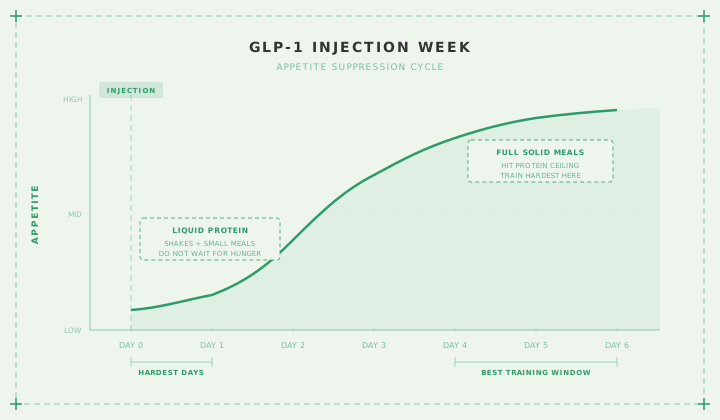
GLP-1 users have predictable appetite and nausea waves tied to injection day. Appetite is typically lowest 24 to 72 hours after the shot and more normal in the back half of the dosing week. If creatine on a mostly empty stomach causes discomfort, take your first doses on the days when eating is easiest. Once the habit is established and your stomach tolerates it, daily dosing becomes simpler.
Timing within the day matters much less than consistency. If your appetite is best later in the injection week, it is still fine to take creatine every day with the meal you can count on. If you need low-volume ideas to pair it with, use Meal Templates for Low Appetite Days: High-Protein, Low-Volume Options.
If you want the wider dosing, safety, and product-form discussion, use The Complete Guide to Creatine (2026) as the companion reference.
05When creatine is a weak fit
Creatine is easy to oversell because the evidence in lifters is real. It is still not the first fix for every GLP-1 problem.
If your current issue is repeated nausea, vomiting, constipation, poor fluid intake, or being unable to clear your protein floor, creatine is not the top priority. The 2025 labels for Wegovy and Zepbound both warn about severe gastrointestinal adverse reactions and acute kidney injury due to volume depletion.78 In that situation, you need intake stability, hydration, and better medication tolerance before you need another supplement.
It is also a weak fit if you are not lifting and are unwilling to start. Creatine helps work that depends on short hard efforts and repeated output. If that work is missing, the return shrinks fast.
06Who should talk to a clinician first
Most healthy adults can treat creatine as a simple supplement decision. A few groups face a higher bar.
| Situation | Why the bar is higher |
|---|---|
| Known kidney disease or a single kidney | Lab interpretation and renal monitoring need clinical context |
| Active dehydration, repeated vomiting, or poor fluid intake on GLP-1 | The medication already has a volume-depletion risk |
| Current renal labs under review | Creatinine can rise a bit without kidney injury, which confuses self-interpretation |
| Tested athlete | Product certification matters more than marketing claims |
| Pregnancy or trying to conceive | This moves out of routine sports-nutrition territory |
For everyone else, the useful question is whether creatine makes your training week better enough to justify a bit more scale noise.
07Run the 14-day test in Fuel
Reading about creatine is not the same as knowing whether it works for you. The only way to find out is to run a controlled test where creatine is the only thing that changed. Two weeks is long enough for the initial water shift to settle and for training quality to show a signal. Here is how to set it up so the data actually tells you something.
Before day one
Capture three baseline measurements so you have something to compare against. Record your current body weight as a 7-day average (not a single morning reading), measure your waist at the navel, and note your current working weight on two anchor lifts (squat, bench, deadlift, or overhead press). These three numbers are your baseline.
Days 1 through 14
Start creatine at 3 to 5 g per day with whichever meal is most reliable. If you are in the first 72 hours after your injection and eating feels hard, pair it with a shake or yogurt rather than skipping the dose. Do not change your calorie target, your training program, or your GLP-1 dose during this window.
The key during these two weeks is consistent food logging so your protein data is clean. Fuel makes this easy. Snap a photo of your meal or describe it with voice and the log is done in seconds. If you eat the same meals often, save them as favorites or tap recents to log them in one step. Keep the rest of the week as stable as possible through Food Logging so that any change you see at the end is from creatine, not from a week where tracking fell apart.
Reading the results
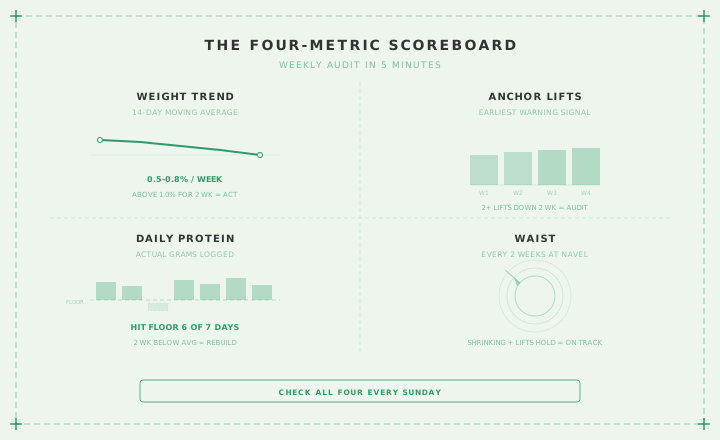
After 14 days, compare four signals using Weekly Review and Timeline.
| Signal | Good outcome | Neutral outcome | Bad outcome |
|---|---|---|---|
| Body-weight trend (7-day average) | Flat or slightly up, then resuming downward trend | Small bump that has not settled yet | Sustained upward trend with no training explanation |
| Waist measurement | Flat or down | Flat | Up alongside loose food logging |
| Anchor-lift performance | Stable or improved | Unchanged | Declining (but check protein and sleep first) |
| Daily protein consistency | Holding above your floor | Occasional misses | Frequent misses (this is a diet problem, not creatine) |
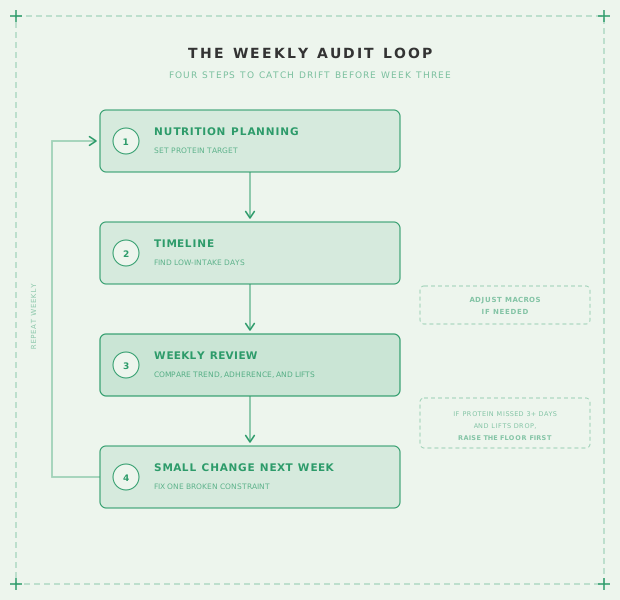
If body weight is a little higher, waist is flat, and training quality is better, creatine is helping the cut. If everything looks the same after two weeks, it may still be doing its job at a level that takes longer to surface. If GI issues or weigh-in anxiety are making the experience worse, stop and reassess.
If you wear an Apple Watch and your activity swings between training days and rest days, pair that review with Apple Watch-Based Calorie Targets. That makes it much easier to separate supplement noise from a week that was simply under-fueled.
08Run creatine through a 14-day Fuel check
If you need the full medication setup first, start with Protein Targets and Training Strategy on Semaglutide or Retatrutide.
If you want the complete lifting-focused playbook, read How to Prevent Muscle Loss on GLP-1s: A Men's Protein Guide.
Keep Creatine open as the quick-reference page for dosing, safety, and scale interpretation.
Footnotes
- Back to textBack to text 2
- Back to textBack to text 2Back to text 3
- Back to text
- Back to text
- Back to text
Effect of creatine supplementation on kidney function: a systematic review and meta-analysis
Back to textWegovy prescribing information, revised August 2025
Back to textBack to text 2Zepbound prescribing information, revised 2025
Back to textBack to text 2- Back to text
Dietary Supplement Considerations During GLP-1 Receptor Agonist Treatment: A Narrative Review
Back to text