The word “peptides” groups together prescription obesity medicines, GH-axis drugs, experimental compounds, and collagen supplements. Their evidence cannot be transferred from one category to another. Controlled weight-loss trials for semaglutide do not establish that an experimental recovery peptide builds muscle or that a rise in growth hormone produces useful recomposition.1
Read each compound against its studied population, measured outcome, safety evidence, and approved indication. Source quality matters for injectables, but a reliable source cannot supply missing evidence of benefit. Personal reports of sleep, fullness, or recovery can suggest research questions; they do not establish causation.
01Find the relevant evidence
Use this index to reach the category you came for. The sections distinguish trial outcomes from mechanistic studies and anecdotal reports.
| Category | Question to ask first | Jump to |
|---|---|---|
| GLP-1 therapies | What happened to fat and lean mass in the studied population? | GLP-1 evidence |
| GH-axis drugs and secretagogues | Was the outcome body composition or only a hormone response? | Three evidence tiers |
| Research peptides | Is there controlled human evidence for this proposed use? | Research peptide limitations |
| Collagen | Is the goal connective-tissue support or muscle protein intake? | Collagen evidence |
02Four peptide categories with different evidence depth
Why "peptides" is a wide word
In biochemistry, a peptide is a chain of amino acids shorter than what most scientists would call a protein. Insulin is a peptide. Oxytocin is a peptide. The collagen fragments in a supplement powder are peptides. Semaglutide is a peptide. BPC-157 is a peptide. The word covers thousands of molecules across very different pharmacology, so "peptides for body recomposition" is roughly as specific as "chemicals for performance." That is not a reason to dismiss the category. It is a reason to sort inside it.
Fitness culture, anti-aging clinics, podcasts, and Reddit all use the word differently. In a gym locker room, "peptides" usually means injectables like BPC-157 or GH secretagogues. On a podcast, it might mean Ozempic. On a supplement shelf, it means collagen. In a telehealth ad, it might mean all of them at once, sold in the same tone and with the same urgency. The tone is the tell. When a clinic markets semaglutide, tesamorelin, CJC-1295, BPC-157, and collagen with identical enthusiasm, the evidence depth behind each compound is being hidden from you on purpose.
Four categories cover the space, which are GLP-1 drugs, GH-axis peptides and secretagogues, research peptides, and collagen. Where it matters, each category is also judged on three things.
- Mechanistic activity in humans. Does the compound actually do what its pharmacology predicts in a human body? For GLP-1 drugs and tesamorelin, the answer is a confident yes. For ipamorelin and CJC-1295, small human studies show the GH/IGF-1 response the mechanism predicts. For BPC-157, most of the mechanism work is in rodents, not humans.
- Human recomposition outcomes. Do controlled human trials show fat loss, lean-mass gain, or both? Semaglutide and tirzepatide have the largest outcome trials ever run in obesity. Tesamorelin has 26-week controlled data on visceral fat and lean body mass. Older sermorelin data shows real GH-axis effects with modest lean-mass signal. Ipamorelin and CJC-1295 have endocrine studies but no large recomposition RCTs. BPC-157 has essentially none in humans.
- Source quality. Is the vial you are putting into your body manufactured under FDA Current Good Manufacturing Practice, compounded by a licensed US pharmacy with characterization testing, or shipped from an overseas research-chemical vendor with a padded mailer and a "not for human consumption" label? For an injectable, this axis can dominate the other two. Real endocrine activity is irrelevant if the peptide in the vial is not the peptide on the label, or is contaminated with a pyrogen that puts you in an ER.
These three axes let you stay pro-peptide and pro-literacy at the same time. "Approved" vs "not approved" is not a fine enough ruler to separate the compounds in this space. "Mechanism, outcomes, source" is.
The four sub-categories
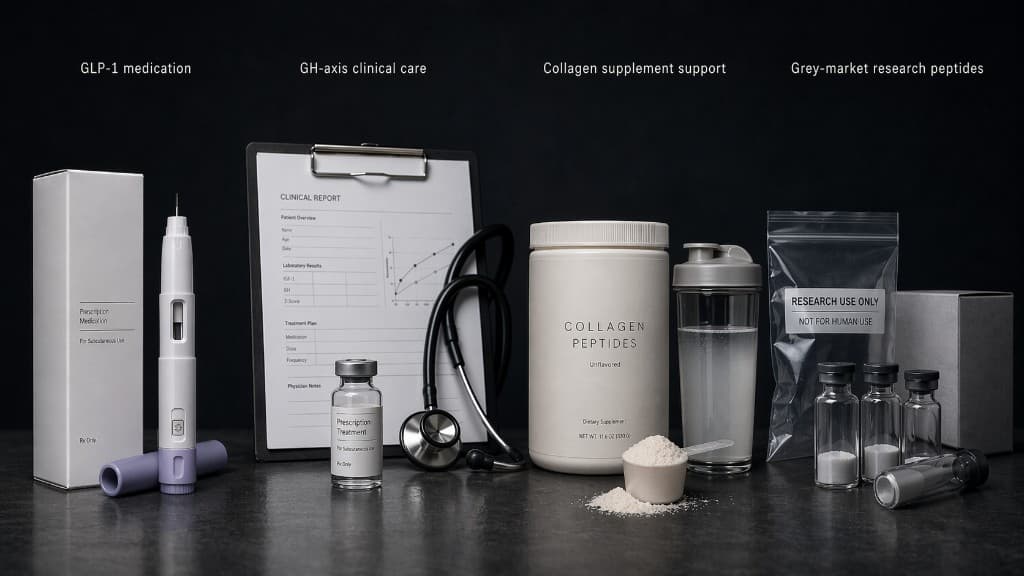
| Category | Examples and internal tiers | Mechanistic Activity in Humans | Human Recomposition Outcomes | Source Quality | Athlete Risk |
|---|---|---|---|---|---|
| GLP-1 and obesity medications | Semaglutide, tirzepatide, orforglipron, retatrutide | High. Consistent appetite suppression, gastric emptying, glycemic effects. | Strong. Large multi-phase RCTs with body-composition sub-analyses showing meaningful fat loss and unavoidable lean-mass exposure. | High for FDA-approved semaglutide, tirzepatide, or orforglipron obtained through a licensed pharmacy. Retatrutide and grey-market products are not. 24 | Not on the 2026 WADA Prohibited List. Verify status before competition and in weight-class sports. |
| GH-axis peptides and secretagogues | Tier 1: tesamorelin. Tier 2: sermorelin. Tier 3: ipamorelin, CJC-1295, GHRP stacks. | Tier 1 and 2 high in humans. Tier 3 shows real GH/IGF-1 stimulation in small human studies. | Tier 1 strongest (VAT reduction and LBM gain at 26 weeks). Tier 2 thinner but real. Tier 3 mechanistically active, outcome-light. | Tesamorelin (EGRIFTA) is FDA-approved. Sermorelin and ipamorelin/CJC sit in compounded or grey-market supply. | Prohibited under WADA Section S2 at all times. High risk for tested athletes across the whole lane. |
| Research peptides | BPC-157, TB-500 | Mostly preclinical. Animal and in vitro data, very limited human mechanism work. | None meaningful. No large human RCTs for body composition or tissue repair. Anecdote heavy, data light. | High risk. Predominantly overseas grey-market supply, no GMP, no purity testing, no batch consistency. | Prohibited under WADA Section S0 (Unapproved Substances). USADA has issued explicit warnings. |
| Collagen peptides | Hydrolyzed collagen, collagen plus Vitamin C | Well characterized as a supplement. Delivers glycine, proline, hydroxyproline. | Emerging signal for connective-tissue support. Not relevant for muscle hypertrophy or fat loss. | Generally good. Mainstream OTC supplement category with third-party testing widely available. | Not prohibited. No sport-eligibility concern. |
Each category requires a fundamentally different conversation, and inside the GH-axis lane the three internal tiers also require different conversations. Mixing them together, or letting "approved" vs "not approved" be the only ruler, is the source of most bad peptide decisions.
GLP-1 receptor agonists
A structured medical conversation with a prescribing physician. The real questions are prescription access, insurance coverage, titration protocols, body-composition monitoring, and the specific protein and training strategy that prevents lean-mass loss during a medication-assisted cut. Source quality is high when you go through a licensed pharmacy. It drops sharply for grey-market or overseas compounded GLP-1s, which are an entirely different and much riskier product even if the molecule name on the vial is the same.
GH-axis peptides and secretagogues
This lane has three internal tiers and one honest conversation per tier. Tesamorelin has an FDA label, real 26-week human body-composition data, and a defined monitoring protocol. Sermorelin is a legacy clinical peptide whose original FDA approval was withdrawn for commercial reasons rather than safety or efficacy, so the older human data still has something to say, but the current supply is compounded rather than manufactured under an active NDA. Ipamorelin and CJC-1295 have real human endocrine activity at the GH and IGF-1 level but no large direct recomposition trials and, in most of the market, unregulated overseas supply chains. These conversations are not equivalent, and grouping them into one bucket loses the signal inside the category.
Research peptides
There is no standard clinical conversation to have here, because these compounds are not approved for human therapeutic use anywhere. The mechanism work on BPC-157 and TB-500 is mostly preclinical, the human outcome data is essentially absent, and the supply chain is dominated by overseas research-chemical vendors whose injectables carry real contamination and mislabeling risk. The productive conversation for most people considering research peptides is with a sports medicine physician, because the underlying problem is almost always a load-management, rehab, or recovery issue that has real evidence-based answers.
Collagen peptides
A supplementation conversation, not a therapy one. Collagen does not require a prescription. It has an emerging signal for connective-tissue support under a specific dose-and-timing protocol. It does not count toward the leucine-driven protein floor, and getting that wrong can quietly undermine a recomposition phase even when everything else looks right on paper.
03GLP-1 therapies are the approved recomposition base
What GLP-1 receptor agonists actually do
GLP-1 stands for glucagon-like peptide-1, a hormone your gut produces after meals. It signals satiety, slows gastric emptying, and helps regulate blood glucose by stimulating insulin release in a glucose-dependent manner. A GLP-1 receptor agonist is a drug that activates the same receptor with a longer duration of action than the native hormone, creating sustained appetite suppression and improved glycemic control.
For body recomposition, the mechanism that matters most is the appetite effect. GLP-1 receptor agonists reduce hunger and food noise in a way that makes it dramatically easier to sustain a calorie deficit. That is both the benefit and the risk. When appetite drops and food volume shrinks, total protein intake tends to drop with it. If protein falls below the floor needed to support muscle protein synthesis and if resistance training quality degrades because of under-fueling, the medication creates a situation where fat loss and lean-mass loss happen together. That is weight loss without recomposition, and the difference shows up in training performance before it shows up in the mirror.
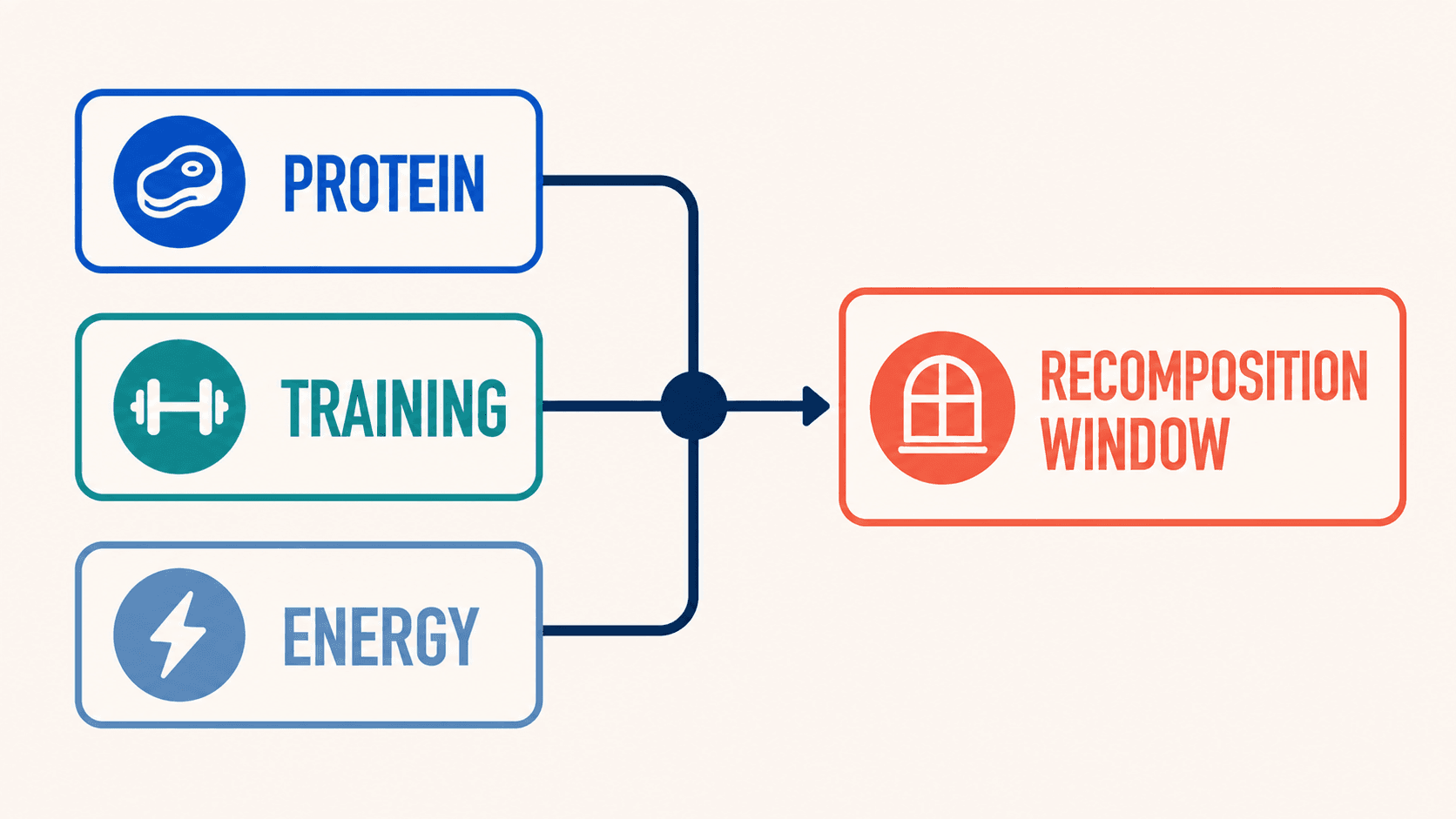
The recomposition window on a GLP-1 medication exists when three conditions hold at the same time:
- Sustained calorie deficit. The drug is doing its job on the appetite side, making a deficit feel manageable rather than punishing.
- Protein intake at or above the lean-mass floor. This means 1.6 g/kg or higher of complete protein per day for trained lifters, spread across three to four feedings.
- Resistance training with enough intensity and volume. The body needs a mechanical reason to preserve muscle tissue. Walking alone does not provide that signal.
When all three conditions are met, GLP-1 therapy becomes one of the most evidence-supported tools available for changing body composition in adults with overweight or obesity. When any one of the three conditions breaks, the tool starts working against the goal.
This is why the GLP-1 diet guide exists as a foundation layer, and why how to preserve muscle on GLP-1 medications is the most important companion read for any lifter considering these drugs.
Semaglutide
Semaglutide is the most extensively studied GLP-1 receptor agonist for weight management. The STEP clinical trial program provides the primary evidence base for its use in obesity.
STEP 1
STEP 1 enrolled adults with overweight or obesity without diabetes. At 68 weeks, the semaglutide group achieved a mean weight loss of 14.9 percent compared to 2.4 percent in the placebo group. The body-composition sub-analysis showed that semaglutide reduced both fat mass and lean mass in absolute terms. Fat mass decreased by approximately 8.4 kg and lean mass decreased by approximately 5.3 kg.1
That lean-mass number is the one that should concern any lifter. It is also the number that training can change, because the trial population was not resistance-trained and the lifestyle intervention did not include a structured progressive-overload program.
STEP 2
STEP 2 examined semaglutide in adults with type 2 diabetes and overweight or obesity. Weight loss was more modest than STEP 1, which is typical in diabetes populations because insulin resistance and glycemic control create a different metabolic environment. The mean weight loss with semaglutide 2.4 mg was approximately 9.6 percent at 68 weeks versus 3.4 percent with placebo.2
For lifters with type 2 diabetes who are considering semaglutide, the lower magnitude of weight loss compared to STEP 1 is worth knowing because it sets more realistic expectations about timeline and the degree of appetite suppression they are likely to experience.
STEP 3
STEP 3 combined semaglutide with intensive behavioral therapy, including a low-calorie diet phase followed by ongoing counseling and physical activity support. The result was a mean weight loss of approximately 16.0 percent at 68 weeks, which exceeded STEP 1.3
This illustrates a principle that matters for the recomposition audience: structured behavioral support amplifies the pharmacological effect. The training and nutrition protocol you build around the drug is a multiplier of the outcome. Men who treat the prescription as a standalone solution and change nothing about their training, protein strategy, or meal architecture get less out of it than men who use the months of lower appetite to build better training, protein, and meal habits.
STEP 4
STEP 4 used a randomized withdrawal design that reveals the other side of the equation. Participants who achieved weight loss on semaglutide were randomized to continue the drug or switch to placebo. Those who continued maintained their weight loss. Those switched to placebo regained approximately two-thirds of the lost weight over the subsequent 48 weeks.4
That regain pattern is consistent with what happens after any intervention that reduces body weight without permanently changing the biological drivers of weight regulation. For a lifter, the STEP 4 result means that the off-ramp matters as much as the on-ramp. If you do not build maintenance habits, protein systems, and training consistency while the drug is suppressing appetite, you will not have them when the drug stops. That planning process is the subject of how to stop GLP-1s without rapid fat regain.
SELECT
SELECT added cardiovascular outcome data. Semaglutide 2.4 mg reduced the risk of major adverse cardiovascular events by 20 percent in adults with overweight or obesity and established cardiovascular disease, without diabetes.5 That trial moved semaglutide beyond a weight-loss-only framing and into a cardiovascular risk reduction tool, which changes the clinical calculus for physicians deciding whether to prescribe.
The key insight for lifters from the semaglutide data is that the drug does not inherently cause disproportionate muscle loss. It causes weight loss, and a meaningful fraction of that weight loss comes from lean tissue unless you actively protect against it. The protection protocol is straightforward: adequate protein, resistance training, and a rate of loss that your training performance can survive. That protocol is detailed in protein targets and training strategy on semaglutide or retatrutide.
The dose matters. Semaglutide 2.4 mg per week is the approved maintenance dose for weight management, and it produces substantially more appetite suppression than the lower titration doses used during the first several months. Many of the protein and training problems show up during or after the titration to full dose, when appetite suppression reaches its peak and men who were eating adequately at 0.5 or 1.0 mg suddenly find that they cannot finish a normal meal. Planning the protein strategy before reaching the full dose, rather than reacting to under-fueling after it has already started, is the practical difference between a productive cut and a messy one.
Tirzepatide
Tirzepatide is a dual GIP and GLP-1 receptor agonist. GIP stands for glucose-dependent insulinotropic polypeptide, and the co-agonism at both receptors appears to produce greater weight loss than GLP-1 receptor agonism alone, though the clinical significance of the GIP component for body composition specifically is still being studied.
SURMOUNT-1
SURMOUNT-1 enrolled adults with obesity or overweight plus at least one weight-related comorbidity, excluding diabetes. At 72 weeks, tirzepatide produced mean weight reductions of 15.0 percent at 5 mg, 19.5 percent at 10 mg, and 20.9 percent at 15 mg, versus 3.1 percent with placebo.6 Those numbers represent a clear step up from semaglutide's STEP 1 results, though cross-trial comparisons have well-known limitations.
SURMOUNT-2
SURMOUNT-2 examined tirzepatide in adults with type 2 diabetes and obesity or overweight. Weight loss was substantial even in the diabetes population, with the 15 mg arm producing a mean reduction of 14.7 percent at 72 weeks.7 That is notable because weight loss in people with type 2 diabetes is generally harder to achieve and smaller in magnitude with most interventions. For a lifter with type 2 diabetes who has struggled to lose fat on previous approaches, tirzepatide represents a real option, but the same lean-mass protection rules apply, and arguably apply more urgently because metabolic disease already increases the importance of preserving muscle tissue as a glucose-disposal organ.
The GI side-effect profile on tirzepatide is worth understanding for training purposes. Nausea, diarrhea, and reduced appetite are the most commonly reported adverse events in the SURMOUNT program, and they tend to be most pronounced during dose escalation. For lifters, the titration phase is the highest-risk period for under-fueling. Planning protein-dense, small-volume meals before the dose increase, rather than reacting to appetite loss after it arrives, is the practical difference between maintaining training quality and watching it erode over several weeks.
SURMOUNT-5
SURMOUNT-5 was a head-to-head trial comparing tirzepatide to semaglutide. Tirzepatide produced greater weight loss, but the trial's primary design was not powered to answer the body-composition question with the granularity that lifters want.8 What SURMOUNT-5 does tell us is that tirzepatide at the highest dose produces more total weight loss than semaglutide at 2.4 mg, which means the absolute amount of lean mass at risk is potentially larger, which means the protein and training guardrails matter even more.
The practical implication is the same as with semaglutide, only more so. Greater appetite suppression means greater risk of under-eating protein. Greater total weight loss means greater absolute lean-mass exposure. The drug is more powerful, but the protection protocol does not change. It just becomes less optional.
Retatrutide
Retatrutide is a triple agonist that acts on GLP-1, GIP, and glucagon receptors. The addition of glucagon receptor agonism is what makes it mechanistically distinct from tirzepatide, and the early data suggests that the triple mechanism may produce even greater weight loss.
Phase 2 obesity data
The phase 2 trial, published in the New England Journal of Medicine, showed a least-squares mean weight reduction of 24.2 percent in the 12 mg retatrutide arm at 48 weeks, compared to 2.1 percent with placebo.9 That is the largest weight-loss number from any incretin-class drug in a controlled trial to date. It is also a phase 2 result, which means the sample size is smaller, the follow-up is shorter, and the safety profile is less fully characterized than what we have for semaglutide or tirzepatide.
Regulatory status
Retatrutide is not FDA-approved. The FDA has explicitly stated that retatrutide cannot be used in compounding under federal law because it is not a component of an FDA-approved drug and has not been found safe and effective for any condition. That means the vials of retatrutide available through grey-market sources and some compounding pharmacies exist in a regulatory space that the agency considers unlawful.
When someone tells you they are "on retatrutide," the compound they are injecting may or may not be what the label says it is, and the oversight that normally protects patients in approved-drug pathways is absent.
Body-composition data
The substudy in adults with type 2 diabetes showed fat-mass reductions of 15.2 percent at pooled 4 mg, 26.1 percent at pooled 8 mg, and 23.2 percent at 12 mg by week 36. The authors noted that the proportion of lean-mass loss relative to total weight loss was similar to other obesity treatments.10 That observation means retatrutide does not appear to be selectively sparing muscle. The lean-mass fraction of weight loss looks roughly the same as with other drugs in this class, which means the absolute amount of lean mass lost is larger simply because total weight loss is larger.
Phase 3 timeline
Eli Lilly has reported positive topline Phase 3 results in type 2 diabetes and osteoarthritis-linked obesity programs. The broader obesity Phase 3 program is ongoing, and FDA submission timing has not been confirmed as of April 2026.
Retatrutide belongs in the emerging tier of the evidence framework. It is interesting. It may eventually become the most effective obesity medication available. But semaglutide and tirzepatide already provide strong, evidence-backed, legally prescribed options for the same goal.
04The recomposition floor
GLP-1 therapy without resistance training is a body-composition failure mode. The data supports this clearly. Weight loss without a mechanical signal to preserve muscle leads to lean-mass loss that is proportional to the deficit and often accelerated by the drug-induced appetite suppression that makes chronic under-fueling feel comfortable rather than alarming.
Protein floor
The minimum daily protein intake below which lean-mass protection becomes unreliable. For the general GLP-1 patient population, the 2025 multi-society advisory on nutritional priorities during GLP-1 therapy recommends 1.2 to 1.6 g/kg adjusted body weight per day with strength training.11 For trained lifters in a deficit, the sports-nutrition literature supports higher intakes, often in the range of 1.6 to 2.2 g/kg, and sometimes higher during aggressive cuts.1213
Rate-of-loss guardrail
For most men on semaglutide, keeping weight loss at or below 0.5 to 1.0 percent of body weight per week preserves the conditions under which muscle retention is most likely. For men on tirzepatide or retatrutide, the stronger appetite suppression often pushes loss rates above that range unless caloric intake is deliberately maintained, and the practical guardrail may need to be tighter at 0.5 to 0.8 percent per week when training quality matters.
Training signal
Resistance training at least three to four times per week with compound lifts provides the mechanical stimulus that tells the body to preserve muscle. Keep intensity high and trim volume before trimming load. If a session feels flat once, that is normal. If sessions feel flat for two consecutive weeks, assume under-fueling before changing the program.
| Checkpoint | Target | What to do if you miss it |
|---|---|---|
| Daily protein intake | 1.6 g/kg or higher for trained lifters | Add a liquid protein feeding or restructure meal timing to front-load protein |
| Resistance training frequency | 3 to 4 sessions per week with compound lifts | Reduce extra cardio before reducing lifting. Keep intensity. Trim volume only if recovery demands it. |
| Rate of weight loss over 14 days | 0.5 to 1.0 percent of body weight per week | Increase calories by 100 to 250 per day, usually around training windows |
| Anchor-lift performance | Stable or improving on 2 to 4 key lifts | If strength drops for two consecutive weeks, assume under-fueling before changing the program |
| Protein distribution | 3 to 4 feedings per day with 30 to 50 g each | Do not rely on one large dinner. Spread feedings to create repeated muscle-protein-synthesis signals. |
The most common failure mode on GLP-1 therapy does not look like failure at first. The scale drops fast. Clothes fit better. People comment on the change. The problem is invisible for the first four to eight weeks because the mirror does not distinguish between fat loss and lean-mass loss at small magnitudes. By the time training performance has clearly degraded, the lifter has already lost tissue that took months or years to build. The cost of undoing that mistake is much higher than the cost of setting the floor correctly from the start.
Walking is valuable but does not replace lifting. Walking supports metabolic health, energy expenditure, and adherence. It does not create the mechanical tension needed to signal muscle preservation. The more productive response to training fatigue on a GLP-1 medication is to maintain intensity while reducing volume, improve pre-training nutrition, and audit sleep.
This is the canonical recomposition floor protocol. Every later scenario and decision framework builds on it.
- Set your daily protein floor at 1.6 g/kg or higher of complete protein, distributed across three to four feedings of 30 to 50 grams each.
- Lift at least three times per week with compound movements. Prioritize squats, deadlifts, presses, rows, and pull-ups. Keep load high and reduce volume before reducing intensity.
- Monitor your 14-day weight trend weekly. Flag any two-week stretch where loss exceeds 1.0 percent of body weight per week.
- Track two to four anchor lifts for performance stability. Two consecutive weeks of declining performance at the same effort level means under-fueling until proven otherwise.
- On low-appetite days, use liquid protein sources (whey shakes, Greek yogurt, casein drinks) to hit the floor without requiring large meal volumes.
- Plan the protein strategy before reaching full dose. Reacting to under-fueling after appetite suppression peaks is harder than preventing it.
GLP-1 and athletic use
As of the 2026 WADA Prohibited List, GLP-1 receptor agonists are not classified as prohibited substances. They do not appear in any section of the list. That means a tested athlete can currently use a prescribed GLP-1 medication without triggering an anti-doping violation, provided the substance is confirmed not prohibited at the time of use. Athletes should verify current status with USADA or their relevant anti-doping authority before competition because the list is updated annually and the regulatory landscape around these drugs is evolving.
The framing that "it is just a diet drug" is incomplete for athletes. While GLP-1 receptor agonists are not performance-enhancing in the traditional sense, their use in weight-class sports, endurance events with power-to-weight considerations, or aesthetic competitions raises questions about competitive fairness that governing bodies may eventually address.
A Therapeutic Use Exemption is not required for GLP-1 medications under the current rules because they are not prohibited. If a future update to the Prohibited List changes that status, a TUE process would apply, and the clinical documentation for the prescription would become relevant. This is another reason why having a legitimate prescription through a standard medical pathway matters more than sourcing through a convenience-first telehealth service.
For athletes in weight-class sports like wrestling, judo, powerlifting, and Olympic weightlifting, the recomposition angle of GLP-1 therapy adds a layer of strategic complexity. These drugs can make it substantially easier to compete at a lower weight class with better body composition, which creates a competitive advantage that is not currently addressed by anti-doping rules. Whether governing bodies will eventually decide that this advantage is inconsistent with the spirit of sport is an open question, but athletes in these disciplines should be aware that the conversation is happening and that the permissibility they enjoy today may not extend indefinitely.
GLP-1 medications create a different set of tradeoffs for endurance competitors. The power-to-weight ratio improvement from losing fat can improve performance on running, cycling, and other body-weight-dependent efforts. At the same time, under-fueling on these drugs can impair glycogen availability, compromise training quality during high-volume blocks, and degrade recovery between sessions. Endurance athletes using GLP-1 therapy should pay particular attention to carbohydrate availability around key training sessions and should not assume that the appetite-suppression benefit is always net positive during periods of high training load.
The broader point for any competitive athlete is that "not prohibited" is not the same as "no considerations." The current WADA and USADA positions are permissive, but the clinical, ethical, and practical dimensions of using these drugs in competitive contexts deserve more thought than a simple rule check provides.
05GH-axis peptides split into three evidence tiers
The three tiers inside this category
Growth hormone secretagogues are compounds that stimulate the pituitary to release endogenous growth hormone. That is meaningfully different from injecting exogenous GH directly, because the body's own feedback loops still shape the signal. It is also a real pharmacology lane with decades of clinical work behind it, not a marketing fiction. The mistake the rest of the internet makes is letting the whole lane collapse into a single sentence, when the evidence depth actually differs by tier:
- Tier 1: Tesamorelin. FDA-approved under EGRIFTA. The clearest human body-composition data in the peptide space, with controlled 26-week trials showing visceral fat reduction and lean-mass gain in the approved population.14
- Tier 2: Sermorelin. A legacy clinical peptide. The original Geref NDAs were withdrawn from the US market for commercial reasons, and the FDA's own determination was that the withdrawal was not for safety or effectiveness.20 Older human GHRH(1-29) studies show real GH-axis activation and some lean-mass and metabolic signal. The current supply is overwhelmingly compounded rather than manufactured under an active NDA.
- Tier 3: Ipamorelin, CJC-1295, and GHRP stacks. Not FDA-approved for any indication. Small human pharmacokinetic and pharmacodynamic studies show real GH and IGF-1 stimulation at predicted doses,21 which means the biology is not imaginary. What is missing is direct recomposition trials. What is also present is real source-quality risk, because most supply is compounded or grey-market and the FDA has specifically flagged several of these compounds for manufacturing and characterization concerns in bulk compounding contexts.22
WADA does not care about these tiers. The whole GH-axis lane is prohibited under Section S2 (Peptide Hormones, Growth Factors, Related Substances, and Mimetics) at all times, in and out of competition. For tested athletes, the only safe position is not to use any of the three tiers.
Tier 1: Tesamorelin
Tesamorelin is the anchor compound of this whole category and deserves to be read as such. It is the peptide with the clearest human body-composition data, not a footnote.
What the outcomes actually look like
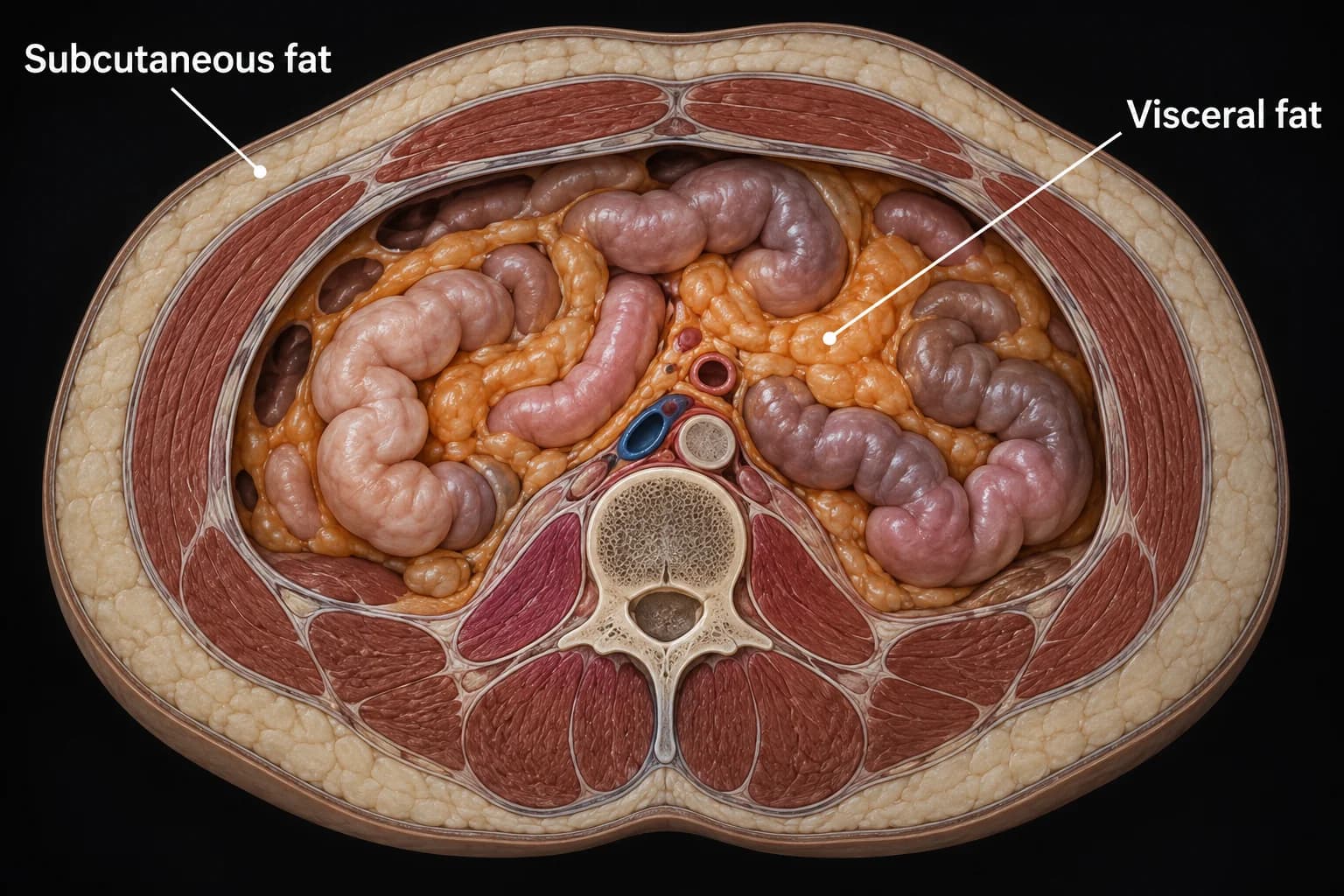
The cutaway distinguishes the two fat compartments discussed in the trial results.
In the pivotal phase 3 program, tesamorelin reduced visceral adipose tissue (measured by CT scan) by roughly 14 to 18 percent over 26 weeks compared to placebo, reduced trunk fat, and increased lean body mass by approximately 1.2 to 1.3 kg. The effects were specific to the visceral compartment rather than representing generalized weight loss, and they reversed on discontinuation.14 For context, there is no other compound in the whole GH-axis lane with a 26-week controlled human dataset of that specificity.
Tesamorelin is not a weight-loss drug, and the EGRIFTA prescribing information explicitly says so. That is an important honesty boundary, not a downgrade. The mechanism is targeted at visceral adiposity and GH-axis restoration, not at driving a calorie deficit. For a lifter, the practical read is that tesamorelin is the strongest candidate in the whole category if the goal is visceral-fat reduction alongside modest lean-mass support, and it is not the right tool if the goal is overall fat loss.
Who the trial population was, and the extrapolation caveat
The approved indication is reduction of excess abdominal fat in HIV-infected adults with lipodystrophy, and the pivotal trials enrolled exactly that population. Applying those outcome numbers directly to a healthy 35-year-old lifter chasing leaner abs for summer is an inference, not direct proof. The mechanism is the same, but the baseline body-composition picture, the inflammatory environment, and the concurrent medication profile are not. Real off-label use of tesamorelin happens. It is a physician judgment call in a legitimate clinical relationship, not a telehealth intake form decision.
Safety monitoring, briefly
The FDA medical review flagged two recurring signals: IGF-1 elevation (expected given the GH-releasing mechanism, worth monitoring given theoretical long-term IGF-1 risk questions) and glucose-tolerance changes in a subset of patients.14 Neither is disqualifying, and both are manageable through the monitoring protocol in the practical caution box below. For a patient with insulin resistance, prediabetes, or existing malignancy concerns, the glucose and IGF-1 signals raise the bar for initiating therapy, not an absolute stop.
Reversal on discontinuation
Visceral fat returns after stopping tesamorelin. That means the decision to start is also implicitly a decision about how long to stay on. This is not unique to tesamorelin; weight lost on any pharmacological intervention tends to return when the intervention stops. But the on-off math belongs in the initial conversation, not two years later.
The legitimate pathway
A legitimate tesamorelin conversation involves a physician (usually endocrinology, infectious disease, or obesity medicine) who understands the HIV-lipodystrophy data, the off-label extrapolation, IGF-1 and glucose monitoring, cost, and the expected 26-week time horizon for evaluation. It does not look like a three-question DTC intake form followed by a vial in the mail.
Tier 2: Sermorelin
Sermorelin is a GHRH(1-29) analog with a complicated regulatory biography that is usually told badly. The short honest version:
- The original FDA-approved products were Geref Diagnostic (for pituitary function evaluation) and Geref (for pediatric idiopathic GH deficiency). Both NDAs were withdrawn from the US market.
- Importantly, the FDA's formal determination was that Geref was not withdrawn for reasons of safety or effectiveness.20 The products left the market for commercial reasons. That distinction matters, because most peptide writing collapses "withdrawn" into "unsafe or ineffective," which is not what the Federal Register says.
- The current sermorelin supply is almost entirely compounded, not manufactured under an active NDA. Compounded drugs do not get the same manufacturing oversight, stability data, or post-market surveillance as FDA-approved products, and source quality varies widely between compounding pharmacies.
The human evidence base on GHRH(1-29) is older and thinner than tesamorelin's, but it is not imaginary. Older studies in adult GH-deficient and healthy-older-adult populations showed real pulsatile GH release, IGF-1 elevation, and signals toward favorable body-composition and metabolic effects. Those studies would not pass today's statistical-power expectations, but they are not nothing, and framing sermorelin as equivalent to BPC-157 on the evidence axis is inaccurate.
For a lifter, the honest read on sermorelin is: real GH-axis activity, older and thinner outcome data than tesamorelin, and a supply picture that depends entirely on the quality of the compounding pharmacy involved. Not fringe. Not first choice. And for a tested athlete, prohibited under WADA S2 at all times, regardless of whether the prescription came from a physician.
Tier 3: Ipamorelin, CJC-1295, and GHRP stacks
This is where the pretending stops. Ipamorelin (a ghrelin-receptor-selective GHRP) and CJC-1295 (a GHRH analog, commonly with a Drug Affinity Complex modification that extends its half-life) are not FDA-approved. They have not been through the modern trial process required for approval. At the same time, small human pharmacokinetic and pharmacodynamic studies show that the compounds do what their mechanism predicts: they raise GH and IGF-1 in humans at expected doses, with a more selective profile than older GHRPs.21 The biology is real. The category is not a scam. What is missing is large randomized controlled trials directly measuring body-composition outcomes in the population that uses them most.
Where the category gets genuinely risky is on the third axis: source quality. Most ipamorelin and CJC-1295 sold in the US sits in one of two supply channels. The better channel is a US licensed compounding pharmacy operating under 503A or 503B with some degree of characterization testing. The worse channel is a research-chemical website shipping vials from overseas manufacturing facilities, frequently traced to Chinese API and finished-product suppliers that do not operate under FDA Current Good Manufacturing Practice, do not run purity or sterility testing that meets injectable standards, and do not produce batch-consistency data you can audit. For an injectable, that is the worst possible failure mode to inherit. Contamination with a pyrogen or endotoxin, a peptide that is not what the label says it is, or a dose that is 30 percent off is a problem no amount of training, protein, or monitoring can correct for. The FDA has specifically called out several GHRH and GHRP compounds in bulk compounding contexts because of exactly these characterization and safety concerns.22
The community pattern around these compounds is consistent enough to state plainly:
What users actually report in the first 4 to 12 weeks on ipamorelin and CJC-1295
- Deeper sleep, measurable on rings and watches as increased deep-sleep minutes. - Faster recovery between hard training sessions. - Increased fullness and vascularity, often interpreted as muscle gain but largely water and glycogen shift. - Some report appetite changes and occasional water retention. - Body-composition changes, when reported, are slower and heavily confounded by concurrent GLP-1s, TRT, training blocks, and calorie intake.
Treat this as signal direction, not proof of outcome. The Reddit and forum base rate for "tried it, noticed something" is real. The base rate for "ran a clean controlled experiment that isolated the peptide" is effectively zero.
For tested athletes, ipamorelin and CJC-1295 are prohibited under WADA S2 at all times. A doping violation does not distinguish between "I bought it from a clinic" and "I bought it from a website." The compound is what the testing detects.
Decision framework for GH-axis peptides
| Situation | Honest read | Recommended action |
|---|---|---|
| HIV-associated lipodystrophy with visceral fat accumulation | Tesamorelin is FDA-approved for exactly this. Strongest data in the whole lane. | Work with an infectious disease or endocrinology specialist. |
| Visceral fat accumulation without the HIV indication | Off-label tesamorelin is a real physician-judgment option with the best outcome data in the GH-axis lane, but it is an inference from the trial population, not direct proof. | Endocrinology or obesity-medicine referral. Expect IGF-1 and glucose monitoring, a 26-week evaluation horizon, and a plan for discontinuation. |
| Adult interested in sermorelin for GH-axis support | Legacy clinical peptide with older human data and compounded-only current supply. Withdrawal from market was not for safety or efficacy reasons. | If pursued, use a reputable 503A/503B compounding pharmacy with characterization testing. Do not assume compounded equals clinical-grade. |
| Adult interested in ipamorelin or CJC-1295 for recomposition or recovery | Real human endocrine activity, weak direct recomposition outcome data, real source-quality risk on most grey-market supply. | If pursued, insist on US-licensed compounding-pharmacy supply with third-party COA. Do not use research-chemical sites. |
| Tested athlete considering any GH-axis peptide | Entire lane is WADA S2 at all times. | Do not use. TUE is not a realistic path for recomposition goals in a healthy athlete. |
| The recomposition floor is not in place | A peptide is trying to fix an adherence problem with pharmacology. | Fix the floor first. It outperforms any peptide for most lifters and carries no IGF-1, glucose, or injectable risk. |
06GH-axis monitoring and practical caution box
This is the practical peptide-literacy version of the caution box. The aim is not to talk you out of the category. The aim is to make sure that if you use anything in the GH-axis lane, you are watching the things that actually go wrong.
Before starting any GH-axis peptide, run a baseline. Repeat on the schedule below.
- IGF-1. Baseline, then every 8 to 12 weeks. The goal is to keep IGF-1 in the age-adjusted normal-to-upper range, not above it. Chronically supra-physiological IGF-1 is the signal the whole lane needs to be dosed down or paused. - Fasting glucose and HbA1c. Baseline, then every 12 weeks. Tesamorelin and, less directly, other GH-axis compounds can worsen glucose tolerance in a subset of users. - Edema and fluid retention. Track daily weight variability, ankle or finger puffiness, and blood pressure. Sudden retention usually means dose is too high. - Carpal-tunnel-type symptoms. Hand numbness, tingling, morning stiffness in the fingers. Classic GH-excess signal. Dose-dependent and reversible on reduction. - Waist circumference and periodic DEXA. Waist weekly, DEXA every 12 to 16 weeks. This is how you know the peptide is producing visceral-fat and lean-mass effects rather than scale noise. - Anchor-lift performance. Two consecutive weeks of unexplained strength decline is a recovery or fueling signal, not a reason to raise the dose. - WADA status for tested populations. Entire GH-axis lane is S2 prohibited at all times. Not a grey area. - Source quality audit. If the vial came from a research-chemical website, stop. The other markers do not matter if the peptide in the vial is not the peptide on the label. Insist on a US-licensed pharmacy, a certificate of analysis from an independent lab, and clear chain of custody.
Before pursuing any GH-axis compound, confirm that the recomposition floor conditions are met. Protein above 1.6 g/kg, three to four compound-lift sessions per week, and a monitored 14-day weight trend is the platform. Peptides add to that platform. They do not substitute for it.
Clinic red flags that still hold, regardless of how pro-peptide the tone is: the clinic markets every peptide with identical enthusiasm; the intake has no meaningful history, exam, or labs; compounded peptides are described as equivalent to FDA-approved drugs; the marketing leans on "bio-optimization" without specifying a condition or outcome; the clinic discourages involving your primary care physician. Any one of those patterns is a reason to slow down and get a second opinion from someone without a financial interest in the prescription.
07Research peptides sit in a separate risk lane
Research peptides belong to a different lane than GH-axis peptides. BPC-157 and TB-500 are claimed for tissue repair, not recomposition. Even on the repair claim, the evidence is predominantly preclinical. And the supply chain is where the real danger lives, not the pharmacology.
Defining the category
Research peptides are compounds sold with "for research use only" or "not for human consumption" labeling that have no approved human therapeutic use from any global regulatory authority. The label language is not a purity marker. It is a legal shield that lets vendors sell compounds intended for human use while disclaiming responsibility for human outcomes.
The FDA has addressed this pattern directly. The agency's warning on unapproved GLP-1 drugs used for weight loss extends to the broader peptide supply chain and explicitly calls out products marketed as "for research purposes" or "not for human consumption" when the actual marketing, packaging, and distribution channels make human use obvious. When a website sells BPC-157 in a vial alongside dosing instructions, bacteriostatic water, and insulin syringes while printing "not for human consumption" on the label, the label is contradicted by every other signal the vendor is sending.
The source-quality problem is the real problem
Most of the research-peptide supply that ends up in US lifters' drawers is finished or sourced overseas, with a large share traced to Chinese API manufacturers and finished-vial suppliers. Export quality from that segment of the market is notorious for a specific cluster of failures that are exactly what you do not want in an injectable:
- Purity variance. Independent analyses of research peptides purchased online have repeatedly found labeled peptide content that is dramatically off from the stated dose, as well as measurable levels of unidentified byproducts.
- Sterility and endotoxin risk. Vials are frequently reconstituted from non-sterile lyophilized powder in environments that do not meet injectable manufacturing standards. Bacterial endotoxin contamination is a real failure mode and a real ER visit.
- Misidentification. Some vials contain structurally related but different peptides than the label claims, because upstream synthesis was sloppy or the mailing label was wrong.
- Zero batch consistency. Two vials from the same vendor bought two months apart are effectively two different products, with no lot-control, no retained samples, and no recall mechanism.
- No adverse-event reporting. If the vial sends you to the hospital, nothing you learn there gets back to anyone else buying from the same source.
For an oral supplement, a sloppy supply chain is a money problem and a mild health problem. For an injectable, contamination is the category of problem you cannot train, eat, or sleep your way out of. This is the honest safety conversation that most "peptide literacy" content skips. It is not paranoid. It is the single biggest variable in whether any given research-peptide decision goes wrong.
Even domestic US compounded supply is not automatically clean on this axis. A reputable 503A or 503B compounder with characterization testing is categorically better than an overseas research-chemical vendor, but both sit below FDA-approved manufacturing on the source-quality ladder. For approved drugs like semaglutide and tirzepatide, sourcing through a licensed pharmacy avoids most of this problem entirely. For research peptides, there is no equivalent clean option.
The argument that "it is legal to buy" is not a safety argument. The legal status of research peptides reflects a regulatory gap, not an affirmative determination of safety.
BPC-157
BPC-157, or Body Protection Compound-157, is a synthetic peptide derived from a protein found in human gastric juice. It has generated substantial interest in fitness and injury-recovery communities because of animal studies showing accelerated healing of tendons, ligaments, muscles, and other tissues in rodent models.
Animal data
The preclinical signal is real, and it is the reason the compound attracted attention in the first place. Studies in rats have shown that BPC-157 promotes angiogenesis, accelerates tendon healing, and reduces inflammation through mechanisms that include modulation of nitric oxide pathways and growth factor expression.
Human evidence gap
There are no published large randomized controlled trials demonstrating that BPC-157 produces clinically meaningful tissue repair, recovery acceleration, or body-composition benefits in humans. The gap between what the animal studies suggest and what has been demonstrated in human trials is the central problem with BPC-157 as a practical recommendation. Mechanism studies in rodents do not establish efficacy in humans. Dose translation from animal models to human use is not straightforward. And the safety profile in humans at the doses commonly used by self-experimenters has not been characterized through the kind of systematic study that would be required for regulatory approval.
USADA position
USADA's advisory on BPC-157 is unambiguous. The compound is prohibited under the WADA Prohibited List category S0, which covers Unapproved Substances. USADA states that BPC-157 is not approved for human clinical use by any global regulatory authority and that there is not enough human study to establish a safe dose or safe use pattern. USADA further notes that websites continue to sell BPC-157 as a "research chemical" while providing human-use suggestions, and the agency treats that pattern as a warning sign.
The telephone problem
The narrative that surrounds BPC-157 in gym culture is the "Wolverine peptide" story: a compound that heals everything, has no side effects, and just needs more research before it becomes mainstream. That narrative is built on animal data, anecdotes, and the assumption that absence of evidence of harm is the same as evidence of safety.
A rodent study shows that BPC-157 accelerates Achilles tendon healing in rats. That study gets cited in a blog post, which gets summarized in a forum thread, which gets mentioned on a podcast, which reaches a man with patellar tendonitis who is twelve weeks out from a HYROX event. By the time the information reaches him, it has been stripped of every qualifier that made the original study honest. The species difference is gone. The dose-translation uncertainty is gone. The fact that no one has demonstrated this effect in a controlled human trial is gone. What remains is a clean story: this peptide heals tendons.
Animal studies are hypothesis generators, not treatment recommendations. They tell us that a mechanism is plausible and worth studying further. They do not tell us that injecting a compound purchased from an unregulated vendor will produce the same effect in a human at the dose listed on a forum post.
For the recomposition audience specifically, BPC-157 has no relevance to fat loss, muscle gain, or body-composition improvement. Its claimed benefits are entirely in the tissue-repair and recovery domain. Even granting the most optimistic interpretation of the preclinical data, BPC-157 does not belong in a recomposition protocol.
For tested athletes in any federation, the answer is simple. BPC-157 is prohibited, the supply chain is unregulated, and using it risks both a doping violation and exposure to an unknown substance profile.
TB-500
TB-500 is a synthetic version of a region of thymosin beta-4, a protein involved in cell migration, angiogenesis, and wound healing. The mechanism hypothesis is that TB-500 promotes tissue repair and reduces inflammation by upregulating actin and facilitating cell movement to injury sites.
The evidence picture is similar to BPC-157 but thinner. There are in vitro and animal studies supporting the mechanistic hypothesis, but the published human evidence for TB-500 as a recovery or body-composition tool consists primarily of case reports and anecdotes. There are no large controlled human trials.
TB-500 is prohibited under the WADA framework. Like BPC-157, it falls under the category of unapproved substances, and its use by any athlete subject to anti-doping testing constitutes a violation.
The common practice of stacking TB-500 with BPC-157 compounds the problems rather than solving them. Each compound individually carries supply-chain risk, dosing uncertainty, and a weak human evidence base. Combining them does not produce a cleaner risk-benefit picture. It produces a more uncertain one, because the interaction effects of two poorly characterized compounds in an uncontrolled manufacturing environment are unknown.
Peptide stacks and amplification risk
The concept of a "peptide stack" borrows language from bodybuilding culture, where stacking refers to combining multiple compounds to amplify effects. In the context of approved pharmaceuticals with known pharmacokinetics and drug-interaction profiles, combination therapy can be rational and evidence-based. In the context of research peptides, stacking amplifies uncertainty rather than efficacy.
When two compounds each have weak or absent human evidence profiles, combining them does not produce strong evidence. It produces compounded uncertainty. You do not know what compound A does in humans at the dose you are taking. You do not know what compound B does in humans at the dose you are taking. You cannot know what the combination does, because nobody has studied it in a controlled setting with the population you belong to.
Contamination and dosing accuracy problems multiply with stacking. If one vial has a 20 percent chance of containing a concentration that differs meaningfully from the label, two vials from the same vendor do not reduce that probability. They create two independent opportunities for error.
For men aged 25 to 55 without pathology, the specific risks of research peptide stacks include exposure to unknown contaminants, immune reactions to impurities, IGF-1 elevation from GH-axis compounds without monitoring, and the psychological cost of building a recovery strategy around compounds whose effects you cannot verify.
Honest risk-benefit table for research peptides
| Compound | Claimed Benefit | Human Evidence Quality | Regulatory Status | Athlete Prohibited Status | Supply Chain Risk |
|---|---|---|---|---|---|
| BPC-157 | Tendon and tissue healing, gut repair, anti-inflammation | Very low. Preclinical data only. No large human RCTs. | Not approved for human use by any regulatory authority. | Prohibited under WADA S0. USADA has issued explicit warnings. | High. No GMP manufacturing, no purity assurance, no batch consistency. |
| TB-500 | Tissue repair, reduced inflammation, improved recovery | Very low. Preclinical and anecdotal only. | Not approved for human use by any regulatory authority. | Prohibited under WADA S0. | High. Same supply chain concerns as BPC-157. |
| CJC-1295 | Increased GH secretion, fat loss, recovery | Low. Small PK/PD studies. No large body-composition RCTs. | Not approved for any indication. | Prohibited under WADA S2. | High. Often sold alongside ipamorelin in unregulated combinations. |
| Ipamorelin | Increased GH secretion, fat loss, improved sleep | Low. Small PK/PD studies. No large body-composition RCTs. | Not approved for any indication. | Prohibited under WADA S2. | High. Same concerns as CJC-1295. |
What to do instead
The gap that research peptides claim to fill is usually a recovery gap, an injury-recovery gap, or a body-composition-progress gap. In nearly every case, the gap has identifiable causes that respond to evidence-based interventions.
Load management
Load management is the most underused tool in the recovery toolbox for men who train hard. Progressive overload does not mean progressive recklessness. When tendon pain, joint soreness, or soft-tissue complaints accumulate, the first intervention is intelligent load modification.
Practical load management looks like this: schedule a deload every four to six weeks where volume drops by 40 to 50 percent while intensity stays moderate. Use RPE-based autoregulation to back off on days when readiness is low rather than grinding through a prescribed number. For tendon complaints specifically, increase loading no more than 10 percent per week and distinguish between structural injury (sharp, localized, getting worse) and overuse adaptation (dull, diffuse, improving with warm-up). The first needs imaging and a sports medicine evaluation. The second needs patience and load management.
Sleep quality and duration
Sleep quality and duration are the single largest modifiable factor in recovery for most men who train. Chronic sleep restriction impairs muscle protein synthesis, increases cortisol, reduces testosterone, and degrades training quality. The practical targets are straightforward. Aim for seven to nine hours of sleep per night. Keep your room cool (65 to 68 degrees Fahrenheit is the most commonly recommended range). Limit bright light exposure in the two hours before bed. Maintain a consistent wake time, even on weekends, because circadian consistency improves sleep architecture more reliably than any supplement.
Sleep is also when the majority of growth hormone release occurs in healthy adults. Men who are considering GH-axis peptides while sleeping six hours per night are trying to pharmacologically replace a signal that their own pituitary would produce if they went to bed on time. Fixing sleep will do more for recovery than any peptide stack, and it costs nothing.
Protein sufficiency
Protein sufficiency protects both muscle and connective tissue during a deficit. If your protein intake is below 1.6 g/kg and you are in a caloric deficit, your tissues are under-resourced for repair. Fixing that before adding a compound is the right sequence.
Collagen peptides plus Vitamin C
Collagen peptides plus Vitamin C, taken before training, represent the closest thing to a research-peptide alternative with an actual evidence signal for connective-tissue support. The protocol, based on the work of Keith Baar and colleagues, involves 15 grams of hydrolyzed collagen or gelatin plus 50 mg of Vitamin C consumed 30 to 60 minutes before a loading session targeted at the affected tissue.15 The evidence base is small and the clinical outcomes are still being established, but the risk profile is categorically different from injecting an unregulated research compound.
Progressive overload
Progressive overload, applied intelligently, is the primary stimulus for tissue adaptation. Tendons, ligaments, and muscles all respond to mechanical loading by getting stronger. The response is slow, especially for tendons, which is why patience with loading progression matters more than acceleration through pharmacology.
The evidence-based rehabilitation pathway
The evidence-based rehabilitation pathway for a genuine injury follows a sequence that research peptides skip entirely:

Supervised loading provides a concrete setting for assessment, progression, and reassessment.
- Symptom assessment. Characterize the pain: location, onset pattern, aggravating movements, response to warm-up.
- Imaging if indicated. A sports medicine physician can determine whether ultrasound or MRI is warranted based on the clinical picture.
- Load-modified training. Maintain fitness in areas that do not stress the injured tissue. Remove the provocative stimulus while preserving everything else.
- Targeted physical therapy. Progressive loading specific to the injured structure, guided by a physiotherapist who understands athletic populations.
- Collagen plus Vitamin C protocol. 15 grams of hydrolyzed collagen plus 50 mg Vitamin C, 30 to 60 minutes before targeted loading of the affected tissue.
- Reassessment at four to six weeks. Evaluate progress, adjust the rehabilitation plan, and determine whether additional interventions (PRP, further imaging, surgical referral) are warranted.
If you are a man who has been considering research peptides for injury recovery, the most productive first step is to book an appointment with a sports medicine physician and describe the problem honestly. Bring your training log. Bring your injury history. Ask what the diagnosis is, what the evidence-based treatment options are, and what the expected recovery timeline looks like.
08Collagen peptides support tissue not muscle protein
Collagen Peptides Are a Supplement, Not a Drug
Collagen peptides get lumped in with drug-grade peptides because of semantic confusion. When someone searches for "peptides for body recomposition," the results often include collagen supplements alongside semaglutide and BPC-157 as though they are all part of the same conversation. They are not. Collagen peptides are a supplement. They are not a therapeutic drug, not a growth hormone modulator, and not a research compound. They belong in a completely separate decision lane, and confusing them with any of the other three categories leads to bad tracking, bad expectations, and bad protein math.
The tracking error
The most common practical mistake involving collagen is counting it as a complete protein source. Collagen is not a complete protein. It is rich in glycine, proline, and hydroxyproline but deficient in the essential amino acids, particularly leucine, that drive muscle protein synthesis. A man who logs 20 grams of collagen as 20 grams of protein in his food tracker and then uses that number to calculate whether he hit his leucine-driven protein floor is fooling his own log.
| Source (20 g serving) | Leucine Content | Muscle Protein Synthesis Signal |
|---|---|---|
| Whey protein | ~2.5 g | Strong. Exceeds the leucine threshold for most adults. |
| Chicken breast | ~1.8 g | Strong when combined with a full meal. |
| Collagen peptides | ~0.3 g | None. Well below the leucine threshold at any practical serving size. |
If your daily protein target is 160 grams and you are counting 20 grams from a collagen supplement, your effective protein intake for muscle-retention purposes is closer to 140 grams of complete protein. On a day when appetite is low because of GLP-1 medication, that 20-gram gap can be the difference between hitting the leucine threshold at your meals and missing it.
The guidance for logging collagen in Fuel is to track it as a supplement, not as a primary protein source. Log it for transparency and total-calorie accuracy, but do not count it toward your leucine-driven protein floor. Build your three to four protein feedings per day around complete protein sources like whey, casein, eggs, dairy, meat, fish, soy, or legume combinations. Then add collagen on top if you are using it for connective-tissue support.
What tendon and joint evidence actually shows
The Baar protocol
The most cited research on collagen peptides and connective tissue comes from the work of Keith Baar and Greg Shaw at the Australian Institute of Sport. Their protocol involves consuming gelatin or hydrolyzed collagen enriched with Vitamin C before a targeted loading session. The proposed mechanism is that collagen-derived amino acids, particularly glycine and proline, are taken up by fibroblasts and used to synthesize new collagen in tendons and ligaments, and that the Vitamin C serves as a cofactor for the hydroxylation step in collagen synthesis.15
The Shaw and Baar studies showed that gelatin plus Vitamin C supplementation increased collagen synthesis markers and improved the mechanical properties of engineered ligaments in vitro. Subsequent small human studies have shown increases in collagen synthesis biomarkers after supplementation, and some clinical trials have reported modest improvements in joint pain scores or functional outcomes in populations with osteoarthritis or exercise-related joint discomfort.
The honest summary of this evidence is: promising signal, not established clinical practice. The studies are generally small, the clinical outcomes are modest, and the translation from collagen synthesis biomarkers to meaningful injury prevention or tissue repair in trained athletes is still being established. Collagen supplementation for connective-tissue support is plausible but unproven. The risk is low, the cost is low, the mechanism is reasonable, and there are small studies showing positive signals. That makes it a reasonable thing to try if you are managing tendon or joint stress during heavy training.
For a man trying to support his tendons and joints during a hard training block, collagen plus Vitamin C before targeted loading is a reasonable, low-downside addition to a broader recovery strategy. It should not be the cornerstone of that strategy, and it does not replace load management, sleep, overall protein adequacy, or sports medicine evaluation when genuine tissue problems arise.
Sourcing, dose, and timing
Sourcing
Hydrolyzed collagen and gelatin are the two main supplemental forms. Hydrolyzed collagen dissolves easily in cold or warm liquids and is the most practical form for daily use. Gelatin requires warm liquid to dissolve and sets when cooled, which makes it less convenient for shakes but useful for making gummy-style supplements or adding to hot foods.
Raw collagen, as found in bone broth or slow-cooked connective tissue, provides collagen-derived amino acids but in less standardized amounts. For the purposes of a targeted connective-tissue protocol, hydrolyzed collagen or gelatin with a known gram amount is more practical than estimating collagen intake from whole foods.
Dose and timing
The evidence-based dose range for the Baar protocol is approximately 15 grams of hydrolyzed collagen or gelatin combined with at least 50 mg of Vitamin C, consumed 30 to 60 minutes before a targeted loading session for the connective tissue in question. The loading session can be as simple as an isometric hold or a light eccentric exercise for the affected tendon, performed in the window when collagen-derived amino acids are circulating.
Supplement labels often recommend lower doses, such as 5 to 10 grams per day, and make broad claims about skin, hair, and joint health. The research that supports connective-tissue benefit uses higher doses in a more specific protocol. If you are using collagen for tendon or joint support, dose and timing according to the research protocol rather than the marketing dose.
09Emerging Compounds and the Pipeline
The GLP-1 landscape is changing faster than any other area of obesity pharmacotherapy. Several compounds in development will enter the recomposition conversation over the next one to three years. Orforglipron is included here for context, but it is now FDA-approved as Foundayo.24 Understanding what is coming helps you evaluate marketing claims, recognize when a clinic is selling you access to an unapproved compound, and plan your own timeline.
The same recomposition principles apply to every compound below. Greater weight loss means greater absolute lean-mass exposure. The protein floor, resistance training signal, and rate-of-loss monitoring do not change because the drug changed. They become more important as the drugs become more powerful.
Survodutide
Survodutide is a dual glucagon and GLP-1 receptor agonist developed by Boehringer Ingelheim. The glucagon receptor agonism distinguishes it from tirzepatide (which acts on GIP and GLP-1) and makes the metabolic mechanism different. Glucagon receptor activation increases energy expenditure and promotes hepatic fat oxidation, which may contribute to fat loss through a pathway that GLP-1-only drugs do not access.
Phase 2 data
In the phase 2 obesity trial, survodutide at the highest tested dose produced a mean weight loss of approximately 18.7 percent at 46 weeks compared to placebo.16 The NAFLD/NASH data has been particularly notable, with survodutide showing meaningful reductions in liver fat content, which is relevant for men with metabolic syndrome who carry visceral and hepatic fat alongside subcutaneous fat.23
Survodutide is currently in Phase 3 development. It is not FDA-approved and is not available through any legitimate prescribing pathway.
Orforglipron
Orforglipron is an oral nonpeptide GLP-1 receptor agonist developed by Eli Lilly and approved as Foundayo for adults with obesity or overweight with at least one weight-related comorbid condition.24 Oral GLP-1 options now include Foundayo and oral Wegovy, alongside injectable semaglutide and tirzepatide products.2425
Phase 2 data
The phase 2 trial published in the New England Journal of Medicine showed a mean weight loss of up to 14.7 percent at 36 weeks with orforglipron compared to placebo.17 Subsequent 72-week ATTAIN-1 data are summarized in Foundayo (Orforglipron): What the ATTAIN-1 Trial Data Actually Show.
Orforglipron is no longer a pipeline-only compound in the United States: Foundayo is FDA-approved for adults with obesity or overweight with at least one weight-related comorbid condition.24
For lifters, an oral GLP-1 changes the access equation but does not change the lean-mass protection equation. The same protein floor, training signal, and monitoring guardrails apply.
Amycretin
Amycretin is a dual amylin and GLP-1 receptor agonist developed by Novo Nordisk. Amylin is a hormone co-secreted with insulin from pancreatic beta cells that contributes to satiety signaling and gastric emptying. The dual mechanism targets appetite through two complementary pathways.
Early phase data
In early-phase results, amycretin produced a mean weight loss of approximately 13 percent at 12 weeks, which is a striking rate given the short duration.18 If that trajectory holds through longer treatment periods, amycretin could produce weight-loss magnitudes that exceed current options.
Amycretin is in early clinical development. No Phase 3 data is available, and FDA approval is likely several years away.
CagriSema
CagriSema is a fixed-dose combination of cagrilintide (a long-acting amylin analog) and semaglutide, also developed by Novo Nordisk. The rationale is similar to amycretin: combining amylin-pathway and GLP-1-pathway appetite suppression in a single product.
Phase 3 status
The REDEFINE Phase 3 program has reported results showing CagriSema produced greater weight loss than semaglutide alone.19 The combination approach suggests that the ceiling for pharmacological weight loss has not yet been reached.
Pipeline summary
| Compound | Mechanism | Development Stage | Key Data Point | Recomposition Relevance |
|---|---|---|---|---|
| Survodutide | Dual glucagon/GLP-1 | Phase 3 | ~18.7% weight loss at 46 weeks (Phase 2) | High interest. Glucagon component may increase energy expenditure. Same lean-mass protection needs. |
| Orforglipron | Oral GLP-1 (nonpeptide) | FDA-approved as Foundayo24 | −11.2% at 72 weeks (ATTAIN-1 treatment-regimen estimand, 36 mg capsule)26 | Changes access and cost equation. Same protein/training requirements. |
| Amycretin | Dual amylin/GLP-1 | Early phase | ~13% weight loss at 12 weeks | Rapid early signal. Very early data. Watch for body-composition sub-analyses. |
| CagriSema | Cagrilintide + semaglutide | Phase 3 | Greater weight loss than semaglutide alone | Combination may set new ceiling. Greater weight loss means greater lean-mass vigilance. |
Every compound in this table will eventually face the same question that semaglutide and tirzepatide face today: what happens to lean mass when weight drops this fast? The answer will be the same. Protein intake, resistance training, and rate-of-loss monitoring determine whether the weight you lose is mostly fat or an expensive mix of fat and muscle. The drug changes. The protection protocol does not.
10Decide the stack only after the floor is solid
Decision tree
The table below routes you to the correct category and the correct set of questions based on your actual situation, so marketing or peer pressure does not push you toward a category that does not fit.
| Your situation | Correct category | Key questions to ask | What to avoid |
|---|---|---|---|
| Physician-managed obesity care. BMI qualifies. Medical history reviewed. | GLP-1 and obesity medications. | Which medication fits my profile. What is the titration plan. What protein and training guardrails do I need. How will we monitor body composition, not just weight. | Treating the prescription like a standalone solution. Ignoring protein, training, and rate-of-loss monitoring. |
| Physician-managed care for HIV-associated lipodystrophy or specific visceral fat indication. | Growth hormone secretagogues, specifically tesamorelin. | Am I a candidate for tesamorelin based on the approved indication. What monitoring is required. What are the IGF-1 and glucose risks. | Assuming tesamorelin is a general cutting drug. Using a DTC clinic that skips real evaluation. |
| Healthy lifter interested in GH optimization with no specific pathology. | None of the above has a clean pathway. Focus on training, nutrition, and sleep first. | Have I actually optimized the basics. Am I sleeping 7 to 9 hours. Is my protein floor set. Is my training progressive and well-managed. | Jumping to GH-axis compounds before the fundamentals are in place. Using non-approved compounds from grey-market sources. |
| Competitive athlete subject to anti-doping testing. | Verify every compound against the current WADA Prohibited List before use. | Is this substance prohibited in competition, out of competition, or at all times. Do I need a TUE. Can my prescribing physician document the clinical need. | Relying on "my clinic said it was fine" without checking USADA or WADA directly. |
| Injury recovery with desire to accelerate healing. | Evidence-based load management, collagen plus Vitamin C, sports medicine referral. | What does the specific tissue injury require in terms of loading, rest, and rehabilitation. Is physical therapy indicated. Do I need imaging. | Buying BPC-157 or TB-500 from a research-chemical website. Self-treating a structural injury with an uncharacterized compound. |
| Tendon or joint support during heavy training blocks. | Collagen peptides. | Am I dosing according to the research protocol. Am I timing it before targeted loading. Am I counting it separately from complete protein. | Counting collagen toward the leucine-driven protein floor. Expecting collagen to replace intelligent load management. |
Before any peptide conversation
Before you spend any time evaluating which peptide category might apply to you, confirm that the three conditions from the recomposition floor are in place: daily protein at or above 1.6 g/kg of complete protein across three to four feedings, resistance training at least three times per week with compound movements, and a monitored rate of loss via 14-day weight trend. If any of those conditions is missing, the most productive next step is setting the floor in Fuel rather than evaluating compounds.
What Fuel tracks and why it matters
Timeline audit
The Timeline audit in Fuel is built around the principle that rate of loss matters as much as total loss. When you review your Timeline, you can see whether your 14-day weight trend is dropping at a pace your training can survive or whether it is running too fast. The Timeline audit is the first place to look when you suspect that appetite suppression is outrunning your protein strategy.
Meal-level protein tracking
Protein targets during GLP-1 use are tracked per meal and per day, which matters because on these drugs, the daily total can look adequate while individual meals fall well below the leucine threshold. If your tracker shows 170 grams of protein but two of your four meals had less than 20 grams each, the daily number is misleading. Fuel's meal-level tracking catches that pattern.
Setting targets
To set your recomposition targets in Fuel, use the goals flow to establish your protein floor, your rate-of-loss target, and your training frequency. Then use weekly review to audit compliance against those targets each week. The weekly review is where you catch the drift that accumulates over days and turns into lost lean mass over months.
Apple Health integration
If your Apple Health data is incomplete, fix Apple Health permissions before you start interpreting calorie burn, recovery trends, or activity data. Bad input produces bad insights, and the most common reason for misleading health data in Fuel is a permissions gap that prevents the app from reading the full picture.
Health Grade
The Health Grade in Fuel reflects the combined quality of your nutrition, training compliance, and body-composition trajectory during a cut. When the Health Grade drops during a cutting phase, it is usually catching a familiar failure mode: protein falling below the floor, training frequency declining, or rate of loss exceeding what the body can sustain without lean-mass erosion.
Evidence tier summary table
Three-axis read per compound: mechanistic activity in humans, direct human recomposition outcomes, source quality. WADA status is kept separate because it can trump everything else for tested athletes.
| Compound | Category (tier) | Mechanism in humans | Human recomp outcomes | Source quality | WADA 2026 status | Recomposition relevance |
|---|---|---|---|---|---|---|
| Semaglutide | GLP-1 and obesity medication | High. Appetite, gastric emptying, glycemic. | Strong. Large STEP-program RCTs with body-composition sub-analyses. | High through licensed pharmacy. Grey-market supply is a different product. | Not prohibited. | High. Strongest evidence for sustained fat loss when protein and training guardrails hold. |
| Tirzepatide | GLP-1 and obesity medication | High. Dual GIP/GLP-1 co-agonism. | Strong. SURMOUNT program shows greater weight loss than semaglutide. | High through licensed pharmacy. | Not prohibited. | High. Greater total weight loss raises absolute lean-mass exposure. |
| Retatrutide | GLP-1 and obesity medication (emerging) | High (early). Triple GLP-1/GIP/glucagon. | Moderate. Phase 2 shows largest weight-loss numbers to date; phase 3 ongoing. | Not yet FDA-approved; cannot be lawfully compounded. | Verify at time of use. | Emerging. Strongest early signal but no legitimate supply path outside a registered trial. |
| Tesamorelin | GH-axis, Tier 1 | High. GHRH analog. | Strongest in the GH-axis lane: ~14–18% VAT reduction, ~1.2–1.3 kg LBM gain at 26 weeks. | FDA-approved (EGRIFTA) through licensed pharmacy. | Prohibited under S2 at all times. | Real. Anchor compound of the GH-axis lane. Off-label use is specialist judgment. |
| Sermorelin | GH-axis, Tier 2 | High. GHRH(1-29). | Thinner but real. Older studies show GH-axis activation and some metabolic signal. | Compounded; original NDA withdrawn for commercial, not safety/efficacy. | Prohibited under S2 at all times. | Legitimate legacy clinical peptide. Evidence older and thinner than tesamorelin. |
| CJC-1295 | GH-axis, Tier 3 | Real. Small human PK/PD studies show GH/IGF-1 rise. | Weak. No large body-composition RCTs. Strong n-of-1 user base. | High risk. Mostly compounded or overseas grey-market. | Prohibited under S2 at all times. | Mechanistically active, outcome-light. Source quality often decides whether use is safe. |
| Ipamorelin | GH-axis, Tier 3 | Real. Selective ghrelin-receptor agonist; human PK/PD. | Weak. Same gap as CJC-1295. | High risk. Same profile as CJC-1295. | Prohibited under S2 at all times. | Mechanistically active, outcome-light. Often stacked with CJC-1295. |
| BPC-157 | Research peptide (repair lane) | Mostly preclinical. | None meaningful in humans. | Very high risk. Predominantly overseas research-chemical supply. | Prohibited under S0. USADA warning. | Not a recomposition tool. Claimed for repair; human RCT support absent. |
| TB-500 | Research peptide (repair lane) | Preclinical and anecdotal. | None meaningful in humans. | Very high risk. Same as BPC-157. | Prohibited under S0. | Not a recomposition tool. |
| Collagen peptides | Supplement | Well characterized as a supplement. | Emerging for connective tissue; not applicable for muscle or fat. | Generally good. Mainstream OTC with third-party testing widely available. | Not prohibited. | Adjunct. Useful for tendon loading protocol. Does not count toward complete protein floor. |
11Protocols by goal and risk tolerance
Man on semaglutide or tirzepatide who wants to preserve muscle
This is the most common scenario in the recomposition audience, and it has the clearest evidence-based protocol. Apply the recomposition floor protocol: protein at 1.6+ g/kg across three to four feedings, resistance training three to four times per week, and rate-of-loss monitoring via the 14-day trend. The specifics for each checkpoint are in the recomposition floor table.
Low-appetite days
On days when GLP-1 appetite suppression makes full meals difficult, use liquid protein sources like whey shakes, Greek yogurt, or casein mixed into a drink to maintain the floor without requiring large meal volumes.
Training quality
Keep the intensity high and trim volume before trimming load. Replacing a hard lower-body session with more steps is a body-composition downgrade for anyone who cares about lean mass. If sessions feel flat for two consecutive weeks, assume under-fueling before assuming you need a different program.
Physician communication
Discuss the following with your prescribing physician: your training goals, your protein strategy, your rate-of-loss targets, and whether the current titration dose is appropriate for your situation. A physician who understands that you are trying to preserve muscle can make better dosing and monitoring decisions than one who only tracks the scale.
Collagen as adjunct
If you are experiencing joint or tendon discomfort during training, adding 15 grams of hydrolyzed collagen plus Vitamin C before targeted loading sessions is reasonable and low-risk. It does not replace any part of the protein or training protocol.
Research peptides add no de-risked value to this scenario. If your protein is adequate, your training is progressive, and your rate of loss is monitored, there is no evidence gap that BPC-157, TB-500, or any other research compound fills. The temptation usually comes from impatience with the rate of progress or discomfort from training during the cut. The first is solved by patience and consistency with the existing protocol, because the evidence-supported rate of loss during a lean-mass-preserving cut is inherently slower than the rate these drugs can produce when unchecked. The second is solved by load management, the collagen protocol, and a sports medicine evaluation if the problem persists.
Weekly checklist
- Monday: weigh yourself and check the 14-day trend in Timeline.
- Training days: confirm that you are hitting the protein target at your pre-training and post-training meals.
- End of each week: use weekly review to audit protein compliance, rate of loss, and training frequency.
- Flag any metric that has drifted for two consecutive weeks and adjust before the drift compounds.
Man with visceral fat accumulation considering GH-axis options
If you are a man with documented visceral fat accumulation and you are interested in whether growth hormone-axis therapy could be part of your care, the legitimate pathway begins with a physician evaluation.
Tesamorelin is the only FDA-approved GH secretagogue with real trial data showing visceral fat reduction, and its approved indication is HIV-associated lipodystrophy. If you have that condition, tesamorelin is a straightforward clinical conversation with your infectious disease or endocrinology specialist. If you do not have HIV-associated lipodystrophy but have visceral fat accumulation that you believe warrants pharmacological intervention, the pathway is a referral to an endocrinologist or obesity medicine specialist who can evaluate whether off-label tesamorelin use is clinically appropriate for your specific situation.
Legitimate clinic vs. peptide mill
A legitimate clinic takes a thorough medical history, performs a physical examination, orders appropriate lab work including IGF-1 and fasting glucose at minimum, explains the approved indication and the off-label nature of the use, discusses the risks including IGF-1 elevation and glucose-tolerance changes, establishes a monitoring schedule, and does not simultaneously market BPC-157, CJC-1295, and collagen peptides as part of the same "optimization protocol." A peptide mill does the intake in five minutes, mentions none of the risks, and ships the compound.
While on tesamorelin or any GH-axis therapy, use Fuel to track the same metrics that matter for any recomposition phase: protein intake, training compliance, 14-day weight trend, and anchor-lift performance.
The timeline for evaluating tesamorelin results is longer than many men expect. The clinical trials measured visceral adipose tissue changes over 26 weeks. The patience required for a legitimate GH-axis intervention is fundamentally different from the immediacy promised by direct-to-consumer peptide culture.
If tesamorelin is not appropriate for your situation, the redirect is usually toward the GLP-1 pathway for general fat loss, combined with the resistance training and protein infrastructure that supports recomposition.
Athlete post-injury seeing BPC-157 recommended online
You got hurt. Your event is in twelve weeks. Someone in a forum, a podcast comment section, or your gym told you that BPC-157 heals tendons fast and that "everyone uses it." Here is the honest evidence summary.
BPC-157 shows interesting tissue-repair effects in rodent models. There are no published large randomized controlled trials demonstrating that it produces clinically meaningful healing acceleration in humans. USADA classifies it as prohibited under WADA Section S0 (Unapproved Substances) and states that there is not enough human study to establish a safe dose or safe use pattern.
If you are subject to anti-doping testing in any federation, using BPC-157 is a doping violation. It does not matter that you bought it from a clinic. It does not matter that you used it out of competition. S0 substances are prohibited at all times.
The legitimate alternative pathway
The legitimate alternative pathway for injury recovery starts with a sports medicine physician who can evaluate the specific tissue, order imaging if warranted, and design a rehabilitation protocol. Follow the evidence-based rehabilitation pathway outlined in the Research Peptides section: symptom assessment, imaging if indicated, load-modified training, targeted physical therapy, collagen plus Vitamin C protocol, and reassessment at four to six weeks.
The psychology of injury recovery
The psychology of injury recovery deserves acknowledgment because it drives more bad peptide decisions than any other factor. When you are injured and your event is approaching, the emotional weight of the situation makes any intervention that promises speed feel more credible than it is. The better framework is to separate what you can control from what you cannot. You can control your nutrition during recovery, your sleep, your training load around the injury, and whether you get a professional evaluation. What you cannot control is the biological timeline of tissue repair.
If the injury is serious enough to threaten your competition timeline, it is serious enough to warrant a sports medicine evaluation. If the injury would not warrant a doctor visit, it would not warrant injecting a research compound either.
Man using collagen powder who wants to know if it counts toward protein
The direct answer is no. Collagen does not count toward the leucine-threshold protein floor that drives muscle protein synthesis.
Collagen is deficient in the branched-chain amino acids, particularly leucine, that trigger the mTOR signaling pathway responsible for initiating muscle protein synthesis. A serving of 20 grams of collagen protein provides roughly 0 to 0.5 grams of leucine, compared to approximately 2.5 grams of leucine in 20 grams of whey protein. The leucine threshold for stimulating muscle protein synthesis in most adults is approximately 2 to 3 grams per meal. Collagen cannot reach that threshold on its own.
To log collagen without skewing your weekly averages in Fuel, enter it as a supplement or track it separately from your complete protein sources. Your daily protein target should be built around sources that can actually hit the leucine threshold: whey, casein, eggs, dairy, meat, fish, soy, or well-combined plant proteins. Collagen goes on top of that target, not inside it.
When collagen is an adjunct: you are using 15 grams plus Vitamin C before targeted loading for tendon or joint support, you are tracking it separately from your muscle-protein floor, and you understand that it is a connective-tissue strategy.
When collagen is just marketing: you are counting it toward your daily protein target, using a collagen-based protein powder as your primary protein source, or believing that "peptides in your shake" are doing the same job as a therapeutic drug. If any of those describe your situation, adjust your tracking and your expectations.
12IGF-1 glucose and body-composition monitoring
The difference between a productive recomposition phase and a destructive one is often invisible for the first four to eight weeks. By the time the consequences show up in the mirror or on the barbell, tissue has already been lost. A structured monitoring protocol catches the drift early, when the correction is small, rather than late, when the damage is expensive to reverse.

A clinical review connects measurements with the person's training, nutrition, and medical context.
The specifics vary by which peptide category you are in, but the principle is the same: measure what matters, at a frequency that catches problems before they compound.
Body-composition monitoring
DEXA scan
Dual-energy X-ray absorptiometry is the most practical clinical method for tracking changes in fat mass, lean mass, and bone mineral density during a recomposition phase. Schedule a baseline scan before starting any peptide therapy or structured cut, then repeat every 12 to 16 weeks. More frequent scans add cost without adding actionable resolution, because body-composition changes at the tissue level need time to accumulate before DEXA can detect them reliably.
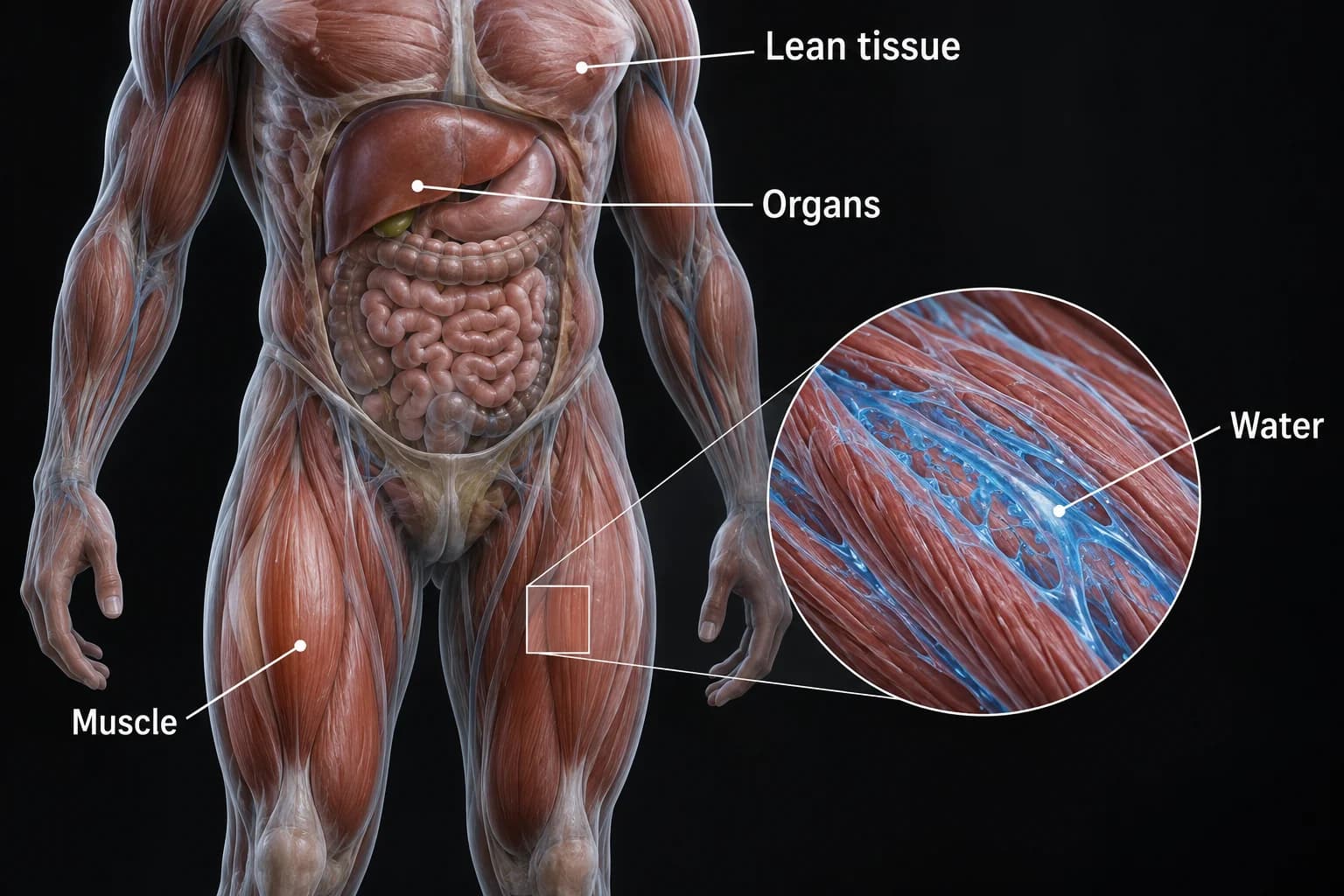
The illustration shows several components of lean tissue. It does not depict measured proportions or a treatment response.
What to look for on a DEXA report: total body fat percentage, appendicular lean mass (arms and legs, which is the closest proxy for skeletal muscle), trunk fat (which includes visceral fat), and the ratio of lean-mass change to total weight change. If your lean-mass loss is exceeding 25 to 30 percent of total weight loss, the protein floor or training signal needs attention.
Waist circumference
A simple, free, and surprisingly informative metric. Measure at the iliac crest (top of the hip bone), first thing in the morning before eating or drinking. Track weekly and review the 14-day trend, the same way you track scale weight. Waist circumference responds to visceral fat changes and can move independently of scale weight during a recomposition phase. A man whose scale weight is stable but whose waist circumference is dropping is likely gaining muscle and losing fat simultaneously.
Progress photos
Standardize the conditions: same lighting, same time of day, same poses, same distance from the camera. Take photos every four weeks. Photos are the only monitoring tool that captures the visual changes that body composition numbers can miss, particularly changes in muscle definition and fat distribution that do not show up on a scale.
Training performance markers
Anchor lifts
Pick two to four compound movements that you perform consistently (squat, bench press, deadlift, overhead press, weighted pull-up). Track the top working set weight and RPE each session. Plot these weekly. Two consecutive weeks of declining performance at the same RPE is the earliest reliable signal that under-fueling or under-recovery is eroding muscle quality. This signal typically appears before DEXA changes, before mirror changes, and before scale changes become alarming.
Training volume
Track total weekly sets per major muscle group. During a caloric deficit, expect a modest volume reduction (10 to 20 percent) compared to maintenance or surplus phases. This is normal and does not indicate a problem as long as intensity (load relative to capacity) stays stable. A sharp, unplanned volume drop, where you are cutting sets because you cannot complete them, signals a recovery problem that needs investigation.
Blood markers by peptide category
Different peptide categories create different monitoring needs. The following recommendations are starting points for discussion with your physician, not replacements for clinical judgment.
GLP-1 therapy users:
| Marker | Frequency | What it tells you |
|---|---|---|
| Fasting glucose | Every 12 weeks | Glycemic response to weight loss and medication. |
| HbA1c | Every 12 weeks | Three-month average glucose control. Especially important for users with prediabetes or type 2 diabetes. |
| Lipid panel | Every 12 to 24 weeks | Cardiovascular risk profile. GLP-1 drugs often improve lipid markers, and tracking confirms the trend. |
| Metabolic panel (CMP) | Every 12 weeks | Kidney and liver function, electrolytes. Baseline safety monitoring during caloric restriction. |
Tesamorelin or GH-axis therapy users:
| Marker | Frequency | What it tells you |
|---|---|---|
| IGF-1 | Every 8 to 12 weeks | Growth hormone axis activity. Tesamorelin elevates IGF-1 by design. Monitoring prevents levels from reaching ranges associated with increased cancer risk. |
| Fasting glucose | Every 8 to 12 weeks | Tesamorelin can worsen glucose tolerance. More frequent monitoring than GLP-1 therapy is warranted. |
| HbA1c | Every 12 weeks | Longer-term glucose trend on GH-axis therapy. |
| Liver panel | Every 12 weeks | Baseline safety monitoring for GH-axis effects on hepatic function. |
General recomposition (no peptide therapy):
| Marker | Frequency | What it tells you |
|---|---|---|
| Testosterone (total and free) | Baseline, then if symptoms present | Chronic caloric restriction can suppress testosterone. If libido, energy, or recovery decline meaningfully during a cut, check levels. |
| Thyroid panel (TSH, free T4) | Baseline, then if symptoms present | Prolonged deficits can downregulate thyroid function. Fatigue, cold intolerance, and unexpected weight-loss stalls warrant a check. |
| Vitamin D | Baseline, then annually | Common deficiency that affects muscle function, bone health, and recovery. Supplement if below 30 ng/mL. |
| Iron studies (ferritin, serum iron) | Baseline, then if symptoms present | Relevant for endurance athletes and anyone with unexplained fatigue during a cut. |
How Fuel connects to monitoring
Timeline tracks the 14-day weight trend and flags rate-of-loss deviations. This is the first thing to check each week.
Meal log captures per-meal and per-day protein totals. On GLP-1 therapy, the daily number can look fine while individual meals fall below the leucine threshold. Fuel's per-meal view catches that pattern.
Weekly review aggregates protein compliance, training frequency, and rate of loss into a single audit. When any metric drifts for two consecutive weeks, the weekly review is where you catch it.
Health Grade reflects the combined quality of your nutrition, training, and body-composition trajectory. A dropping Health Grade during a cut is usually catching a failure mode before you notice it yourself.
13Related reading
GLP-1 and recomposition cluster
These articles cover the practical side of using GLP-1 medications for body recomposition while protecting lean mass.
Protein Targets and Training Strategy on Semaglutide or Retatrutide is the detailed execution guide for setting protein floors, structuring meals, and maintaining training quality during GLP-1 therapy.
How to Preserve Muscle on GLP-1 Medications covers the full evidence base and practical protocol for preventing lean-mass loss during medication-assisted weight loss. Read this if your primary concern is the muscle side of the recomposition equation.
How to Stop GLP-1s Without Rapid Fat Regain addresses the off-ramp, which is one of the most neglected parts of the GLP-1 conversation. Build your exit plan while appetite is still controlled, not after the last dose when hunger returns.
The GLP-1 diet guide provides the nutritional foundation for anyone on these medications, with meal architecture, food-tolerance guidance, and side-effect management.
Growth hormone secretagogue cluster
The growth hormone secretagogue lane is narrower than most peptide content implies.
Testosterone is linked here because GH-axis discussions in clinic settings frequently overlap with testosterone evaluation, and understanding the distinction between GH optimization and testosterone replacement helps prevent conflation of two separate clinical conversations.
Research peptides cluster
Best Peptide Advice from Huberman, Drive, FoundMyFitness, Tim Ferriss surveys how prominent health and performance podcasters have discussed the peptide landscape, including which compounds they have endorsed, which they have cautioned against, and how their framing has evolved as the evidence picture has developed.
Collagen and connective tissue cluster
Collagen is the glossary entry that covers the biochemistry, supplement forms, and protein-tracking implications of collagen peptides.
Emerging compounds cluster
The development-stage compounds in this list are survodutide, amycretin, and CagriSema. Orforglipron is now FDA-approved as Foundayo.24 The numbers above will keep moving as more trial data reports out.
Glossary cross-links
- GLP-1 covers the native hormone and its role in appetite and glucose regulation.
- GLP-1 receptor agonist explains the drug class that includes semaglutide and tirzepatide.
- Semaglutide covers the molecule, its approved indications, and the trial program that supports it.
- Tirzepatide covers the dual agonist mechanism and the SURMOUNT trial program.
- Retatrutide covers the triple agonist mechanism and the current state of the clinical development program.
- Collagen covers collagen biochemistry, supplement forms, and protein-tracking implications.
- Testosterone provides context for the hormonal landscape that intersects with GH-axis discussions.
14Frequently Asked Questions
Are peptides legal?
The word "peptides" covers too many categories for a single answer. FDA-approved GLP-1 receptor agonists like semaglutide and tirzepatide are legal when prescribed by a licensed physician. Tesamorelin is legal when prescribed for its approved indication. Research peptides like BPC-157 and TB-500 are sold in a grey area where the vendor labels them "for research use only" while marketing them for human use. The FDA has warned consumers about this pattern. Retatrutide is not FDA-approved and cannot be lawfully compounded per federal regulations. Legal to purchase does not mean safe to use, approved for human administration, or free from sport-eligibility consequences.
Is semaglutide a peptide?
Yes. Semaglutide is a peptide molecule that is a modified analog of the human GLP-1 hormone. Calling semaglutide "a peptide" in the same breath as BPC-157 or collagen obscures the fact that semaglutide is an FDA-approved pharmaceutical with extensive clinical trial data, while the others occupy completely different evidence and regulatory categories.
What peptides are banned in sport?
Under the 2026 WADA Prohibited List, growth hormone secretagogues including tesamorelin, sermorelin, CJC-1295, and ipamorelin are prohibited under Section S2 (Peptide Hormones, Growth Factors, Related Substances, and Mimetics) at all times. Research peptides including BPC-157 and TB-500 are prohibited under Section S0 (Unapproved Substances). GLP-1 receptor agonists like semaglutide and tirzepatide are not currently prohibited. Collagen peptides are not prohibited. Athletes should verify current status with USADA or their relevant anti-doping authority before any use.
Does BPC-157 work for humans?
The honest answer is that we do not know with confidence. BPC-157 shows tissue-repair effects in rodent models that are genuinely interesting. There are no published large randomized controlled trials demonstrating that it produces clinically meaningful benefits in humans at any dose. The gap between animal data and proven human efficacy is the central problem. USADA has stated that there is not enough human study to establish a safe dose or safe use pattern.
Is tesamorelin the same as sermorelin?
No. Both are GH-axis peptides in the same lane, but they sit at different tiers of evidence. Tesamorelin is an FDA-approved GHRH analog (EGRIFTA) with controlled 26-week body-composition data showing visceral fat reduction and lean-mass gain in HIV-associated lipodystrophy. Sermorelin is a GHRH(1-29) analog whose original FDA-approved products (Geref, Geref Diagnostic) were withdrawn from the US market; the Federal Register determination on that withdrawal states it was not for reasons of safety or effectiveness.20 Current sermorelin is supplied through compounding pharmacies. Tesamorelin has the stronger and more recent data set. Sermorelin has older but real GH-axis evidence and a compounding-dependent supply picture.
Do CJC-1295 and ipamorelin actually do anything?
Yes, on the mechanism axis. Small human pharmacokinetic and pharmacodynamic studies show that ipamorelin and CJC-1295 raise GH and IGF-1 at expected doses, which is what their receptor pharmacology predicts.21 What is missing is large randomized controlled trials directly measuring body-composition outcomes in the population that uses them. The more important caveat for most US users is source quality: most supply is compounded or sourced from overseas research-chemical vendors with no mandatory purity testing or batch consistency, and the FDA has flagged several GHRH and GHRP compounds in bulk compounding contexts for exactly this reason.22 Mechanism real, recomp outcomes thin, source quality often the biggest risk.
Can I use collagen as a protein source?
Collagen provides amino acids but is not a complete protein source for muscle-retention purposes. It is deficient in leucine and the essential amino acids that drive muscle protein synthesis. You should not count collagen toward your leucine-driven protein floor. Track it separately as a supplement and build your protein meals around complete sources like whey, eggs, dairy, meat, fish, or soy.
What peptides are FDA-approved?
In the categories relevant to body recomposition, the FDA-approved compounds are semaglutide (Wegovy for weight management, Ozempic for type 2 diabetes), tirzepatide (Zepbound for weight management, Mounjaro for type 2 diabetes), and tesamorelin (EGRIFTA for HIV-associated lipodystrophy). Retatrutide, CJC-1295, ipamorelin, BPC-157, and TB-500 are not FDA-approved. Sermorelin's original approval was withdrawn for commercial reasons; the Federal Register determination specifies that the withdrawal was not for safety or effectiveness.20
What does USADA say about peptides?
USADA has issued specific advisories on several peptide categories. The BPC-157 advisory states that the compound is prohibited, not approved for human clinical use, and lacks sufficient human study for safe-dose determination. USADA's annual advisory on the WADA Prohibited List covers growth hormone secretagogues under Section S2. Athletes are directed to check the USADA and WADA resources for the most current substance classification before using any compound.
Are GLP-1s prohibited in competition?
As of the 2026 WADA Prohibited List, GLP-1 receptor agonists including semaglutide and tirzepatide are not prohibited in or out of competition. This status could change in future list updates. Athletes should verify current status with their anti-doping authority before competition. The fact that GLP-1s are not prohibited does not mean their use in weight-class sports or aesthetic competitions is free from ethical scrutiny.
What is a growth hormone secretagogue?
A growth hormone secretagogue is a compound that stimulates the pituitary gland to release growth hormone rather than providing exogenous growth hormone directly. This category includes tesamorelin, sermorelin, CJC-1295, ipamorelin, and various other GHRH and GHRP analogs. The distinction from exogenous GH injection matters because the mechanism, regulatory status, and safety profile differ. Not all growth hormone secretagogues are FDA-approved, and the category spans a wide range from legitimate pharmaceuticals to grey-market research compounds.
Does tirzepatide cause muscle loss?
Tirzepatide causes weight loss, and a fraction of that weight loss comes from lean mass. This is consistent with all forms of weight loss, including diet alone, bariatric surgery, and other medications. The SURMOUNT trials showed substantial total weight reduction, and any time total weight drops by 15 to 20 percent, lean-mass loss is a real concern. The proportion of lean-mass loss relative to total weight loss appears to be in the range typical for this class of drugs. The practical response is to apply the recomposition floor protocol. Greater total weight loss means greater absolute lean-mass exposure, which means the protection protocol is more important.
What should I ask my doctor about peptides?
Start by specifying which category you mean. If you are interested in GLP-1 therapy for weight management, ask whether you qualify based on BMI and comorbidity criteria, what the titration schedule looks like, what protein and training monitoring your physician recommends, and what the off-ramp plan is. If you are interested in tesamorelin, ask about the approved indication, whether your clinical picture supports off-label consideration, and what monitoring IGF-1 and glucose-tolerance changes require. If someone has recommended BPC-157 or another research peptide, ask your physician whether there is human trial evidence supporting its use and what evidence-based alternatives exist for your specific situation. A good physician will not be offended by specific questions. A good physician will be concerned if you are injecting compounds without asking them first.
Is it safe to buy peptides online?
It depends entirely on which peptide and from which source. FDA-approved medications like semaglutide or tirzepatide obtained through a licensed US pharmacy with a valid prescription carry the assurances of FDA approval and GMP manufacturing oversight. A reputable 503A or 503B compounding pharmacy with characterization testing sits a step below that, but is still categorically safer than a research-chemical site. Research peptides sold with "not for human consumption" labels are at the bottom of that ladder. Much of that supply is sourced or finished overseas, with a large share tied to Chinese API and finished-product manufacturing, and the failure modes are exactly what you do not want in an injectable: purity variance, bacterial endotoxin contamination, misidentified compounds, no batch consistency, and no adverse-event reporting. The FDA has warned consumers about this pattern. For any peptide, source quality is the single biggest safety lever you control, and it matters more than the pharmacology for most grey-market buyers.
How do I know if a peptide clinic is legitimate?
A legitimate clinic performs a thorough medical evaluation before prescribing anything, explains the approved indication and the off-label nature of any use, orders appropriate baseline labs and establishes a monitoring schedule, discusses risks and contraindications openly, differentiates between evidence tiers rather than marketing all compounds with the same enthusiasm, and does not pressure you to add compounds you did not ask about. Red flags include a minimal intake process, no lab work, marketing that treats all peptide categories as equivalent, bundled "optimization protocols" that combine approved drugs with research compounds, and discouragement of involving your primary care physician.
What are survodutide and orforglipron?
Survodutide is a dual glucagon and GLP-1 receptor agonist in Phase 3 development by Boehringer Ingelheim. Orforglipron is an oral nonpeptide GLP-1 receptor agonist approved as Foundayo by Eli Lilly.24 Survodutide and orforglipron showed meaningful weight loss in Phase 2 trials (approximately 18.7 percent and 14.7 percent respectively). Orforglipron is notable as an oral GLP-1 option for obesity. See the emerging compounds section for full details on both compounds and the broader pipeline.
How often should I get a DEXA scan during a cut?
A baseline scan before starting a structured cut or peptide therapy, followed by repeat scans every 12 to 16 weeks, provides the most useful resolution. More frequent scanning adds cost without adding actionable information, because body-composition changes need time to accumulate before DEXA can detect them reliably. See the monitoring section for the full protocol including waist circumference, anchor lifts, and blood markers.
Can I use the recomposition floor protocol without any peptides?
Yes, and it is the recommended starting point. The recomposition floor protocol (protein at 1.6+ g/kg, resistance training three to four times per week, rate-of-loss monitoring) is the foundation for any body recomposition phase, whether or not a peptide or medication is involved. Most men who have not optimized protein intake, training consistency, and sleep have substantial room for body-composition improvement before any compound enters the conversation. Start with the floor. Evaluate compounds only after the fundamentals are producing results and you have a specific reason to believe pharmacological support would add value.
15Where to go next
If hunger and appetite management are the bottleneck in your cut, start with the GLP-1 diet guide for the nutritional foundation and then read how to preserve muscle on GLP-1 medications for the full lean-mass protection protocol.
If you are already on semaglutide or tirzepatide and want the specific protein and training numbers, go directly to protein targets and training strategy on semaglutide or retatrutide.
If you want to understand how the leading health and performance podcasters have discussed the peptide landscape, including where they agree and where they diverge, read best peptide advice from Huberman, Drive, FoundMyFitness, Tim Ferriss.
If any term was unfamiliar, the GLP-1 glossary entry is a good starting point for the hormonal and pharmacological vocabulary.
Then open Fuel, set your protein floor, audit the week in Timeline, and use weekly review to catch under-fueling before it turns into quiet muscle loss. The peptide decision matters. The system you build around it matters more.
Footnotes
Jensen T, Sattar N, McGowan B, et al. Impact of Semaglutide on Body Composition in Adults With Overweight or Obesity: Exploratory Analysis of the STEP 1 Study. J Endocr Soc. 2021;5(Suppl 1):A16-A17.
Back to textBack to text 2Davies M, Faerch L, Jeppesen OK, et al. Semaglutide 2.4 mg once a week in adults with overweight or obesity, and type 2 diabetes (STEP 2): a randomised, double-blind, double-dummy, placebo-controlled, phase 3 trial. Lancet. 2021;397(10278):971-984.
Back to textWadden TA, Bailey TS, Billings LK, et al. Effect of Subcutaneous Semaglutide vs Placebo as an Adjunct to Intensive Behavioral Therapy on Body Weight in Adults With Overweight or Obesity: The STEP 3 Randomized Clinical Trial. JAMA. 2021;325(14):1403-1413.
Back to textRubino D, Abrahamsson N, Davies M, et al. Effect of Continued Weekly Subcutaneous Semaglutide vs Placebo on Weight Loss Maintenance in Adults With Overweight or Obesity: The STEP 4 Randomized Clinical Trial. JAMA. 2021;325(14):1414-1425.
Back to textLincoff AM, Brown-Frandsen K, Colhoun HM, et al. Semaglutide and Cardiovascular Outcomes in Obesity without Diabetes. N Engl J Med. 2023;389(24):2221-2232.
Back to textJastreboff AM, Aronne LJ, Ahmad NN, et al. Tirzepatide Once Weekly for the Treatment of Obesity. N Engl J Med. 2022;387(3):205-216.
Back to textGarvey WT, Frias JP, Jastreboff AM, et al. Tirzepatide once weekly for the treatment of obesity in people with type 2 diabetes (SURMOUNT-2): a double-blind, randomised, multicentre, placebo-controlled, phase 3 trial. Lancet. 2023;402(10402):613-626.
Back to textAronne LJ, Horn DB, le Roux CW, et al. Tirzepatide as Compared with Semaglutide for the Treatment of Obesity. N Engl J Med. 2025. https://doi.org/10.1056/NEJMoa2416394
Back to textJastreboff AM, Kaplan LM, Frias JP, et al. Triple-Hormone-Receptor Agonist Retatrutide for Obesity: A Phase 2 Trial. N Engl J Med. 2023;389(6):514-526.
Back to textCoskun T, Wu Q, Schloot NC, et al. Effects of retatrutide on body composition in people with type 2 diabetes: a substudy of a phase 2, double-blind, parallel-group, placebo-controlled, randomised trial. Lancet Diabetes Endocrinol. 2025;13(8):674-684.
Back to textMozaffarian D, Agarwal M, Aggarwal M, et al. Nutritional priorities to support GLP-1 therapy for obesity: a joint advisory from the American College of Lifestyle Medicine, the American Society for Nutrition, the Obesity Medicine Association, and The Obesity Society. Obesity. 2025. https://doi.org/10.1002/oby.24336
Back to textMorton RW, Murphy KT, McKellar SR, et al. A systematic review, meta-analysis and meta-regression of the effect of protein supplementation on resistance training-induced gains in muscle mass and strength in healthy adults. Br J Sports Med. 2018;52(6):376-384.
Back to textMettler S, Mitchell N, Tipton KD. Increased protein intake reduces lean body mass loss during weight loss in athletes. Med Sci Sports Exerc. 2010;42(2):326-337.
Back to textFDA. Medical Review for NDA 022505 (Tesamorelin, EGRIFTA). Center for Drug Evaluation and Research. 2010.
Back to textBack to text 2Back to text 3Shaw G, Lee-Barthel A, Ross ML, Wang B, Baar K. Vitamin C-enriched gelatin supplementation before intermittent activity augments collagen synthesis. Am J Clin Nutr. 2017;105(1):136-143.
Back to textBack to text 2le Roux CW, Steen O, Lucas KJ, et al. Glucagon and GLP-1 receptor dual agonist survodutide for obesity: a randomised, double-blind, placebo-controlled, dose-finding phase 2 trial. Lancet Diabetes Endocrinol. 2024;12(3):162-173. https://doi.org/10.1016/S2213-8587(23)00356-X
Back to textWharton S, Blevins T, Connery L, et al. Daily Oral GLP-1 Receptor Agonist Orforglipron for Adults with Obesity. N Engl J Med. 2023;389(10):877-888.
Back to textNovo Nordisk. Amycretin Phase 1/2 Data. Company pipeline update. 2024.
Back to textNovo Nordisk. CagriSema REDEFINE Phase 3 Program Results. Company press release. 2024.
Back to textUS Food and Drug Administration. Determination That GEREF (Sermorelin Acetate) Injection, 0.5 Milligrams Base/Vial and 1.0 Milligrams Base/Vial, Was Not Withdrawn From Sale for Reasons of Safety or Effectiveness. Federal Register. 2013;78(43):14279-14280.
Back to textBack to text 2Back to text 3Back to text 4Raun K, Hansen BS, Johansen NL, et al. Ipamorelin, the first selective growth hormone secretagogue. Eur J Endocrinol. 1998;139(5):552-561. https://pubmed.ncbi.nlm.nih.gov/9849822/ Teichman SL, Neale A, Lawrence B, Gagnon C, Castaigne JP, Frohman LA. Prolonged stimulation of growth hormone and insulin-like growth factor I secretion by CJC-1295, a long-acting analog of growth hormone-releasing hormone, in healthy adults. J Clin Endocrinol Metab. 2006;91(3):799-805. https://pubmed.ncbi.nlm.nih.gov/16352683/
Back to textBack to text 2Back to text 3US Food and Drug Administration. Certain Bulk Drug Substances for Use in Compounding May Present Significant Safety Risks. The FDA page identifies CJC-1295-related characterization and immunogenicity concerns and discusses ipamorelin acetate safety-risk review by route of administration. Accessed 2026. https://www.fda.gov/drugs/human-drug-compounding/safety-risks-associated-certain-bulk-drug-substances-nominated-use-compounding
Back to textBack to text 2Back to text 3Sanyal AJ, Bedossa P, Fraessdorf M, et al. A Phase 2 Randomized Trial of Survodutide in MASH and Fibrosis. N Engl J Med. 2024;391(4):311-319. https://doi.org/10.1056/NEJMoa2401755
Back to textEli Lilly and Company. FOUNDAYO (orforglipron) tablets, prescribing information. U.S. Food and Drug Administration, initial U.S. approval 2026, revised April 2026. FDA label
Back to textBack to text 2Back to text 3Back to text 4Back to text 5Back to text 6Back to text 7Back to text 8Novo Nordisk. WEGOVY (semaglutide) tablets and injection, prescribing information. U.S. Food and Drug Administration, revised June 2026. FDA label
Back to textWharton S, Aronne LJ, Stefanski A, et al. Orforglipron, an Oral Small-Molecule GLP-1 Receptor Agonist for Obesity Treatment. N Engl J Med. Published September 16, 2025, 393(18), 1796-1806. NEJM article PDF. DOI: 10.1056/NEJMoa2511774
Back to text