Why this page exists
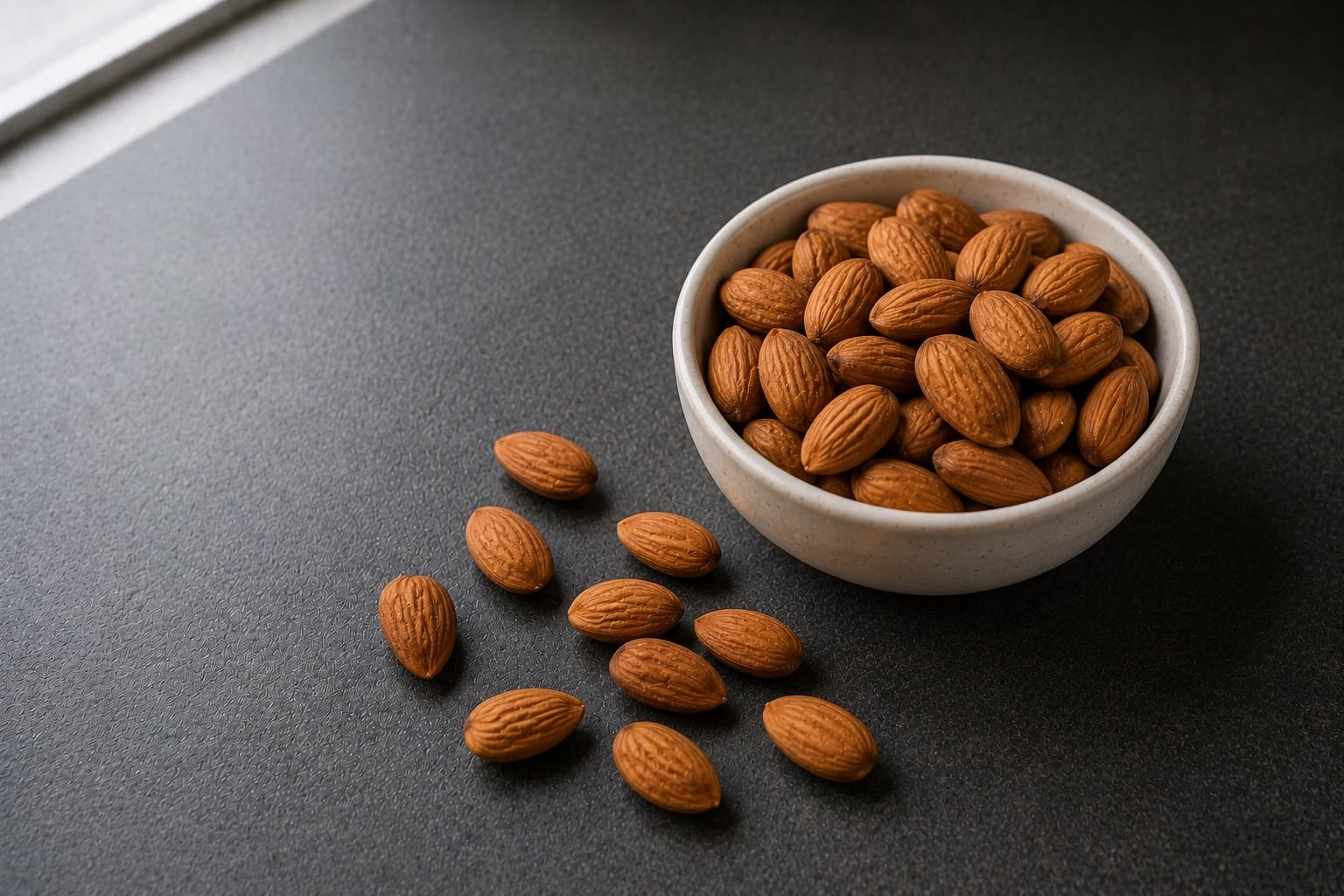
Almonds are the food most trackers log by unit instead of by scale. Someone counts out almonds by a number a diet headline gave them once, or tips a handful from the bag and moves on. The raw record on this page carries a USDA reference amount of 30 g, and an unweighed handful can drift materially from that reference.
That drift matters at 626 calories per 100 g. Almond butter removes the one thing that slowed a handful down at all, a discrete unit to lose count of. The creamy almond butter record on this page carries no USDA reference portion whatsoever, so the spoon dipped from the jar has nothing in the dataset behind this page to check itself against.
What is in a serving
Every figure below is scaled from the USDA record named at the bottom of this panel.
Serving basisgrams
100 gof Whole, raw
- Calories
- 626 cal
- Protein
- 21.5 g
- Carbs
- 20 g
- Fat
- 51.1 g
| Nutrient | Per serving100 g | Per 100 greference |
|---|---|---|
| Calories | 626 cal | 626 cal |
| Protein | 21.5 g | 21.5 g |
| Carbs | 20 g | 20 g |
| Fat | 51.1 g | 51.1 g |
| Fiber | 10.8 g | 10.8 g |
| Sugar | not reportedUnavailable. This record does not report sugar. | not reportedUnavailable. This record does not report sugar. |
| Sodium | 0 mg | 0 mg |
Sugar is not reported on Whole, raw.
A nutrient the record does not measure shows as — and never as 0. A zero here is a measured zero.
FDC 2346393USDA Foundation FoodsNuts, almonds, whole, rawPublished October 28, 2022
The records behind this page
One food family, 4 source records. The figures are per 100 g, which is the basis the USDA publishes and the only fair way to compare records whose servings differ.
| Record | Caloriescal | Proteing | Carbsg | Fatg | Fiberg | Sugarg | Sodiummg |
|---|---|---|---|---|---|---|---|
| Nuts, Almonds, Whole, RawFDC 2346393FoundationRawShown by default | 626 | 21.5 | 20 | 51.1 | 10.8 | not reportedUnavailable. This record does not report sugar. | 0 |
| Nuts, Almonds, Dry Roasted, With Salt AddedFDC 323294FoundationCooked | 620 | 20.4 | 16.2 | 57.8 | 11 | 4.2 | 256 |
| Almond Butter, CreamyFDC 2262074Foundation | 645 | 20.8 | 21.2 | 53 | 9.7 | not reportedUnavailable. This record does not report sugar. | 1 |
| Flour, AlmondFDC 2261420Foundation | 622 | 26.2 | 16.2 | 50.2 | 9.3 | not reportedUnavailable. This record does not report sugar. | 1 |
Logging almonds without guessing
Weigh the 30 g reference amount once, on a scale, and keep the number. Raw almonds at that weight run 188 calories, 6.5 g of protein, 6 g of carbs and 15.3 g of fat. The raw record defines that weight as one serving. Set your own handful next to it the first time you weigh one, the same 15 g a Greek yogurt bowl calls for on top.
Roasted and raw are closer on calories than the flavor difference suggests. Dry-roasted almonds with salt added run 620 calories per 100 g against raw's 626, a gap under 1 percent. What actually moves is fat, up from 51.1 g to 57.8 g per 100 g, and carbs, down from 20 g to 16.2 g. Roasting drives off water, and losing water concentrates whatever mass is left in every 100 g measured. Fiber barely shifts, 10.8 g raw against 11 g roasted, so fiber is not what roasting is spending.
Sugar is where the two records actually disagree, and one side of that disagreement is a blank, not a zero. The raw record reports no sugar figure at all, so the page marks it unavailable rather than 0 g. The roasted record reports 4.2 g per 100 g. That gap reflects a record that measured sugar against one whose entry never took the measurement, not roasting adding sugar to the nut.
Salt is the real cost of "roasted," not calories. 30 g of the dry-roasted, salted record carries 77 mg of sodium. The same weight of raw carries none, because the raw record reports 0 mg. Log the variant that matches the bag when sodium is the number you track, because the two records are nearly interchangeable on calories and not interchangeable on that one.
Almond butter and almond flour turn the same plant into two different serving problems. The butter record runs 645 calories per 100 g, slightly denser than raw, and publishes no reference portion, so every spoonful has to be weighed to mean anything at all. The flour record runs 622 calories per 100 g with a 15 g reference amount, half of whole almonds' 30 g, because flour gets folded into a recipe by the spoonful rather than eaten by the handful. It also carries the highest protein of the four records, 26.2 g per 100 g against raw's 21.5 g.
Where almonds fit, and where they don't
Closing a calorie gap without adding volume. 32 g of almond butter, weighed rather than guessed at two tablespoons, delivers 206 calories, 6.7 g of protein and 17 g of fat in a couple of spoonfuls. That density is the reason it works for readers who struggle to eat enough, and the reason it works against readers trying not to.
A fixed calorie budget, where the reference amount is the ceiling. 30 g of raw almonds at 188 calories is a real number to plan around. Readers cutting on a fixed budget should treat that 30 g as the serving and weigh past it deliberately when they decide to have more, rather than eating from an open bag and finding out later.
A fiber contribution, not a fiber strategy. Every record on this page reports at least 9.3 g of fiber per 100 g: raw at 10.8, roasted at 11, butter at 9.7, flour at 9.3. A weighed 30 g handful of raw almonds carries about 3.2 g of that. It adds up across a day of eating without carrying the day on its own.
Where it does not fit. A food running roughly half its calories from fat, most of it unsaturated, is still a slow-emptying choice right before hard training, and every record on this page sits between 50 g and 58 g of fat per 100 g. Save the handful, the butter, and the flour for well before or well after the session. For a different fat profile at a similar calorie density, peanut butter and olive oil are the nearby swaps worth weighing against these numbers instead of assuming they behave the same way.
Where it fits against a goal
A weighed handful, not a guessed one
30 g of Nuts, Almonds, Whole, RawFDC 2346393
- Calories
- 188 cal
- Fat
- 15.3 g
The USDA's own reference amount for raw almonds is 30 g, which runs 188 calories and 15.3 g of fat. That is what a serving means on this page. Compare your own handful against it the first time you weigh one, and expect it to run heavier than you guessed.
Roasted and salted, same weigh-in
30 g of Nuts, Almonds, Dry Roasted, With Salt AddedFDC 323294
- Calories
- 186 cal
- Sodium
- 77 mg
30 g of the dry-roasted, salted record costs 186 calories, almost identical to raw, and carries 77 mg of sodium that the raw record does not report at all. Track sodium against this record, not the raw one, once salt is added.
Eating enough without more volume
32 g of Almond Butter, CreamyFDC 2262074
- Calories
- 206 cal
- Protein
- 6.7 g
- Fat
- 17 g
32 g of creamy almond butter, about two tablespoons weighed rather than scooped, runs 206 calories, 6.7 g of protein and 17 g of fat. The record carries no USDA reference portion, so weigh the spoonful once and keep the number rather than eyeballing it from the jar each time.
Almond flour in a recipe, not a bowl
15 g of Flour, AlmondFDC 2261420
- Calories
- 93 cal
- Protein
- 3.9 g
- Carbs
- 2.4 g
15 g of almond flour, half the reference amount whole almonds carry, costs 93 calories and delivers 3.9 g of protein against 2.4 g of carbs. It is the highest-protein record on this page per 100 g, which matters more in a baked recipe than in a handful.
Methodology
Where the numbers come from
Every figure on this page is scaled from a per-100 g value in a USDA record by one shared function, so the numbers here and the numbers on a meal page that uses this ingredient cannot disagree. Values are rounded once, at the point of display.
- FDC 2346393Nuts, almonds, whole, rawUSDA Foundation Foods
- FDC 323294Nuts, almonds, dry roasted, with salt addedUSDA Foundation Foods
- FDC 2262074Almond butter, creamyUSDA Foundation Foods
- FDC 2261420Flour, almondUSDA Foundation Foods
Unavailable values
A nutrient a record does not measure is shown as unavailable and never as zero. Across the 405 records in this dataset, 165 report no fiber and 228 report no sugar, so the distinction is not a rare edge case. A zero on this page means the analysis measured zero.
Source coverage
Every claim on this page resolves to one of the records listed here. This family has no open source gaps.
Datasets
- USDA FoodData Central Foundation FoodsExport 2026-04-30 · 363 of 395 entries normalized
- USDA FoodData Central SR LegacyExport 2018-04 · 42 of 7793 entries normalized