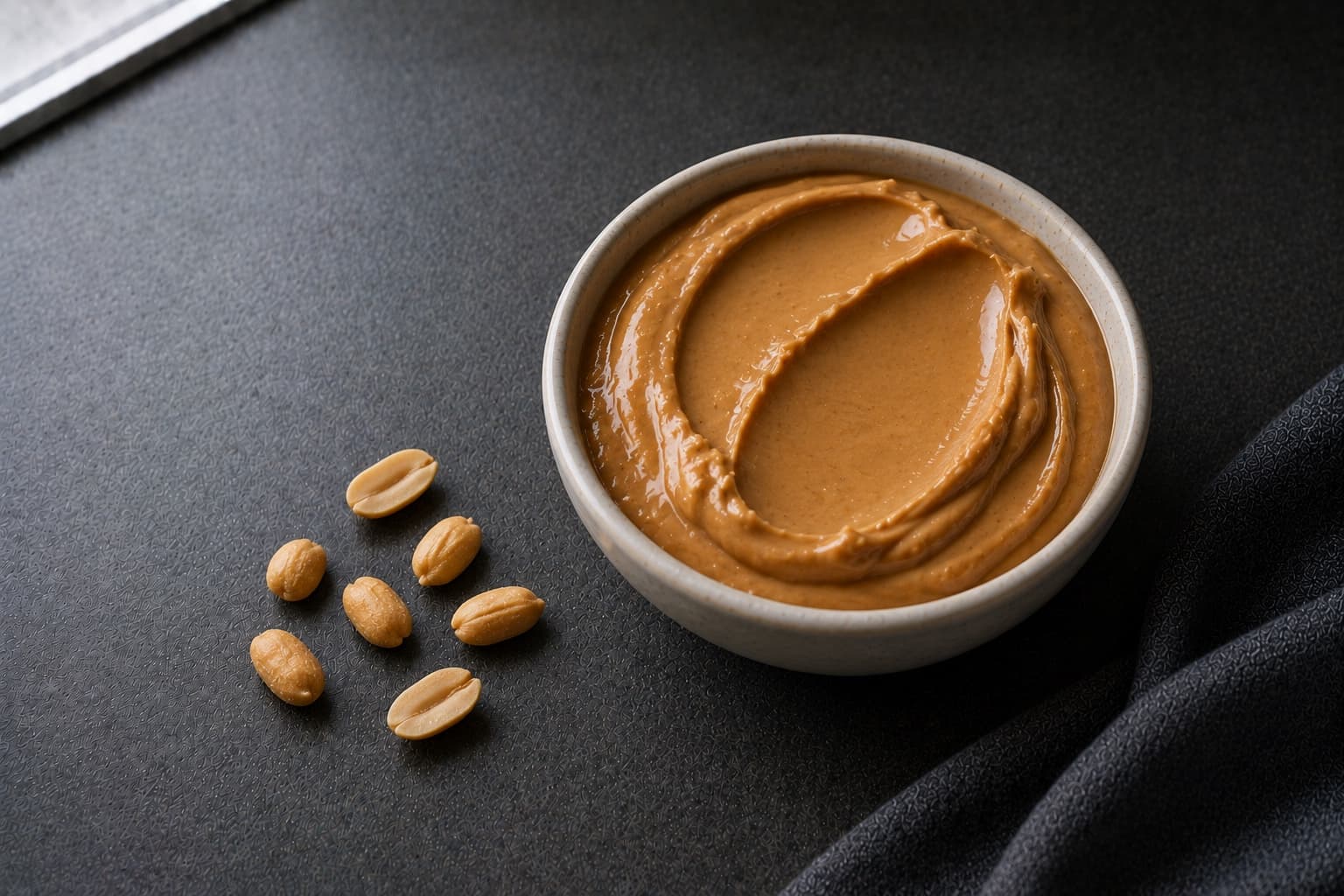
Why this page exists
A spoonful is not a unit. Ask five people to describe a tablespoon of peanut butter and you get five different weights, and because the creamy record runs 632 calories per 100 g, the gap between those five spoons is bigger than most people's other daily logging errors combined. This is the food where guessing costs the most per guess.
Level the knife across the top of the spoon and a tablespoon settles around 15 g, which works out to 95 calories on the creamy record. Let it heap instead, the way peanut butter comes off a spoon out of the jar when nobody is measuring, and the same motion can pull 30 g or more off the rim, close to 190 calories. Nothing about the recipe changed. Only the geometry of the spoon did.
The jar does not save you from this. USDA's record for creamy peanut butter carries no portion data at all, only the composition per 100 g, so there is no database serving size to fall back on and no cup measure either. Weigh it, or accept that the number in the log is a guess wearing a decimal point.
What is in a serving
Every figure below is scaled from the USDA record named at the bottom of this panel.
Serving basisgrams
100 gof Peanut Butter, Creamy
- Calories
- 632 cal
- Protein
- 24 g
- Carbs
- 22.7 g
- Fat
- 49.4 g
| Nutrient | Per serving100 g | Per 100 greference |
|---|---|---|
| Calories | 632 cal | 632 cal |
| Protein | 24 g | 24 g |
| Carbs | 22.7 g | 22.7 g |
| Fat | 49.4 g | 49.4 g |
| Fiber | 6.3 g | 6.3 g |
| Sugar | not reportedUnavailable. This record does not report sugar. | not reportedUnavailable. This record does not report sugar. |
| Sodium | 221 mg | 221 mg |
Sugar is not reported on Peanut Butter, Creamy.
A nutrient the record does not measure shows as — and never as 0. A zero here is a measured zero.
FDC 2262072USDA Foundation FoodsPeanut butter, creamyPublished April 28, 2022
The records behind this page
One food family, 2 source records. The figures are per 100 g, which is the basis the USDA publishes and the only fair way to compare records whose servings differ.
| Record | Caloriescal | Proteing | Carbsg | Fatg | Fiberg | Sugarg | Sodiummg |
|---|---|---|---|---|---|---|---|
| Peanut Butter, CreamyFDC 2262072FoundationShown by default | 632 | 24 | 22.7 | 49.4 | 6.3 | not reportedUnavailable. This record does not report sugar. | 221 |
| Peanuts, RawFDC 2515376FoundationRaw | 588 | 23.2 | 26.5 | 43.3 | 8 | not reportedUnavailable. This record does not report sugar. | 1 |
Logging peanut butter without guessing
The grind barely touches the macros. The salt does. Per 100 g, raw peanuts carry 588 calories, 23.2 g of protein, and 43.3 g of fat. The creamy butter record carries 632 calories, 24 g of protein, and 49.4 g of fat for the same weight. That is a jar that is mostly ground peanut plus a modest amount of added oil, not a different food. Sodium is where the two records split hard: 1 mg per 100 g in raw peanuts against 221 mg per 100 g in the jar. The salt is added at the factory, not by the plant.
Fiber drops when the peanut becomes butter. Raw peanuts report 8 g of fiber per 100 g. Creamy peanut butter reports 6.3 g for the same weight. On a 30 g serving that is 2.4 g against 1.9 g, small in isolation and worth tracking if fiber is the macro you are chasing this week.
Neither record reports sugar. USDA lists sugar as unavailable, not zero, for both the creamy butter and the raw peanuts on this page. A jar with added sugar on its ingredient list will run higher than either record shows, because a record cannot report a number it was never given. Check the label on your own jar rather than trusting an app to fill in a figure the dataset does not have.
The only portion this family publishes belongs to raw peanuts. USDA lists a 30 g reference amount for the raw peanut record and nothing beyond per-100-g composition for the creamy butter. If a tracker offers a preset serving size for peanut butter, it invented that number, because the dataset behind it never supplied one.
Where peanut butter fits, and where it doesn't
Eating enough, when the problem is getting calories in rather than avoiding them. Two heaped tablespoons, roughly 30 g, add close to 190 calories and 14.8 g of fat to a shake or a bowl of oats without adding volume that fights appetite. That is the exact profile a reader trying to gain weight or struggling to eat enough food needs, and it is the opposite of how most people treat it. Readers who log peanut butter defensively, rationing it like a treat, are treating a genuinely useful calorie-dense food as a liability instead of a lever.
Padding protein on a shake or an oatmeal bowl. Two tablespoons of the creamy record add 7.2 g of protein alongside those 190 calories, a real contribution but a slow one per calorie compared with whey or Greek yogurt. Use it to round out a protein shake or protein oatmeal where the fat and calories are already budgeted for, not as the meal's primary protein source.
Switching to raw peanuts for more fiber per calorie. At 30 g, the USDA reference amount, raw peanuts carry 2.4 g of fiber against 1.9 g for the same weight of creamy butter, for 14 fewer calories. When fiber is the macro under target this week and spreadability is not the point, raw peanuts are the better record to log against, not a lesser version of the same food.
Where it does not fit. A calorie-dense, high-fat food eaten straight from the jar during a cut works against the exact constraint a deficit imposes, because the calories-per-volume ratio is the worst kind for someone managing hunger on a fixed budget. On a cut, a thin layer weighed to 10 or 12 g does more for satisfaction than restriction ever does. Weighing it down to a specific number is portion control, and that is the actual skill being asked for here, not abstinence.
Weigh it. Choose the creamy record or the raw peanut record depending on whether the goal is fat and calories or fiber and crunch. Either way, stop trusting the tablespoon to tell you the truth.
Where it fits against a goal
Eating enough when appetite is the limiter
30 g of Peanut Butter, CreamyFDC 2262072
- Calories
- 190 cal
- Fat
- 14.8 g
Two heaped tablespoons, close to 30 g, add roughly 190 calories and 14.8 g of fat to a shake or a bowl of oats without adding volume that fights appetite. That is the profile that matters for a reader trying to gain weight or simply struggling to eat enough food in a day. Log it deliberately here rather than rationing it like a treat.
Protein padding a shake or oatmeal bowl
30 g of Peanut Butter, CreamyFDC 2262072
- Protein
- 7.2 g
- Calories
- 190 cal
The same 30 g adds 7.2 g of protein alongside those 190 calories, a real contribution but a slow one per calorie next to whey or Greek yogurt. Use it to round out a shake or a bowl where the fat is already budgeted for, not as a meal's main protein source.
Choosing raw peanuts for more fiber per calorie
30 g of Peanuts, RawFDC 2515376
- Fiber
- 2.4 g
- Calories
- 176 cal
At the USDA reference amount of 30 g, raw peanuts carry 2.4 g of fiber for 176 calories against 1.9 g of fiber for 190 calories in the same weight of creamy butter. When fiber is the macro you are short on this week and spreadability does not matter, raw peanuts are the better record to log against.
Methodology
Where the numbers come from
Every figure on this page is scaled from a per-100 g value in a USDA record by one shared function, so the numbers here and the numbers on a meal page that uses this ingredient cannot disagree. Values are rounded once, at the point of display.
- FDC 2262072Peanut butter, creamyUSDA Foundation Foods
- FDC 2515376Peanuts, rawUSDA Foundation Foods
Unavailable values
A nutrient a record does not measure is shown as unavailable and never as zero. Across the 405 records in this dataset, 165 report no fiber and 228 report no sugar, so the distinction is not a rare edge case. A zero on this page means the analysis measured zero.
Source coverage
Every claim on this page resolves to one of the records listed here. This family has no open source gaps.
Datasets
- USDA FoodData Central Foundation FoodsExport 2026-04-30 · 363 of 395 entries normalized
- USDA FoodData Central SR LegacyExport 2018-04 · 42 of 7793 entries normalized