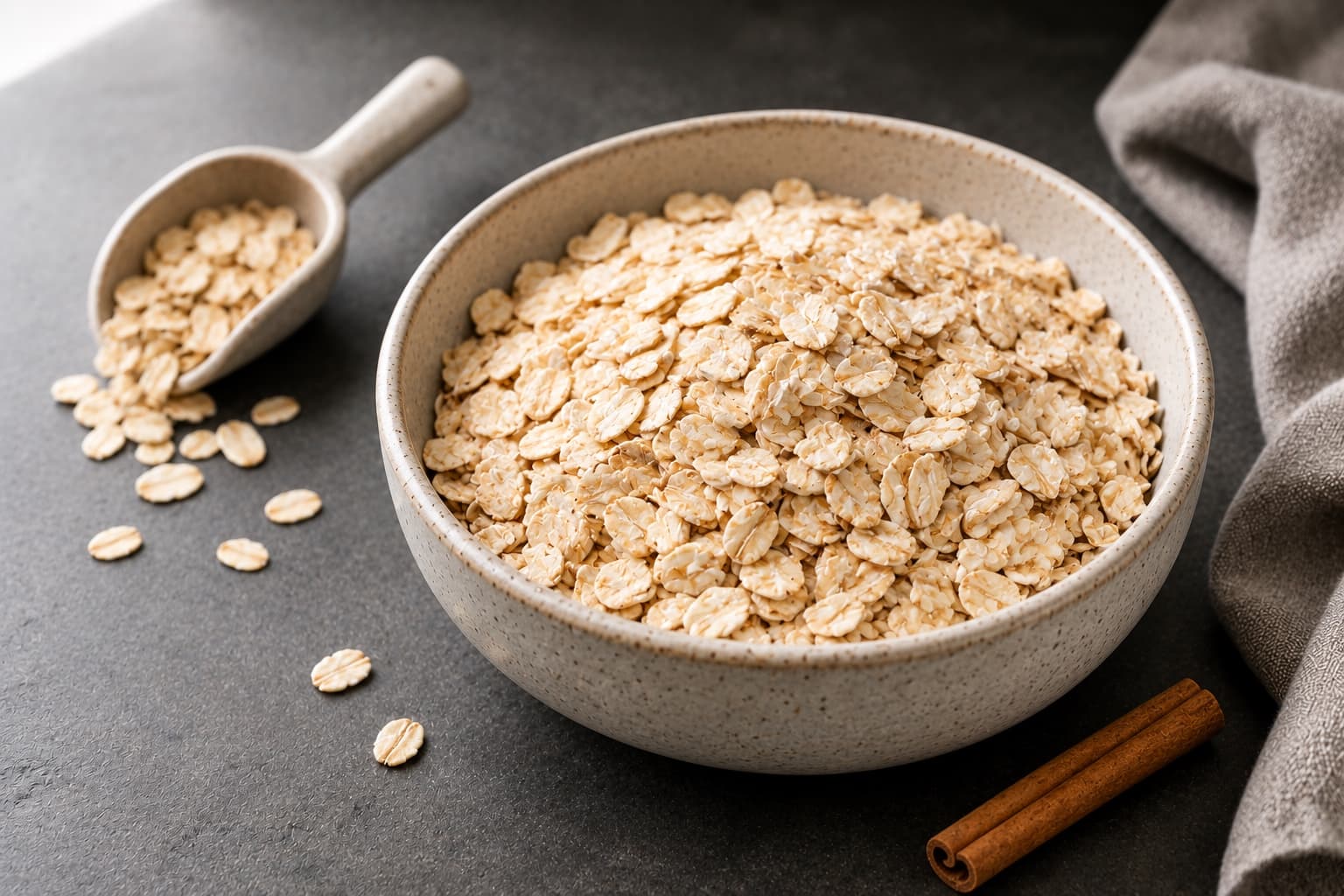
Why this page exists
Oats change jobs depending on when you eat them. At breakfast with two hours before you move, they work as a slow-digesting carbohydrate base that holds hunger down through the morning. Eaten thirty minutes before a hard session, that same slow digestion is what fights you through the warm-up. The USDA dataset behind this page carries six records across three preparation states: dry rolled and dry steel-cut oats, dry regular-and-quick oats and its cooked counterpart, and fortified instant oats dry and cooked. The gap between the dry and cooked figures, and between the plain and fortified ones, explains most of what goes wrong when oats get logged.
Everything below is scaled from those six records. The serving control changes the amount, the variant selector changes which record you are looking at, and every figure carries the FDC identifier it came from.
What is in a serving
Every figure below is scaled from the USDA record named at the bottom of this panel.
Serving basisgrams
100 gof Rolled, dry
- Calories
- 382 cal
- Protein
- 13.5 g
- Carbs
- 68.7 g
- Fat
- 5.9 g
| Nutrient | Per serving100 g | Per 100 greference |
|---|---|---|
| Calories | 382 cal | 382 cal |
| Protein | 13.5 g | 13.5 g |
| Carbs | 68.7 g | 68.7 g |
| Fat | 5.9 g | 5.9 g |
| Fiber | 10.4 g | 10.4 g |
| Sugar | not reportedUnavailable. This record does not report sugar. | not reportedUnavailable. This record does not report sugar. |
| Sodium | 1 mg | 1 mg |
Sugar is not reported on Rolled, dry.
A nutrient the record does not measure shows as — and never as 0. A zero here is a measured zero.
FDC 2346396USDA Foundation FoodsOats, whole grain, rolled, old fashionedPublished October 28, 2022
The records behind this page
One food family, 6 source records. The figures are per 100 g, which is the basis the USDA publishes and the only fair way to compare records whose servings differ.
| Record | Caloriescal | Proteing | Carbsg | Fatg | Fiberg | Sugarg | Sodiummg |
|---|---|---|---|---|---|---|---|
| Oats, Whole Grain, Rolled, Old FashionedFDC 2346396FoundationShown by default | 382 | 13.5 | 68.7 | 5.9 | 10.4 | not reportedUnavailable. This record does not report sugar. | 1 |
| Oats, Whole Grain, Steel CutFDC 2346397Foundation | 381 | 12.5 | 69.8 | 5.8 | 12 | not reportedUnavailable. This record does not report sugar. | <1 |
| Cereals, Oats, Regular and Quick, Not Fortified, DryFDC 173904SR LegacyDry | 379 | 13.2 | 67.7 | 6.5 | 10.1 | 1 | 6 |
| Cereals, Oats, Regular and Quick, Unenriched, Cooked with Water (includes Boiling and Microwaving), Without SaltFDC 173905SR LegacyCooked | 71 | 2.5 | 12 | 1.5 | 1.7 | 0.3 | 4 |
| Cereals, Oats, Instant, Fortified, Plain, DryFDC 171661SR LegacyDry | 362 | 11.9 | 69.5 | 6.9 | 10 | 1.5 | 220 |
| Cereals, Oats, Instant, Fortified, Plain, Prepared with Water (boiling Water Added or Microwaved)FDC 171662SR LegacyCooked | 68 | 2.4 | 11.7 | 1.4 | 1.7 | 0.5 | 49 |
Logging oats without guessing
Dry weight is the reliable number, cooked weight is the visual trap. Dry regular-and-quick oats run 379 calories per 100 g. Cooked with water and no added salt, the same class of oat drops to 71 calories per 100 g, because water now makes up most of the weight. A 1 cup dry measure of that record is 81 g and 307 calories. A 1 cup cooked measure of the cooked record is 234 g and 166 calories. Two bowls, both called "a cup," and one carries less than half the calories of the other. Weigh the dry oats before they go in the pot and log against the dry record, or weigh the finished bowl and log against the cooked one. Do not mix the two.
Rolled and steel-cut carry almost the same macros, and cut fiber and cook time apart. Per 100 g dry, rolled oats give 382 calories, 13.5 g protein, 68.7 g carbs, and 10.4 g fiber. Steel-cut gives 381 calories, 12.5 g protein, 69.8 g carbs, and 12 g fiber. At a 40 g serving that is 4.2 g of fiber from rolled against 4.8 g from steel-cut, a difference that survives the smaller portion. Sugar is not reported on either record. Neither the table nor this page can tell you it is zero, so leave sugar unlogged for rolled or steel-cut oats rather than entering 0 g.
Fortification is where the sodium moves, not the calories. Dry regular-and-quick oats without fortification carry 6 mg of sodium per 100 g. Dry fortified instant oats carry 220 mg per 100 g, close to 37 times as much, and a single 28 g instant packet still delivers 62 mg on its own. The gap holds after cooking too: the plain cooked record with no added salt reports 4 mg of sodium per 100 g, and the fortified instant cooked record reports 49 mg. Calories and carbs barely move between the fortified and unfortified dry records. Sodium does. Check which record you are logging against before you assume a bowl of oats is automatically low in sodium.
Toppings do more damage to the log than the oat type does. Honey, nut butter, granola, and dried fruit are not part of any oats record on this page. If your usual bowl includes them, log them as their own entries instead of folding their calories into "oatmeal." Peanut butter has its own page with its own numbers for exactly this reason.
Overnight oats use the same dry record you would use for a stovetop bowl. Soaking rolled or steel-cut oats in milk or yogurt overnight does not change the oats' own macros, because the dry-weight record is still what you started with. What changes the total is the liquid, the yogurt, the seeds, and the sweetener stirred in, and none of those are oats. Weigh the dry oats going into the jar and log the rest as what it actually is.
Where oats fit around training and eating windows
Two hours or more before training, oats are a genuine fuel-and-satiety base. Satiety data across common foods lists oats among the higher-scoring carbohydrate sources, which matters most in a deficit when hunger is working against the plan. A 40 g dry serving of rolled oats carries 153 calories and 27.5 g of carbs, enough runway for a session two or more hours out.
Thirty minutes before a hard session, that same slow digestion works against you. Fueling early-morning training tracks oatmeal with milk at 60 to 120 minutes to clear the stomach, slower than nearly everything else on that table. Eat oats two or more hours before a hard session, and switch to liquid carbohydrate or simple sugars inside that window.
Processing changes texture and cook time more than it changes energy density. Rolled, steel-cut, and dry regular-and-quick oats land within a few calories of each other per 100 g dry, at 382, 381, and 379 respectively. How oat structure changes the glycemic response is a separate question from calorie density, and the fiber viscosity behind that response depends on how intact the oat still is once it is milled. Pick rolled, steel-cut, or instant for texture and prep time, since a macro difference between them will not show up on this page.
Protein is the gap this page cannot close on its own. A 40 g dry serving of rolled oats carries 5.4 g of protein, and the steel-cut record sits close behind at 5 g. Neither reaches a per-meal protein target by itself. Protein oatmeal exists to pair oats with a fixed amount of a protein source rather than leaving the reader to guess how much milk or whey closes the gap.
Where it fits against a goal
Pre-training carb base, eaten 2+ hours out
40 g of Oats, Whole Grain, Rolled, Old FashionedFDC 2346396
- Calories
- 153 cal
- Carbs
- 27.5 g
A 40 g dry serving of rolled oats runs 153 calories and 27.5 g of carbs, the reference amount the USDA uses for this record. That is enough runway for a session two or more hours out. Eaten any closer than that, slow digestion works against the warm-up instead of for it.
Reading a cooked cup correctly
234 g of Cereals, Oats, Regular and Quick, Unenriched, Cooked with Water (includes Boiling and Microwaving), Without SaltFDC 173905
- Calories
- 166 cal
- Carbs
- 28.1 g
A cooked cup of plain oatmeal without added salt weighs 234 g and carries 166 calories. A dry cup of a comparable regular-and-quick record weighs 81 g and carries 307 calories. Both get called "a cup." Decide which one is in your bowl before you log it, and weigh the dry oats if there is any doubt.
Watching sodium on a fortified brand
28 g of Cereals, Oats, Instant, Fortified, Plain, DryFDC 171661
- Calories
- 101 cal
- Sodium
- 62 mg
A single 28 g packet of fortified instant oats carries 62 mg of sodium. Unfortified dry oats carry 6 mg of sodium per 100 g, close to a 37-fold difference in concentration. Calories barely move between the fortified and unfortified dry records. If sodium is the number you track, check the label for "fortified" before you assume oats are a low-sodium food.
Maximizing fiber per dry gram
40 g of Oats, Whole Grain, Steel CutFDC 2346397
- Fiber
- 4.8 g
- Calories
- 152 cal
A 40 g dry serving of steel-cut oats carries 4.8 g of fiber against 152 calories, versus 4.2 g of fiber in the same 40 g of rolled oats. The gap is small in absolute terms and consistent every time you weigh it, unlike a topping choice that varies by the tablespoon.
Methodology
Where the numbers come from
Every figure on this page is scaled from a per-100 g value in a USDA record by one shared function, so the numbers here and the numbers on a meal page that uses this ingredient cannot disagree. Values are rounded once, at the point of display.
- FDC 2346396Oats, whole grain, rolled, old fashionedUSDA Foundation Foods
- FDC 2346397Oats, whole grain, steel cutUSDA Foundation Foods
- FDC 173904Cereals, oats, regular and quick, not fortified, dryUSDA SR Legacy
- FDC 173905Cereals, oats, regular and quick, unenriched, cooked with water (includes boiling and microwaving), without saltUSDA SR Legacy
- FDC 171661Cereals, oats, instant, fortified, plain, dryUSDA SR Legacy
- FDC 171662Cereals, oats, instant, fortified, plain, prepared with water (boiling water added or microwaved)USDA SR Legacy
Unavailable values
A nutrient a record does not measure is shown as unavailable and never as zero. Across the 405 records in this dataset, 165 report no fiber and 228 report no sugar, so the distinction is not a rare edge case. A zero on this page means the analysis measured zero.
Source coverage
Every claim on this page resolves to one of the records listed here. This family has no open source gaps.
Datasets
- USDA FoodData Central Foundation FoodsExport 2026-04-30 · 363 of 395 entries normalized
- USDA FoodData Central SR LegacyExport 2018-04 · 42 of 7793 entries normalized