Why this page exists
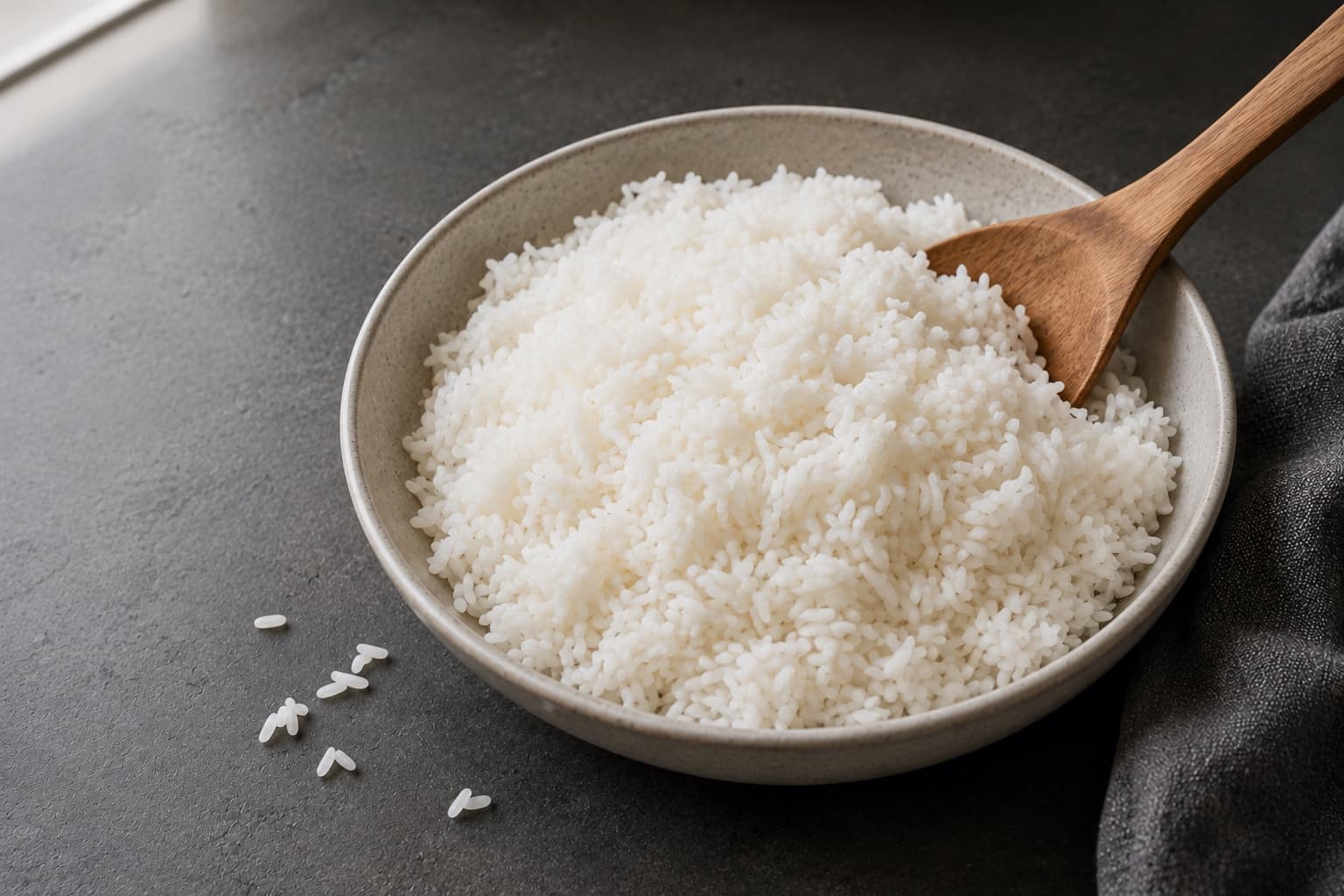
A tracker entry that just says "rice" can be pointing at three different foods depending on where in the cooking process someone put it on the scale. Dry white rice runs 365 calories per 100 g. The same rice, cooked, runs 130 calories per 100 g. Brown rice makes the same swing, 366 raw to 123 cooked. Scoop a cup of cooked rice into a bowl and log it against the raw entry, or the reverse, and every macro in that row is off by close to three times, not just the calorie count.
The swing is water. A pot of rice absorbs roughly two and a half to three times its dry weight as it cooks, and everything else in the grain dilutes by close to that same factor. Protein per 100 g drops from 7.1 g raw to 2.7 g cooked in the white record, and from 7.3 g to 2.7 g in the brown one, the same ratio showing up twice in two different grains. The rice did not lose protein between the pot and the bowl. The reading moved because water joined it.
The records on this page cover both sides of that swing for white and brown. Black and red rice only carry raw records here, which matters for how you log them and is covered below. Which record to use depends on when you put the rice on the scale, and the rest of this page is built around getting that decision right.
What is in a serving
Every figure below is scaled from the USDA record named at the bottom of this panel.
Serving basisgrams
100 gof White, Unenriched, Raw
- Calories
- 359 cal
- Protein
- 7 g
- Carbs
- 80.3 g
- Fat
- 1 g
| Nutrient | Per serving100 g | Per 100 greference |
|---|---|---|
| Calories | 359 cal | 359 cal |
| Protein | 7 g | 7 g |
| Carbs | 80.3 g | 80.3 g |
| Fat | 1 g | 1 g |
| Fiber | 0.1 g | 0.1 g |
| Sugar | not reportedUnavailable. This record does not report sugar. | not reportedUnavailable. This record does not report sugar. |
| Sodium | <1 mg | <1 mg |
Sugar is not reported on White, Unenriched, Raw.
A nutrient the record does not measure shows as — and never as 0. A zero here is a measured zero.
FDC 2512381USDA Foundation FoodsRice, white, long grain, unenriched, rawPublished April 20, 2023
The records behind this page
One food family, 7 source records. The figures are per 100 g, which is the basis the USDA publishes and the only fair way to compare records whose servings differ.
| Record | Caloriescal | Proteing | Carbsg | Fatg | Fiberg | Sugarg | Sodiummg |
|---|---|---|---|---|---|---|---|
| Rice, White, Long Grain, Unenriched, RawFDC 2512381FoundationRawShown by default | 359 | 7 | 80.3 | 1 | 0.1 | not reportedUnavailable. This record does not report sugar. | <1 |
| Rice, White, Long-Grain, Regular, Raw, EnrichedFDC 168877SR LegacyRaw | 365 | 7.1 | 80 | 0.7 | 1.3 | 0.1 | 5 |
| Rice, White, Long-Grain, Regular, Enriched, CookedFDC 168878SR LegacyCooked | 130 | 2.7 | 28.2 | 0.3 | 0.4 | 0.1 | 1 |
| Rice, Brown, Long Grain, Unenriched, RawFDC 2512380FoundationRaw | 366 | 7.3 | 76.7 | 3.3 | 3 | not reportedUnavailable. This record does not report sugar. | 0 |
| Rice, Brown, Long-Grain, CookedFDC 169704SR LegacyCooked | 123 | 2.7 | 25.6 | 1 | 1.6 | 0.2 | 4 |
| Rice, Black, Unenriched, RawFDC 2710825FoundationRaw | 370 | 7.6 | 77.2 | 3.4 | 4.2 | not reportedUnavailable. This record does not report sugar. | 0 |
| Rice, Red, Unenriched, Dry, RawFDC 2710838FoundationRaw | 370 | 8.6 | 76.2 | 3.4 | 4.2 | not reportedUnavailable. This record does not report sugar. | <1 |
Logging rice without guessing
Weigh cooked rice if you eat straight from the pot. A USDA cup of cooked white rice weighs 158 g and carries 205 calories and 44.6 g of carbs. Logging that same 158 g against the raw white record instead prints 577 calories, because the raw record is dry rice and the cooked record has already taken on its water. If your kitchen scale sees the rice after it comes off the stove, log it against the cooked entry every time.
Weigh dry rice if you are batch-cooking or want the more stable number. A dry cup or scoop is a fixed, reproducible quantity in a way a cooked scoop is not, because cooked rice compacts and holds water differently bowl to bowl. USDA's reference amount for dry rice is 45 g, which nets 162 calories and 36.1 g of carbs from the unenriched white record. If you cook a large batch, the more reliable move is to weigh the total cooked yield once it comes off the stove and divide by the number of servings you planned, rather than estimating a scoop size for each bowl over the course of a week.
White and brown cost about the same per bowl. Fiber is where they differ. Cooked white runs 130 calories and 0.4 g of fiber per 100 g. Cooked brown runs 123 calories and 1.6 g of fiber per 100 g. The calorie density is close enough that swapping one for the other barely moves your daily total. The fiber difference is real and shows up at cup scale too, 0.6 g in a cup of cooked white against 3.2 g in a cup of cooked brown. Brown also takes longer on the stove. If the reason you are choosing between them is calories, it will not matter much. If the reason is fiber, log the swap and expect the difference to show up.
Black and red rice only have raw records here. Black rice runs 370 calories, 7.6 g protein, and 4.2 g fiber per 100 g raw. Red rice runs 370 calories, 8.6 g protein, and 4.2 g fiber per 100 g raw, dry. Neither has a cooked record on this page, so the only defensible way to log either is by dry weight before it goes in the pot. That is the same discipline the dry-weight guidance above already recommends, and here it is the only option rather than one of two.
Added salt and fat sit on top of these numbers, not inside them. The cooked records here carry almost no sodium, 1 mg per 100 g for white and 4 mg for brown, which means they were prepared without added salt. If you salt your cooking water or finish the bowl with butter or oil, that is a separate line in your log. The rice itself is not carrying it.
Where rice fits, and where it does not
Race-week carb loading. Cooked white rice is a low-residue, fast-digesting carbohydrate with almost nothing in the bowl besides carbs, which is why it shows up in race-week nutrition planning and carb loading protocols ahead of higher-fiber options. 300 g of it, about two USDA cups, delivers 390 calories and 84.6 g of carbs without the volume or the fiber load of brown rice or beans the night before something long.
Post-workout, next to protein rather than instead of it. A cup of cooked white rice carries just 4.3 g of protein against 44.6 g of carbs, so it is doing the glycogen side of a post-workout meal and needs a protein source doing the other half. That pairing is why the chicken rice bowl and salmon rice bowl are two of the most-built meals on this site rather than rice eaten alone.
Cooled and reheated, with a limit on what this page can tell you. Rice cooked and then cooled develops some resistant starch, a mechanism this page's records cannot measure because resistant starch is not a line item in a standard nutrient panel. The resistant starch entry covers what that means. It does not change what you log for the bowl in front of you.
Where it does not fit. Cooked white rice carries 0.4 g of fiber per 100 g, cooked brown 1.6 g. Both are lower-fiber, lower-volume foods per calorie than potatoes or oats, which are the better swap on a day when the problem is appetite control on a fixed calorie budget rather than carbohydrate delivery around training. Check those foods' own pages for their numbers rather than assuming rice's numbers apply. The decision rule here is simple: know which side of cooking your scale caught the rice on, log that record, and treat white and brown as a fiber decision rather than a calorie one.
Where it fits against a goal
Logging a cooked bowl instead of guessing
158 g of Rice, White, Long-Grain, Regular, Enriched, CookedFDC 168878
- Calories
- 205 cal
- Carbs
- 44.6 g
One USDA cup of cooked white rice weighs 158 g and carries 205 calories and 44.6 g of carbs. Log that weight against the cooked record. The same 158 g logged against the raw white entry prints 577 calories, more than double, because that record is measuring dry rice that has not taken on water yet.
Weighing dry before you cook
45 g of Rice, White, Long Grain, Unenriched, RawFDC 2512381
- Calories
- 162 cal
- Carbs
- 36.1 g
USDA's reference amount for dry rice is 45 g, which nets 162 calories and 36.1 g of carbs from this record. That is smaller than what most bowls actually hold. Weigh your real dry portion on a scale once and write the number down, because a cup scoop compacts differently depending on how full you pack it.
Swapping white for brown without changing the bowl
202 g of Rice, Brown, Long-Grain, CookedFDC 169704
- Calories
- 248 cal
- Fiber
- 3.2 g
A USDA cup of cooked brown rice weighs 202 g and carries 248 calories and 3.2 g of fiber. The equivalent cup of cooked white weighs 158 g and carries 205 calories and 0.6 g of fiber. The calorie gap is small. The fiber gap is the actual reason to switch.
Loading carbs before a long session
300 g of Rice, White, Long-Grain, Regular, Enriched, CookedFDC 168878
- Calories
- 390 cal
- Carbs
- 84.6 g
300 g of cooked white rice, roughly two USDA cups, delivers 390 calories and 84.6 g of carbs with almost nothing in the bowl that is not carbohydrate. That low-residue profile is why it shows up in race-week plans ahead of brown rice or beans the night before a long session.
Methodology
Where the numbers come from
Every figure on this page is scaled from a per-100 g value in a USDA record by one shared function, so the numbers here and the numbers on a meal page that uses this ingredient cannot disagree. Values are rounded once, at the point of display.
- FDC 2512381Rice, white, long grain, unenriched, rawUSDA Foundation Foods
- FDC 168877Rice, white, long-grain, regular, raw, enrichedUSDA SR Legacy
- FDC 168878Rice, white, long-grain, regular, enriched, cookedUSDA SR Legacy
- FDC 2512380Rice, brown, long grain, unenriched, rawUSDA Foundation Foods
- FDC 169704Rice, brown, long-grain, cooked (Includes foods for USDA's Food Distribution Program)USDA SR Legacy
- FDC 2710825Rice, black, unenriched, rawUSDA Foundation Foods
- FDC 2710838Rice, red, unenriched, dry, rawUSDA Foundation Foods
Unavailable values
A nutrient a record does not measure is shown as unavailable and never as zero. Across the 405 records in this dataset, 165 report no fiber and 228 report no sugar, so the distinction is not a rare edge case. A zero on this page means the analysis measured zero.
Source coverage
Every claim on this page resolves to one of the records listed here. This family has no open source gaps.
Datasets
- USDA FoodData Central Foundation FoodsExport 2026-04-30 · 363 of 395 entries normalized
- USDA FoodData Central SR LegacyExport 2018-04 · 42 of 7793 entries normalized