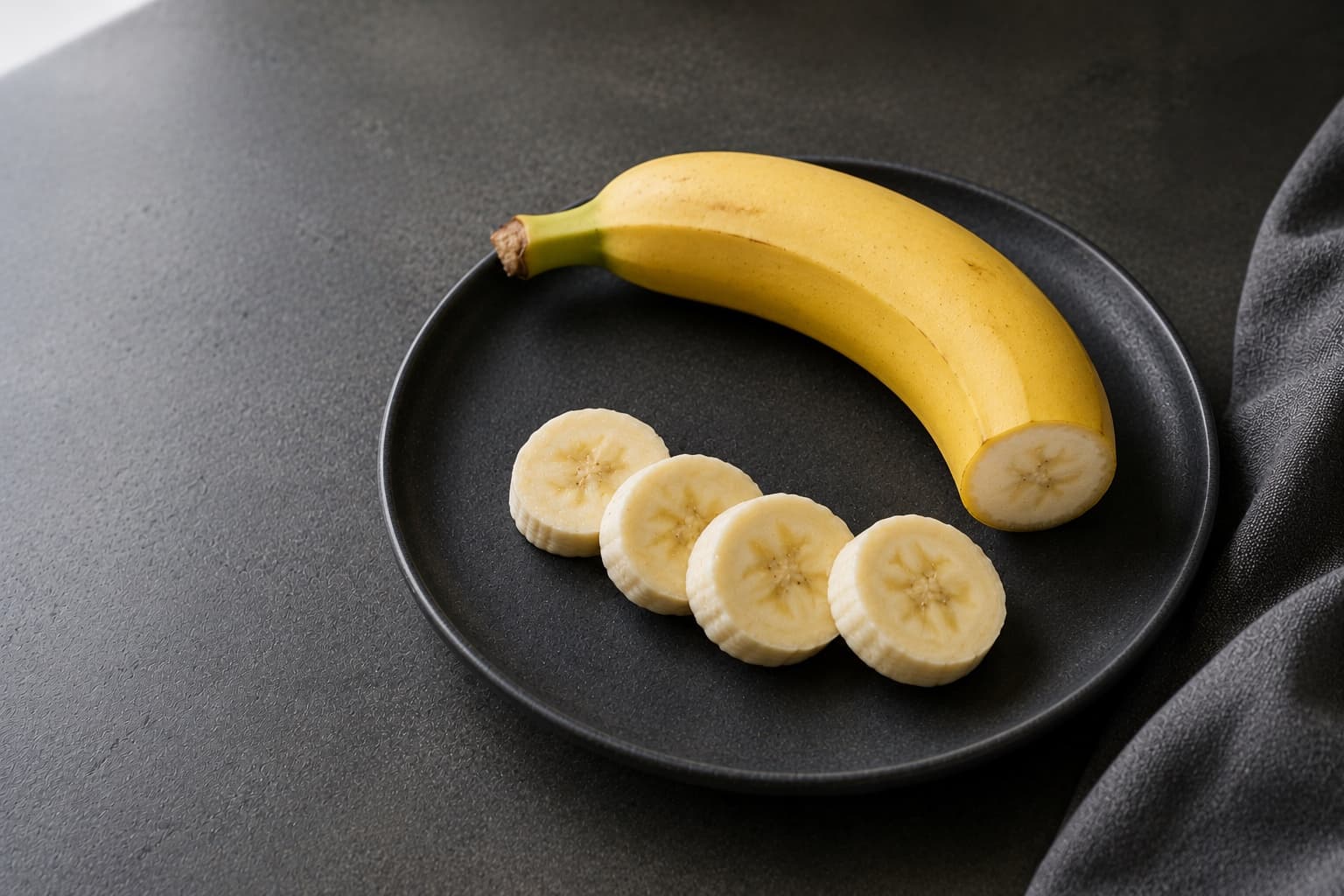
Why this page exists
Most foods on this site need a citation to show that state changes the numbers. Banana does not. The USDA carries a separate record for ripe-and-slightly-ripe and for overripe, and at the 140 g reference weight both share, the overripe record loses 17 calories and 4.1 g of total carbohydrate against the ripe one. Sugar and fiber do not move: sugar is 22.1 g and fiber is 1.7 g in both records, while protein is nearly unchanged. As a banana goes from yellow to brown-spotted, this dataset shows lower calories, carbohydrate, and fat at the same reference weight, with sugar and fiber holding flat.
That gap between "less carbohydrate" and "no more sugar" is exactly where glycemic index earns its place on this page instead of being a filler stat. A green-tipped banana runs a GI in the low 40s, and a fully ripe, spotted banana runs into the low 50s or higher, a difference driven by how much of the starch is still intact enough to resist digestion rather than by the sugar total changing.gi Bulk sugar content is a poor stand-in for how fast a banana digests. Ripeness is the actual variable, and this page treats it as one.
What is in a serving
Every figure below is scaled from the USDA record named at the bottom of this panel.
Serving basisgrams
100 gof Ripe and Slightly Ripe, Raw
- Calories
- 97 cal
- Protein
- 0.7 g
- Carbs
- 23 g
- Fat
- 0.3 g
| Nutrient | Per serving100 g | Per 100 greference |
|---|---|---|
| Calories | 97 cal | 97 cal |
| Protein | 0.7 g | 0.7 g |
| Carbs | 23 g | 23 g |
| Fat | 0.3 g | 0.3 g |
| Fiber | 1.7 g | 1.7 g |
| Sugar | 15.8 g | 15.8 g |
| Sodium | 0 mg | 0 mg |
Every macro in this table is measured on Ripe and Slightly Ripe, Raw.
A nutrient the record does not measure shows as — and never as 0. A zero here is a measured zero.
FDC 1105314USDA Foundation FoodsBananas, ripe and slightly ripe, rawPublished April 1, 2020
The records behind this page
One food family, 2 source records. The figures are per 100 g, which is the basis the USDA publishes and the only fair way to compare records whose servings differ.
| Record | Caloriescal | Proteing | Carbsg | Fatg | Fiberg | Sugarg | Sodiummg |
|---|---|---|---|---|---|---|---|
| Bananas, Ripe and Slightly Ripe, RawFDC 1105314FoundationRawShown by default | 97 | 0.7 | 23 | 0.3 | 1.7 | 15.8 | 0 |
| Bananas, Overripe, RawFDC 1105073FoundationRaw | 85 | 0.7 | 20.1 | 0.2 | 1.7 | 15.8 | not reportedUnavailable. This record does not report sodium. |
Logging bananas without guessing
Weigh peeled, not whole. The peel is inedible and is excluded from the records on this page. The portions this page cites, 115 g for the ripe-and-slightly-ripe record and 110 g for the overripe one, are both peeled weights. If your kitchen scale reading includes the peel, peel first and weigh what you are actually about to eat.
"1 medium banana" hides a real spread. The USDA reference amount for both records is 140 g peeled, which sits closer to a large banana than a typical grocery-store medium. At the ripe record's density, 97 kcal per 100 g, a small banana around 100 g peeled runs 97 kcal and a large one at the 140 g reference weight runs 136 kcal. That is a 39-calorie gap between two bananas that both get logged under the same "1 medium banana" entry in most apps. Weigh yours once, note the peeled weight against your usual size, and stop treating "medium" as a unit.
Ripe and overripe are not the same food, and the difference runs the opposite direction from what most people assume. Per 100 g, the ripe-and-slightly-ripe record carries 97 kcal and 23 g of carbohydrate. The overripe record carries 85 kcal and 20.1 g. Sugar sits at 15.8 g per 100 g in both. A banana that has gone soft and spotted is lower in calories and total carbohydrate at the same weight, not higher, even though it tastes sweeter and digests faster. Sweetness and glycemic speed track the starch-to-sugar conversion and the physical breakdown of the fruit's structure. Calorie count tracks total mass, and overripe bananas lose mass to moisture and respiration as they age. Log the record that matches what is actually in your hand.
Frozen changes the volume, not the food. A banana frozen for a smoothie is the same peeled weight it was before freezing, just harder to eyeball once it is in chunks in a bag. Weigh peeled bananas before freezing and write the weight on the bag, or count them and use a peeled-weight average. Guessing volume from a bag of frozen chunks is where smoothie logging drifts furthest from the plate.
Fiber and protein hold flat across ripeness. Both records report 1.7 g of fiber per 100 g and roughly three-quarters of a gram of protein. Neither of those numbers moves as the banana ripens, so ripeness is a carbohydrate and calorie question on this page, not a fiber or protein one.
Where banana fits, and where it does not
Pre-workout and race-day carbs, where the ripe record is the right one. A ripe-and-slightly-ripe banana at 115 g delivers 112 kcal and 26.5 g of fast, low-fiber, low-fat carbohydrate that clears the stomach quickly enough to work 20 to 40 minutes ahead of a session. The site's race-week and early-morning-training content already reaches for bananas by default. This is the record that default should point at, not the overripe one that happened to be softer.
Resistant starch in the green-tipped banana, and a lever with real but modest size. A banana still carrying green at the stem end has more of its starch in an undigested, resistant form, which is the mechanism behind its lower glycemic response.gi The magnitude is smaller than the folklore around it suggests, and ripeness is the practical control a reader actually has. See resistant starch for how that fraction behaves in the gut rather than repeating the mechanism here.
Potassium, in proportion. A medium banana carries roughly 420 mg of potassium, about 9 percent of the adult daily value.potassium That is a real contribution and it is not the largest one on this site. A medium potato delivers more potassium per serving than a banana does, so reach for banana as a convenient, no-prep source rather than as the single best one. See potassium for the full range of food sources and why the mineral matters for training.
Pairing, not replacing, protein. Neither banana record breaks 1 g of protein per 100 g. A banana next to a protein shake or folded into protein oatmeal covers the carbohydrate side of a pre- or post-training meal while something else covers protein. A banana alone is not a meal.
Where it does not fit. A banana adds fast carbohydrate and very little else, which is exactly wrong for a reader trying to close a fiber or protein gap for the day. Rice and oats both carry a similar or larger carbohydrate load with a role that changes more depending on preparation. Reach for banana when the job is speed and convenience, and reach elsewhere when the job is volume or protein.
Footnotes
Atkinson FS, Brand-Miller JC, Foster-Powell K, Buyken AE, Goletzke J. International tables of glycemic index and glycemic load values 2021: a systematic review. Am J Clin Nutr. 2021,114(5):1625-1632. PubMed
Back to textBack to text 2NIH Office of Dietary Supplements. Potassium Fact Sheet for Health Professionals. Updated June 2, 2022. NIH ODS
Back to text
Where it fits against a goal
Pre-workout or race-morning carbs
115 g of Bananas, Ripe and Slightly Ripe, RawFDC 1105314
- Calories
- 112 cal
- Carbs
- 26.5 g
A single peeled banana at the USDA portion, 115 g, carries 112 kcal and 26.5 g of carbohydrate with no fat and no fiber load to slow it down. That is the record to log for a banana eaten 20 to 40 minutes before a session, not the overripe one sitting on the counter because it looked riper.
Smoothies and baking, where overripe gets used
110 g of Bananas, Overripe, RawFDC 1105073
- Calories
- 94 cal
- Carbs
- 22.1 g
The banana going soft on the counter is lower in both calories and carbohydrate per peeled fruit than a firmer one of similar size, 94 kcal and 22.1 g against 112 kcal and 26.5 g. If you keep a mental note that overripe bananas are "more sugary and more caloric," this record says otherwise on both counts.
Sizing the log entry without a scale
140 g of Bananas, Ripe and Slightly Ripe, RawFDC 1105314
- Calories
- 136 cal
- Carbs
- 32.2 g
- Sugar
- 22.1 g
140 g is the USDA reference amount both records on this page share, which is close to a large banana rather than a small one. Weigh yours once peeled. At the ripe record's density, a 100 g small banana runs 97 kcal and a 140 g large one runs 136 kcal, a 39-calorie spread that "1 medium banana" hides completely.
Methodology
Where the numbers come from
Every figure on this page is scaled from a per-100 g value in a USDA record by one shared function, so the numbers here and the numbers on a meal page that uses this ingredient cannot disagree. Values are rounded once, at the point of display.
- FDC 1105314Bananas, ripe and slightly ripe, rawUSDA Foundation Foods
- FDC 1105073Bananas, overripe, rawUSDA Foundation Foods
Unavailable values
A nutrient a record does not measure is shown as unavailable and never as zero. Across the 405 records in this dataset, 165 report no fiber and 228 report no sugar, so the distinction is not a rare edge case. A zero on this page means the analysis measured zero.
Source coverage
Every claim on this page resolves to one of the records listed here. This family has no open source gaps.
Datasets
- USDA FoodData Central Foundation FoodsExport 2026-04-30 · 363 of 395 entries normalized
- USDA FoodData Central SR LegacyExport 2018-04 · 42 of 7793 entries normalized