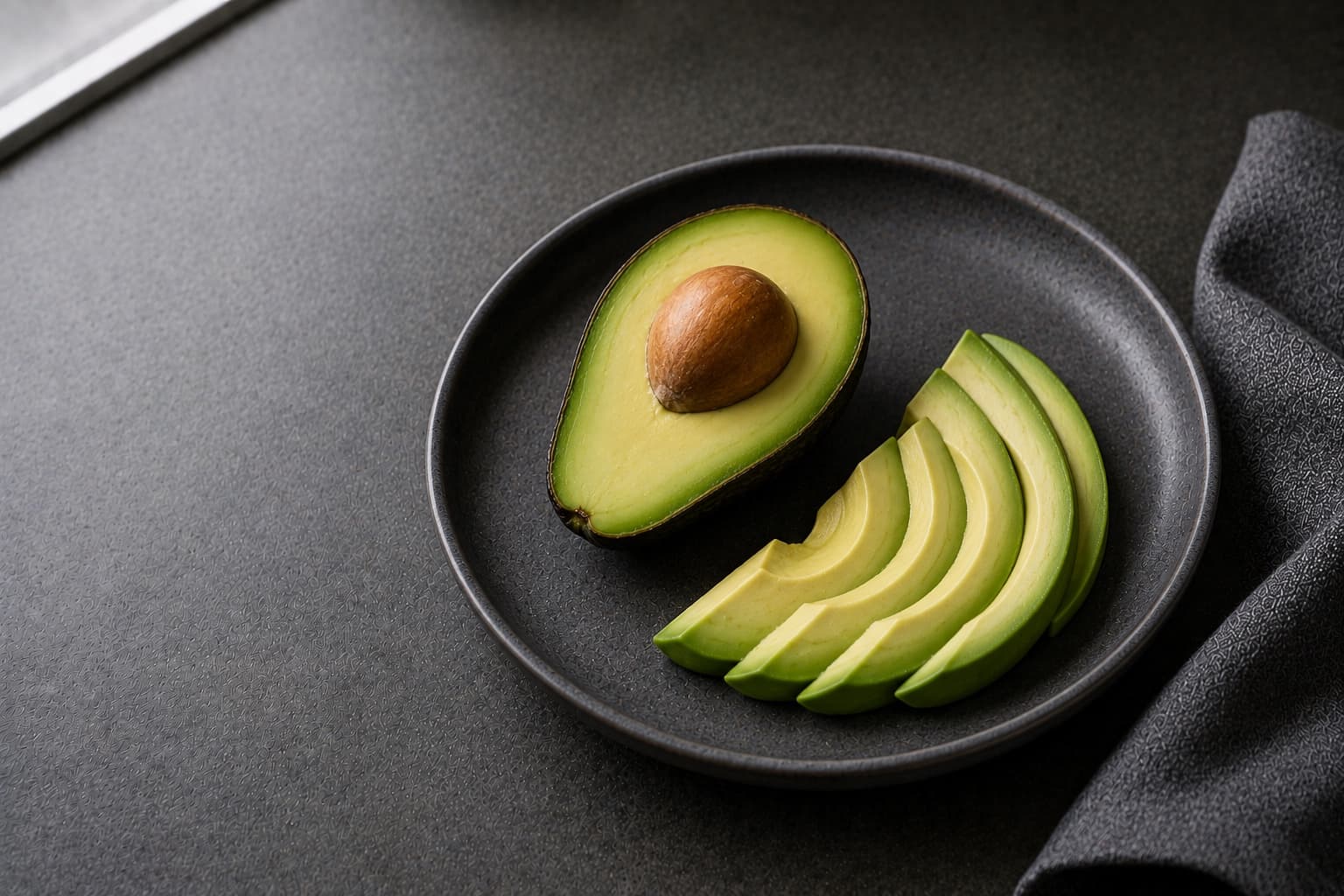
Why this page exists
Avocado carries 223 calories per 100 g of Hass flesh, the single record behind this page. That is denser than most people's mental model of a fruit, and the portion size everyone reaches for compounds the miscalculation. "Half an avocado" assumes a fixed avocado. USDA does not publish one, because there isn't one. A small Hass and a large Hass can differ by well over a hundred grams of edible flesh, and half of two different fruits produces two different calorie counts logged under the same phrase.
The record measures peeled flesh only. The avocado sitting on a kitchen scale still carries its pit and skin, which are excluded from the record. Weigh the flesh after removing both, or log a separately measured edible portion, rather than applying the flesh record to the whole unpeeled fruit.
Everything below scales from that one record. Change the weight and every figure moves with it.
What is in a serving
Every figure below is scaled from the USDA record named at the bottom of this panel.
Serving basisgrams
100 gof Avocado, Hass, Peeled, Raw
- Calories
- 223 cal
- Protein
- 1.8 g
- Carbs
- 8.3 g
- Fat
- 20.3 g
| Nutrient | Per serving100 g | Per 100 greference |
|---|---|---|
| Calories | 223 cal | 223 cal |
| Protein | 1.8 g | 1.8 g |
| Carbs | 8.3 g | 8.3 g |
| Fat | 20.3 g | 20.3 g |
| Fiber | not reportedUnavailable. This record does not report fiber. | not reportedUnavailable. This record does not report fiber. |
| Sugar | not reportedUnavailable. This record does not report sugar. | not reportedUnavailable. This record does not report sugar. |
| Sodium | 0 mg | 0 mg |
Fiber and Sugar are not reported on Avocado, Hass, Peeled, Raw.
A nutrient the record does not measure shows as — and never as 0. A zero here is a measured zero.
FDC 2710824USDA Foundation FoodsAvocado, Hass, peeled, rawPublished October 31, 2024
The records behind this page
One food family, 1 source record. The figures are per 100 g, which is the basis the USDA publishes and the only fair way to compare records whose servings differ.
| Record | Caloriescal | Proteing | Carbsg | Fatg | Fiberg | Sugarg | Sodiummg |
|---|---|---|---|---|---|---|---|
| Avocado, Hass, Peeled, RawFDC 2710824FoundationRawShown by default | 223 | 1.8 | 8.3 | 20.3 | not reportedUnavailable. This record does not report fiber. | not reportedUnavailable. This record does not report sugar. | 0 |
Logging avocado without guessing
Peel and pit before the fruit touches the scale. The 223 calories and 20.3 g of fat per 100 g in this record describe flesh only. Weighing the whole fruit first and subtracting nothing after peeling is how a 140 g serving of flesh gets logged as 200 g or more, calories and all.
There is no "1 avocado" or "1 cup mashed" portion published for this record. The only portion USDA carries is a 140 g reference amount. At that weight the record delivers 312 calories, 28.4 g of fat, 2.5 g of protein, and 11.6 g of carbohydrate. That figure is USDA's single fixed anchor in a food where the raw material varies by far more than a tub of yogurt or a bag of rice does, and it will rarely match what a particular fruit weighs once peeled. Weigh the flesh after prep and log that gram figure. Treat the 140 g anchor as a rare coincidence.
Sodium sits at 0 for this record. Any salt in a bowl of guacamole came entirely from what got added at the counter, since the fruit itself contributes none. The record also has nothing to say about a store-bought guacamole or a restaurant dip, both of which routinely add salt and oil or cream that this page does not cover.
This page will not give you a fiber number for avocado. The Hass record carries no fiber value, and the table renders that as unavailable. It never invents a zero for a nutrient nobody measured. If a fiber target depends on avocado's contribution, get that number from the product label in front of you. This dataset does not support a generic figure.
Where avocado fits, and where it does not
Bulking, where the problem is getting calories in without more food volume. 140 g of flesh adds 312 calories and 28.4 g of fat to a plate that otherwise looks identical. That is useful specifically because it requires no extra cooking step, which matters on the days appetite is already the limiting factor.
Cutting, where the same density works against the reader. A 30 g scoop costs 67 calories and 6.1 g of fat, small enough to sit on a sandwich without eating a large share of a tight fat allowance. The failure mode on a cut is repeating an eyeballed scoop at lunch and dinner without ever weighing it or seeing the running total.
Pair it with protein, because the record will not supply any. 100 g of flesh carries 1.8 g of protein against 20.3 g of fat, so a bowl built around avocado alone is a fat source wearing a meal's clothing. It works in a high-protein salad with a protein anchor already in it, folded into a chicken wrap, or set beside a salmon rice bowl where the fish is doing the protein work and the avocado is doing the fat work.
Where it competes for the same fat budget. Olive oil, almonds, and peanut butter sit in the same calorie-dense bracket for a reason, and stacking two or three of them into one meal on top of avocado is how a plate that looks like leafy greens with a garnish turns into the day's largest fat load. Pick one dense fat source per meal and let the rest of the plate carry lower-density volume, leafy greens among them.
The decision rule for this page is short. Peel and pit first, then weigh the flesh in grams and log that figure against this record.
Where it fits against a goal
Adding calories to a bulk without another meal
140 g of Avocado, Hass, Peeled, RawFDC 2710824
- Calories
- 312 cal
- Fat
- 28.4 g
The 140 g reference amount carries 312 calories and 28.4 g of fat in one serving of flesh, with no cooking step between the scale and the plate. That is a meaningful addition to a bulk's daily total without another prepared component.
Cutting on a fixed calorie budget
30 g of Avocado, Hass, Peeled, RawFDC 2710824
- Calories
- 67 cal
- Fat
- 6.1 g
30 g of flesh runs 67 calories and 6.1 g of fat. Weigh a scoop this size before it goes on the plate, because eyeballing a scoop twice as large is exactly where a cutting day's fat allowance disappears without a corresponding line in the log.
Splitting a shared bowl without losing track
50 g of Avocado, Hass, Peeled, RawFDC 2710824
- Calories
- 112 cal
- Fat
- 10.2 g
50 g of flesh costs 112 calories and 10.2 g of fat. When a bowl of guacamole gets split three or four ways at a table, this weight is closer to what actually lands on one plate than the whole avocado the recipe started with.
Reading the fat and protein trade the record makes
100 g of Avocado, Hass, Peeled, RawFDC 2710824
- Protein
- 1.8 g
- Fat
- 20.3 g
100 g of flesh carries 1.8 g of protein against 20.3 g of fat. This record supplies fat far more than it supplies protein, and it only does double duty in a meal when something else at the table is carrying the protein.
Where this page stops short of the data
One claim this page would like to make does not resolve to a record in the dataset. Each one carries the decision that was made about it.
Claim dropped
Dietary fiber per 100 g of avocado flesh
No record supports this, so the page does not say it. There is no estimate standing in for the missing figure.
Methodology
Where the numbers come from
Every figure on this page is scaled from a per-100 g value in a USDA record by one shared function, so the numbers here and the numbers on a meal page that uses this ingredient cannot disagree. Values are rounded once, at the point of display.
- FDC 2710824Avocado, Hass, peeled, rawUSDA Foundation Foods
Unavailable values
A nutrient a record does not measure is shown as unavailable and never as zero. Across the 405 records in this dataset, 165 report no fiber and 228 report no sugar, so the distinction is not a rare edge case. A zero on this page means the analysis measured zero.
Source coverage
This family has 1 recorded gap between the editorial brief and the dataset, each shown above with the decision made about it.
Datasets
- USDA FoodData Central Foundation FoodsExport 2026-04-30 · 363 of 395 entries normalized
- USDA FoodData Central SR LegacyExport 2018-04 · 42 of 7793 entries normalized