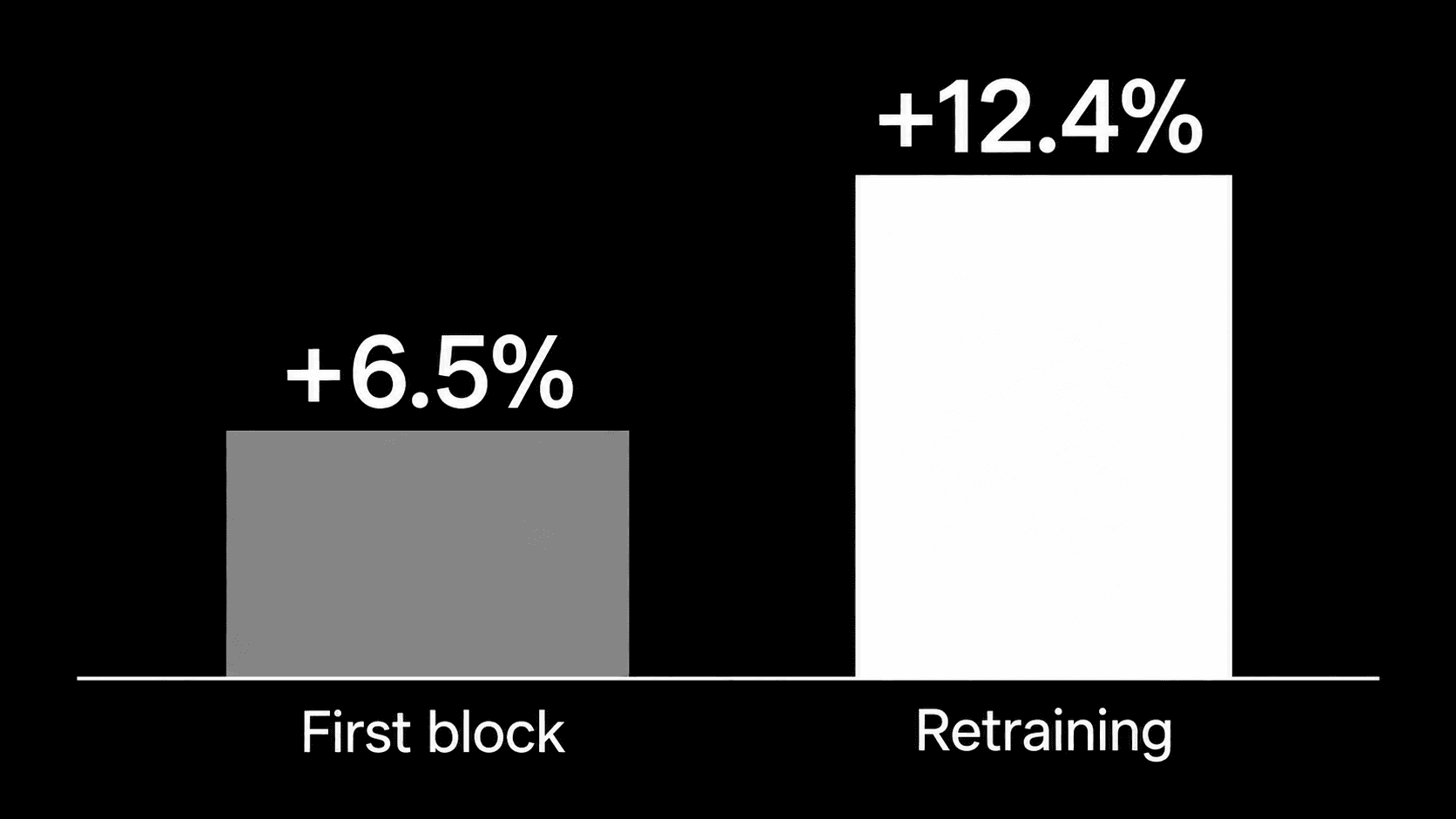
Eight previously untrained men lifted for 7 weeks, stopped for 7 weeks, then lifted for 7 weeks again. Lower-limb lean mass rose 6.5% in the first block. After the layoff it had fallen back toward the start. The second block added 12.4% from the original baseline, 5.9 percentage points more than the first time through.1 The sample is small. The pattern is the one every returning lifter is betting on.
That pattern is muscle memory. The fiber you already grew is easier to grow again than a fiber that has never been large. The useful questions are how long the advantage lasts, what actually stays in the tissue, and what to eat when you walk back into the gym.
01Myonuclei stay after the fiber shrinks
A muscle fiber is a long cell with many nuclei. Each nucleus governs a volume of cytoplasm, the myonuclear domain. When the fiber grows past what the existing nuclei can support, satellite cells donate new nuclei. Bruusgaard overloaded mouse muscle, watched those new nuclei appear before the fiber got much larger, then denervated the muscle. Fiber size collapsed. The extra nuclei did not.9
That rodent result is the origin of the gym story that you never lose the nuclei you paid for. Human data is less tidy. Psilander trained one leg for 10 weeks in 19 adults. CSA rose about 17% and strength about 20%. Myonuclear number did not rise as a group, so the study could not test whether extra nuclei survive a layoff. After 20 weeks off, thickness and CSA were back at baseline.2 A later look at the people who did add nuclei found that most of those extra nuclei were gone after detraining.10
Cumming changed the muscle and the method. Twelve untrained men and women trained one elbow flexor for 10 weeks, sat out 16 weeks, then trained both arms for 10 weeks. Type 2 myonuclei rose 34% in the trained arm and stayed there through detraining, 33% higher than the control arm when retraining started. Type 2 fiber area ended larger in the previously trained arm. The change during retraining was not different between arms.5 Extra nuclei can persist in human muscle.
A 2022 meta-analysis by Rahmati pooled human and animal work and concluded that myonuclei are lost during atrophy and with ageing in humans, and that rodent nuclei look more durable.11 The mechanism is contested. The faster regain is easier to show than its cause. Seaborne's lean-mass numbers are one human demonstration of that gap.1 Cumming found nuclei that persisted and still did not find a clearly larger retraining gain.5
The second candidate is epigenetic. Seaborne mapped DNA methylation across 850,000 sites. Reloading hypomethylated 18,816 CpG sites. The first loading block hypomethylated 9,153. Several growth-related genes stayed hypomethylated through the 7 weeks off, after lean mass had fallen.1 That is a molecular mark that outlasts the tape measure. It is also a study of eight men. Treat it as a candidate mechanism. It does not tell you how to train.
02Strength holds longer than size
Neural skill decays slower than contractile protein. Psilander's trainees lost the CSA they had gained and kept about 60% of the strength gain after 20 weeks of no lifting.2 The leftover likely reflects neural adaptation and skill in the lift. It will make the first sessions back feel better than your arms look.
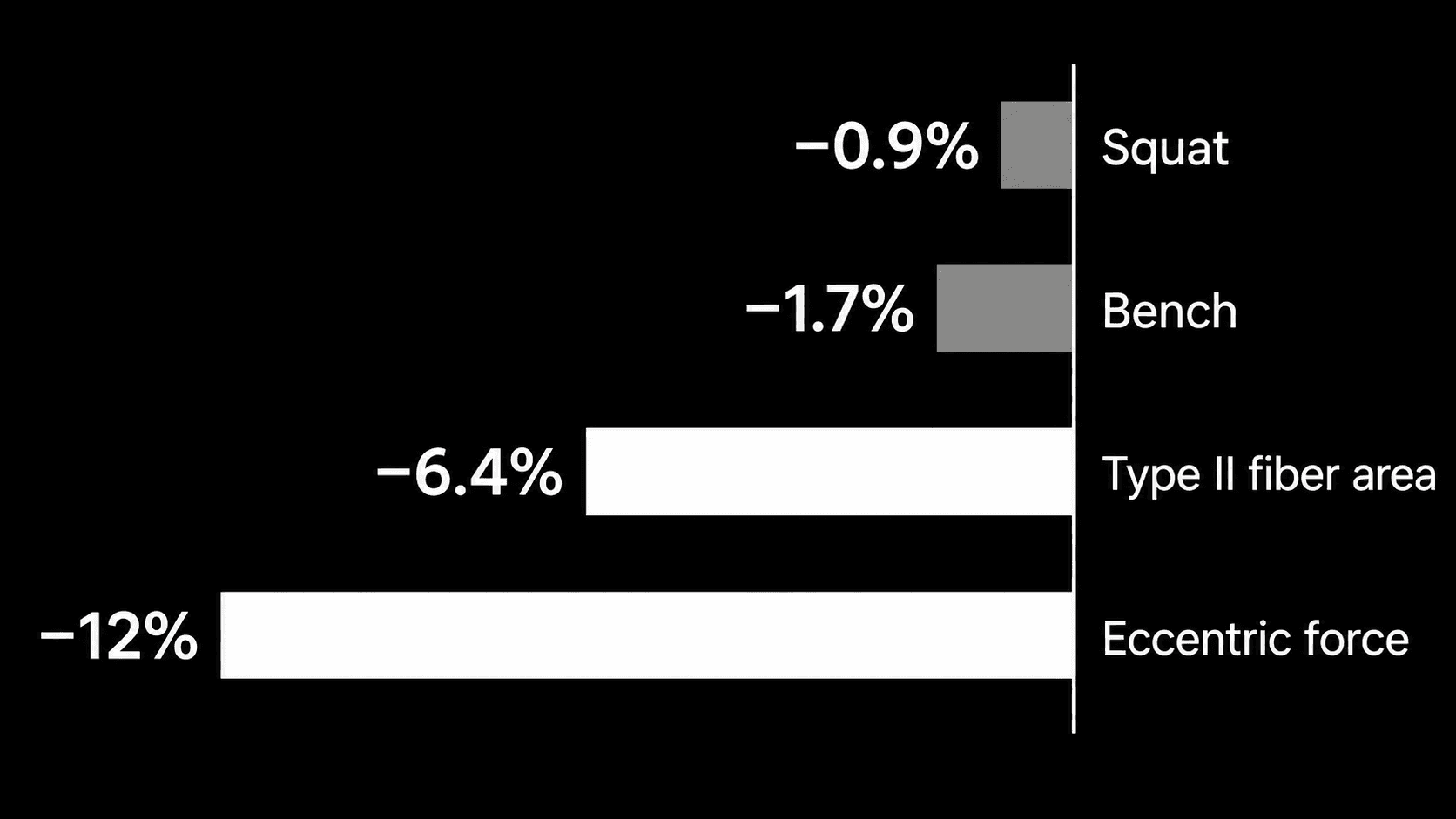
Fourteen days off in Hortobágyi's 12 power athletes left free-weight bench press down 1.7% and squat down 0.9%. Isokinetic eccentric knee extension fell 12% in every subject. Type II fiber area fell 6.4%. Type I area did not.3 The bar weight can lie for two weeks. The fiber already started shrinking.
Some of the first week of looking smaller is likely glycogen and the water bound to it, which comes back once carbohydrate and training return. Some of it is fiber. Hortobágyi measured a Type II area drop in trained athletes after two weeks.3 Wall measured an 8.4% quadriceps CSA drop after two weeks in a cast.8 Use the mirror as a mood check. Use load and tape as the actual score.
03Weeks off still leave a trained muscle
Ogasawara split 15 untrained men into continuous bench-press training or a 6-week block, 3 weeks off, then more training. After the 3-week gap, CSA and 1-RM had not fallen in a statistically significant way. Retraining CSA gains looked like the first block. At 15 weeks both groups had similar 1-RM and CSA.4 A later 24-week version with repeated 3-week gaps reached similar hypertrophy with about 25% fewer sessions than continuous training.12
Three weeks of missed gym time in a healthy lifter is a pause. Keep protein up, keep walking, and come back. The expensive version is a month of eating like you are still training hard while you are on the couch, or cutting protein because the barbell is unused.
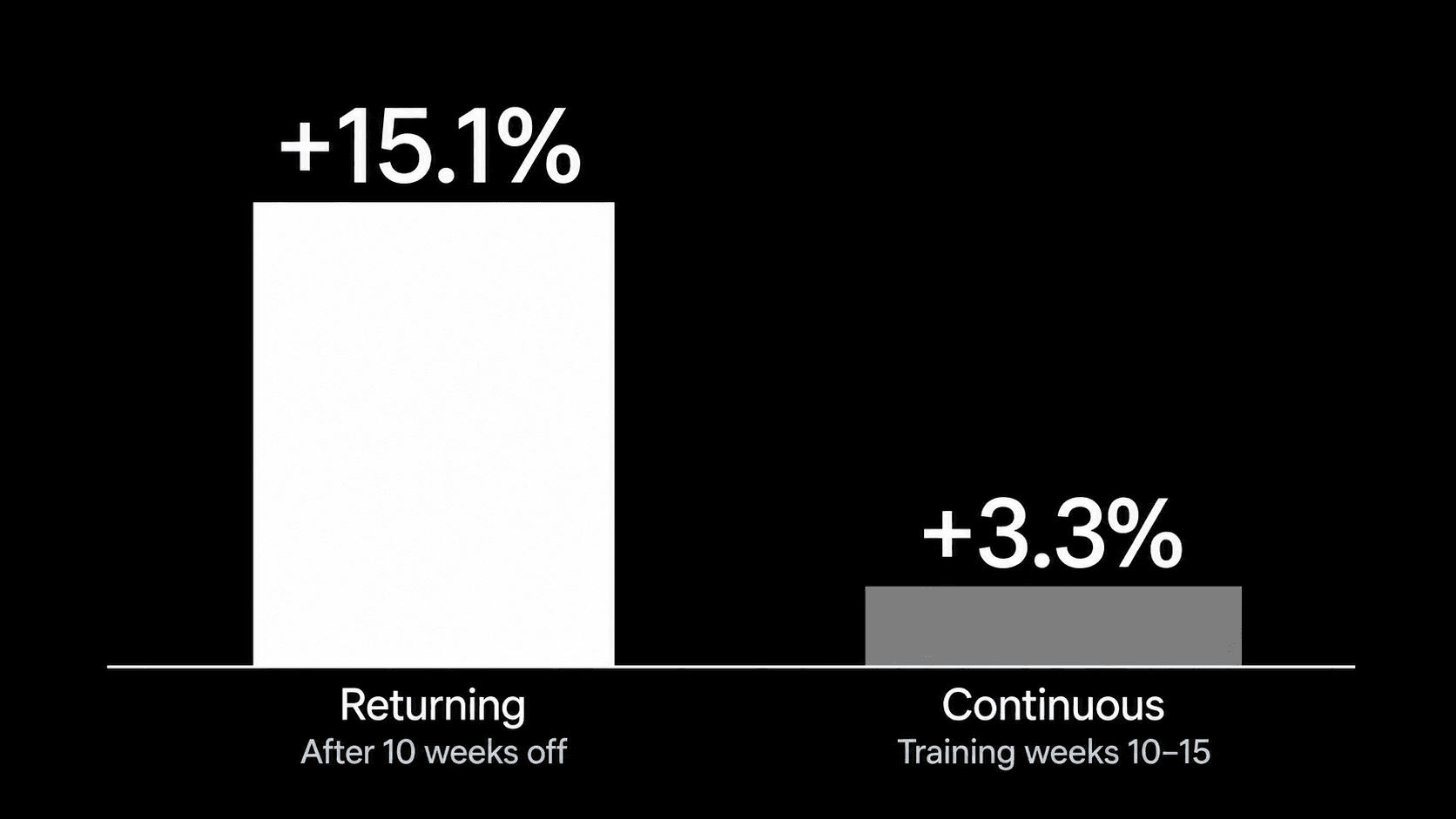
Ten weeks off is a larger hit, and it still comes back fast once loading returns. Halonen randomized 55 untrained adults, mean age 32, 45% women. Forty-two finished. The periodic group lifted for 10 weeks, stopped for 10, then lifted for 10. Vastus lateralis CSA fell 9.9% and leg-press 1-RM fell 5.4% during the break. The first 5 weeks of retraining raised CSA 15.1% and leg-press 1-RM 12.2%. People who had kept training through weeks 10 to 15 of a continuous block gained 3.3% CSA and 5.9% 1-RM in that same window. End-of-study size and strength matched.17 A planned 10-week gap cost the weeks you were gone, and retraining paid them back.
A cast, a surgical boot, or bed rest is a different dose of disuse. Wall immobilized one leg for 14 days in 12 healthy young men. Quadriceps CSA fell 8.4%. Strength fell 22.9%. After 20 g of protein, mixed-muscle protein synthesis ran 31% lower than it had before the cast.8 Five days of the same model already cut CSA 3.5%.13 If you cannot load the limb, use the protein and calorie plan in What to Eat After Surgery or a Cast to Protect Muscle. Do not treat that page as advice for a two-week vacation.
04Protein and calories in the first weeks back
Eat as if you are training, because you are about to. Morton pooled 49 resistance-training studies and 1,863 people. Protein supplementation helped fat-free mass, and intakes above about 1.62 g/kg/day did not add more FFM from the extra protein.6 The protein effect was larger in people with training experience, a group that likely includes returning lifters. Hold 1.6 to 2.2 g/kg. Distribute it across three or four meals so each feeding clears the leucine threshold.
Calories shape how much of the regained weight is muscle and how much is fat. A small surplus of 200 to 350 kcal is the working range for most intermediates in Lean Bulk Without Belly Gain. Beginners can sit a little higher. Advanced lifters can sit a little lower. Muscle memory does not justify a 700 kcal surplus. The tissue can come back quickly. The fat that arrives with a sloppy surplus does not leave quickly, which is the composition problem in When weight cycling returns fat faster than lean mass.
| Situation | Protein | Energy | Why |
|---|---|---|---|
| 1 to 3 weeks off, still walking | 1.6 to 2.2 g/kg | Maintenance | CSA and 1-RM barely move in the Ogasawara and Hortobágyi windows34 |
| First 4 to 8 weeks back | 1.6 to 2.2 g/kg | Maintenance to a 200 to 350 kcal surplus | Returning size needs amino acids and a small surplus67 |
| Coming off a cut into regain | 1.6 to 2.2 g/kg | Rise to maintenance first, then a surplus | Hold the post-cut maintenance until waist and strength stabilize |
| Cast, boot, or bed rest | Keep protein, individualize | May fall with activity, protein stays | Disuse blunts the response to a 20 g protein feeding8 |
Creatine is a training tool on the way back. Johnston used 20 g/day during 7 days of upper-arm casting in 7 young men. Lean tissue mass held at +0.9% on creatine and fell 3.7% on placebo.14 Backx loaded creatine then immobilized a leg for 7 days in 30 young men. Quadriceps CSA fell about 5.5% in both groups.15 Hespel found the same pattern in a 2-week cast plus 10-week rehab design. Creatine did not stop the immobilization loss. It sped CSA and power recovery once knee-extensor training restarted.18 Use 3 to 5 g of creatine monohydrate if you already tolerate it. Do not expect it to replace loading. The broader evidence is in The Complete Guide to Creatine.
Extra protein did not protect a casted leg either. Dirks gave older men extra protein during 5 days of one-leg immobilization and lifted intake to 1.6 g/kg. Quadriceps CSA and strength still fell, with no advantage over the control diet.19 Keep protein. Load the limb as soon as the clinician allows.
During a voluntary layoff, the common error is dropping protein with the training sessions. Muscle protein synthesis does not stop when the sessions do. The fiber is smaller and still turning over. Keep the protein target even when the calendar is empty.
05Training load for the first month
Start below recent working weights. Add load when the reps are clean. The first sessions back are a tissue-tolerance problem. Tendon, joint, and skill return on different clocks than the pump. Hortobágyi's athletes kept their squat and bench after two weeks and still lost Type II area and eccentric force.3 Matching last-cycle top sets on day one is how people collect a tendon complaint in week two.
Two to four hard sessions a week is enough to restart the signal. The minimum effective dose logic in Strength Training Minimum Effective Dose During a Cut still applies when calories are at maintenance. You need enough hard sets to tell the fiber it is wanted. You do not need to make up every missed week in the first 10 days.
A deload week is a planned reduction inside a training block. A layoff is unplanned time away. Treat the first two weeks back as a ramp, then return to progressive overload. Seaborne's second 7-week block outgrew the first without any special exercise except showing up again.1 Cumming's previously trained biceps had more type 2 nuclei and still did not pull away from the untrained arm during retraining.5 The work still has to be done.
06Age and drugs change the memory
Satellite-cell contribution to new nuclei is less reliable with age. Rahmati's ageing comparison found lower myonuclear content and lower satellite-cell content in older adults, especially in type II fibers.11 That is one reason anabolic resistance in men over 40 is a per-meal protein and loading problem. The operating numbers are in Protein and Anabolic Resistance for Men Over 40. For an older lifter coming back, that means higher per-meal protein and more recovery between hard sessions.
Egner treated female mice with testosterone for 14 days. Myonuclei rose 66% and fiber CSA rose 77%. Three months after the drug was gone, fiber size had returned to control. Nuclei were still about 28% higher. Six days of overload then grew those fibers 31%. Control fibers did not grow in a meaningful way over the same six days.16 In these mice, a drug-driven gain in nuclei outlasted the size it built and sped the next round of growth.
Nielsen biopsied 25 men, including 7 former anabolic-steroid users a geometric mean of 4.0 years after stopping. Type II fibers in the former users had higher myonuclear density and smaller myonuclear domains than controls. Longer accumulated use tracked with even smaller domains.20 That is a cross-sectional observation. Nobody retrained these men and measured how fast they grew. It is one reason anti-doping researchers treat nuclear permanence as a live policy question.
The first month back is a protein and loading problem. Extra nuclei and leftover methylation marks only pay off if you train and eat. Waiting does not grow the fiber.
Footnotes
Seaborne RA, Strauss JA, Cocks M, et al. Human skeletal muscle possesses an epigenetic memory of hypertrophy. Scientific Reports. 2018, 8:1898. PubMed
Back to textBack to text 2Back to text 3Back to text 4Back to text 5Psilander N, Eftestøl E, Cumming KT, et al. Effects of training, detraining, and retraining on strength, hypertrophy, and myonuclear number in human skeletal muscle. Journal of Applied Physiology. 2019, 126(6):1636-1645. PubMed
Back to textBack to text 2Hortobágyi T, Houmard JA, Stevenson JR, Fraser DD, Johns RA, Israel RG. The effects of detraining on power athletes. Medicine and Science in Sports and Exercise. 1993, 25(8):929-935. PubMed
Back to textBack to text 2Back to text 3Back to text 4Back to text 5Ogasawara R, Yasuda T, Sakamaki M, Ozaki H, Abe T. Effects of periodic and continued resistance training on muscle CSA and strength in previously untrained men. Clinical Physiology and Functional Imaging. 2011, 31(5):399-404. PubMed
Back to textBack to text 2Back to text 3Cumming KT, Reitzner SM, Hanslien M, et al. Muscle memory in humans. Evidence for myonuclear permanence and long-term transcriptional regulation after strength training. The Journal of Physiology. 2024, 602(17):4171-4193. PubMed
Back to textBack to text 2Back to text 3Back to text 4Morton RW, Murphy KT, McKellar SR, et al. A systematic review, meta-analysis and meta-regression of the effect of protein supplementation on resistance training-induced gains in muscle mass and strength in healthy adults. British Journal of Sports Medicine. 2018, 52(6):376-384. PubMed
Back to textBack to text 2Back to text 3See the surplus ranges in Lean Bulk Without Belly Gain.
Back to textBack to text 2Wall BT, Snijders T, Senden JM, et al. Disuse impairs the muscle protein synthetic response to protein ingestion in healthy men. Journal of Clinical Endocrinology and Metabolism. 2013, 98(12):4872-4881. PubMed
Back to textBack to text 2Back to text 3Back to text 4Bruusgaard JC, Johansen IB, Egner IM, Rana ZA, Gundersen K. Myonuclei acquired by overload exercise precede hypertrophy and are not lost on detraining. Proceedings of the National Academy of Sciences. 2010, 107(34):15111-15116. PubMed
Back to textMurach KA, Dungan CM, Dupont-Versteegden EE, McCarthy JJ, Peterson CA. "Muscle memory" not mediated by myonuclear number? Secondary analysis of human detraining data. Journal of Applied Physiology. 2019, 127(6):1814-1816. PubMed
Back to textRahmati M, McCarthy JJ, Malakoutinia F. Myonuclear permanence in skeletal muscle memory: a systematic review and meta-analysis of human and animal studies. Journal of Cachexia, Sarcopenia and Muscle. 2022, 13(5):2276-2297. PubMed
Back to textBack to text 2Ogasawara R, Yasuda T, Ishii N, Abe T. Comparison of muscle hypertrophy following 6-month of continuous and periodic strength training. European Journal of Applied Physiology. 2013, 113(4):975-985. PubMed
Back to textWall BT, Dirks ML, Snijders T, et al. Substantial skeletal muscle loss occurs during only 5 days of disuse. Acta Physiologica. 2014, 210(3):600-611. PubMed
Back to textJohnston APW, Burke DG, MacNeil LG, Candow DG. Effect of creatine supplementation during cast-induced immobilization on the preservation of muscle mass, strength, and endurance. Journal of Strength and Conditioning Research. 2009, 23(1):116-120. PubMed
Back to textBackx EMP, Hangelbroek R, Snijders T, et al. Creatine loading does not preserve muscle mass or strength during leg immobilization in healthy, young males. A randomized controlled trial. Sports Medicine. 2017, 47(8):1661-1671. PubMed
Back to textEgner IM, Bruusgaard JC, Eftestøl E, Gundersen K. A cellular memory mechanism aids overload hypertrophy in muscle long after an episodic exposure to anabolic steroids. The Journal of Physiology. 2013, 591(24):6221-6230. PubMed
Back to textHalonen EJ, Gabriel I, Kelahaara MM, Ahtiainen JP, Hulmi JJ. Does taking a break matter. Adaptations in muscle strength and size between continuous and periodic resistance training. Scandinavian Journal of Medicine and Science in Sports. 2024, 34(10):e14739. PubMed
Back to textBack to text 2Hespel P, Op't Eijnde B, Van Leemputte M, et al. Oral creatine supplementation facilitates the rehabilitation of disuse atrophy and alters the expression of muscle myogenic factors in humans. The Journal of Physiology. 2001, 536(Pt 2):625-633. PubMed
Back to textDirks ML, Wall BT, Nilwik R, Weerts DH, Verdijk LB, van Loon LJ. Skeletal muscle disuse atrophy is not attenuated by dietary protein supplementation in healthy older men. Journal of Nutrition. 2014, 144(8):1196-1203. PubMed
Back to textNielsen JL, Rasmussen JJ, Frandsen MN, et al. Higher myonuclei density in muscle fibers persists among former users of anabolic androgenic steroids. Journal of Clinical Endocrinology and Metabolism. 2023, 109(1):e266-e273. PubMed
Back to text