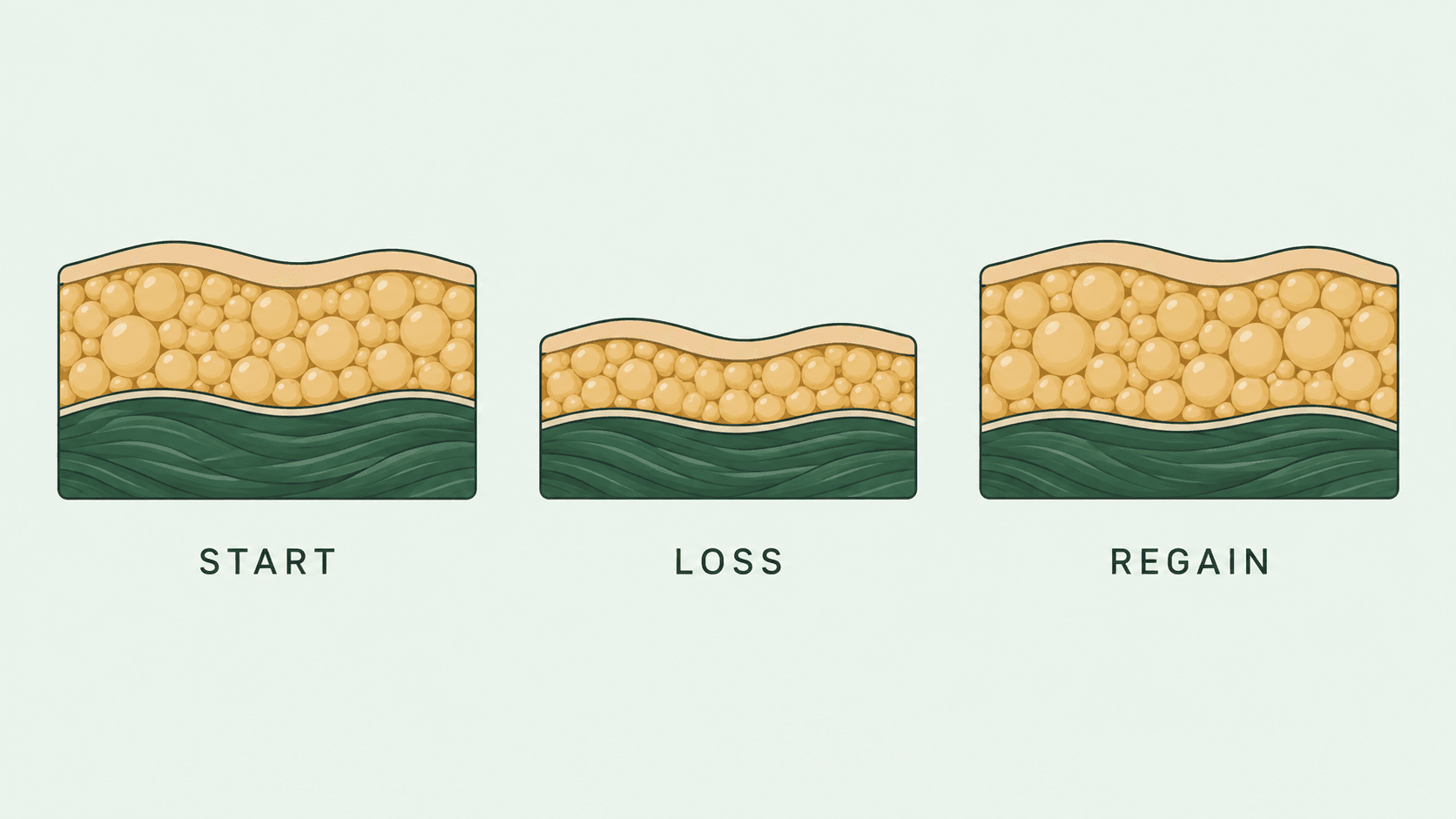
Among postmenopausal women who regained at least 2 kg after a 5-month weight-loss intervention, each kilogram of fat lost corresponded to 0.26 kg of lean tissue lost; each kilogram of fat regained over the next year corresponded to 0.12 kg of lean tissue regained.1 The scale can look like a completed cycle. The tissues did not trade evenly.
Weight cycling is repeated loss and regain. The useful question is what came back. In measured studies, severe loss in normal-weight or already-lean people can be followed by fat mass overshooting the starting point while fat-free mass catches up.378 In higher-BMI groups, available studies have not consistently shown disproportionate fat regain.48 These are different patterns, and they point to the same next move. Finish the lean-mass recovery at maintenance before you open another calorie deficit.
01When regain favors fat over lean mass
The cleanest human measurement of this pattern is Beavers and colleagues in 2011. Ninety-five postmenopausal women completed a 5-month weight-loss intervention; 78 returned at six months, 73 at 12 months, and 68 had complete measurements at all four time points. Among the women who regained at least 2 kg over the next year, the lean-to-fat ratio fell. Of the original loss, 67% had been fat and 33% lean. Of the regain across 12 months, 81% was fat and 19% was lean. The difference between the loss and regain slopes was not statistically significant (P = .28), so this small study describes a subgroup pattern rather than a universal rule.1
The Health, Aging, and Body Composition Study found the same direction in older adults. Men lost 0.42 kg of lean mass per kilogram of weight lost and regained 0.37 kg of lean per kilogram gained. Women lost 0.06 kg of lean per kilogram lost. Both sexes lost proportionally more lean during the loss period than they recovered during the regain, and the leftover lean deficit was larger in men. Incomplete weight regain explained much of that gap.6
A cycle can therefore end near the old scale weight with a worse fat-free mass to fat ratio. Waist and training logs catch that earlier than the scale does. How to tell fat loss from muscle loss is the measurement problem during the cut. After a regain, the same tools tell you whether the cycle restored the body you actually wanted back.
| Study | Who | What returned | Practical read |
|---|---|---|---|
| Beavers 20111 | Postmenopausal women after a 5-month cut; ≥2 kg regainers | 0.26 kg lean lost per kg fat lost. 0.12 kg lean regained per kg fat regained | The measured regain favored fat over lean tissue |
| Lee 20106 | Older adults in Health ABC | More lean left during loss than returned during regain. Larger leftover deficit in men | The cohort retained a lean-mass deficit after regain |
| Nindl 19972 | 10 lean men, 8-week Ranger course, then 5 weeks of free eating | Fat-free mass and performance returned. Fat mass exceeded baseline | Lean, large, fast losses overshoot fat |
| Fothergill 20164 | 14 Biggest Loser contestants, 6-year follow-up | About 80% of weight change was fat mass at both time points | In class III obesity, regain tracked the weight that came back |
02When leaner bodies overshoot original fat mass
Dulloo's collateral-fattening model proposes that fat mass can recover before fat-free mass after severe loss, leaving appetite signals elevated while fat-free mass is restored.37 The 2012 review reports a mean fat overshoot of 3.3 kg in the Minnesota Starvation Experiment, or 4.6 kg after correction; a later analysis reports individual values from 0 to 9 kg, with greater overshoot in leaner men.7
The Ranger data is a small athletic example of that proposed pattern. Nindl and colleagues put 10 healthy lean men through an 8-week course with about a 1,000 kcal daily deficit and a 12% loss of body mass. At five weeks of unrestricted eating, fat-free mass and the performance tests were back. Fat mass had climbed past the starting value.2
The 2014 Bosy-Westphal and Müller review described a conditional population split. In people with obesity, its summary said current evidence did not support an adverse effect of weight cycling on body composition. In normal-weight people after severe loss with a large lean-mass loss, it said partitioning may shift toward transiently higher total and abdominal fat regain.8 The review does not establish a universal pattern across dieters.
A 2024 meta-analysis of weight-cycling athletes found body weight and fat-free mass generally recovered. Strength-sport athletes, who often use longer loss and regain blocks, did not fully recover their initial fat mass in the pooled estimate.9 Combat-sport making weight is mostly water, glycogen, and gut content. A prolonged cut with no plan for the week after is a practical composition-risk scenario. Cutting weight for wrestling and MMA is the acute protocol.
03Higher starting fat blunts disproportionate fat regain
Fothergill followed 14 Biggest Loser contestants for six years. They had lost 58.3 kg in 30 weeks and regained 41.0 kg. About 80% of each measured change in body weight was fat mass at the end of the competition and at six years. The fat-versus-weight points sat on the same curve. Mean weight was still 11.9% below baseline.4
Metabolic adaptation at the end of the competition did not predict who regained more (r = -0.1). The people who kept more weight off at year six were the ones still showing greater metabolic slowing.4 That slowing belongs to people still defending a lower weight. The size of adaptive thermogenesis in ordinary dieting, and the stack of NEAT, logging drift, and lost lean mass that feels like damage, is covered in Metabolic Damage From Dieting Is Adaptive Thermogenesis.
Bosy-Westphal and colleagues measured 47 young adults with overweight or obesity after a 13-week low-calorie diet. Regainers had not finished returning the lost weight by six months. Fat distribution did not worsen. Regainers did show a lower resting energy expenditure after the loss, adjusted for organ and tissue masses.10 Jebb's earlier cycling study in women with obesity also failed to find a metabolic-rate penalty from intermittent dieting.11
The folklore says every cycle leaves you fatter and slower. In higher-BMI groups, the evidence here shows substantial regain without a consistent disproportionate-fat pattern. Most of the lost weight can come back, hunger can stay elevated, and the next attempt starts from whatever training and protein habits survived the rebound.4512
04Hunger stays high after the scale turns around
Sumithran and colleagues prescribed a 10-week very-low-energy diet to 50 adults with overweight or obesity. Thirty-four people completed the 62-week follow-up. Mean loss at week 10 was 13.5 kg. By week 62 they had regained 5.5 kg and still sat 7.9 kg below baseline.5
Leptin fell 64.5% by week 10 and remained 35.5% below baseline at week 62. Ghrelin rose with the loss and was still above baseline a year later. Peptide YY and cholecystokinin, both satiety signals, stayed lower alongside insulin. Subjective hunger stayed higher.5 Leptin and ghrelin do not reset just because the scale has started moving up.
That is why a rebound week can feel like the diet is still running.5 As a practical planning rule, eating back to the old intake while those signals are high can turn a planned reverse into an unplanned surplus. Reverse dieting after a cut is the intake structure. The Sumithran study did not test reverse dieting or a maintenance block.
After stopping semaglutide, the STEP 1 extension included 327 participants in total; 232 were in the semaglutide arm, and 197 had week-120 data. In that semaglutide arm, mean weight loss was 17.3% by week 68, mean regain was 11.6 percentage points of lost weight by week 120, and net loss was 5.6% from baseline. That was about two-thirds of the prior loss in one year off treatment.12 The extension measured body weight and cardiometabolic outcomes. It did not test fat-versus-lean regain, protein, lifting, tapering, or a medication off-ramp. Build the practical plan with How to Stop GLP-1s Without Rapid Fat Regain.
Observational papers report associations between weight variability and higher cardiovascular and mortality rates. Zou and colleagues pooled 23 studies and 441,199 people and reported relative risks of 1.41 for all-cause death and 1.36 for cardiovascular death.13 These results do not establish that weight cycling caused the outcomes. Illness, smoking, and unintentional loss sit inside those cohorts. A well-run cut you can hold is still worth doing. Treat regain as unfinished work.
05Start the next cut from the new composition
The next deficit inherits whatever tissues the rebound actually restored. If waist is up and lifts are down at the same scale weight, you are leaner in the logbook than you are in the mirror. A deficit from that starting point asks muscle to pay again.
Rate of loss is the first lever. Garthe split 24 elite athletes onto faster and slower timelines for the same weight-loss target. Both groups lost about 5.5% of body weight. The slower group lost more fat and gained 2.1% lean mass. Lean mass in the faster group stayed flat.14 After a cycle, choose the slow end of the range in How Fast You Should Lose Fat Without Losing Muscle.
Protein and hard lifting are the second lever. A practical protein target for active adults during a deficit is 1.6 to 2.2 g/kg/day, with the upper end for leaner people and deeper cuts.1516 The weight-cycling studies cited here did not test this target during regain. Keep resistance training in place and track whether strength holds.
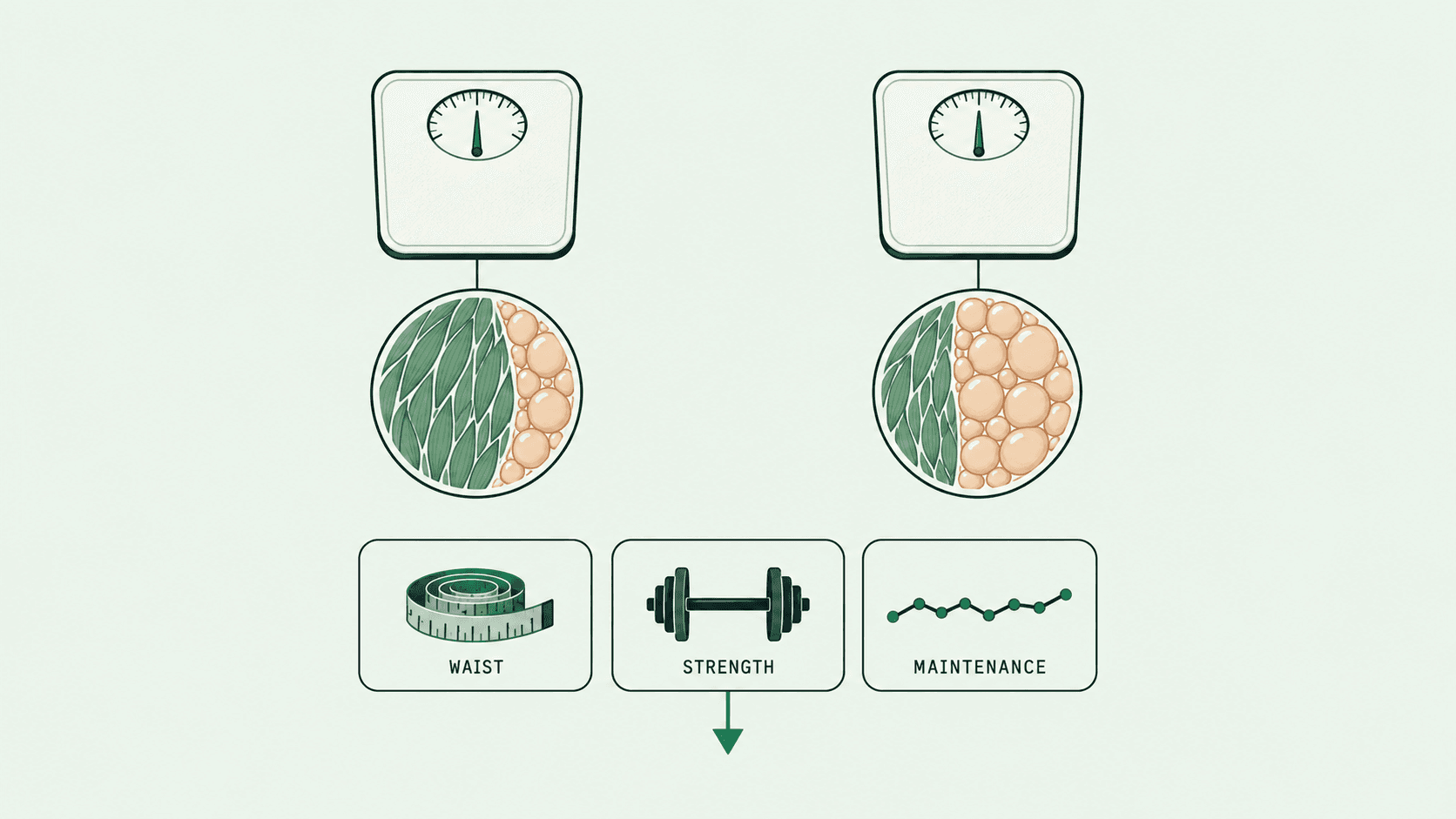
The decision rules below are practical heuristics for interpreting a rebound. The cited weight-cycling studies did not validate these thresholds or timelines.
| Situation | What the cycle probably did | Next move |
|---|---|---|
| 4 to 8 kg back after a moderate cut, waist steady, lifts intact | Mostly glycogen, gut content, and some fat | Hold estimated maintenance calories 8 to 16 weeks. Do not recut this month. |
| Scale is back, waist is larger, top sets are down | More fat than muscle returned | Train and eat at maintenance until strength and waist stabilize |
| Already lean, deep cut, then a fast rebound | Highest fat-overshoot risk | Slow the next deficit. Protect fat-free mass first. |
| After semaglutide withdrawal12 | Weight regain was measured; body-composition response was not | Use the linked off-ramp guide; STEP 1 did not test protein, lifting, or tapering. |
A DEXA scan can settle an argument about what returned. It is optional. As practical monitoring heuristics, four weeks of a stable morning waist, a 14-day weight average, and a log of working sets provide context on whether the body that came back is the one you meant to keep.
06Hold maintenance before the next deficit
The impulse after a rebound is to recut immediately. That is how a cycle gets a second lap before the first one finished paying back the lean tissue.
The post-cut maintenance phase already sets a practical hold at 8 to 16 weeks. After a regain, use the long end of that window as a planning heuristic. Use hunger, training quality, and the 14-day weight average as practical signals: the average should sit inside a band rather than climb a stair. These are operating signals, not endpoints tested in the cited studies. Then you have a working baseline for the next phase.
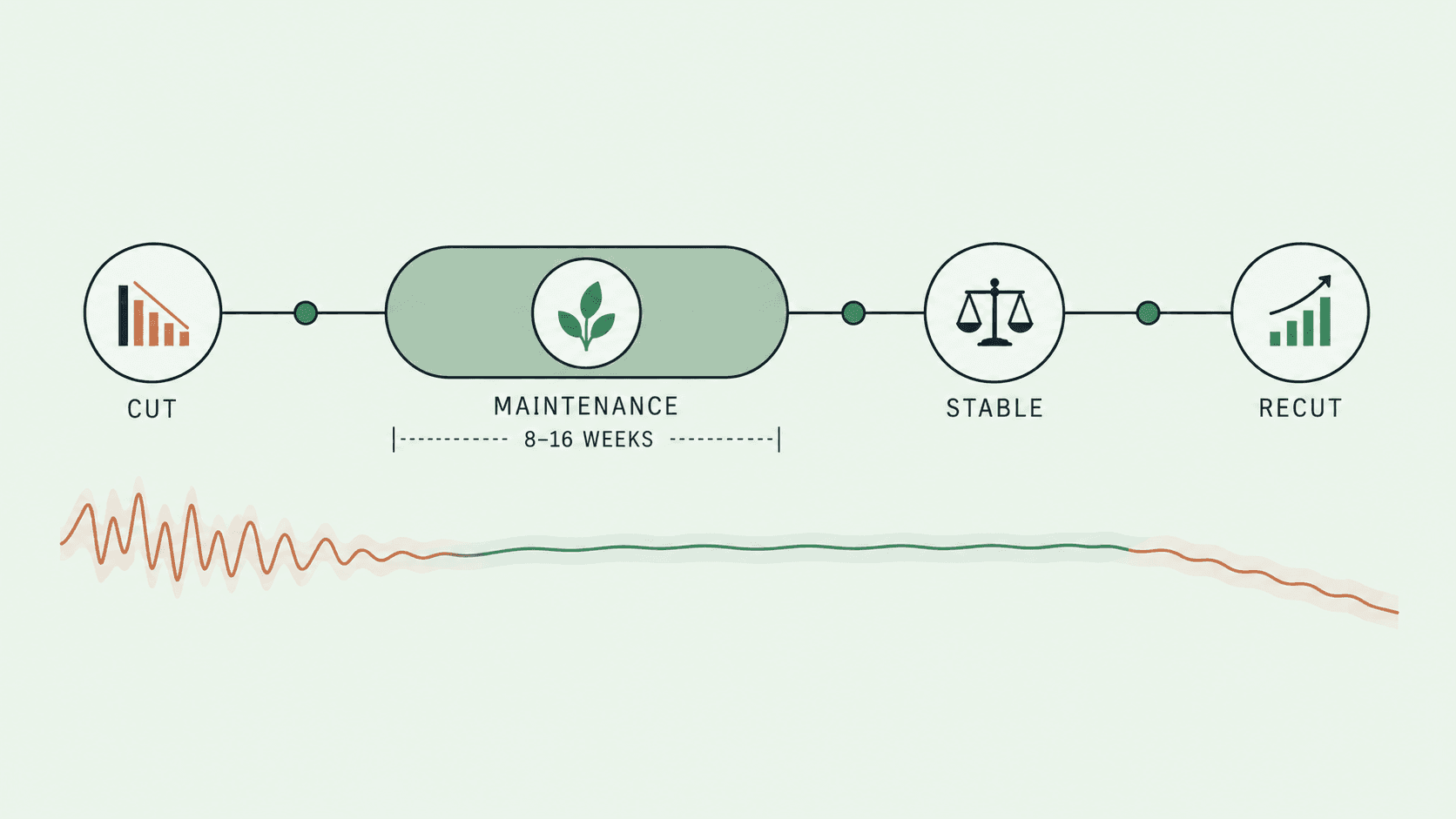
If the last cut was aggressive, the next one should be slower and shorter. If the last cut skipped protein or skipped the barbell, those are the first repairs, and they happen at maintenance. The recut can wait until that work is done.
Footnotes
Beavers KM, Lyles MF, Davis CC, Wang X, Beavers DP, Nicklas BJ. Is lost lean mass from intentional weight loss recovered during weight regain in postmenopausal women? Am J Clin Nutr. 2011. PubMed
Back to textBack to text 2Back to text 3Back to text 4Nindl BC, Friedl KE, Frykman PN, Marchitelli LJ, Shippee RL, Patton JF. Physical performance and metabolic recovery among lean, healthy men following a prolonged energy deficit. Int J Sports Med. 1997. PubMed
Back to textBack to text 2Back to text 3Dulloo AG, Miles-Chan JL, Schutz Y. Collateral fattening in body composition autoregulation. Its determinants and significance for obesity predisposition. Eur J Clin Nutr. 2018. Ranger means and the inverse fat-overshoot relationship with starting adiposity are tabulated here. PubMed PMC
Back to textBack to text 2Back to text 3Fothergill E, Guo J, Howard L, et al. Persistent metabolic adaptation 6 years after The Biggest Loser competition. Obesity (Silver Spring). 2016. PubMed PMC
Back to textBack to text 2Back to text 3Back to text 4Back to text 5Back to text 6Sumithran P, Prendergast LA, Delbridge E, et al. Long-term persistence of hormonal adaptations to weight loss. N Engl J Med. 2011. Completer analyses used 34 of 50 enrolled adults. Weight change -13.5 kg at week 10, +5.5 kg from week 10 to 62, -7.9 kg from baseline to week 62. Leptin -64.5% at week 10 and -35.5% at week 62. PubMed
Back to textBack to text 2Back to text 3Back to text 4Back to text 5Lee JS, Visser M, Tylavsky FA, et al. Weight loss and regain and effects on body composition: the Health, Aging, and Body Composition Study. J Gerontol A Biol Sci Med Sci. 2010. PubMed PMC
Back to textBack to text 2Dulloo AG, Jacquet J, Montani JP. How dieting makes some fatter. From a perspective of human body composition autoregulation. Proc Nutr Soc. 2012. The review reports a mean Minnesota fat overshoot of 3.3 kg, or 4.6 kg after correction; a later analysis reports individual values from 0 to 9 kg, with greater overshoot in leaner men. PubMed PMC
Back to textBack to text 2Back to text 3Bosy-Westphal A, Müller MJ. Measuring the impact of weight cycling on body composition: a methodological challenge. Curr Opin Clin Nutr Metab Care. 2014. PubMed
Back to textBack to text 2Back to text 3Bagot S, Pelissier L, Pereira B, et al. Weight regain, body composition, and metabolic responses to weight loss in weight cycling athletes. A systematic review and meta-analyses. Obes Rev. 2024. PubMed
Back to textBosy-Westphal A, Schautz B, Lagerpusch M, et al. Effect of weight loss and regain on adipose tissue distribution, composition of lean mass and resting energy expenditure in young overweight and obese adults. Int J Obes (Lond). 2013. PubMed
Back to textJebb SA, Goldberg GR, Coward WA, Murgatroyd PR, Prentice AM. Effects of weight cycling caused by intermittent dieting on metabolic rate and body composition in obese women. Int J Obes. 1991. PubMed
Back to textWilding JPH, Batterham RL, Davies M, et al. Weight regain and cardiometabolic effects after withdrawal of semaglutide: the STEP 1 trial extension. Diabetes Obes Metab. 2022. PubMed
Back to textBack to text 2Back to text 3Zou H, Yin P, Liu L, et al. Body-weight fluctuation was associated with increased risk for cardiovascular disease, all-cause and cardiovascular mortality: a systematic review and meta-analysis. Front Endocrinol. 2019. PubMed
Back to textGarthe I, Raastad T, Refsnes PE, Koivisto A, Sundgot-Borgen J. Effect of two different weight-loss rates on body composition and strength and power-related performance in elite athletes. Int J Sport Nutr Exerc Metab. 2011. PubMed
Back to textHelms ER, Aragon AA, Fitschen PJ. Evidence-based recommendations for natural bodybuilding contest preparation: nutrition and supplementation. J Int Soc Sports Nutr. 2014. PubMed
Back to textMorton RW, Murphy KT, McKellar SR, et al. A systematic review, meta-analysis and meta-regression of the effect of protein supplementation on resistance training-induced gains in muscle mass and strength in healthy adults. Br J Sports Med. 2018. PubMed
Back to text