Most vitamin D failure looks the same. An athlete takes 1,000 IU per day for years, never retests, then turns up below 25 ng/mL on a winter blood draw with a stress fracture, an upper-respiratory cold that will not clear, or training that feels heavier than the numbers say it should. The dose was the problem. 1,000 IU is roughly a third of the maintenance dose in a lifter with normal body fat and roughly a fifth of the corrective dose once adiposity is in the picture.
What works is a status target, a dose adjusted for body composition, and a retest cadence built around the seasonal trough.
0125(OH)D is the test that decides everything
Vitamin D circulates in two forms after intake. Cholecalciferol from sunlight or supplements is the precursor. The liver hydroxylates it to 25-hydroxyvitamin D, which is the storage form and the half-life-defining pool. The kidney then converts a small fraction to 1,25-dihydroxyvitamin D, the active hormone that binds the vitamin D receptor.1
The trap is ordering 1,25(OH)2D as a status check. The body defends 1,25(OH)2D aggressively under deficiency by upregulating renal 1-alpha-hydroxylase, so the active form can read normal or even high in an athlete who is functionally deficient. 25(OH)D has a half-life of roughly 2 to 3 weeks and reflects substrate availability across the prior month or two, which is the variable that status decisions actually depend on.3
Order 25(OH)D total. Some labs split D2 and D3, which matters mostly for athletes who supplement with cholecalciferol (D3). The total number is the one that matches the threshold literature.
0225(OH)D thresholds still disagree across guidelines
Three sources dominate the threshold conversation, and they do not agree.
| Source | Deficient | Insufficient | Adequate | What the number is built for |
|---|---|---|---|---|
| Institute of Medicine, 2011 | Below 12 ng/mL | 12-20 ng/mL | At or above 20 | Population bone health for the general adult |
| Endocrine Society, 2011 | Below 20 ng/mL | 20-29 ng/mL | At or above 30 | Clinical risk groups, including athletes |
| Athlete-focused reviews and applied practice | Below 20 ng/mL | 20-32 ng/mL | 32-50 ng/mL | Bone, immune, and performance signals in athletes |
The IOM threshold is built for population public-health policy and is conservative for an athlete making a supplementation decision.2 The 2011 Endocrine Society guideline used a higher clinical-risk threshold, while the 2024 prevention guideline no longer endorses a universal 30 ng/mL target for generally healthy adults.324 The practical athlete read still works inside a 30 to 50 ng/mL band because the upside is clearest when low status is corrected and the benefit signal flattens once an athlete is already replete.1119
A more practical reading.
| 25(OH)D | What it usually means for an athlete | First action |
|---|---|---|
Below 20 ng/mL | Genuine deficiency. Bone, recovery, and immune symptoms are likely | Begin a corrective protocol with clinician oversight |
20-30 ng/mL | Functional insufficiency in most active populations | Daily 2,000-4,000 IU and a recheck in 8-12 weeks |
30-50 ng/mL | Operating band | Maintain. Adjust by season |
50-80 ng/mL | High-normal. No additional benefit signal in trial data | Hold dose. Do not push higher by habit |
Above 100 ng/mL | Approaching toxicity range | Pause supplementation, check serum calcium now, and recheck 25(OH)D in 4-6 weeks |
03Adiposity changes the dose more than people realize
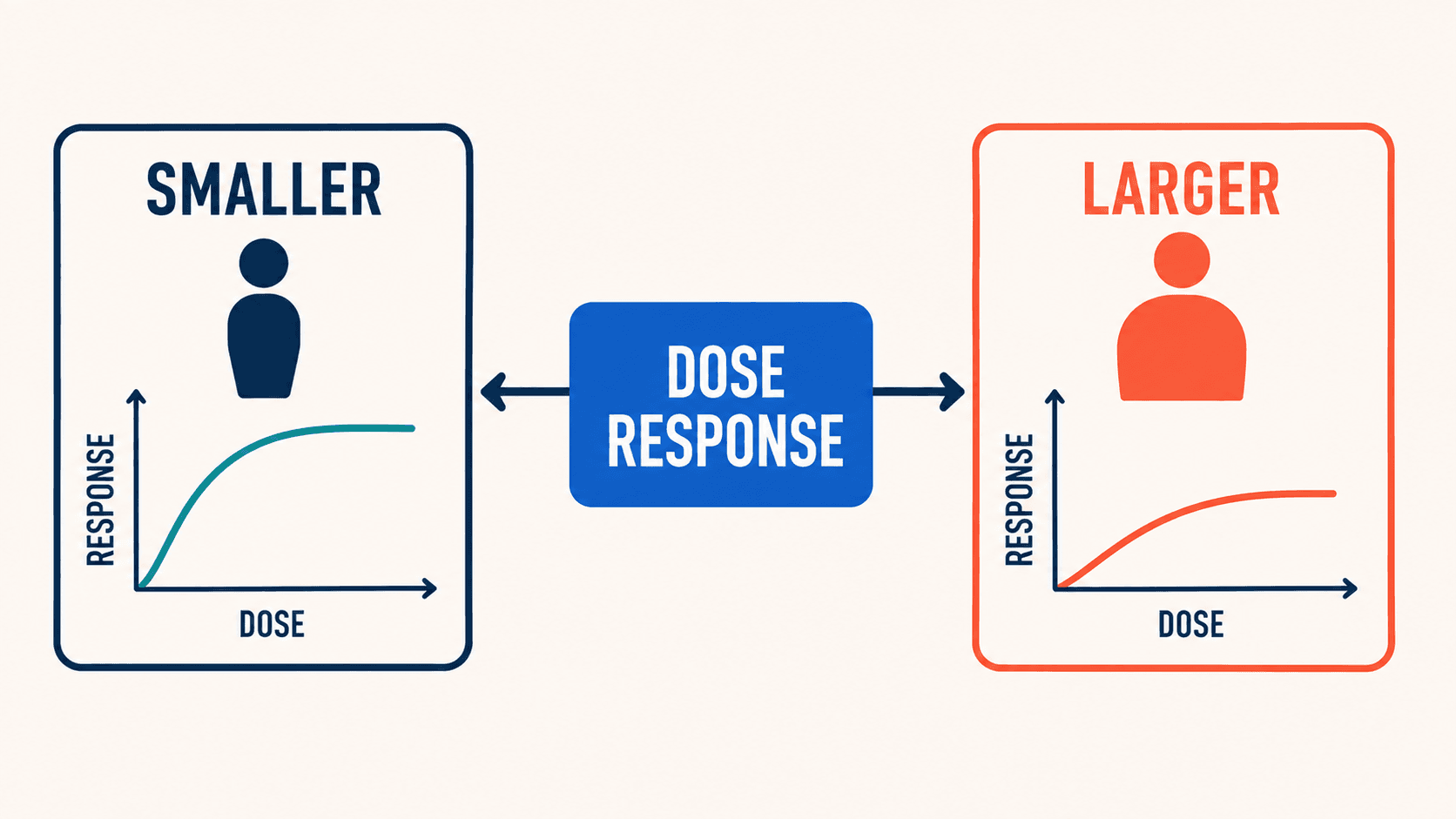
This is the lever almost no one adjusts for. Vitamin D is fat-soluble, and adipose tissue acts as a slow reservoir that pulls cholecalciferol out of plasma. A reader at 30 percent body fat absorbs the same dose, distributes more of it into adipose, and releases less into circulation than a leaner person on the same milligrams.
Wortsman and colleagues showed in 2000 that adults with obesity had lower circulating parent vitamin D after UVB exposure and oral vitamin D2 dosing, and the gap tracked body fat percentage rather than weight per se.4 Drincic and colleagues in 2012 tested a different framing. They estimated that the inverse relationship between body weight and 25(OH)D status is best explained by simple volumetric distribution of cholecalciferol through total body mass, with adipose acting as a large dilution compartment rather than a hard sequestration trap.5 Ekwaru and colleagues in 2014 ran dose-response analyses in over 17,000 supplement users and found that participants with obesity needed two to three times the dose of normal-weight participants to reach the same serum 25(OH)D.6
The practical adjustment.
| Body composition | Dose multiplier | Practical example |
|---|---|---|
Lean athlete, body fat under 20% | 1.0x | 2,000 IU/day for maintenance, 4,000 IU/day for correction |
Average BMI 25-30 | 1.5-2.0x | 3,000-4,000 IU/day for maintenance |
BMI above 30 | 2.0-3.0x | Up to 4,000 IU/day self-directed. Clinician oversight above that, retest at 8-12 weeks |
| Athlete in deep cut, very low BF | 0.8-1.0x | 2,000 IU/day. Watch the lab trend as fat drops |
A related corollary. Substantial fat loss can modestly raise 25(OH)D in some people without any change in dose. The storage compartment shrinks, so the same intake distributes through a smaller adipose volume. Retest before increasing the dose.
04Performance gains show up mainly in deficiency
The vitamin D performance literature is messier than the supplement industry suggests. The strongest signal sits in three places: bone, immune function, and skeletal-muscle performance in genuinely deficient populations.
Bone is the cleanest. Ruohola and colleagues followed Finnish military recruits through basic training and found that men below the median 25(OH)D level had roughly 3.6 times the stress-fracture odds of men above the median.8 Tenforde and colleagues add the athlete context: in adolescent girls, prior fracture, BMI below 19, late menarche, and prior gymnastics or dance history were independent stress-fracture risk factors.7 Read vitamin D beside the rest of the bone-risk picture, not as a lone lab value.
Immune signal is real and modest. Martineau and colleagues published an individual-participant-data meta-analysis of 25 RCTs in 2017 showing that daily or weekly vitamin D reduced acute respiratory infections, with the largest effect concentrated in people with baseline 25(OH)D below 25 nmol/L (about 10 ng/mL).10 The benefit comes from correcting low status. Adding vitamin D to an already-replete athlete does very little.
Performance evidence is mixed, and the signal is still promising in the right athlete. Close and colleagues supplemented UK athletes with 5,000 IU/day for 8 weeks, raised winter 25(OH)D, and reported improvements in 10 m sprint and vertical jump in a small trial.9 A separate Close dose-response trial raised 25(OH)D with 20,000 or 40,000 IU/week, but did not improve bench press, leg press, or vertical jump over 12 weeks.21 Backx and colleagues showed that 2,200 IU/day corrected deficient or insufficient status in most Dutch elite athletes within 3 months, but that study tested vitamin D status rather than performance outcomes.12 Owens and colleagues reviewed the athlete literature and reached the useful coaching conclusion: vitamin D is a biological requirement first, and a promising performance lever mainly when an athlete is correcting low status.11
Treat vitamin D as a corrective intervention. Effect size scales with the size of the gap it is closing.
05Athletic populations that test low more often
A handful of profiles repeat in the screening data and vitamin D physiology literature, and they predict who needs supplementation in the first place.1126
| Population | Why intake or status tends to run low | Practical read |
|---|---|---|
| Indoor strength athletes at high latitudes | Limited UVB, gym schedule, often capped dietary fat | Confirm with 25(OH)D. Seasonal supplementation can be appropriate |
| Dark-skinned athletes at high latitudes | Higher melanin extends the UVB exposure required to make the same precursor | Confirm with 25(OH)D and plan supplementation around the result |
| Masters-aged athletes | Cutaneous synthesis declines with age | Annual lab. Maintenance dose typically 2,000+ IU/day |
| Athletes with high adiposity or recent weight gain | Volumetric dilution into adipose compartment | Multiply dose 1.5-2.5x. Recheck at 12 weeks |
| Female endurance athletes with low energy availability | Broader micronutrient risk, lower total intake, and bone-health pressure | Fix energy availability first. Take vitamin D with a fat-containing meal. See Low Energy Availability in Female Endurance Athletes |
| Athletes on corticosteroids, anticonvulsants, or interacting medications | Vitamin D metabolism or requirements can shift | Higher doses, more frequent labs, clinician oversight |
| Indoor-trained early-morning runners | Low-UVB training hours remove the major synthesis window | Confirm with 25(OH)D rather than assuming outdoor training is enough |
The most underrated subset is the last one. Athletes who train outdoors year-round but mostly before sunrise or after sundown look like they should be replete. Time of day changes UVB exposure, so blood work is the clean way to know.26
06The dose-response math you can plan around
Heaney and colleagues in 2003 established the most useful rule of thumb. In healthy adults, 1,000 IU of cholecalciferol per day often raises serum 25(OH)D by approximately 6 to 7 ng/mL over 8 to 12 weeks at steady state, with substantial variation by body weight, baseline status, adherence, season, and genetics in vitamin D-binding protein.13 The relationship is usable for planning at ordinary supplemental doses and becomes less predictable as dose rises.
Four practical lanes for athletes.
Starting 25(OH)D | Goal | Dose strategy | Time to retest |
|---|---|---|---|
12 ng/mL | At or above 30 | 4,000-5,000 IU/day daily, paired with adequate magnesium intake | 8-12 weeks |
22 ng/mL | At or above 35 | 2,000-3,000 IU/day | 8-12 weeks |
30 ng/mL | Maintain | 1,000-2,000 IU/day at lean BMI, 2,000-3,000 IU/day at higher BMI | 6 months |
45 ng/mL | Maintain | 1,000 IU/day or 2,000 IU four to five days per week | 6-12 months |
Two cautions sit on top of these numbers. First, response varies by genetic factors in vitamin D-binding protein and the vitamin D receptor. Some adults are slow responders and need more dose and more time before the lab moves. Second, monthly megadose protocols deserve to be retired. Sanders and colleagues randomized older women to a single annual 500,000 IU dose or placebo in 2010 and found a 26 percent increase in falls and a 26 percent increase in fractures in the high-dose group.14 Bischoff-Ferrari and colleagues in 2016 compared 24,000 IU monthly, 60,000 IU monthly, and 24,000 IU plus calcifediol monthly in older adults and found increased fall risk in the higher monthly doses despite higher 25(OH)D.15 For athletes, daily or weekly dosing is easier to titrate and better matched to retesting.
07Cofactors that actually matter
The cofactor list has three real entries and a long list of marketing-driven additions.
Magnesium is required for the hepatic 25-hydroxylase and renal 1-alpha-hydroxylase that activate vitamin D. Reviews and randomized trial data show that magnesium status can influence vitamin D metabolism, and 48 percent of Americans ingest less magnesium from food and beverages than their respective EARs.222325 Anyone running a vitamin D protocol should make magnesium intake boringly adequate first. The form, dose, and timing playbook is in Magnesium for Sleep, Cramps, and Recovery.
Vitamin K helps activate vitamin K-dependent proteins involved in bone metabolism and calcium handling. The mechanism, the supplement-dose evidence, and the gap between the two are covered in Vitamin K2: What the Evidence Actually Shows for Bones and Arteries. People taking warfarin or similar anticoagulants need consistent vitamin K intake rather than casual changes from supplements.27
Calcium adequacy matters because vitamin D's bone-mineral job depends on it. The RDA is roughly 1,000 mg/day from food for most adults.2 Dairy, leafy greens, sardines, tofu, and fortified plant milks are the practical floor. Athletes running vitamin D repletion while undereating calcium are leaving the main bone-health pathway underfed. The separate calcium-timing evidence guide explains what one pre-exercise meal trial found for acute PTH and CTX-I responses.29
Preformed vitamin A (retinol) deserves attention when someone is stacking supplements. Fish liver oils contain vitamin D and can also contribute preformed vitamin A.28 Use a plain D3 supplement when you want predictable dosing.
Zinc, boron, and the long tail of supplement-stack additions are not load-bearing for vitamin D status. Skip them.
One absorption detail can raise the response from the same dose by about half. Mulligan and Licata showed that taking vitamin D with the largest meal of the day raised serum 25(OH)D by about 50 percent over two to three months compared to taking it on an empty stomach or with a light breakfast.20 Dietary fat at the same meal is the operative variable.
08Testing cadence and what to retest
The pattern that fails is one annual lab in spring, drawn at the climbing edge of the seasonal curve.
| Test | Cadence | Why it matters |
|---|---|---|
25(OH)D total | Late winter (Feb-Mar) and late summer (Aug-Sep) | Captures the seasonal range rather than averaging through it |
| Serum calcium | At the start of any correction protocol, then with each 25(OH)D check | Catches rare hypercalcemia early |
| Magnesium intake review | With each correction protocol | Low intake can make vitamin D response less predictable |
| Intact PTH | When 25(OH)D will not rise despite a sensible dose | Elevated PTH plus low 25(OH)D points at functional deficiency or absorption failure |
Retest at least 8 weeks after a dose change. Earlier draws catch the wrong slope. Aim the late-winter draw at the same calendar week each year so the seasonal comparison stays clean.
09The bigger-is-better trap
The temptation when an athlete reads 28 ng/mL is to push to 80. The evidence does not support that move. Above 50 ng/mL the bone, immune, and muscle benefit signal flattens, and the toxicity tail begins.
The VITAL trial randomized 25,871 adults to 2,000 IU/day vitamin D or placebo for a median 5.3 years. There was no reduction in invasive cancer, cardiovascular events, or all-cause mortality. The cohort's mean baseline 25(OH)D was about 31 ng/mL.16 The DO-HEALTH trial in 2,157 relatively healthy European adults aged 70 plus tested 2,000 IU/day vitamin D3 in a factorial design and found no significant improvement in blood pressure, infection rate, physical performance, cognition, or nonvertebral fractures over three years.17
The Mendelian randomization data tell a related story. Brøndum-Jacobsen and colleagues used genetic variants associated with lower 25(OH)D to estimate causal effects on cardiovascular disease and showed much smaller effects than the observational literature had implied.18 Most of the apparent benefit of high vitamin D status in observational data was probably confounding by sun exposure, fitness, and other health behaviors that travel with outdoor time.
The verdict from VITAL, DO-HEALTH, and the Mendelian randomization work is consistent. Vitamin D supplementation in already-replete adults does very little. Correcting deficiency is where the action is: bone health is the strongest target, respiratory-infection benefits are strongest in people starting very low, and athlete performance remains most promising when low status is corrected.
Toxicity is rare and worth taking seriously. It is usually supplement-driven and marked by hypercalcemia, hypercalciuria, and very high 25(OH)D, typically above about 150 ng/mL. Severe cases can involve kidney stones, renal failure, and soft-tissue or coronary calcification. Case reports cluster around self-prescribed megadose protocols, often 50,000 IU per day for weeks. The IOM adult Tolerable Upper Intake Level is 4,000 IU/day, which should be treated as a safety ceiling rather than a target.2
10Simple vitamin D testing and dosing plan
The protocol most athletes do not run, and should.
- Order 25(OH)D total before changing anything. Do not guess by symptoms.
- Read the number against the 30 to 50 ng/mL operating band. That is the band where the bone, immune, and performance signals cluster.
- If below 30, calculate a corrective dose against your body composition. Roughly 1,000 IU/day for every 6 to 7 ng/mL of expected rise in a normal-weight adult, more if BMI is above 25.
- Confirm magnesium intake reaches the EAR. 265 mg/day for women, 350 mg/day for men, from food or supplementation. The vitamin D protocol is easier to correct when magnesium intake is already adequate.
- Take vitamin D with the meal that contains the most fat. Absorption improves meaningfully compared to a fat-free or low-fat meal, with one clinical report showing about a 50 percent higher 25(OH)D response.
- Retest at 8 to 12 weeks. Adjust dose by the response curve, not by feel.
- Reset cadence to twice yearly once status is stable. Late-winter trough and late-summer peak.
- Avoid annual megadose protocols, especially in older adults. For athletes, daily or weekly dosing is easier to titrate against retesting than intermittent megadosing.
The common version of vitamin D failure comes down to skipping the lab work. Athletes who run a twice-yearly loop find that 25(OH)D becomes a trend they can plan against. Athletes who guess at dose and skip retesting accumulate quiet deficits that show up in bones, sleep, and the recovery numbers a watch cannot see.
Footnotes
Holick MF. Vitamin D deficiency. N Engl J Med. 2007. PubMed
Back to textBack to text 2Institute of Medicine. Dietary Reference Intakes for Calcium and Vitamin D. National Academies Press. 2011. NAP
Back to textBack to text 2Back to text 3Holick MF, Binkley NC, Bischoff-Ferrari HA, et al. Evaluation, treatment, and prevention of vitamin D deficiency, an Endocrine Society clinical practice guideline. J Clin Endocrinol Metab. 2011. PubMed
Back to textBack to text 2Back to text 3Wortsman J, Matsuoka LY, Chen TC, Lu Z, Holick MF. Decreased bioavailability of vitamin D in obesity. Am J Clin Nutr. 2000. PubMed
Back to textBack to text 2Drincic AT, Armas LAG, Van Diest EE, Heaney RP. Volumetric dilution, rather than sequestration, best explains the low vitamin D status of obesity. Obesity. 2012. PubMed
Back to textBack to text 2Ekwaru JP, Zwicker JD, Holick MF, Giovannucci E, Veugelers PJ. The importance of body weight for the dose response relationship of oral vitamin D supplementation and serum 25-hydroxyvitamin D in healthy volunteers. PLoS One. 2014. PubMed
Back to textBack to text 2Tenforde AS, Sayres LC, McCurdy ML, Sainani KL, Fredericson M. Identifying sex-specific risk factors for stress fractures in adolescent runners. Med Sci Sports Exerc. 2013. PubMed
Back to textBack to text 2Ruohola JP, Laaksi I, Ylikomi T, et al. Association between serum 25(OH)D concentrations and bone stress fractures in Finnish young men. J Bone Miner Res. 2006. PubMed
Back to textBack to text 2Close GL, Russell J, Cobley JN, et al. Assessment of vitamin D concentration in non-supplemented professional athletes and healthy adults during the winter months in the UK, implications for skeletal muscle function. J Sports Sci. 2013. PubMed
Back to textMartineau AR, Jolliffe DA, Hooper RL, et al. Vitamin D supplementation to prevent acute respiratory tract infections, systematic review and meta-analysis of individual participant data. BMJ. 2017. PubMed
Back to textOwens DJ, Allison R, Close GL. Vitamin D and the athlete, current perspectives and new challenges. Sports Med. 2018. PubMed
Back to textBack to text 2Back to text 3Back to text 4Backx EMP, Tieland M, Maase K, et al. The impact of 1-year vitamin D supplementation on vitamin D status in athletes, a dose-response study. Eur J Clin Nutr. 2016. PubMed
Back to textHeaney RP, Davies KM, Chen TC, Holick MF, Barger-Lux MJ. Human serum 25-hydroxycholecalciferol response to extended oral dosing with cholecalciferol. Am J Clin Nutr. 2003. PubMed
Back to textSanders KM, Stuart AL, Williamson EJ, et al. Annual high-dose oral vitamin D and falls and fractures in older women, a randomized controlled trial. JAMA. 2010. PubMed
Back to textBack to text 2Bischoff-Ferrari HA, Dawson-Hughes B, Orav EJ, et al. Monthly high-dose vitamin D treatment for the prevention of functional decline, a randomized clinical trial. JAMA Intern Med. 2016. PubMed
Back to textBack to text 2Manson JE, Cook NR, Lee IM, et al. Vitamin D supplements and prevention of cancer and cardiovascular disease (VITAL). N Engl J Med. 2019. PubMed
Back to textBischoff-Ferrari HA, Vellas B, Rizzoli R, et al. Effect of vitamin D supplementation, omega-3 fatty acid supplementation, or a strength-training exercise program on clinical outcomes in older adults, the DO-HEALTH randomized clinical trial. JAMA. 2020. PubMed
Back to textBrøndum-Jacobsen P, Benn M, Afzal S, Nordestgaard BG. No evidence that genetically reduced 25-hydroxyvitamin D is associated with increased risk of ischaemic heart disease or myocardial infarction, a Mendelian randomization study. Int J Epidemiol. 2015. PubMed
Back to textDawson-Hughes B, Heaney RP, Holick MF, Lips P, Meunier PJ, Vieth R. Estimates of optimal vitamin D status. Osteoporos Int. 2005. PubMed
Back to textMulligan GB, Licata A. Taking vitamin D with the largest meal improves absorption and results in higher serum levels of 25-hydroxyvitamin D. J Bone Miner Res. 2010. PubMed
Back to textClose GL, Leckey J, Patterson M, et al. The effects of vitamin D3 supplementation on serum total 25(OH)D concentration and physical performance, a randomised dose-response study. Br J Sports Med. 2013. PubMed
Back to textUwitonze AM, Razzaque MS. Role of magnesium in vitamin D activation and function. J Am Osteopath Assoc. 2018. PubMed
Back to textBack to text 2Dai Q, Zhu X, Manson JE, et al. Magnesium status and supplementation influence vitamin D status and metabolism, results from a randomized trial. Am J Clin Nutr. 2018. PubMed
Back to textBack to text 2Demay MB, Pittas AG, Bikle DD, et al. Vitamin D for the prevention of disease, an Endocrine Society clinical practice guideline. J Clin Endocrinol Metab. 2024. Endocrine Society
Back to textNational Institutes of Health Office of Dietary Supplements. Magnesium fact sheet for health professionals. NIH ODS
Back to textBack to text 2National Institutes of Health Office of Dietary Supplements. Vitamin D fact sheet for health professionals. NIH ODS
Back to textBack to text 2National Institutes of Health Office of Dietary Supplements. Vitamin K fact sheet for health professionals. NIH ODS
Back to textNational Institutes of Health Office of Dietary Supplements. Vitamin A and carotenoids fact sheet for health professionals. NIH ODS
Back to textHaakonssen EC, Ross ML, Knight EJ, et al. The effects of a calcium-rich pre-exercise meal on biomarkers of calcium homeostasis in competitive female cyclists, a randomised crossover trial. PLoS One. 2015. PubMed
Back to text