At 220 pounds, using a 170-pound goal weight lowers a 1.6 g/kg protein calculation from about 160 to 123 grams a day. That 37-gram difference comes entirely from the weight you entered. Choosing the smaller number because it is easier to eat does not establish that it meets your needs.
The trials below did not compare current weight, goal weight, and fat-free mass as calculation methods.45 Official guidance and exercise recommendations use different populations and weight bases.123 Keep those limits attached to the number before turning it into a meal plan.
01Choose a weight for your protein calculation
Current weight is the default because the main recommendations are written that way. The Dietary Guidelines for Americans 2025-2030 give a general protein goal of 1.2 to 1.6 g per kilogram of body weight a day, adjusted to individual calorie needs.1 The guidelines do not tell you to calculate from goal weight, and they do not address whether a different denominator suits people with high body fat.
The International Society of Sports Nutrition position stand also uses body weight. It recommends 1.4 to 2.0 g/kg a day for most healthy exercising people.2 At 220 pounds that range runs from about 140 to 200 g. The position stand covers exercising people broadly and did not test how the range behaves in someone carrying 40 percent body fat.
Current weight gives you a transparent first calculation. The general guideline is not a personalized prescription for muscle retention during a deficit. If its range is difficult to fit alongside the carbohydrate and fat your plan needs, a realistic reference weight can help frame a discussion with a dietitian. Treat that adjustment as a planning choice that still needs individual judgment.
02Compare three weight inputs
Changing the weight input changes the target even when the multiplier stays the same. The 170-pound reference weight below is an example, not a recommended weight. Choose a reference weight you could plausibly reach and hold, taking your history, height, and health into account.
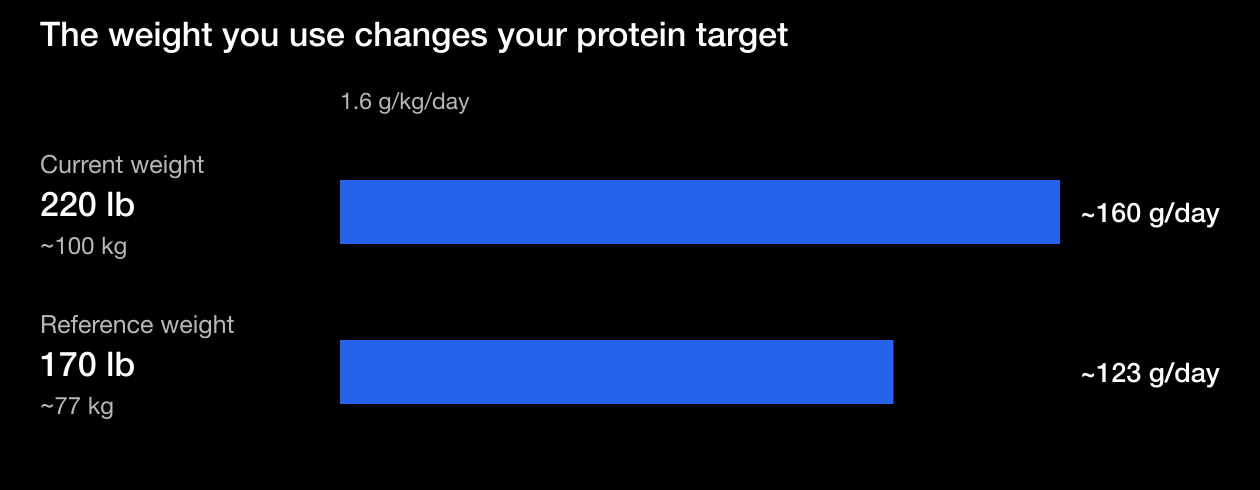
At the same illustrative multiplier of 1.6 g/kg, 220 pounds gives about 160 g and a 170-pound reference gives about 123 g. The guideline uses body weight. Applying it to a reference weight is a planning heuristic, not a tested optimal target.1
| Input | Weight used | Arithmetic | Daily protein | What the number is |
|---|---|---|---|---|
| Current weight | 220 lb (99.79 kg) | 99.79 × 1.2 to 99.79 × 1.6 | 119.75 to 159.66 g, about 120 to 160 g | The guideline range as written1 |
| Reference weight | 170 lb (77.11 kg) | 77.11 × 1.2 to 77.11 × 1.6 | 92.53 to 123.38 g, about 93 to 123 g | A planning heuristic, not a tested optimal denominator |
| Estimated fat-free mass | 121 to 143 lb (54.88 to 64.86 kg) if body fat is 35 to 45 percent | No multiplier is established for this example by the cited guidance or trials | Not calculated | An estimate with a 10 kg spread |
The two ranges meet near 120 g. That figure is the bottom of the general guideline range at current weight and sits near the top of the reference-weight calculation. It is a provisional planning example, not evidence that 120 g is optimal for this lifter. Training demands, deficit size, health, and how the overall diet fits still matter.
03Fat-free mass includes more than muscle
Fat-free mass sounds like a cleaner base for the calculation, and in lean athletes it often is. Fat-free mass is everything that is not fat, which includes muscle along with organs, bone, water, and glycogen. It is a larger and noisier number than muscle, and it moves with hydration and carbohydrate intake.
Measurement adds another choice. As an arithmetic illustration, assuming 35 percent body fat instead of 45 percent changes estimated fat-free mass for a 220-pound person from 121 to 143 pounds. That is about 10 kg in the calculation. These hypothetical percentages are not a claimed error margin for any scan. The DEXA accuracy guide explains measurement limits and the value of consistent testing conditions.
Use a fat-free-mass multiplier only when the recommendation is written for that weight base and your situation matches its population. A more detailed measurement cannot validate an unsuitable multiplier.
04Protein trials in higher-body-fat adults
The most relevant trial is small and specific. Josse and colleagues assigned 90 premenopausal women with a BMI of 27 to 40 to one of three diet groups during 16 weeks of energy restriction combined with aerobic and resistance exercise.4 The higher-protein, higher-dairy group ate about 1.3 g/kg a day, gained lean tissue, and lost fat.4 Protein and dairy rose together, so the trial cannot isolate protein, and it did not compare ways of calculating the target.
Longland and colleagues tested a much harder protocol. Forty young men spent four weeks in a deficit of about 40 percent while doing resistance and high-intensity training six days a week, eating either 2.4 or 1.2 g/kg a day.5 Lean mass rose 1.2 kg in the higher-protein group and 0.1 kg in the lower group, and fat loss was 4.8 kg against 3.5 kg.5 Four weeks of near-daily hard training at a 40 percent deficit is a stress test, and it tells you little about a 220-pound beginner lifting three times a week for six months.
Taken together, higher-protein diets paired with training went with better body composition in these groups over these timeframes. Neither trial tells you which weight to multiply, and neither guarantees that any individual keeps their muscle.
05Keep contest-prep targets in context
The highest numbers circulating online come from a different person. Helms, Aragon, and Fitschen reviewed nutrition for natural bodybuilding contest preparation and recommended 2.3 to 3.1 g/kg of lean body mass a day.3 Their readers are lean, trained competitors in long deficits, and the paper scales the range upward with leanness and the severity of the calorie cut.
That range has a denominator of lean body mass and a population of contest-prep athletes. Moving it onto total body weight inflates the target far above the guideline and position-stand ranges written for body weight.12 Moving it onto an estimated lean mass for a beginner with 40 percent body fat carries the measurement error from the section above. It also borrows a rationale built on leanness and long contest diets, two conditions that beginner does not share.3
If your source for a protein number is bodybuilding prep, check whether you share that situation before you borrow the multiplier. Most people reading this do not.
06Split protein across your usual meals
Once the daily number is set, the remaining question is logistics. The table below is arithmetic for planning. It divides each daily target evenly and makes no claim about a per-meal threshold for muscle.
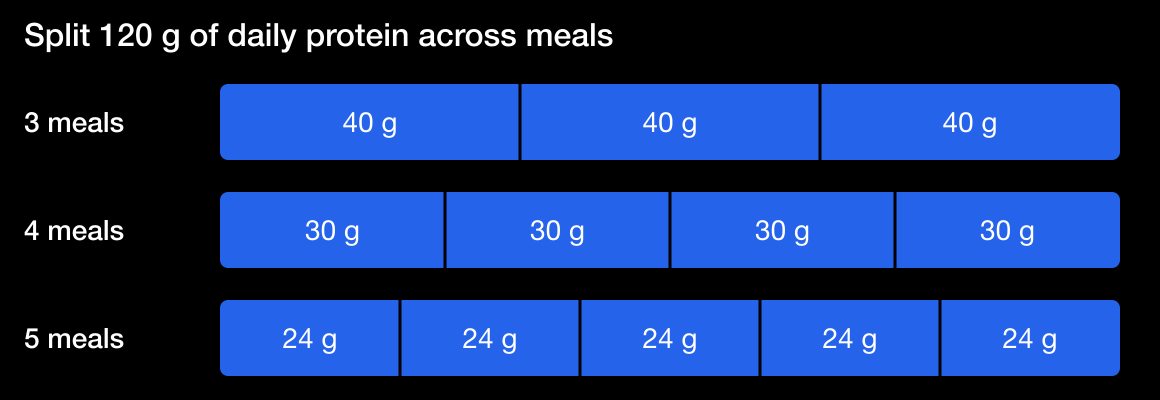
The same 120 g daily total gives 40 g across three meals, 30 g across four, or 24 g across five. These are planning amounts, not measured food portions or a muscle-building threshold.
| Daily target | Three meals | Four meals | Five eating occasions |
|---|---|---|---|
| 93 g | 31 g each | about 23 g each | about 19 g each |
| 120 g | 40 g each | 30 g each | 24 g each |
| 160 g | about 53 g each | 40 g each | 32 g each |
For the 220-pound example, 120 g across four meals means 30 g at breakfast, lunch, dinner, and one more meal or snack. Pick the meal count you already eat, since a fourth meal you have to invent is harder to keep than a slightly larger portion at three. The leucine threshold guide covers what per-meal research does and does not show. Set the daily protein goal first and let carbohydrate and fat fill the remaining calories, as described in how to count macros for weight loss.
07Individualize targets for medical needs
Some situations change the answer enough to need an individualized plan. If you have chronic kidney disease, have recently had bariatric surgery, or are struggling to eat enough during GLP-1 treatment, set the target with the clinician or dietitian managing that care. The kidney health evidence review, the bariatric surgery nutrition guide, and the GLP-1 protein and training guide give context for those conversations.
The broader training and deficit decisions are in fat loss with muscle preservation and the complete guide to macronutrients. When you enter your protein target, record the weight and multiplier that produced it. A number you can explain is easier to review than one copied from a calculator.
Footnotes
U.S. Department of Agriculture and U.S. Department of Health and Human Services. Dietary Guidelines for Americans, 2025-2030. PDF
Back to textBack to text 2Back to text 3Back to text 4Back to text 5Back to text 6Back to text 7Back to text 8Jäger R, Kerksick CM, Campbell BI, et al. International Society of Sports Nutrition Position Stand: protein and exercise. Journal of the International Society of Sports Nutrition. 2017, 14:20. DOI
Back to textBack to text 2Back to text 3Helms ER, Aragon AA, Fitschen PJ. Evidence-based recommendations for natural bodybuilding contest preparation: nutrition and supplementation. Journal of the International Society of Sports Nutrition. 2014, 11:20. DOI
Back to textBack to text 2Back to text 3Back to text 4Josse AR, Atkinson SA, Tarnopolsky MA, Phillips SM. Increased consumption of dairy foods and protein during diet- and exercise-induced weight loss promotes fat mass loss and lean mass gain in overweight and obese premenopausal women. Journal of Nutrition. 2011, 141(9):1626-1634. DOI
Back to textBack to text 2Back to text 3Back to text 4Longland TM, Oikawa SY, Mitchell CJ, Devries MC, Phillips SM. Higher compared with lower dietary protein during an energy deficit combined with intense exercise promotes greater lean mass gain and fat mass loss: a randomized trial. American Journal of Clinical Nutrition. 2016, 103(3):738-746. PubMed
Back to textBack to text 2Back to text 3Back to text 4