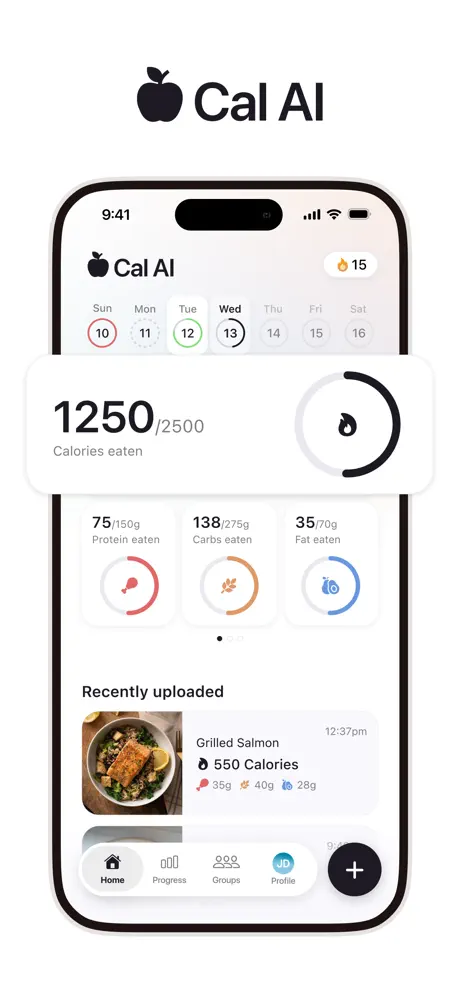


Cal AI and Noom could not be more different in what they believe makes nutrition work. Cal AI is a speed play: photograph your meal and get instant calorie estimates with zero friction. Noom is a behavior change program: learn to think about food differently through psychology-based content and access to a human coach. They barely compete for the same user, but both have execution problems that undercut their respective premises.
Key Takeaways
- Cal AI is a fast, cheap logging tool with no coaching or behavioral guidance, best for users who just want numbers. - Noom is a coaching-first program with genuine behavioral psychology content and human coaches, but at ~$70/month with significant app reliability issues. - The choice between them is really a choice between a logging tool and a coaching program. They solve fundamentally different problems.
01About Cal AI
Cal AI is a photo-first calorie tracking app that uses AI to estimate macronutrients from pictures of your food. The entire product is built around speed: snap a photo, get calorie and macro estimates, move on with your day. Cal AI was acquired by MyFitnessPal in December 2025 and continues as a standalone app. It provides a calorie target and photo logging, nothing else. No coaching, no behavioral science, no guidance on why you eat what you eat. Users report the AI frequently misidentifies dishes, estimates incorrect portions, produces macro math errors, and does not retain corrections between sessions.
02About Noom
Noom is a behavioral psychology coaching program that includes food tracking as one component of a broader behavior change curriculum. Founded on the principle that sustainable weight management requires changing your relationship with food rather than only counting calories, Noom provides daily psychology lessons, a color-coded food categorization system, and access to a human coach. At approximately $70/month, it is the most expensive option in the nutrition app category by a significant margin. The app has persistent reliability problems including frequent load failures, data loss on reinstall, and customer support that users describe as unreachable.
03Cal AI ownership privacy and billing risk
Three events from December 2025 through April 2026 changed the picture for any new Cal AI user. MyFitnessPal acquired Cal AI in December 2025. In March 2026, an unauthenticated Google Firebase backend with 4-digit account PINs leaked 3.2 million Cal AI user records, including names, dates of birth, height and weight, meal logs, and subscription details. In April 2026, Apple removed Cal AI from the App Store for deceptive billing, including bypassing in-app purchases with an embedded Stripe checkout, displaying weekly pricing more prominently than the actual billed amount, and a free-trial toggle that obscured automatic renewal. The app was reinstated after the developer redesigned the billing flow.
Underneath the events, the product picture is shaped by what Cal AI built versus what it borrowed. The barcode scanner returns accurate values because the lookup hits FatSecret's nutrition database. The in-house pieces of the product, including photo recognition, the Apple Watch app, Apple Health sync for food entries, macro arithmetic, the Firebase backend, and the in-app support agent, are where the documented failures cluster. Pricing on Cal AI is also dynamic and A/B tested during onboarding, with reported tiers including a $5.99 weekly plan, $29.99 and $49.99 annual plans, and a $59.99 family plan. See our Cal AI review for full detail and source citations.
04Speed tracking vs behavior change program
Cal AI and Noom start from entirely different assumptions about why people struggle with nutrition. Cal AI believes the problem is friction. If you remove the effort of logging through no typing, no searching, and just a camera, people will track consistently. The insight has merit, but Cal AI stops there. It gives you numbers and assumes you know what to do with them. There is no guidance, no coaching, and no framework for understanding why your eating patterns look the way they do.
Noom believes the problem is psychology. Change how you think about food, including understanding emotional eating triggers, learning cognitive reframing techniques, and building awareness of habitual patterns, and the tracking becomes a tool in service of deeper change. Noom's psychology curriculum draws on real research in cognitive behavioral therapy and motivational interviewing. The intellectual foundation is sound, and for users who engage with the content, the behavioral insights can be genuinely transformative.
Winner: Noom. For depth of approach. Whether you need behavioral coaching or just a logging tool depends on your individual situation, but Noom's framework addresses a layer that Cal AI ignores entirely.
05Food Logging Experience
Cal AI's logging is the fastest in the category. Photo, tap, done. The speed is real and undeniable. The accuracy is not. Users report wrong foods, wrong macros, and corrections that do not persist. But the act of logging itself is as frictionless as it gets. Meal copying is available, so recurring meals require even less effort on subsequent days. For users who eat similar meals regularly, the combination of photo logging and meal copying creates a workflow that takes minimal daily effort.
Noom's food logging is basic and entirely manual. You search for foods by name, select entries from search results, and adjust portion sizes. There is no photo logging, no voice logging, and barcode scanning is not a prominent or reliable feature. The logging experience feels like an afterthought to the coaching content, functional but uninspired, with an interface that has not kept pace with what users expect from a daily-use nutrition tool. Manual food additions behave inconsistently, with some users reporting that custom entries fail to save or appear incorrectly in the log. The absence of meal copying is a particularly frustrating omission. Logging the same breakfast every day requires the same full search-and-select effort every single day. For a product that costs approximately $70/month, the logging tooling is surprisingly primitive compared to free alternatives.
Winner: Cal AI. The logging experience is faster, includes meal copying, and requires less daily effort, even with its accuracy limitations.
06Coaching Quality
Noom's coaching is its reason for existing and its strongest differentiator. The psychology curriculum covers emotional eating, portion awareness, cognitive distortions around food, and practical strategies for sustainable behavior change. The daily lessons are short, digestible, and build on each other over weeks. Access to a human coach provides accountability and personalized guidance that no algorithm replaces. For users who have tried and failed with calorie counting alone, Noom's approach addresses the root causes rather than only the symptoms.
Cal AI has no coaching layer. It provides a static calorie target and a camera. If you overeat, Cal AI does not ask why. If you undereat, Cal AI does not adjust. If you have a difficult day and abandon tracking, Cal AI has no mechanism to bring you back. It is a logging tool with no intelligence beyond the AI that reads your photos.
Winner: Noom. By a wide margin. Noom provides real coaching with psychological depth. Cal AI provides none.
07Crashes and day-to-day stability
This is where Noom's execution fails its philosophy. Users report the Noom app frequently failing to load with blank screens, infinite loading states, and crashes that require complete reinstallation. The reinstallation process resets user preferences, which means coaching progress, food logging history, customized settings, and behavioral tracking data can be lost. For an app that builds on weeks of accumulated coaching interactions and behavioral patterns, losing that history undermines the continuity that makes behavioral coaching work. Customer support is described as unreachable. Responses take days when they come at all, resolution is not guaranteed, and there is no escalation path that users have found effective. For an app that costs $70/month and depends on daily engagement with coaching content, these reliability failures directly undermine the product's core value proposition.
Cal AI's reliability issues are different in character. The app generally opens and functions without crashes or load failures. The data it produces is unreliable, with wrong estimates, non-persistent corrections, and arithmetic errors, but these are data-quality issues rather than functional breakdowns. You can use Cal AI every day without the app failing to launch. You just cannot fully trust the numbers it shows you. The errors are predictable and consistent rather than catastrophic and intermittent.
Winner: Cal AI. The app works consistently, even if the data does not. Noom's load failures, data loss, and unreachable support are categorically more disruptive than Cal AI's accuracy issues.
08Apple Ecosystem and Device Integration
Neither app provides a meaningful Apple ecosystem experience, which is an increasingly notable gap as more users expect their health apps to participate in the Apple Watch and Health pipeline. Cal AI's Apple Watch app is described by users as non-functional. It fails to load, displays stale data, or crashes. Apple Health sync is partial. Water intake flows to Health but food and macro data does not, meaning other health apps cannot benefit from your Cal AI nutrition logs.
Noom has no Apple Watch app at all. Apple Health integration exists but is limited in scope and reliability. For an app that costs approximately $70/month and positions itself as a comprehensive wellness coaching program, the absence of any wrist-based experience or robust Health integration is a particularly notable gap. Users who track steps, heart rate, and exercise through Apple Watch have no way to see that data contextualized alongside Noom's coaching content without switching between apps.
Winner: Tie. Both fail to deliver on Apple ecosystem expectations, with different specific shortcomings.
09Free tiers and paid walls
The price gap between these apps is dramatic and reflects their fundamentally different product categories. Cal AI is a free download, but it has a hard paywall during onboarding and there is no access to the app otherwise. Pricing is dynamic and A/B tested during onboarding rather than published, with reported tiers including a $5.99 weekly plan, $29.99 and $49.99 annual plans, and a $59.99 family plan, which is much lower than Noom's pricing. For that price, you get photo logging and a calorie target with no coaching component.
Noom costs approximately $70/month, making it the most expensive option in the nutrition and weight management category by a significant margin. For context, MacroFactor charges $11.99/month for adaptive coaching, MyFitnessPal Premium is $19.99/month, and most trackers charge under $10/month. Noom's price buys behavioral psychology coaching, human coach access, daily psychology lessons, and a food tracking tool. The value proposition depends entirely on whether you need that coaching. If behavioral change guidance is what you need, particularly if previous attempts at calorie counting have failed because the problem was psychological rather than informational, $70/month for a structured curriculum with human support is defensible. If you just need a food logger, Noom is wildly overpriced for what its tracking tool delivers.
Winner: Depends on needs. Noom is worth the premium for users who need coaching and can tolerate the app issues. Cal AI is the better value for users who only want logging.
10Who should pick Cal AI vs Noom
Choose Cal AI if you want a simple, fast calorie logging tool and do not need coaching or behavioral guidance. Cal AI suits users who already know what they should eat and just need a convenient way to record it. The accuracy issues limit its usefulness for precise macro tracking, but for rough calorie awareness at a much lower annual price, it serves its purpose. Cal AI is also the right choice for users who are budget-conscious. The price gap between Cal AI and Noom is enormous, and if you do not need behavioral coaching, paying $70/month for Noom's psychology curriculum makes no sense.
Choose Noom if you have tried calorie counting before and struggled, particularly if your challenge is understanding why you eat the way you do rather than logging food. Noom's behavioral psychology approach addresses emotional eating, habit formation, and cognitive patterns that no logging tool touches. The coaching content has genuine intellectual depth, and the human coach access adds accountability that algorithms cannot replicate. The decision to pay approximately $70/month should factor in the app's reliability problems, including load failures, data loss on reinstall, and unreachable support, and the risk that technical issues may interrupt your engagement with the very coaching content that justifies the price. If you commit and the app cooperates, Noom addresses a layer of nutrition management that Cal AI does not acknowledge exists.
11Final pick based on your priority
Cal AI and Noom solve different problems for different people. Cal AI is a tool, a camera that estimates calories. Noom is a program, a coaching curriculum that uses food tracking as one component of behavior change. Comparing them directly is almost a category error, but users evaluating nutrition apps often consider both.
If coaching is what you need, Noom provides it at a level no pure tracker matches. The psychology content is genuine, the human coaching adds accountability, and the framework addresses root causes of eating challenges. The execution problems, including app crashes, data loss, and unreachable support, are significant and may undermine consistent engagement, which is critical for behavior change.
If logging is what you need, Cal AI is faster and cheaper. The accuracy problems are real, but the app functions reliably as a daily tool. It just provides no guidance on what to do with the data it collects.
Looking for both fast AI logging and meaningful coaching in one app? Fuel delivers correctable photo logging, a daily coaching loop with health score and weekly reviews, and full Apple Watch integration, without the $70/month price tag or the app reliability issues.
Frequently Asked Questions
Is Noom worth the price compared to Cal AI?
Noom costs approximately $70/month, while Cal AI's tested annual pricing is much lower. Noom provides behavioral psychology coaching and human coach access that Cal AI completely lacks. Whether that is worth the price premium depends on whether you need coaching to change eating habits or just want a logging tool.
Does Noom have AI food logging?
No. Noom uses manual food search only, with no photo logging, no voice logging, and no barcode scanning as a primary feature. The food logging experience is basic and often described as an afterthought to the coaching content.
Why does the Noom app crash so often?
Users report frequent load failures where Noom fails to open or displays blank screens. The typical workaround is reinstalling the app, which resets all user preferences and progress data. Noom has not publicly addressed the persistence of these issues.
Can I copy meals between days in Noom?
No. Noom does not offer meal copying. If you eat the same breakfast every day, you must manually search and log each item every time. Cal AI does offer meal copying.
Which app is better for long-term behavior change?
Noom is explicitly designed for behavior change through its psychology curriculum and human coaching. Cal AI provides no behavioral guidance and is a logging tool only. However, Noom's app reliability issues can undermine consistent engagement with the coaching content.