
Key Takeaways
- Noom's behavioral psychology curriculum is intellectually compelling, but the app delivering it is plagued by load failures, missing features, and unreachable support, at roughly $70/month. - Fuel delivers daily AI coaching through a reliable product with photo/voice/text logging, a five-dimension health score, and a full Apple Watch app, at $24.99/month. - If you want coaching that actually works every day, the app has to actually work every day.
01About Fuel
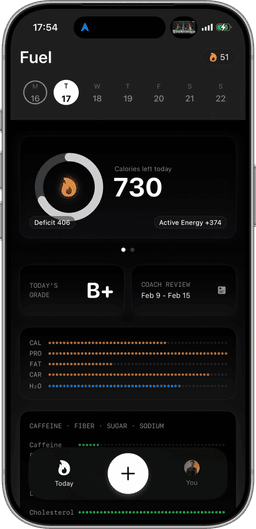
Fuel is an AI-powered nutrition coaching app built for the Apple ecosystem. You log meals by photographing a nutrition label, describing what you ate in plain text, or speaking it aloud, then refine with natural language corrections like "that was 150g not 200g" or "add olive oil." A daily health score tracks five dimensions in real time: calorie pacing, macro quality, micronutrient coverage, limits, and movement. A personalized morning recap reviews how yesterday landed and what to focus on today. A weekly review delivers an explicit action plan based on your actual patterns. A living plan timeline recalculates your goal date from real adherence, not a static projection. Data is stored on-device by default, there are no ads, and a full Apple Watch companion app supports quick log, favorites, a calories ring, water tracking, and streaks.
02About Noom
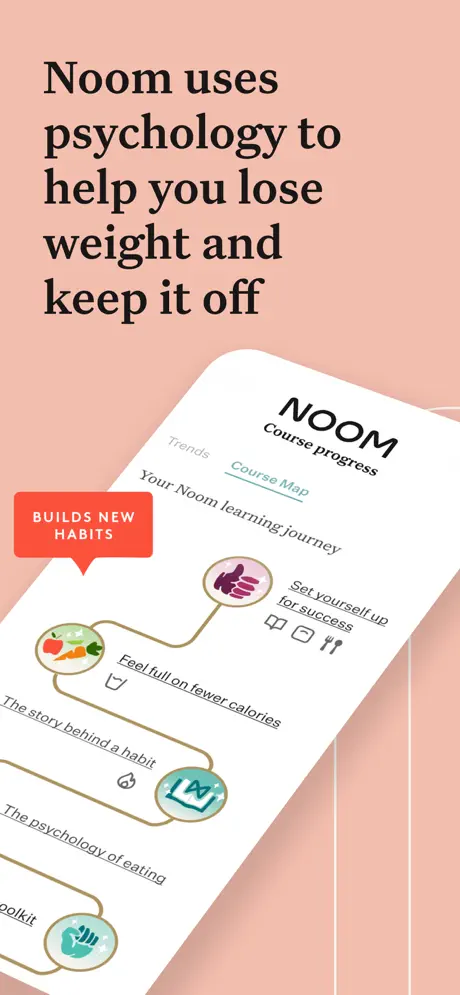
Noom is a weight management app built around behavioral psychology. The core product is an educational curriculum, with daily lessons on habits, triggers, emotional eating, and mindset, combined with access to a human coach for accountability. The coaching philosophy is rooted in real research and some users find the content genuinely transformative. Food logging is manual search-and-select with a color-coded system (green, yellow, red) that categorizes foods by caloric density. Noom is available on both iOS and Android. The subscription runs approximately $70/month on shorter plans with discounts for longer commitments. A limited trial is available, though evaluating the full system before subscribing is difficult given the trial constraints.
03Coaching Philosophy
Noom's pitch is intellectually coherent: change the psychology around food rather than obsessing over calorie counts. The curriculum draws from cognitive behavioral therapy and motivational interviewing. Daily lessons arrive as short articles covering topics like emotional eating triggers, portion awareness, and habit formation. A human coach checks in periodically via messaging. Group support adds social accountability through shared challenges and community discussion. For users who need to understand why they overeat before they can change what they eat, this approach makes theoretical sense, and when the content lands, users describe real shifts in their relationship with food.
Fuel's coaching is embedded in the daily product loop rather than layered on top as content. A live daily health score gives you a real-time signal across five dimensions: calorie pacing, macro quality, micronutrient coverage, limits, and movement. A personalized morning recap tells you how yesterday landed and what to prioritize today. A weekly review with an explicit action plan tells you what to adjust next week based on your actual data. A living plan timeline recalculates your goal date from real adherence. The coaching isn't a course you read alongside a tracker. It is the tracker.
Winner: Fuel. Coaching built into the daily feedback loop compounds faster than a curriculum you read once.
04Crashes and day-to-day stability
This is where Noom's execution collapses. The single most common user complaint is that the app simply will not open. It hangs on a loading screen indefinitely. The recommended fix from Noom's own support resources is to uninstall and reinstall the app, which resets all user preferences, settings, and customizations. You lose your configured foods, your saved meals, your display preferences. Every reinstall is a partial restart. For an app that costs $70/month, this is not a minor inconvenience. It is a fundamental product failure.
Fuel's data lives on-device by default. There is no server dependency for your logging data to survive. The app launches reliably because it is built as a daily-use tool first, rather than a content delivery platform with a logging feature attached. When your coaching system requires you to open the app every single day, reliability is a prerequisite rather than a feature.
Winner: Fuel. An app that won't load cannot coach you, regardless of the philosophy behind it.
05How each app handles food logging
Noom's food logging is manual search only. There is no photo logging, no voice logging, no barcode scanner. You type a food name, scroll through results, and select one. The color-coded system (green, yellow, red) provides a simple heuristic for caloric density, but the logging experience itself lacks the speed and convenience that even free competitors provide. You cannot copy meals between days. Manual entries behave inconsistently. For an app asking $70/month, the logging toolset feels like an afterthought.
Fuel's AI logger supports three input modes: photograph the nutrition label or the meal itself, type a description, or speak it. Natural language corrections let you refine entries conversationally with prompts like "swap the rice for quinoa," "that was grilled not fried," or "remove the cheese." Corrections persist and the system learns your patterns over time. The logging experience is designed to be the fastest path from plate to data, because the coaching system downstream depends on complete and accurate input.
Winner: Fuel. Photo, voice, and text logging with natural language corrections vs. basic manual search with no copy functionality.
06Apple Watch & Ecosystem Integration
Fuel treats the Apple Watch as a first-class surface. The companion app supports quick logging, favorites access, a calories ring that mirrors your daily pacing, water tracking, and streak maintenance, all from your wrist. Apple Health sync is fully bidirectional: Fuel reads activity and workout data, and writes food, nutrients, liquids, and workouts back. No re-import gaps, no double-counting, no sync ambiguity.
Noom does not have an Apple Watch app. There is no wrist-based logging, no glanceable progress, no complication for your watch face. Apple Health integration is limited. Noom reads step data but does not write nutrition or meal data back, which means your Apple Health dashboard remains incomplete if Noom is your primary tracker. For users who depend on the Apple ecosystem as their health data hub, this is a significant gap. The Watch is where many health-conscious users spend their most frequent interactions with their data, including a quick glance at a calories ring, a tap to log water, or a reminder to move, and Noom is entirely absent from that surface.
Winner: Fuel. Full Watch companion app and bidirectional Health sync vs. no Watch presence at all.
07Human coaches vs in-app AI coaching
This is Noom's strongest differentiator: access to a real human coach. For some users, knowing that another person is reviewing their progress and providing encouragement matters in a way that AI cannot replicate. The accountability of a human relationship, even a mediated, asynchronous one, can be the difference between sticking with a program and abandoning it. Noom also offers group coaching, which adds a social layer that purely automated systems lack.
Fuel's coaching is entirely AI-driven. The daily health score, morning recap, and weekly review are generated from your data by algorithms, not by a person. The upside is consistency. The system never forgets to check in, never has a bad day, and never takes a vacation. The feedback arrives every single morning and every single week without fail. The downside is that it cannot read emotional context the way a human coach might. For users who need the psychological relationship, Noom's human element has real value, provided you can tolerate the app delivering it.
Winner: Noom. Human coaching is a genuine differentiator for users who need interpersonal accountability.
08Data Persistence & Customer Support
Noom's reinstall problem creates a compounding data trust issue. Every time the app fails to load and you reinstall, your preferences reset. Over months of use, this means repeatedly reconfiguring the same settings. Users who have experienced this multiple times report a fundamental loss of trust in the platform. If your data can vanish at any time, the effort of meticulous logging feels wasted. Making matters worse, customer support is described consistently across user reviews as effectively unreachable. When the app breaks and you cannot get help, the $70/month subscription feels like a trap rather than a service.
Fuel stores data on-device by default. Your logging history, preferences, plan data, and coaching history persist regardless of app updates or reinstalls. The architecture is designed so that the device is the source of truth rather than a remote server that may or may not respond. This means your streak survives, your weekly patterns remain visible, and your living plan timeline maintains its full history of adjustments. Support is accessible through the app's built-in help center. The contrast is not subtle: one app treats your data as expendable collateral of a known bug, the other treats it as the foundational asset of the coaching relationship.
Winner: Fuel. On-device data persistence and accessible support vs. frequent data resets and unreachable customer service.
09Pricing & Value
Noom is among the most expensive nutrition apps in the category. Monthly plans run approximately $70/month, with discounts available for longer commitments (typically 6-12 months). The limited trial makes it difficult to fully evaluate the system before committing financially. Given the app reliability issues, the manual-only logging, and the absent Watch support, the price-to-value ratio is hard to justify unless the behavioral psychology curriculum is specifically what you need and cannot find elsewhere.
Fuel Pro is $24.99/month, roughly one-third of Noom's monthly price. The free tier includes one full coached week with daily health scores and weekly reviews, AI logging for up to 7 meals per week, and a preview of plan progress. This means you can evaluate the complete coaching system, including the daily health score, morning recaps, the weekly action plan, and the living plan timeline, plus logging quality and app reliability, all before spending anything. You know exactly what you are paying for before you pay. No other app in the category offers a comparable trial of its full coaching experience, and the contrast with Noom's limited trial is stark.
Winner: Fuel. $24.99/month with a meaningful free tier vs. ~$70/month with a limited trial and significant app reliability risks.
10Who should pick Fuel vs Noom
Choose Fuel if you want daily AI coaching that compounds through a reliable product you actually open every day. If you are in the Apple ecosystem, want fast multi-modal logging with photo, voice, and text input, care about data persistence and privacy, and prefer a system that tells you what to do based on what you actually did rather than what a curriculum says you should think, Fuel is built for you. The Apple Watch companion app and bidirectional Health sync make it the strongest option for users who live inside the Apple health stack. It is especially strong for users who have tried Noom and found the philosophy compelling but the app execution unacceptable.
Choose Noom if you specifically want a behavioral psychology curriculum with human coach access and you are willing to tolerate significant app reliability issues, manual-only food logging, no Apple Watch support, and a $70/month price point to get it. If the educational content and human accountability are what you need to change your relationship with food, Noom's approach has genuine merit. The delivery vehicle is the problem rather than the destination.
11Final pick based on your priority
Noom represents one of the more frustrating products in the nutrition space. The coaching philosophy is real. The behavioral psychology curriculum is grounded in legitimate research. The idea of changing how you think about food before obsessing over macros is genuinely valuable for a subset of users. The human coaching element provides accountability that AI systems cannot fully replicate. On paper, Noom should be excellent.
In practice, the app fails to load with alarming regularity. Reinstalling, the official fix, resets your preferences and forces you to reconfigure from scratch. Food logging is manual search only, with no photo, voice, or copy functionality. There is no Apple Watch app. Customer support is unreachable when things break. And this costs approximately $70/month, nearly three times what Fuel charges for a more complete feature set.
Fuel delivers coaching that compounds daily through a product that actually works. The AI health score, morning recap, and weekly review create a feedback loop that turns tracking data into behavioral change, which is, ironically, exactly what Noom promises. Photo, voice, and text logging with natural language corrections make the input side fast and accurate. A full Apple Watch app, bidirectional Apple Health sync, and on-device data storage make the infrastructure reliable. And it costs $24.99/month with a free tier that lets you evaluate everything before paying.
The question is not whether behavioral psychology matters. It does. The question is whether an unreliable app at three times the price is the best vehicle for delivering it. Fuel proves that daily coaching, adaptive plans, and behavioral change can be delivered through AI inside a product that works every time you open it. For most users, the answer is clear: the best coaching philosophy in the world cannot survive an app that will not load.
Frequently Asked Questions
Is Fuel or Noom better for weight loss?
Both apps support weight loss but through different mechanisms. Noom teaches behavioral psychology concepts through a curriculum and human coach. Fuel delivers daily coaching through a live health score, morning recap, weekly review with action plans, and a living plan timeline that recalculates based on real adherence. Noom changes how you think about food. Fuel changes what you do every day, if the Noom app cooperates.
Does Noom have an Apple Watch app?
No. Noom does not offer an Apple Watch app. Fuel provides a full Apple Watch companion app with quick log, favorites, a calories ring, water tracking, and streaks.
How much does Noom cost per month?
Noom costs approximately $70 per month on shorter plans, with discounts for longer commitments. Fuel Pro is $24.99 per month, and the free tier includes a full coached week with daily and weekly reviews plus AI logging for up to 7 meals per week.
Why does the Noom app keep crashing?
Noom users frequently report the app failing to load entirely. The standard troubleshooting advice is to uninstall and reinstall, but reinstalling resets all user preferences and settings. Fuel stores data on-device by default, so nothing is lost even if you need to troubleshoot.
Can I log food with photos in Noom?
No. Noom only supports manual food search. Fuel supports photo, voice, and text logging with natural language corrections. You can photograph a nutrition label, describe a meal out loud, or type what you ate and refine it conversationally.
Is Fuel free to use?
Yes. Fuel's free tier includes one full coached week with daily health scores and weekly reviews, AI logging for up to 7 meals per week, and a preview of plan progress. Pro unlocks unlimited logging and full coaching features at $24.99 per month.