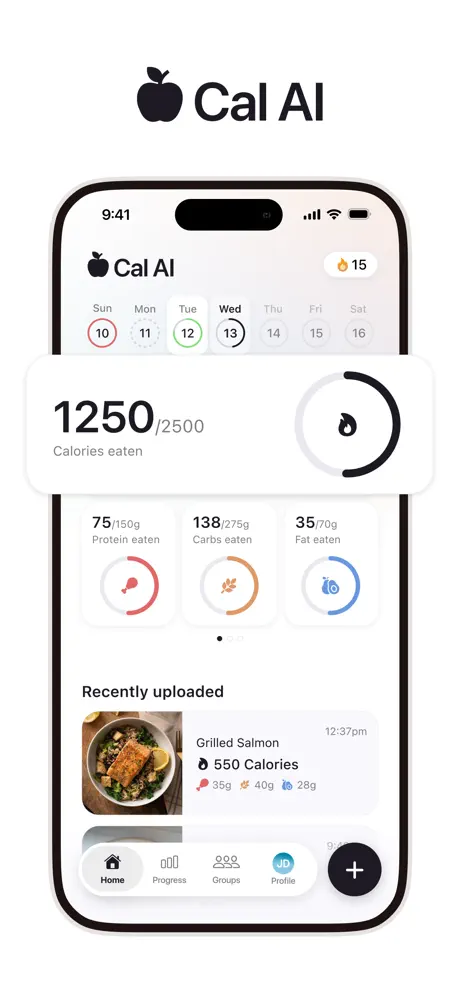

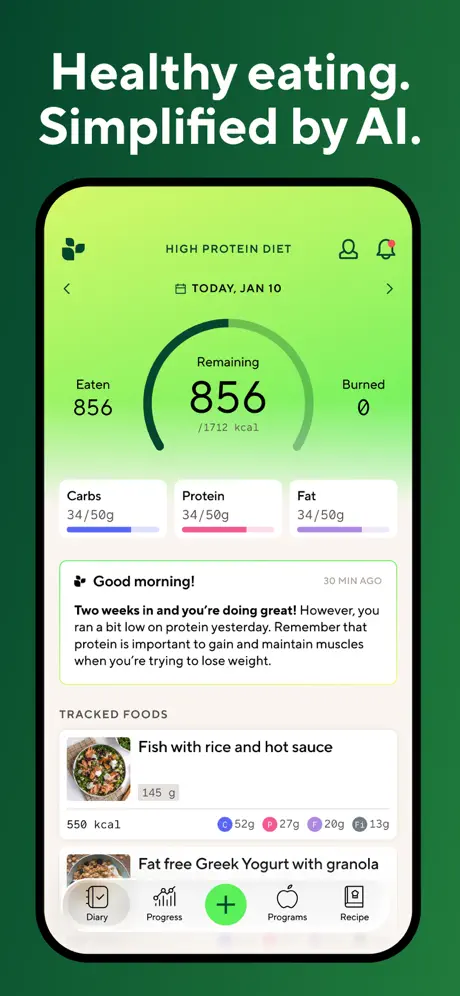
Cal AI and Lifesum both bet on AI-powered food logging, but they took different paths to get there and landed on different problems. Cal AI built around photo recognition from day one. Lifesum pivoted from a well-regarded structured meal tracker to AI-powered text logging, alienating a portion of its user base in the process. Both approaches have accuracy problems that undercut their AI promises, but the specific trade-offs differ in ways that matter for daily use.
Key Takeaways
- Cal AI uses photo-based AI logging that is fast but inaccurate, with corrections that do not persist between sessions. - Lifesum uses text-based AI logging that replaced a more reliable structured system, and removed the ability to correct AI estimates entirely. - Lifesum offers more features overall (diet plans, recipes, Life Score), but its AI pivot has destabilized the daily experience.
01About Cal AI
Cal AI is a photo-first calorie tracking app that estimates macronutrients from pictures of your food using artificial intelligence. The product is built entirely around the camera-to-calories pipeline: snap a photo, get numbers. Cal AI was acquired by MyFitnessPal in December 2025 and continues operating as a separate app. It targets users who find traditional food logging too tedious, offering the fastest possible input method at the cost of accuracy. Users report frequent misidentifications, incorrect macro splits, and basic arithmetic errors in the calorie math.
02About Lifesum
Lifesum is a nutrition and wellness app that pivoted from structured meal tracking to AI-powered text logging. Before the pivot, Lifesum was known for organized meal categories, diet plans, recipes, and a clean interface. The AI update replaced the structured logging system with a text-based input where you describe what you ate and the AI interprets it. Lifesum retains diet plans and recipes behind its $9.99/month Premium subscription, and includes a Life Score gamification system. However, the AI transition broke meal structure, removed correction capabilities, and introduced stability issues that surface after app updates.
03Cal AI ownership privacy and billing risk
Three events from December 2025 through April 2026 changed the picture for any new Cal AI user. MyFitnessPal acquired Cal AI in December 2025. In March 2026, an unauthenticated Google Firebase backend with 4-digit account PINs leaked 3.2 million Cal AI user records, including names, dates of birth, height and weight, meal logs, and subscription details. In April 2026, Apple removed Cal AI from the App Store for deceptive billing, including bypassing in-app purchases with an embedded Stripe checkout, displaying weekly pricing more prominently than the actual billed amount, and a free-trial toggle that obscured automatic renewal. The app was reinstated after the developer redesigned the billing flow.
Underneath the events, the product picture is shaped by what Cal AI built versus what it borrowed. The barcode scanner returns accurate values because the lookup hits FatSecret's nutrition database. The in-house pieces of the product, including photo recognition, the Apple Watch app, Apple Health sync for food entries, macro arithmetic, the Firebase backend, and the in-app support agent, are where the documented failures cluster. Pricing on Cal AI is also dynamic and A/B tested during onboarding, with reported tiers including a $5.99 weekly plan, $29.99 and $49.99 annual plans, and a $59.99 family plan. See our Cal AI review for full detail and source citations.
04Photo AI logging vs text AI logging
Cal AI's approach is visual: point your phone's camera at food and the AI identifies the dish, estimates the portion, and returns calories and macros. It is intuitive and fast, with the interaction taking just a few seconds. The failure mode is misidentification. The AI confuses visually similar foods, defaults to generic portion sizes, and produces macro splits that do not match known nutritional data for the identified food. When it gets a meal right, the experience is seamless. When it gets a meal wrong, which users report happens frequently, you are left manually correcting numbers that the app will not remember.
Lifesum's approach is textual: type a description of what you ate and the AI parses it into nutritional data. This can handle more complex inputs like "two eggs scrambled with cheddar and a slice of sourdough toast," but accuracy is questioned. Users report the AI misinterpreting quantities, assigning wrong foods to descriptions, and producing calorie counts that do not align with expectations. The text-based method is slower than a photo snap but potentially handles multi-item meals better. The critical difference is what happens when the AI is wrong.
Winner: Cal AI. Marginally, because photo input is faster and at least allows corrections, even if they do not persist.
05Corrections and Error Handling
This is where the comparison gets stark and where the philosophical difference between these two AI implementations becomes most consequential for daily use. Cal AI lets you edit AI-generated entries. If the AI logs your burrito as 350 calories when you know it is closer to 700, you can tap in and fix it. The problem is that corrections do not carry forward. Log the same burrito tomorrow and Cal AI will produce a fresh incorrect estimate with no memory of yesterday's correction. The correction system exists but does not learn from your edits, making it a daily chore rather than a one-time fix. Over weeks of use, this means re-correcting the same recurring errors repeatedly.
Lifesum is materially worse in this regard. The AI update removed the ability to correct AI-generated entries entirely. Whatever the AI decides your meal contains, that is what goes in your log, permanently. If the AI interprets "grilled chicken salad" as 200 calories when the actual meal was closer to 500, you have no recourse within the app. You cannot edit the calories, adjust the macros, or replace the AI's interpretation with a manual entry. This is a significant regression from Lifesum's pre-AI system, where users could manually search, select, and edit entries with full control over every number. Users have described this change as "fixing something that wasn't broken," and it represents one of the most user-hostile design decisions in the current tracker landscape.
Winner: Cal AI. Having flawed corrections is materially better than having no corrections at all.
06Tools past the log screen
Lifesum offers substantially more beyond food tracking. Diet plans provide structured meal guidance for various goals like weight loss, muscle gain, balanced eating, and specific protocols including the Mediterranean or Scandinavian diets. A recipe library gives you meal ideas that link directly to the tracker for one-tap logging. The Life Score gamification system awards points for consistent tracking, hydration, and healthy food choices, adding a motivational layer that encourages daily engagement. Lifesum also tracks water intake and provides a broader wellness dashboard that contextualizes your food logging within a bigger health picture. All of these features sit behind the Premium subscription at $9.99/month, but they make Lifesum feel like a more complete wellness platform rather than a single-purpose logging tool.
Cal AI is exclusively a logging tool. There are no diet plans, no recipes, no gamification, no coaching, no water tracking integration, and no features beyond the camera-to-calories pipeline. The entire product is the AI estimation engine. For users who want only logging and nothing else, this simplicity could be an advantage, with less to navigate and fewer decisions to make. But for users who want guidance on what to eat, structured dietary frameworks, or motivational features to maintain consistency, Cal AI offers nothing.
Winner: Lifesum. The broader feature set provides genuine value, especially for users who want structured dietary guidance and motivational tools.
07Meal Structure and Organization
Lifesum's AI pivot disrupted what was previously one of its strengths: meal organization. The earlier version of Lifesum used clear meal categories (breakfast, lunch, dinner, snacks) with structured entries that made it easy to review your day at a glance. The AI update replaced this with a flat list. Foods logged via the AI are sometimes assigned to the wrong meal category, and the overall daily view lost the organizational clarity that users valued.
Cal AI uses a standard meal structure that is straightforward if basic. It does not have the organization depth that Lifesum once offered, but it also did not break something that was working. The logging view shows estimated entries in a simple list, and the meal categorization works as expected.
Winner: Cal AI. Lifesum actively regressed from a better system, while Cal AI's organization remains adequate.
08Stability after major app updates
Both apps have reliability concerns, but the character of those problems differs significantly. Cal AI's issues are consistent and predictable: the AI produces inaccurate estimates, corrections do not persist, and macro math contains basic arithmetic errors. These are persistent annoyances that do not change dramatically between app versions. You know what you are getting each day, and you can develop workarounds like mentally adjusting estimates or double-checking calorie math that remain valid over time.
Lifesum's issues are more unpredictable and disruptive. Users report the AI tracker breaking after updates, sometimes reverting logging behavior without explanation or changelog documentation. Paid Premium subscribers have reported being unable to add foods at all following certain updates, a fundamental failure for a food tracking app. The app occasionally requires reinstallation to restore basic functionality, and the reinstallation process can reset customized settings and preferences. When Lifesum works as intended, it offers a more feature-rich and engaging experience than Cal AI. When it breaks, and user reports suggest it breaks with notable frequency around update cycles, the daily experience falls apart entirely rather than just being imprecise.
Winner: Cal AI. Consistent imperfection is more manageable than intermittent breakage that can render the app unusable.
09Free tiers and paid walls
Cal AI is a free download, but it has a hard paywall during onboarding and there is no access to the app otherwise. Pricing is dynamic and A/B tested during onboarding rather than published, with reported tiers including a $5.99 weekly plan, $29.99 and $49.99 annual plans, and a $59.99 family plan. The subscription provides photo logging and a calorie target, nothing else. No diet plans, no recipes, no gamification, no food database. The value proposition is narrow: you are paying for the AI estimation engine and nothing more.
Lifesum offers a free tier with limited functionality that lets you evaluate the basic experience before committing. Premium at $9.99/month unlocks diet plans, recipes, detailed nutritional breakdowns, the Life Score system, and the full AI logging experience. This is more expensive than many competitors (Cronometer Gold is $5.49/month, YAZIO Pro is $6.99/month) but includes a substantially broader feature set than either. The question is whether those features are worth the premium when the AI logging layer that underpins daily use has the stability and accuracy issues described above. For users who will actively use the diet plans and recipes, the value is there. For users who only use the food logger, the price is harder to justify.
Winner: Lifesum. More features for the money, despite the higher monthly cost, provided the stability issues do not make those features inaccessible.
10Who should pick Cal AI vs Lifesum
Choose Cal AI if photo-based logging appeals to you and your primary goal is quick calorie awareness without additional features. Cal AI suits users who would not track at all if it required typing, and who are willing to accept rough estimates in exchange for a sub-five-second logging experience. The ability to correct entries, even imperfectly, gives Cal AI a meaningful edge for users who want some degree of control over the data in their log. If you just want a fast, simple calorie estimate and nothing else, Cal AI delivers that narrow value proposition effectively.
Choose Lifesum if you want a broader wellness platform with diet plans, recipes, and gamification alongside your food tracking. Lifesum is the better choice for users who benefit from structured dietary guidance, enjoy motivational features like the Life Score, and want a single app that covers more nutritional ground than just calorie estimation. The diet plans and recipe library add genuine value that Cal AI cannot match. However, go in with realistic expectations about the AI logging layer. It is less reliable than the structured system it replaced, the inability to correct AI entries is a significant limitation, and updates can break core functionality in ways that require patience to resolve.
11Final pick based on your priority
Both Cal AI and Lifesum represent the current state of AI-powered food logging: promising in concept, inconsistent in execution, and not yet reliable enough to replace traditional manual tracking for users who need accuracy. Cal AI is faster and gives you at least some ability to correct errors, making it the better pure-logging tool for users who prioritize speed above all else. Lifesum offers a richer feature set with diet plans, recipes, and gamification, making it the more complete wellness platform, but its AI pivot broke core logging reliability, removed user control over data accuracy, and introduced stability issues that surface unpredictably after app updates.
Neither AI implementation is trustworthy enough to use without independent verification. If you are choosing between these two, the decision comes down to whether you value logging speed (Cal AI) or feature breadth (Lifesum). Neither offers coaching, adaptive goals, or a functional Apple Watch experience.
Want AI logging that is correctable, accurate, and backed by real coaching? Fuel lets you fix AI estimates in natural language with corrections that actually persist, plus daily coaching that goes beyond calorie targets.
Frequently Asked Questions
Which AI logging method is more accurate, photo or text?
Neither is reliably accurate. Cal AI's photo recognition frequently misidentifies dishes and portion sizes. Lifesum's text-based AI has accuracy issues and removed the ability to correct its estimates, making errors permanent.
Can I correct AI mistakes in Cal AI and Lifesum?
Cal AI allows corrections, but they do not persist between sessions. The same food will produce the same wrong estimate next time. Lifesum removed the correction feature entirely in its AI update, so you cannot modify AI-generated entries at all.
Does Lifesum still have meal plans and recipes?
Yes. Lifesum offers diet plans and recipes behind its Premium subscription ($9.99/mo). These features survived the AI pivot, though the meal structure was replaced with a flat list that users find less organized.
Why did Lifesum remove corrections?
Lifesum's AI update replaced the previous structured logging system with text-based AI entry. The ability to manually edit AI-generated nutritional values was removed as part of this transition. Users have described this as fixing something that was not broken.
Which app is more stable after updates?
Neither is great. Cal AI has consistent accuracy issues but generally remains functional. Lifesum's AI tracker breaks after updates more frequently, sometimes reverting behavior without explanation, with paid users reporting inability to add foods.