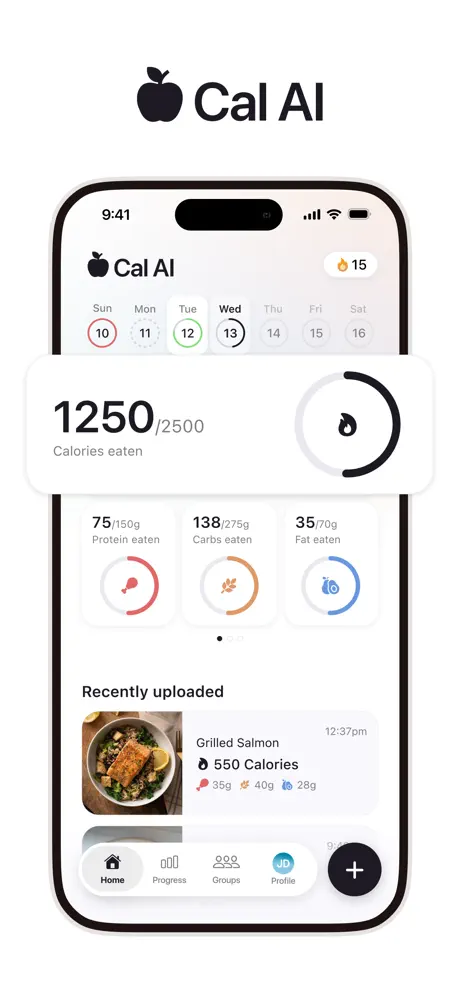

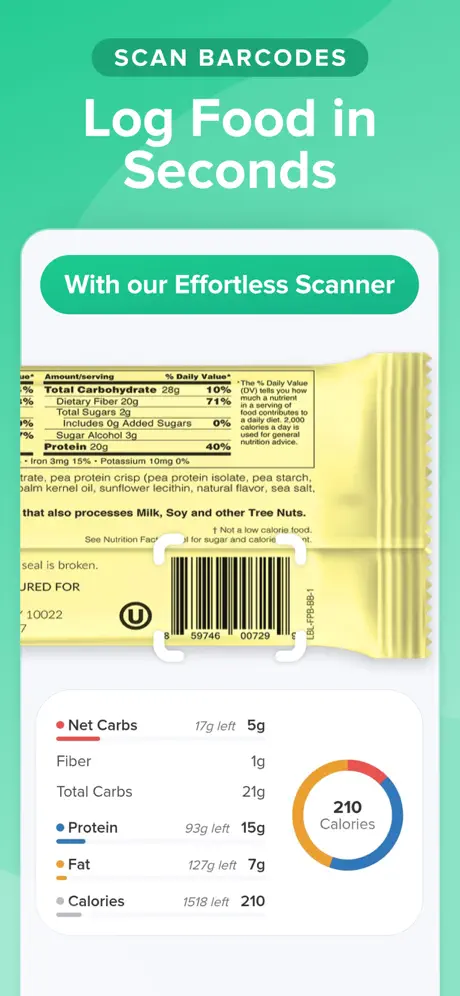
Cal AI and Carb Manager approach nutrition tracking from opposite directions. Cal AI bets everything on speed: photograph your food and skip the manual logging entirely. Carb Manager bets on dietary depth: a complete keto ecosystem with net carb tracking, meal plans, and a recipe library. They serve different users with fundamentally different priorities, and the right choice depends on whether you value logging speed or dietary structure.
Key Takeaways
- Cal AI is the faster logger but suffers from unreliable AI estimates, non-persistent corrections, and no dietary framework beyond a basic calorie target. - Carb Manager is purpose-built for keto and low-carb lifestyles with net carb tracking, meal plans, and recipes, though its meal plan builder has stability issues. - Neither app offers coaching, adaptive goals, or a functional Apple Watch experience.
01About Cal AI
Cal AI is a photo-first calorie tracking app that uses AI to estimate macronutrients from pictures of your food. The idea is to eliminate the friction of manual logging: no database searching, no barcode scanning, just point your camera and get numbers. Cal AI was acquired by MyFitnessPal in December 2025 and continues operating as a standalone app. It targets casual users who want the lowest-effort path to calorie awareness, though users frequently report that the AI misidentifies dishes, assigns incorrect portion sizes, and produces macro math errors that undermine the speed advantage.
02About Carb Manager
Carb Manager is a keto-focused nutrition tracker that provides net carb calculations, ketosis-specific targets, a built-in meal plan builder, and a large library of keto recipes. It uses traditional database search and free barcode scanning for food logging, wrapped in a framework designed specifically for low-carb and ketogenic diets. At $7.99/month for Premium, it offers one of the more complete dietary ecosystems in the category, though the meal plan builder has known stability issues and the app is less useful for people not following a keto or low-carb approach.
03Cal AI ownership privacy and billing risk
Three events from December 2025 through April 2026 changed the picture for any new Cal AI user. MyFitnessPal acquired Cal AI in December 2025. In March 2026, an unauthenticated Google Firebase backend with 4-digit account PINs leaked 3.2 million Cal AI user records, including names, dates of birth, height and weight, meal logs, and subscription details. In April 2026, Apple removed Cal AI from the App Store for deceptive billing, including bypassing in-app purchases with an embedded Stripe checkout, displaying weekly pricing more prominently than the actual billed amount, and a free-trial toggle that obscured automatic renewal. The app was reinstated after the developer redesigned the billing flow.
Underneath the events, the product picture is shaped by what Cal AI built versus what it borrowed. The barcode scanner returns accurate values because the lookup hits FatSecret's nutrition database. The in-house pieces of the product, including photo recognition, the Apple Watch app, Apple Health sync for food entries, macro arithmetic, the Firebase backend, and the in-app support agent, are where the documented failures cluster. Pricing on Cal AI is also dynamic and A/B tested during onboarding, with reported tiers including a $5.99 weekly plan, $29.99 and $49.99 annual plans, and a $59.99 family plan. See our Cal AI review for full detail and source citations.
04Logging Speed and Method
Cal AI's entire value proposition is eliminating logging friction. Point your camera at a plate of food and the AI returns calorie and macro estimates within seconds. No tapping through search results, no scanning barcodes, no measuring portions. When the AI correctly identifies your meal, it is genuinely the fastest logging experience available. The problem is that "correctly identifies" is doing significant heavy lifting. Users report the AI confusing rice dishes for pasta, estimating wildly different calorie counts for the same meal photographed at different angles, and defaulting to generic "average portion" estimates that rarely match what is actually on the plate. Corrections are available but do not persist. Log the same meal tomorrow and you will re-encounter the same errors.
Carb Manager takes the traditional approach: database search with free barcode scanning. It is slower than a photo snap, requiring you to type, search, and select entries. But the underlying data is more trustworthy, especially for keto staples. The database includes curated keto-specific entries, and net carb calculations properly subtract fiber and sugar alcohols, a distinction that matters enormously for anyone tracking ketosis. The trade-off is clear: more taps per meal, but numbers you can actually use for dietary decisions.
Winner: Tie. Cal AI is faster to log. Carb Manager is more accurate. The right choice depends on whether you prioritize speed or data quality.
05Net Carb Tracking and Keto Support
This is Carb Manager's defining advantage and the reason most keto dieters choose it over general-purpose trackers. The app calculates net carbs automatically by subtracting fiber and sugar alcohols from total carbohydrates, a calculation that matters enormously for anyone monitoring ketosis. It sets ketosis-specific macro targets, provides a dashboard designed around the metrics keto dieters actually care about, and displays real-time progress toward your daily net carb ceiling. You can customize your carb-to-fat ratios, set protein floors, and monitor ketosis alignment throughout the day. The keto-specific goal framework means Carb Manager understands that eating 30 grams of total carbs with 15 grams of fiber is fundamentally different from eating 30 grams of sugar, a distinction that generic calorie trackers ignore entirely.
Cal AI has no concept of net carbs, no keto framework, and no dietary structure beyond a basic calorie target. It estimates total carbs from photos, with the accuracy caveats already noted, but provides no tools for evaluating those carbs in a keto context. There is no way to set a net carb ceiling, no fiber subtraction, and no ketosis-related metrics. If you are following a structured low-carb diet, Cal AI simply does not support it. You would need to do the net carb math manually using Cal AI's already-unreliable estimates, a workflow that defeats the purpose of using a tracking app.
Winner: Carb Manager. By a wide margin for anyone following keto or low-carb protocols.
06Meal Planning and Recipes
Carb Manager includes a built-in meal plan builder that generates daily and weekly plans based on your macro targets and dietary preferences. It also offers a large library of keto-specific recipes that link directly to the tracker. In theory, this closes the loop between planning what to eat and logging what you ate. In practice, the meal plan builder has significant stability issues. Users report crashes when applying multiple preference filters, plans that ignore stated restrictions, and generated meals that repeat ingredients in ways that make grocery shopping impractical. The recipe library is more reliable. Recipes are browsable, well-organized, and link to tracking entries correctly.
Cal AI has no meal planning features and no recipe library. The product is exclusively a camera-to-calories pipeline. If you want help deciding what to eat rather than only logging what you already ate, Cal AI offers nothing.
Winner: Carb Manager. Even with the meal plan builder's stability problems, having the feature at all is a meaningful differentiator.
07Apple Ecosystem and Device Integration
Neither app provides a strong Apple ecosystem experience, which is increasingly notable as more users expect their health apps to work seamlessly across iPhone, Apple Watch, and Apple Health. Cal AI's Apple Watch app is consistently described by users as non-functional. It either fails to load or displays stale data that does not reflect recent logs. Some users report the Watch app crashing immediately on launch, making it effectively decorative. Apple Health integration is partial: water intake syncs, but food and macro data does not flow between Cal AI and Apple Health in a useful way. This means workout apps, sleep trackers, and health dashboards that rely on Apple Health data cannot access your Cal AI nutrition logs.
Carb Manager has no Apple Watch app at all. There is nothing to install on your wrist. Apple Health sync exists but is limited in scope and reliability. Water logging is restricted to 8-ounce increments, which is an odd limitation for an app that otherwise provides granular macro tracking down to the gram. Neither app gives you a way to log or review nutrition data from your wrist, and neither provides the kind of seamless, bidirectional Apple Health integration that would let your nutrition data enrich other health apps or vice versa.
Winner: Tie. Both are weak here, with different specific shortcomings.
08Database noise and accuracy sources
Cal AI's accuracy issues are fundamental to its approach. Photo-based calorie estimation is an inherently imprecise technology, and Cal AI's implementation compounds the problem with macro math errors. Users report protein and fat grams that do not add up to the stated calorie total. Corrections are available but do not save between sessions. The result is a logging experience that feels fast but produces data you cannot confidently use for dietary decisions.
Carb Manager's accuracy issues are different in character. The core database is reasonably reliable, especially for common keto foods. The problems are more operational: the meal plan builder crashes, preference filters fail to apply correctly, and some features do not work as documented. But when you manually search and log a food item, the nutritional data is generally trustworthy. The foundation is solid even when the features built on top of it are not.
Winner: Carb Manager. Its core tracking data is more reliable than Cal AI's AI estimates, despite the stability issues in peripheral features.
09Free tiers and paid walls
Cal AI is a free download, but it has a hard paywall during onboarding and there is no access to the app otherwise. Pricing is dynamic and A/B tested during onboarding rather than published, with reported tiers including a $5.99 weekly plan, $29.99 and $49.99 annual plans, and a $59.99 family plan. For that price, you get photo logging and a calorie target, with no meal plans, no recipes, no dietary frameworks, no barcode scanning, and no food database.
Carb Manager offers a genuinely functional free tier that includes core macro tracking, database search, barcode scanning, and basic net carb calculations. This means you can evaluate the app's core value proposition without paying anything. Premium at $7.99/month adds the meal plan builder, advanced analytics, expanded recipe content, and more detailed reporting. Dollar for dollar, Carb Manager provides substantially more functionality, especially for users who will actually use the keto-specific tools. The free tier alone offers more features than Cal AI's paid subscription.
Winner: Carb Manager. A free tier plus a lower Premium price with more features makes it the better value.
10Who should pick Cal AI vs Carb Manager
Choose Cal AI if you eat a general diet, logging friction is your primary barrier, and you are willing to accept that the numbers on screen may not match what you actually ate. Cal AI is best suited for casual calorie awareness, getting a rough sense of daily intake without the effort of manual tracking. It is not built for any structured dietary protocol, and the absence of a food database means you cannot fall back to manual search when the AI gets things wrong. Cal AI works best for users who want directional data rather than precision.
Choose Carb Manager if you follow a keto or low-carb diet and want an app that understands your dietary framework. The net carb tracking, ketosis targets, meal plans, and recipe library create an ecosystem that supports the full keto workflow, from planning meals to logging them to evaluating your daily macros against ketosis-specific goals. Even with the meal plan builder's stability issues, no other tracker matches Carb Manager's keto depth. The free tier provides enough functionality to evaluate whether the app fits your workflow before committing to Premium. If you are not doing keto, Carb Manager still works as a general tracker but loses its primary differentiator. At that point, other general-purpose trackers may be a better fit.
11Final pick based on your priority
This comparison largely comes down to diet type and tracking philosophy. For keto and low-carb dieters, Carb Manager is the clear winner. It is purpose-built for that framework with net carb calculations, ketosis targets, meal plans, and a curated recipe library that Cal AI cannot match. The meal plan builder's stability issues are real, but the core tracking is reliable and the keto-specific tools are genuinely useful.
For general diet users who prioritize speed above all else, Cal AI is faster, but the accuracy problems significantly limit the usefulness of that speed. Logging a meal in two seconds means little if the numbers are wrong and your corrections will not persist. Cal AI also faces road map uncertainty following its December 2025 acquisition by MyFitnessPal.
Neither app offers coaching, adaptive goal adjustment, or a functional Apple Watch experience. Both leave you with a calorie or macro target and no guidance on what to do when reality diverges from the plan.
Looking for a tracker that combines fast AI logging with adaptive coaching for any dietary framework? Fuel delivers correctable photo logging, a daily coaching loop, and full Apple ecosystem integration, whether you're doing keto, general tracking, or anything in between.
Frequently Asked Questions
Is Cal AI or Carb Manager better for keto?
Carb Manager is the clear choice for keto. It calculates net carbs by subtracting fiber and sugar alcohols, offers ketosis-specific targets, and includes keto meal plans and recipes. Cal AI has no diet-specific framework at all.
Can Cal AI identify keto-friendly foods from photos?
Cal AI estimates calories and macros from photos but doesn't evaluate whether foods are keto-friendly. It has no net carb calculation, no ketosis targets, and no dietary framework beyond a basic calorie goal.
Does Carb Manager have a free version?
Yes. Carb Manager offers a free tier with core tracking, database search, and barcode scanning. Premium ($7.99/mo) unlocks the meal plan builder, advanced analytics, and additional recipe content.
Why do Carb Manager meal plans crash?
Users report the meal plan builder freezing or crashing when applying dietary preference filters. The core tracking remains functional, but the meal planning feature has known stability issues that Carb Manager has acknowledged.
Which app has better Apple ecosystem support?
Neither excels. Cal AI's Apple Watch app is described as non-functional. Carb Manager has no Apple Watch app. Both have limited Apple Health integration.