
Key Takeaways
- Carb Manager is a keto-first tracker with deep net carb features and a large recipe library, but no coaching layer and key workflows that break under daily use. - Fuel is an AI coaching system that works across all dietary frameworks including keto, with photo/voice/text logging, a daily health score, and adaptive plan tracking. - Carb Manager costs less ($7.99/mo vs $24.99/mo), but Fuel delivers coaching, Apple Watch integration, and reliable daily workflows that Carb Manager doesn't offer at any price.
01About Fuel
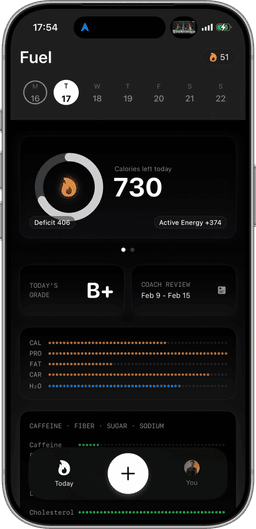
Fuel is an AI-powered nutrition coaching app built for the Apple ecosystem. You log meals by photographing nutrition labels, describing food in plain text, or speaking, then refine entries with natural language corrections until they match exactly what you ate. A daily health score tracks five dimensions in real time: calorie pacing, macro quality, micronutrient coverage, limits, and movement. A morning recap reviews yesterday and sets priorities. A weekly review delivers an explicit action plan based on your patterns. A living plan timeline recalculates your goal date from real adherence, not a static projection. Fuel works across all dietary frameworks including keto, high-protein, Mediterranean, and body recomposition, with data stored on-device, no ads, and a full Apple Watch companion app.
02About Carb Manager
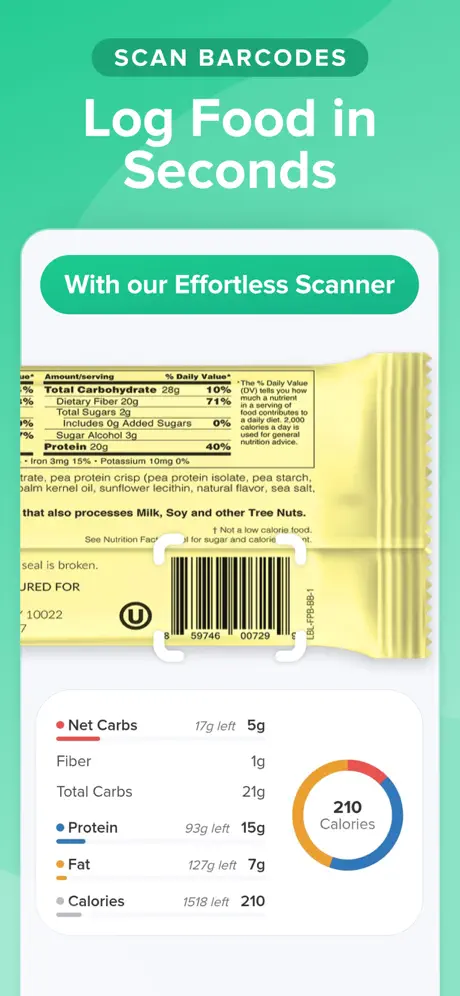
Carb Manager is a nutrition tracking app built specifically for keto and low-carb eating. The core value proposition is deep net carb tracking: macros tuned for ketosis, keto-specific meal plans, and a large library of low-carb recipes. Food logging uses a traditional manual search and barcode scanner. The app offers a meal plan builder that generates weekly plans based on your macro targets and dietary preferences. A free tier covers basic tracking, and Premium at $7.99/month unlocks meal plans, additional macro tools, and expanded recipe access. Carb Manager has built a sizable keto-focused community, but the app does not offer coaching, an Apple Watch app, or support for dietary frameworks beyond low-carb and keto.
03How each app handles food logging
Carb Manager's logging workflow is manual search and barcode scan, the standard approach shared by most calorie trackers. You type a food name, scroll through results, select a serving size, and log it. The barcode scanner handles packaged foods. It works, but the process is slow relative to newer approaches, and accuracy depends entirely on database coverage. For whole foods, homemade meals, or restaurant dishes, you're assembling entries from individual ingredients or hoping someone else has submitted the right combination.
Fuel replaces the search-and-select workflow with AI. Photograph the nutrition label, describe the meal in text, or speak it aloud. The AI extracts the data and lets you refine with natural language corrections: "that was 6oz not 8oz," "remove the cheese," "add a side of rice." The entry reflects what you actually ate, corrected in real time. No database scrolling, no barcode dependency, no assembling meals from ingredient lists.
Winner: Fuel. AI-powered photo, voice, and text logging with natural language corrections is faster and more accurate than manual search and barcode scanning.
04Coaching style and daily feedback
This is where the two apps diverge most fundamentally. Carb Manager tracks your net carbs against a ketosis target. That is the extent of its coaching. There is no daily health score, no morning recap, no weekly review, no action plan, no adaptive goal adjustment. You see your net carb number and whether you're above or below it. If you fall off track for a week, the app shows red numbers but doesn't tell you what happened, what pattern caused it, or what to change.
Fuel is a coaching system. A live daily health score evaluates five dimensions: calorie pacing, macro quality, micronutrient coverage, limits, and movement. The score gives you a real-time picture of how the day is going rather than a single macro number. A personalized morning recap reviews yesterday's performance and tells you what to focus on today. A weekly review analyzes your patterns across the entire week and delivers an explicit action plan with specific changes for next week. The difference is structural, between a number on a screen and a system that interprets your data and tells you what to do with it.
Winner: Fuel. A five-dimension coaching loop is a different category of product than a net carb counter.
05Meal Planning
Carb Manager's meal plan builder is arguably its most promoted feature, and also its most problematic. The builder generates weekly keto meal plans based on your macro targets and dietary preferences. In practice, users report crashes during plan generation, and preference filters that fail silently. Setting a "no seafood" preference and receiving salmon-based recipes is a documented issue. When the plan builder works, the plans themselves are keto-locked, useful if keto is your permanent framework but limiting if your goals evolve.
Fuel's plan is a living timeline rather than a static meal schedule. It calculates your goal date based on your actual adherence and recalculates continuously as real data comes in. Miss a day, and the timeline adjusts. Beat your targets for a week, and the projected date moves closer. This approach sidesteps the fragility of a static plan generator. There is nothing to crash, no filter to ignore, and the plan stays relevant because it reflects what you are actually doing rather than what a generator predicted you would do.
Winner: Fuel. A living adaptive timeline vs. a static meal plan generator with crashes and broken preference filters.
06Diet Flexibility
Carb Manager is built for keto. Net carb tracking, keto-tuned macros, keto meal plans, keto recipes, a keto community. If you are committed to keto as a permanent dietary framework, the depth is genuine. But if your goals shift, if you want to transition to a higher-protein approach, try Mediterranean eating, or pursue body recomposition with cycling macros, Carb Manager's architecture doesn't support the pivot. The recipes, meal plans, and macro targets are designed around ketosis.
Fuel is framework-agnostic. The coaching system, macro targets, health score, and plan timeline work across keto, high-protein, Mediterranean, body recomposition, and custom approaches. You can start with keto, shift to recomp when you hit a plateau, and move to maintenance, all within the same system. The AI adapts its coaching, recommendations, and action plans to whatever framework you're using. For users whose goals evolve over time, framework lock-in is a real cost.
Winner: Fuel. Works across all dietary frameworks instead of locking you into keto.
07Apple Watch & Ecosystem
Fuel provides a full Apple Watch companion app: quick log meals from your wrist, access favorites, track a calories ring, log water, and maintain streaks. Apple Health sync is fully bidirectional. Fuel reads your activity and workout data and writes food, nutrients, and liquids back. No re-import gaps, no data dead ends.
Carb Manager does not have an Apple Watch app. There is no wrist-based logging, no glanceable progress, no quick water log from the Watch face. Apple Health integration is limited compared to Fuel's full bidirectional sync. For users embedded in the Apple ecosystem who want nutrition tracking on their wrist alongside fitness data, this is a significant gap.
Winner: Fuel. Full Apple Watch companion app and bidirectional Apple Health sync vs. no Watch support.
08Water Logging & Daily Workflows
Small daily workflow friction compounds over weeks and months. Carb Manager's water logging uses fixed 8oz increments. You tap to add one 8oz glass at a time. If you drank a 20oz bottle, you tap twice and accept the rounding, or tap three times and overshoot. There is no way to enter a custom amount. Day-to-day meal copying, one of the most common daily workflows for people who eat similar meals, requires multiple taps with no bulk-add option. Copying yesterday's breakfast, lunch, and snacks to today is a multi-step process for each meal.
Fuel's water logging accepts flexible amounts. Enter exactly what you drank. Day-to-day meal workflows are streamlined, and the Apple Watch app adds an additional surface for quick water logging throughout the day. These aren't headline features, but they are the kind of daily-use friction that determines whether you're still using an app in month three.
Winner: Fuel. Flexible water logging and streamlined daily workflows vs. fixed increments and multi-tap copying.
09Free tiers and paid walls
Carb Manager is significantly cheaper. The free tier covers basic macro tracking, and Premium at $7.99/month unlocks meal plans, additional macro customization, and expanded recipe access. For budget-conscious users who want keto tracking without a large monthly commitment, the price is a real advantage.
Fuel's Pro subscription is $24.99/month, roughly three times the cost. The free tier includes one full coached week with daily and weekly reviews, AI logging for up to 7 meals per week, and a preview of plan progress. The question is whether coaching, AI logging, Apple Watch integration, and dietary flexibility are worth the premium. For users who only need net carb tracking, they may not be. For users who want a coaching system that adapts to their behavior, the value gap closes quickly.
Winner: Carb Manager on price. $7.99/mo vs. $24.99/mo is a significant difference. Fuel delivers more, but Carb Manager costs less.
10Who should pick Fuel vs Carb Manager
Choose Fuel if you want a coaching system that works across every dietary framework. If you want AI-powered logging that's faster than manual search, a daily health score that tracks more than net carbs, a living plan that adapts to your real adherence, and full Apple Watch integration, Fuel is built for you. It's especially strong for users whose goals extend beyond ketosis: body recomposition, high-protein diets, or anyone who's tried keto tracking and wants more guidance than a carb counter provides.
Choose Carb Manager if you're committed to keto as your primary dietary framework, want a budget-friendly tracker with deep net carb features and a large keto recipe library, and don't need coaching, Apple Watch support, or dietary flexibility. If keto is your framework and $7.99/month is your budget, Carb Manager covers the basics.
11Final pick based on your priority
Carb Manager earns its position as the most keto-focused tracker on the market. Net carb tracking, keto-tuned meal plans, and a large low-carb recipe library make it a natural choice for committed keto dieters who want a simple, affordable tracking tool. At $7.99/month, the price is hard to argue with.
The problems are in the details. A meal plan builder that crashes and ignores dietary preferences undermines the feature it's supposed to deliver. Fixed 8oz water increments and multi-tap meal copying create daily friction that accumulates into abandonment. No Apple Watch app means no wrist-based logging in an ecosystem where most fitness-minded users wear one. And the complete absence of a coaching layer means you're counting net carbs alone, with no daily score, no morning recap, no weekly action plan, and no system to interpret your data or adapt when patterns shift.
Fuel costs three times as much and delivers a fundamentally different product: AI logging that replaces manual search, a five-dimension daily health score, adaptive coaching with morning recaps and weekly action plans, a living plan timeline, full Apple Watch integration, and support for every dietary framework. For users who need more than a net carb counter, the architecture gap between the two apps is wider than the price gap.
Frequently Asked Questions
Is Fuel or Carb Manager better for keto?
Carb Manager was built specifically for keto and offers dedicated net carb tracking and keto-tuned meal plans. However, Fuel also supports keto alongside every other dietary framework, and adds AI coaching, a daily health score, and adaptive plan adjustments that Carb Manager lacks. If keto is your only concern and you don't need coaching, Carb Manager is purpose-built. If you want coaching and flexibility, Fuel handles keto and more.
Does Carb Manager have an Apple Watch app?
No. Carb Manager does not offer an Apple Watch app. Fuel provides a full Apple Watch companion with quick log, favorites, a calories ring, water tracking, and streaks.
How much does Carb Manager cost?
Carb Manager's free tier covers basic tracking. Premium costs $7.99/month and unlocks meal plans, macros, and additional features. Fuel's free tier includes a full coached week with daily and weekly reviews and AI logging for up to 7 meals per week. Fuel Pro is $24.99/month.
Can I use Carb Manager for non-keto diets?
Carb Manager's features, recipes, and meal plans are built around keto and low-carb eating. While you can technically set custom macro targets, the app's coaching, content, and community are keto-first. Fuel is designed to work across all dietary frameworks from the ground up.
Which app has better food logging?
Fuel offers AI-powered logging via photo, voice, or text with natural language corrections. No database searching required. Carb Manager uses a traditional manual search and barcode scanner approach, which is functional but slower and depends on database coverage.
Does Fuel work for body recomposition?
Yes. Fuel is specifically designed to support body recomposition, simultaneous fat loss and muscle retention, with macro targets, protein pacing, and deficit tracking that adapt to your real adherence. Carb Manager is focused on ketosis and net carbs rather than recomp-specific programming.