A Whole Foods container can be the best lunch in your week or the most expensive mistake your tracker absorbs without complaint. The hot bar looks clean, the refrigerated case looks engineered for macros, and the receipt rarely tells you how much oil moved with the tongs. The line between those two outcomes is decided by whether the container starts with a real protein anchor, whether the oil and sauce get logged honestly, and whether you treat anonymous by-weight scoops with the conservative math they actually deserve.
Whole Foods has not published a clean public macro table for the full hot bar. The Prepared Foods department page describes the scope of what is offered, including ready-to-eat sandwiches, chef-prepared meals, prepacked meals, rotisserie chicken, soups, and salads, and tells shoppers that availability varies by store and ZIP code.1 That is the practical reality you are logging against. The packaged case usually carries labels. The hot bar usually does not. Your job is to choose containers that protect protein, control fat, and survive that label gap.
This guide is independent editorial analysis. Fuel is not affiliated with, endorsed by, or sponsored by Whole Foods Market or Amazon.
01A simple order to start with
Choose an identifiable protein, vegetables, and one starch portion. Keep dressing separate. If you need a tighter estimate today, take a labeled protein from the refrigerated case and pair it with labeled sides. Photograph the labels before discarding the packaging.
At the hot bar, weigh components separately when practical and choose database entries that match how they were cooked. The receipt's total container weight cannot tell you how much chicken, rice, or oil is inside. A saved mixed-meal entry is only reusable when the portions and recipe are similar.
02Build the protein first at the hot bar
Most Whole Foods macro failures are decided in the first ten seconds at the hot bar. The eater grabs a starch base because it is at the front of the line, fills 60 percent of the container with mac and cheese, roasted potatoes, and rice pilaf, then squeezes a few pieces of chicken on top because the container is already heavy. That meal logs as chicken with sides. It eats like a fat-and-starch plate with a protein garnish.
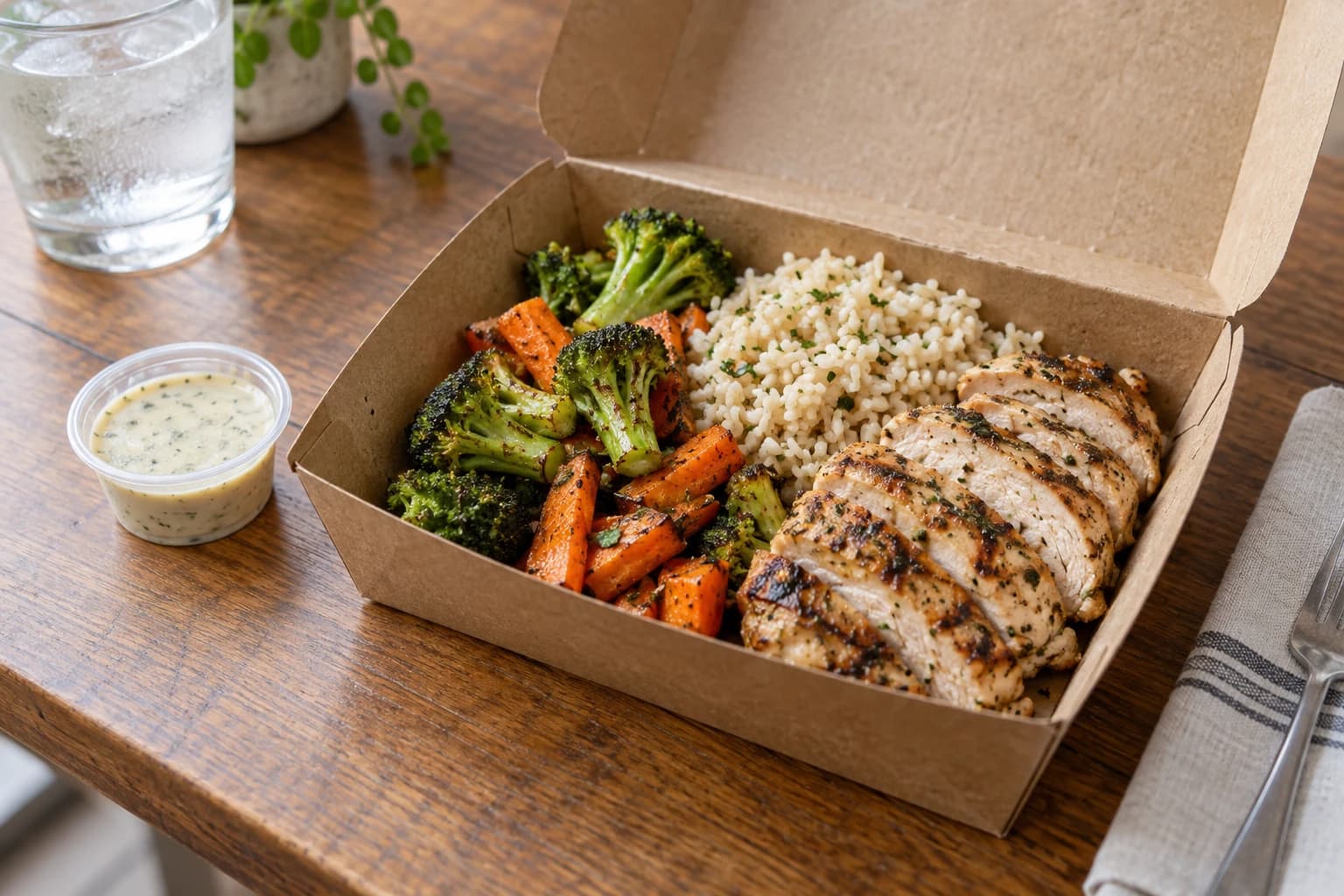
Illustrative meal, not a photographed Whole Foods order or a measured serving.
The discipline is to invert the order. Build the container as protein first, then vegetable volume, then starch matched to training, then any oily side or sauce on top. The same logic applies in the refrigerated prepared case. A salmon entree with a labeled package next to two unlabeled sides is a different logging problem than a salad bowl with a chicken topping pulled from the hot line.
The decision rules below are short on purpose.
| Slot | What goes in first | What to avoid |
|---|---|---|
| Protein anchor | Rotisserie chicken, grilled chicken, salmon, turkey, tofu, lean beans | Sauce-heavy meatballs, breaded items, glazed proteins as anchors |
| Vegetable volume | Roasted vegetables, greens, simple salads, cabbage slaws | Creamy slaws, oil-bath vegetable medleys logged as plain veg |
| Starch by training | Brown rice, plain potatoes, quinoa, beans on a training day | Mac and cheese as the default base on a fat-loss day |
| Oily sides and sauces | Measured spoon of dressing, one labeled side from the packaged case | Free-pour creamy dressings, glaze-finished proteins, oil-drenched grains |
Starting with protein makes its portion easier to see and log. Scoop order helps you see the protein portion, and the amount you serve sets the protein total.
03Protein anchors that actually work
Whole Foods is at its best for macro trackers when the protein is identifiable, visible, and either weighable on a kitchen scale at home or attached to an actual package label.
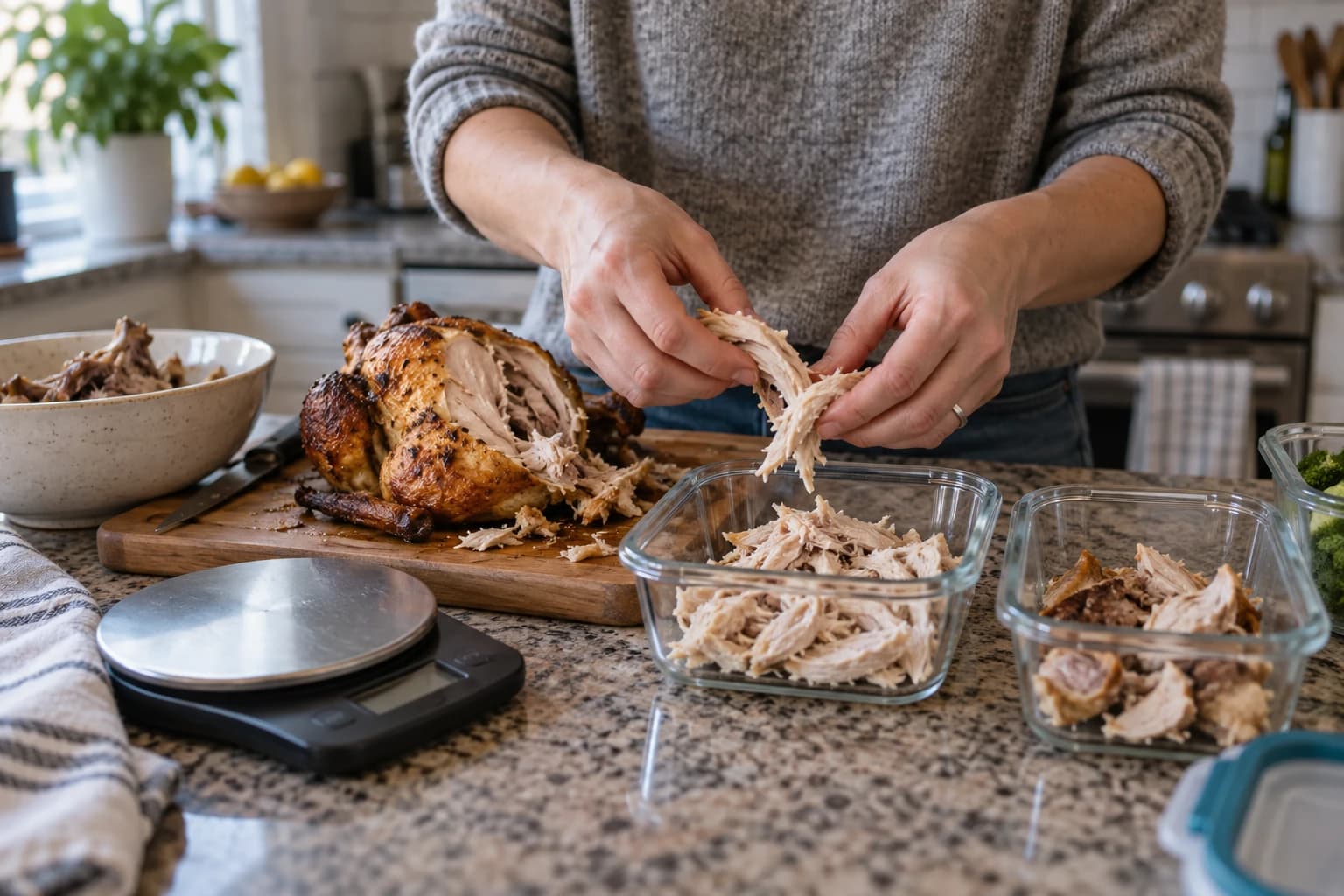
Rotisserie chicken
Rotisserie is the most useful anchor in the store because the product page or package label exists. The Whole Foods Organic KC BBQ Rotisserie Chicken official panel lists a 3 oz portion of meat at 170 calories, 15 g protein, 12 g fat, 2 g carbohydrate, and 95 mg sodium.2 That is a specific item, not a universal rotisserie macro. Other Whole Foods rotisserie variants use different brines, marinades, and glazes, and the prepared-foods scope page confirms that rotisserie is one product line inside a much larger prepared-foods category that includes sandwiches, chef-prepared meals, soups, and salads, each with its own formulation.1
Use rotisserie as an anchor when you can keep skin and sauce decisions intentional. Skin moves fat up sharply. Sauce moves sodium and sugar. If the product label is unavailable, choose a cooked-chicken entry matching the cut and skin status. The KC BBQ label cannot be substituted for every plain breast portion.
Grilled chicken and chicken preparations
Whole Foods publishes recipes that show what a clean grilled-chicken preparation can look like nutritionally. The Grilled Barbecue Chicken recipe lists 360 calories, 49 g protein, 10 g fat, 17 g carbohydrate, and 800 mg sodium per serving.6 The Grilled Chicken with Fresh Herbs recipe lists 260 calories, 29 g protein, 15 g fat, 1 g carbohydrate, and 520 mg sodium per piece.7 Those are example preparations from official recipes, not hot bar macros. The lesson is that chicken can carry the protein number even after a sauce step, and the sodium and fat lines move with the marinade, glaze, and finishing oil.
A visible breast portion has no standard weight. Estimate or weigh the cooked portion and match its preparation; do not infer sodium from appearance.
Salmon and other fish
When the prepared case carries a salmon or white fish entree with a label, use the label. When the hot bar carries an unlabeled salmon portion, log conservatively as 6 oz of cooked salmon at roughly 300 to 360 kcal with 35 to 40 g of protein, and account for glaze or oil only if the chosen entry excludes it. Treat that as an estimate band, not a published fact.
Turkey, meatballs, and other roasted proteins
Whole Foods rotates turkey, meatballs, and roasted proteins in both the hot bar and the prepared case. The packaged versions usually have a label, and that label is the source of truth. The hot bar version usually does not, and meatballs in particular can carry hidden fat from the bind and the sauce. If meatballs are the protein, account for the sauce, then make the starch and oil decisions tighter to compensate.
Tofu, beans, and plant proteins
The plant section of the hot bar tends to favor flavor over protein density. Tofu cubes, lentil salads, chickpea preparations, and bean chilis can hold their place in a macro plan, but each carries a mixed macro profile. A scoop of lentil salad is not a pure protein. It is a protein plus carbohydrate plus often a meaningful oil dose. For meals built around plant proteins, plan on a larger total scoop, a paired protein source, or a packaged tofu side with a real label.
04Prepared, hot bar, and packaged case are three different problems
Whole Foods Prepared Foods includes ready-to-eat sandwiches, custom pizzas, chef-prepared meals, build-your-own family meals, prepacked meals, rotisserie chicken, soups, and salads.1 The product aisle for Deli and Prepared Foods adds entrees, sides, deli salads, soups, stews, chili, sushi, sandwiches, wraps, dips, pasta and sauces, casseroles, potpies, and quiches.5 That breadth is real, and it is also why one logging rule does not work for all of it.
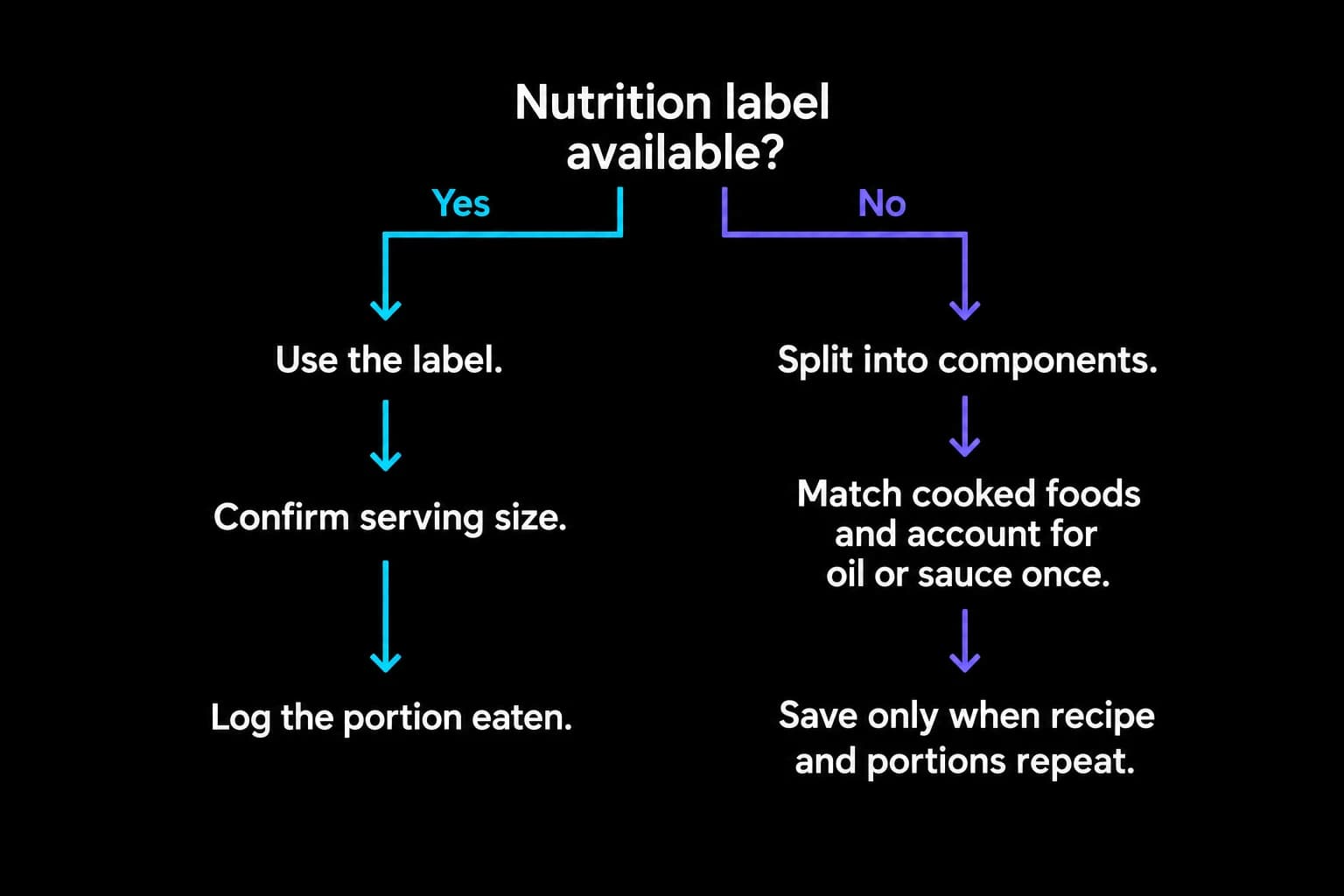
| Source | Label quality | Logging strategy |
|---|---|---|
| Packaged refrigerated case | Usually has a full nutrition panel | Scan the label and save as the source of truth |
| Whole Foods branded product page | Often available online for branded items | Use as a logging anchor when the package label is missing |
| Hot bar by-weight container | Rarely has published per-scoop macros | Estimate by component, save a conservative custom entry |
| Sushi case | Some items labeled, many not | Match sauces and tempura to the entry used |
| Sandwich case | Some have labels, build-your-own do not | Log bread, protein, cheese, and spread as separate components |
| Bakery and pastry case | Rarely labeled per piece | Use a comparable item and estimate its weight |
The point of separating these is that the packaged case usually deserves precise logging and the hot bar usually deserves honest estimation. Treating an anonymous hot bar container as if its macros were known is the same failure mode covered in Food Database Accuracy, where a clean-looking entry can carry a structural error every time it repeats.
05Whole Foods plates by goal
These are illustrative macro targets, not calculated nutrition for the portions in the adjacent columns. The food combinations show a meal pattern; portion them using the actual product labels. Calories below use 4 kcal/g protein, 4 kcal/g carbohydrate, and 9 kcal/g fat, rounded where needed.
| Goal | Protein anchor | Vegetable volume | Starch | Oily side or sauce | Approx. macro target |
|---|---|---|---|---|---|
| Fat loss day | 6 oz rotisserie breast, no skin | Two large scoops greens or roasted vegetables | Half scoop of plain potato or quinoa | One spoon dressing on the side | 428 kcal, 45 g protein, 12 g fat, 35 g carb |
| Muscle gain or hard training | 8 oz chicken plus 4 oz salmon, or double chicken | One scoop simple vegetables | Full scoop rice plus half scoop beans | Measured guacamole or olive oil | 785 kcal, 70 g protein, 25 g fat, 70 g carb |
| High-output training day | 6 oz chicken plus a labeled tofu side | One scoop greens | Full scoop rice and labeled sweet potato | One spoon tahini or pesto | 738 kcal, 55 g protein, 22 g fat, 80 g carb |
| Low appetite or GLP-1 day | 4 oz rotisserie or a labeled salmon piece | Small scoop greens | Skip the starch | Skip the sauce | 318 kcal, 40 g protein, 14 g fat, 8 g carb |
| Office or travel lunch | Labeled prepared salmon or chicken from case | Small salad from case | Labeled grain side | Label-listed dressing | 520 kcal, 40 g protein, 20 g fat, 45 g carb |
These are working defaults, not promises about what a specific Whole Foods store will plate on a given Tuesday. The container that lands close to these numbers most weeks is what makes macro meal planning survive a real schedule.
06Oils, sauces, and the sodium tax
The fat that breaks Whole Foods plates is rarely the protein. It is the oil bath on the vegetable side, the glaze on the chicken, the dressing on the grain salad, and the creamy spoon on the slaw. A tablespoon of olive oil is roughly 120 kcal, and an oil-tossed vegetable side can easily carry one or two tablespoons of oil across a normal scoop.4 That moves a 60 kcal vegetable serving toward 180 to 300 kcal with the same visible volume.
Sodium follows the same pattern in a different direction. The FDA daily value for sodium is 2,300 mg, and FDA guidance asks people to compare labels because most adults eat more sodium than recommended.38 A brined rotisserie chicken portion plus a sauce-heavy side plus a soup can spend half the day's sodium allowance before dinner.
The defensive moves are short.
Glossy vegetables may include cooking oil, but appearance cannot measure its quantity. Choose an oil-cooked vegetable entry, or add an estimated oil amount to a plain-vegetable entry. Do not do both. Apply the same rule to creamy sides and grain salads. Ask for dressings and finishing sauces on the side when the prepared case allows it, and use a measured spoon at home if the meal travels. After a higher-sodium meal, temporary water retention can change the scale, and the size and timing vary, which is the same scale noise covered in Restaurant, Takeout, Travel, and Weekend Macro Tracking.
07How to log a by-weight container without a label
The by-weight hot bar container is the place where most macro trackers either build a good custom entry or pretend the scoop is something it isn't. The honest workflow takes a few minutes the first time and seconds every time after.
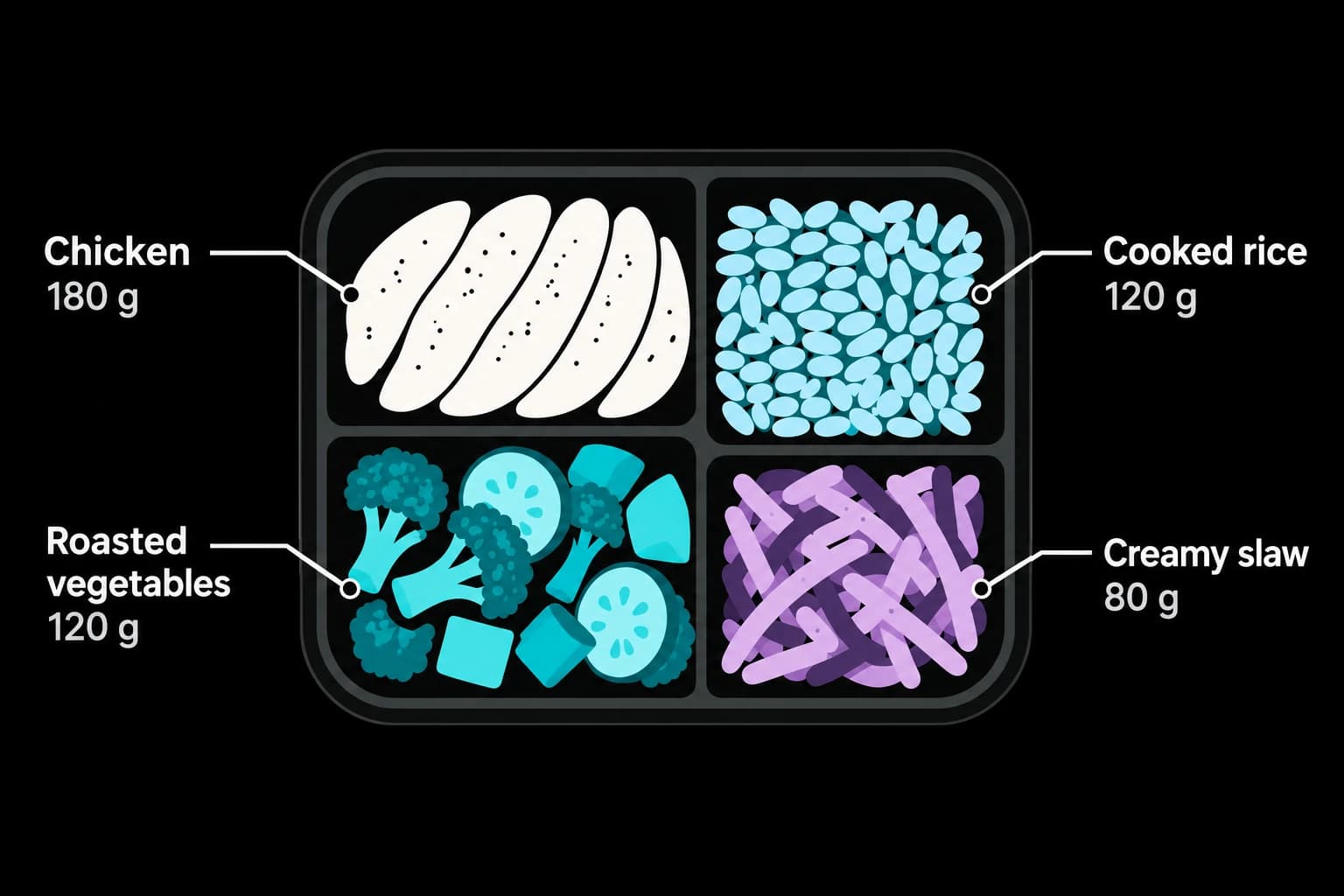
Illustrative component weights, not a measured Whole Foods serving. Total container weight alone cannot determine them.
Weigh what the receipt or scale already tells you
If the checkout receipt prints the container weight or the bar has a customer scale, write down the total grams. That single number lets you split the container into rough components instead of guessing total mass from sight.
Split the container into components
Decompose the meal as you eat it or before you eat it. A reasonable split for a 500 g hot bar container might be 180 g chicken, 120 g rice, 120 g roasted vegetables, and 80 g of a creamy slaw. Log each component as its own conservative entry. The chicken can use a verified product like the official rotisserie macro band, the rice can use a standard cooked rice entry, the vegetables get an oil-aware estimate, and the slaw gets a creamy-side proxy.
Save the build as a custom entry in Fuel
Once a container is logged honestly, save it. Whole Foods lunches repeat, and a conservative custom entry called something like Whole Foods chicken rice and vegetable plate (custom) is more useful next Tuesday than another fresh database search. Saving reusable entries is covered in Food Logging and is one of the highest-value habits in the Food Database Accuracy audit.
Use photo or text logging when components are not separable
If a container is too mixed to split, log it as a photo or text entry, accept the wider estimation band, and adjust after the meal. Fuel's quick log is designed to take a messy real-world input and produce a structured draft you can edit, then save once it is correct.
Use Food Library when the item is packaged
A labeled prepared salmon entree, a packaged grain salad, or a labeled soup belongs in Food Library rather than in an estimate. The package is the source of truth.
Use Eat Out when the decision is happening at the store
When the question is what to order from the prepared case before you commit, Eat Out lets the menu scan narrow you toward an option that fits your remaining calories and macros, which is more useful than retrofitting a poor choice into a tight day. If you are choosing from an unfamiliar menu, see how to scan it against your remaining targets, then log the food and portion you actually ate.
08Stores drift, menus drift, recipes drift
The official Prepared Foods department page says in-store availability varies by ZIP code and product line.1 Whole Foods recipe pages note that current package labels should be checked because formulations can change.6 That is not a marketing line. It is the right way to treat any prepared food across stores, days, and seasons.
The practical version for macro trackers is simple. The hot bar dish that was a clean protein last month may have a different sauce, a different brine, or a different oil content this month. A chicken side that was 95 mg of sodium per 3 oz in one product is not the same as a chicken side from a different recipe line. A salmon entree in the refrigerated case can change vendors. A grain salad can quietly add nuts and oil between visits.
Two habits prevent that drift from poisoning your log.
Recheck the label on packaged items the first time you buy a new version, even if the box looks the same. Keep your custom hot bar entries conservative on purpose so a small formulation change does not break the week. The same conservative-proxy logic applies to chain restaurants and is covered in Restaurant, Takeout, Travel, and Weekend Macro Tracking.
09Where Whole Foods is actually strongest
Whole Foods is most useful for macro trackers in three specific cases. The first is a clean labeled prepared meal from the refrigerated case, where the macros are printed on the package and the logging burden is a barcode scan. The second is a rotisserie chicken used as a take-home protein anchor for two or three meals, where the breast meat carries the protein number and the rest of the bird is treated as a separate, fattier ingredient. The third is a hot bar lunch built from a clear protein scoop, a vegetable scoop, and a measured starch, logged as a saved custom entry rather than a fresh guess each time.
Whole Foods is weakest when the container is a pile of unlabeled scoops from the hot bar, finished with a generous sauce drizzle and a creamy side. That meal can still be eaten with intention. It just needs to be logged with the wider error band and checked against your weight trend and energy over time, without treating the estimate as exact.
10Keep each container simple enough to log
If the container in your hand is too mixed to log, build the next one from parts you can name and weigh. A smaller mystery is still a mystery. A bigger plate with a clear protein, a clear starch, a clear vegetable, and one named sauce is a meal you can save once and reuse for a year. That is the version of Whole Foods you can log as reliably as a home-cooked meal, and it keeps your weight trend readable.
Footnotes
Whole Foods Market. Prepared Foods department. Accessed May 15, 2026. https://www.wholefoodsmarket.com/departments/prepared-foods
Back to textBack to text 2Back to text 3Back to text 4Whole Foods Market. Organic KC BBQ Rotisserie Chicken product page. Checked September 8, 2026. https://www.wholefoodsmarket.com/grocery/product/organic-kc%20bbq%20rotisserie%20chicken-b07g75d6t2
Back to textBack to text 2U.S. Food and Drug Administration. Daily Value on the Nutrition and Supplement Facts Labels. Accessed May 15, 2026. https://www.fda.gov/food/nutrition-facts-label/daily-value-nutrition-and-supplement-facts-labels
Back to textBack to text 2U.S. Department of Agriculture, FoodData Central. Olive oil energy reference, approximately 119 to 120 kcal per tablespoon. Accessed May 15, 2026. https://fdc.nal.usda.gov/
Back to textBack to text 2Whole Foods Market. Deli and Prepared Foods product aisle. Accessed May 15, 2026. https://www.wholefoodsmarket.com/products/prepared-foods
Back to textWhole Foods Market. Grilled Barbecue Chicken recipe. Accessed May 15, 2026. https://www.wholefoodsmarket.com/recipes/grilled-barbecue-chicken
Back to textBack to text 2Back to text 3Whole Foods Market. Grilled Chicken with Fresh Herbs recipe. Accessed May 15, 2026. https://www.wholefoodsmarket.com/recipes/grilled-chicken-fresh-herbs
Back to textU.S. Food and Drug Administration. Sodium in Your Diet. Accessed May 15, 2026. https://www.fda.gov/food/nutrition-education-resources-materials/sodium-your-diet
Back to text