The mistake most trained men make at 35 is running the same plan they ran at 27 and blaming hormones when it stops working. The plan is the problem more often than the endocrine system. Sleep is shorter. Recovery from hard pulls and heavy squats takes a day longer than it used to. Per-meal protein that was fine a decade ago is now under the dose that actually moves muscle protein synthesis. The deficit that used to feel clean now arrives with two extra glasses of wine and a missed breakfast.
Men 35 and up who lift, track, and want a tighter waist without watching their bench press fall into the floor need a lever-by-lever execution plan for body recomposition inside the body they have at 38, 45, or 52 — GLP-1 medications aside.
01What actually changes after 35
The popular story is that testosterone collapses, metabolism slows by half, and physique work stops mattering. The data is more boring than that.
Travison and colleagues studied 1,667 men at baseline in the Massachusetts Male Aging Study, with 947 and 584 men at follow-up waves, and found total testosterone fell by roughly 1.6% per year on average, with a population-wide downward shift across decades.5 That is a real population trend, not a countdown clock for every man. Age, BMI, smoking status, medication use, sleep, alcohol, diabetes, cardiovascular disease, and other health variables travel together in real life, which means a lower testosterone result at 45 is not automatically proof that age itself did the damage. The useful reading is narrower and more actionable: hormones can matter, but the first pass is still body composition, sleep, training, alcohol, medication context, and a properly interpreted lab panel.
Resting metabolic rate tells a similar story. Pontzer and colleagues in 2021 analyzed 6,421 subjects across age and body composition and found that fat-free-mass-adjusted total energy expenditure stays remarkably stable from age 20 to 60, with the meaningful decline starting closer to 60.6 Most of the slowdown men feel between 35 and 50 is non-exercise activity loss, not biology. Knees stop wanting to play pickup. Steps drop. The dog walk replaces the lunchtime run. None of that shows up on the watch as a missing workout.
The bigger story is anabolic resistance. Wall, Dirks, and van Loon reviewed the disuse and aging literature and showed that older muscle responds less to a given protein dose and a given training session, and that even short bouts of inactivity blunt muscle protein synthesis further.7 That is the real after-35 lever. Smaller meals stop counting. Skipped sessions cost more than they used to. The doses that worked at 27 are now under the threshold.
There is still a medical off-ramp. If libido, morning erections, mood, energy, anemia, fertility, unexplained strength loss, or rapid waist gain change in a way that does not match sleep, diet, training, alcohol, or medication changes, stop guessing about hormones and get a proper lab panel. Read Testosterone for the marker context and use Optimizing Your Health as the broader lab-review frame. A single morning total testosterone result is a clue, not a diagnosis.
| Variable | What changes after 35 | What to do |
|---|---|---|
| Total testosterone | Roughly 1 to 2% decline per year on average5 | Real but small year over year, dwarfed by sleep, alcohol, and visceral fat changes |
| Resting metabolic rate | Stable per kg of fat-free mass until about age 606 | Most felt slowdown is fewer steps and lower NEAT, not a broken metabolism |
| Per-meal protein response | Higher dose needed to fully stimulate MPS in older muscle1 | Move from 0.25 g/kg per meal toward 0.4 g/kg and treat breakfast as a real protein meal |
| Recovery latency | Heavy compound work lingers in the joints and CNS a day longer | Frequency over intensity, smaller sessions more often, fewer max-effort top sets per week |
| Sleep architecture | Less deep sleep, more fragmentation, alcohol hits harder | Defend 7.5 hours and treat alcohol as a recovery cost rather than a calorie cost |
| Visceral fat | Tends to drift up with stable weight if training and sleep slip | Waist measurement carries more signal than scale at this age |
Train often, eat real meals, protect sleep, and track waist alongside weight.
02The recomposition lane for men over 35
Body recomposition is the middle lane between a real cut and a real bulk. It works best when there is enough body fat to fund the energy gap and a strong reason to keep or build muscle. For most men 35 and up who already lift, this is the right lane more often than not.
Use the table below to pick a strategy honestly. Forcing recomposition on a body that needs a different phase is the most common failure mode at this age.
| Starting context | Better phase | Why |
|---|---|---|
25%+ body fat, returning to lifting | Recomposition | Plenty of fuel for a small deficit, training is novel enough to drive new growth, lifts will rise on their own |
18 to 25% body fat, training inconsistently | Recomposition | Same logic with a smaller margin, sleep and protein architecture do most of the work |
12 to 17% body fat, well-trained | Short cut, then recomposition | Recomposition gets slow at single-digit margins of error, a tight 8- to 12-week cut followed by maintenance lifting often outperforms a 6-month flat phase |
| Single-digit body fat, advanced lifter | Measured surplus | The room to lose fat is already small, growth is the bottleneck, recomposition produces a thin signal at this end of the spectrum |
| Recovering from injury, illness, or layoff | Recomposition | Detrained muscle rebuilds quickly through retained satellite cells and intact motor patterns, which makes this the strongest starting condition |
That strong starting condition depends on what happened during the layoff itself. A man who ate light through six weeks in a cast comes back with a bigger hole to fill than one who kept protein high while immobilized. What to Eat After Surgery or a Cast to Protect Muscle covers the targets that limit the damage before rebuilding starts.
The harder version of the question is timeline. Recomposition is slow. A trained 42-year-old should plan in 12-week blocks and judge the block by waist, photos, and lifts together. If the scale moves 0.25 to 0.5% of body weight per week downward while squat and bench are flat or rising and waist falls, the phase is working. If two of those three signals stall for 4 straight weeks, walk the weight-loss plateau decision tree before changing the plan.
03Calorie target
Most men over 35 set the deficit too aggressively or never set it at all. Both errors fail the same way. A 1,000 kcal deficit blows up sleep, joints, and lifts in three weeks. A vibes-based deficit produces six months of flat trend.
Start with a real estimate of maintenance calories, then size the gap to the goal.
| Body fat range | Recomposition deficit | Expected weekly loss | Why this works |
|---|---|---|---|
Above 25% | 400 to 600 kcal/day | 0.5 to 0.8% body weight/week | Larger fat reserves can fund a faster phase, training quality usually holds |
18 to 25% | 250 to 450 kcal/day | 0.4 to 0.6% body weight/week | Standard recomposition lane for trained men, lifts should rise or hold |
12 to 17% | 150 to 300 kcal/day | 0.25 to 0.4% body weight/week | Margin gets thin, bias toward maintenance days on hard training days |
Below 12% | Maintenance with periodic mini-cuts | Body weight stable, waist drops | Recomposition logic still works, the deficit shifts to a few days per week instead of every day |
Two practical rules sit underneath the table.
First, set the target by trend, not by arithmetic. The best estimate of your actual maintenance comes from 14 days of consistent logging at a weight that does not move. If your watch says 2,800 kcal/day and your trend is rising on 2,500 kcal of logged intake, your real maintenance is closer to 2,300 than to 2,800. Apple Watch is a useful day classifier and a noisy lab instrument. The execution layer for this calibration lives in Apple Watch-Based Calorie Targets for Body Recomposition.
Second, do not feel a need to flatten the deficit across the week. Most men over 35 do better with bigger food on lifting days and tighter food on rest days. If your week has three lifting days and four light days, a target that swings between 2,800 kcal on lifting days and 2,200 kcal on rest days often beats a flat 2,500 kcal/day target with the same weekly average. Training quality benefits from the food-on-training-day pattern, and adherence improves when rest-day eating is allowed to be smaller without feeling like a failure.
04Protein targets and meal timing after 35
Total daily protein matters. Per-meal architecture matters more after 35.
The Morton meta-regression on resistance training pooled trials and found that fat-free-mass gains plateau around 1.6 g/kg/day, with the upper 95% confidence interval near 2.2 g/kg/day.2 That is the working range for trained men in a recomposition phase. The Longland four-week trial in young men showed that doubling protein from 1.2 to 2.4 g/kg/day during a severe 40% energy deficit shifted outcomes from roughly maintenance of lean mass to about 1.2 kg of lean-mass gain alongside 4.8 kg of fat loss.8 Smaller deficits are a different experiment. The direction is still useful: higher protein plus hard training protects the lean compartment when calories are low.
The wrinkle for men over 35 is per-meal dosing. Yang and colleagues compared 20 g and 40 g of whey after lifting in older men and found that the larger dose produced a meaningfully higher myofibrillar protein synthesis response.9 Moore, Churchward-Venne, Witard, Breen, Burd, Tipton, and Phillips then pooled single-meal protein-dose data from healthy older and younger men and estimated the myofibrillar protein synthesis plateau at about 0.40 g/kg body mass in older men versus about 0.24 g/kg in younger men.17 In younger men, the response often saturates closer to 20 g in narrower exercise settings.10 The honest reading is that older muscle sits further to the right on the dose-response curve. The fix is to stop running on small protein meals.
| Goal | Daily protein | Per-meal protein | Why |
|---|---|---|---|
Recomposition, trained man 35 to 50 | 1.8 to 2.2 g/kg | 0.4 g/kg per meal across 3 to 4 meals | Covers the upper Morton range and matches the Moore older-men meal estimate |
Recomposition, trained man 50+ | 2.0 to 2.4 g/kg | 0.4 to 0.55 g/kg per meal | Anabolic resistance is more pronounced, the meal signal has to be stronger |
| Maintenance with serious training | 1.6 to 2.0 g/kg | 0.35 g/kg per meal | Less catabolic pressure, daily total can come down |
| Cutting harder than recomposition (mini-cut) | 2.0 to 2.4 g/kg | 0.4 g/kg per meal minimum | Energy restriction increases protein oxidation, push the floor up |
For an 85 kg man at 2.0 g/kg, that is 170 g of daily protein, divided as 45 g at breakfast, 45 g at lunch, 50 g at dinner, and 30 g from a pre-sleep snack. The 0.4 g/kg meal floor puts him at 34 g before food quality, mixed-meal digestion, or dieting pressure are considered. Skipping breakfast and loading dinner is the single most common pattern that quietly costs muscle at this age.
The full per-meal logic and threshold evidence lives in Leucine Threshold, How Much Protein Per Meal Actually Matters. For most men over 35, breakfast is the meal that needs to grow. Use the body-weight math first, then choose foods that make the number ordinary. If meal delivery is part of the weekly structure, compare Trifecta vs Factor for body recomposition by protein density, meal count, and whether the service helps you hit the breakfast and lunch slots instead of only rescuing dinner.
| Body weight | 0.4 g/kg meal target | Breakfast template |
|---|---|---|
75 kg | 30 g protein | 250 g Greek yogurt plus berries and 15 g whey mixed in |
85 kg | 34 g protein | 3 eggs plus 150 g egg whites and toast |
95 kg | 38 g protein | 250 g cottage cheese plus fruit and 2 slices high-protein toast |
105 kg | 42 g protein | Whey shake with 35 g protein plus 2 eggs or a turkey-and-egg breakfast wrap |
These are templates, not fixed prescriptions. The point is that breakfast earns its place in the muscle-retention plan instead of borrowing protein from dinner.
Pre-sleep protein becomes a real lever once the daytime pattern is solid. Kouw and colleagues showed that 40 g of casein before sleep raised overnight muscle protein synthesis in healthy older men.11 That is a useful late-stage lever. It is not a replacement for breakfast.
05Training that keeps progressive overload clear
Training is what makes the protein matter. Without mechanical tension, dietary amino acids get burned and excreted instead of becoming muscle.
The non-negotiables for trained men over 35 in a recomposition phase are three or four lifting sessions per week, intensity preserved on the major lifts, and weekly per-muscle-group volume that the body recognizes as a real training signal. The order of edits when life gets hard is the same as the cut version covered in Strength Training Minimum Effective Dose During a Cut. Cut accessories first. Cut failure work next. Cut conditioning that exists for vibes. Touch frequency last.
Currier and colleagues' 2023 network meta-analysis ranked higher-load prescriptions best for strength outcomes and multiset training best for hypertrophy across the resistance-training literature.12 The Bickel maintenance trial showed that younger adults can hold hypertrophy with sharply reduced volume after a build phase, and that older adults need more weekly loading to do the same.13 Both findings push in the same direction for the over-35 lifter. Frequency and load matter. Very low maintenance volume gets riskier as age and training history rise.
| Phase situation | Practical weekly target | What the week looks like |
|---|---|---|
| Strong start, recovery good | 10 to 15 hard sets per major muscle group per week | 4-day upper-lower or 3-day full-body, two heavy compound exposures per movement pattern |
| Mid-phase, lifts stable, fatigue rising | 8 to 12 hard sets per major muscle group | Same split, shorter sessions, fewer accessories, top sets preserved |
| Travel week, bad sleep stretch, work crisis | 6 hard sets per major muscle group for 1 to 2 weeks | Two short full-body sessions, compound lifts only, accessories paused |
Older lifter (50+) or past tendon trouble | Bias toward 4 shorter sessions over 2 long ones | Three to four exposures per major movement pattern, slightly lower per-session volume, more rep ranges in 8 to 15 |
Two specifics matter more after 35.
Joint and tendon tolerance is often the constraint that quietly sets the ceiling on how hard you can push. Achilles, patellar, and shoulder tendinopathies can take months to settle once they appear. The conservative move is to keep one heavy day and one moderate-load day per movement pattern instead of stacking two max-effort days. Tempo work, paused reps, and broken sets are coaching tools for keeping high-quality loading in the plan without turning every set into a joint stress test.
The second specific is conditioning. Some cardio is useful for fat loss and metabolic health. Too much cardio can create an interference effect, especially when recovery is already limited. Wilson and colleagues' 2012 meta-analysis of concurrent training found that hypertrophy and strength outcomes degrade as endurance frequency, duration, and intensity rise.14 For most men over 35 in a recomposition phase, two to three short conditioning sessions of 15 to 30 minutes is a practical starting ceiling before lifting starts paying the bill. Daily steps in the 7,000 to 10,000 range do more for fat loss than another running block, with almost no recovery cost.
06Sleep as the recovery lever after 35
Short sleep is the cheapest way to ruin a recomposition phase, and it is the lever most men over 35 underestimate. The full mechanism walk-through is in Sleep and Fat Loss, Why Short Sleep Raises Hunger, Lowers Training Quality, and Changes What Weight You Lose. The two numbers worth memorizing are below.
Nedeltcheva and colleagues ran two 14-day calorie-restriction phases in a crossover design. One phase allowed 8.5 hours in bed. The other allowed 5.5 hours. Total weight loss was similar across phases. Body composition was not. The short-sleep phase produced about 55% less fat loss, with the remainder coming from fat-free mass.4 The Buxton trial restricted 20 healthy men to 5 hours of sleep per night for one week and found a 20% reduction in insulin sensitivity.15
Translate those numbers honestly. A trained 42-year-old running a 300 kcal deficit on 6 hours of sleep is not running the same phase as one running it on 8 hours. The deficit is more catabolic, hunger is louder, glucose handling is worse, and the trip to the kitchen at 11 pm gets harder to talk yourself out of.
The functional sleep target for recomposition at this age is 7.5 hours, defended with a stable wake time. The wake time is the lever, not the bedtime. A 5:45 am alarm seven days a week beats an aspirational 10 pm bedtime that drifts to 11:45 pm. If kids, work, or a partner make 7.5 hours impossible some nights, plan the phase around the constraint instead of around the constraint's absence. Recomposition tolerates one bad night a week. It does not tolerate four.
07Alcohol costs recovery more than calories
For men over 35 doing recomposition, alcohol is rarely the decisive variable, and almost always more expensive than the calories suggest.
Parr and colleagues had eight resistance-trained men complete a leg session and then provided either protein, alcohol with carbohydrate, or alcohol with protein in a crossover design. The alcohol dose was 1.5 g/kg, which is roughly 8 to 9 US standard drinks for an 80 kg man. In that condition, myofibrillar muscle protein synthesis was reduced by about 24% even when high-quality protein was consumed alongside.16 One drink with dinner does not replicate this signal. A heavy drinking night after training is the scenario this study makes hard to dismiss.
The bigger cost at this age is sleep architecture. Even moderate alcohol cuts REM sleep, raises overnight heart rate, and lowers heart rate variability for hours after the last drink. The full dose-by-dose breakdown is in Alcohol and Body Composition. The decision rule worth carrying into a recomposition phase is short. One or two drinks with food on a non-training night, factored into the calorie total, does not derail the plan. Four or more drinks on any night extracts a recovery and sleep tax that often shows up in the next two training sessions.
08Tracking that matches the phase
Most men over 35 weigh themselves daily, glance at the number, and call that tracking. That is the wrong instrument panel for this phase.
Recomposition produces small scale changes and large composition changes. A 42-year-old can lose 2 cm of waist, hold body weight, add 5 kg to the squat, and call it a non-event because the scale did not move. That is a successful month.
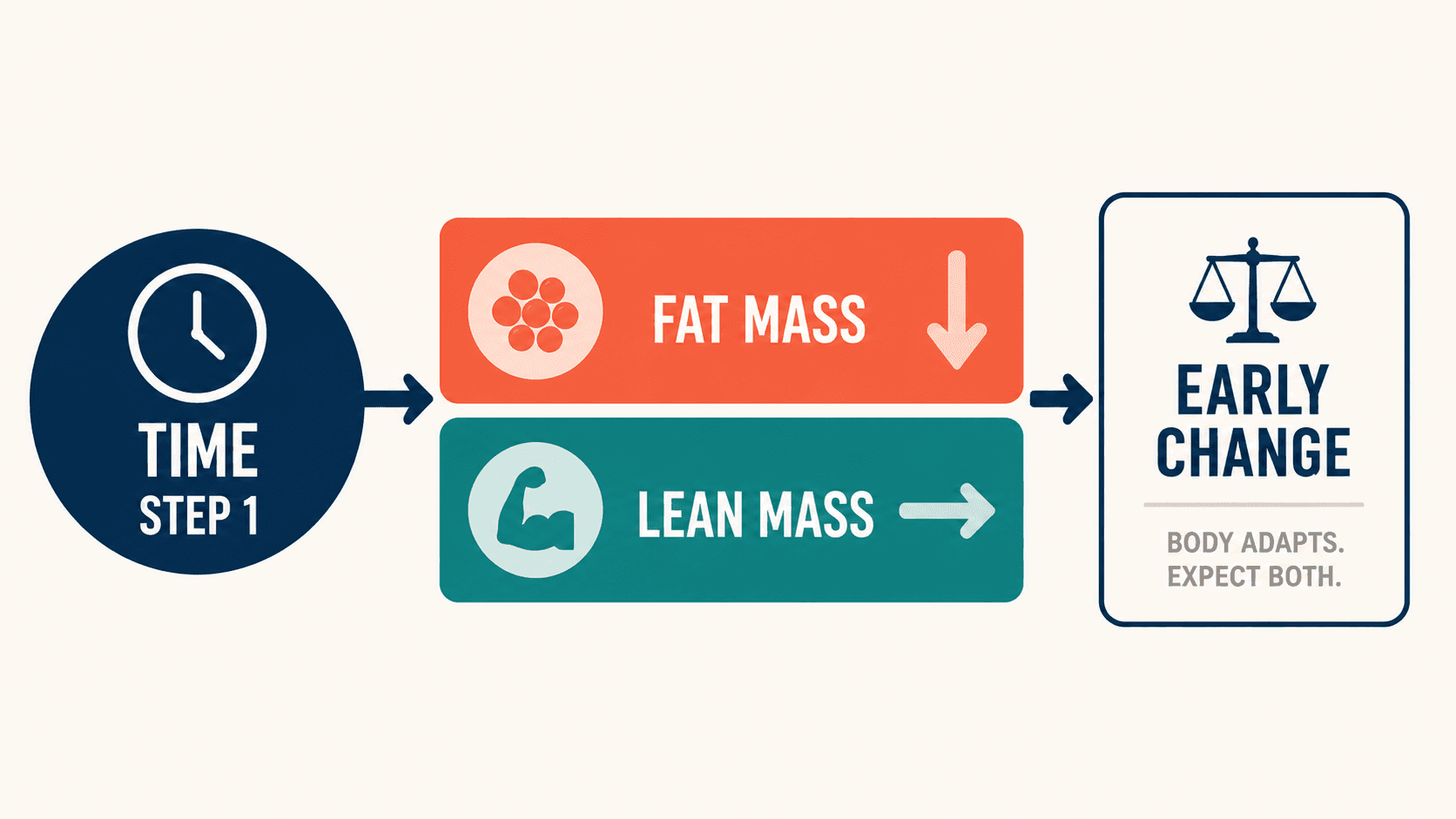
Track these five inputs and four outputs. Inputs are what you control. Outputs tell you whether the inputs are working.
| Type | Metric | Cadence | What it tells you |
|---|---|---|---|
| Input | Daily protein hit rate | Daily, weekly average | Whether the per-meal architecture is real or aspirational |
| Input | Lifting sessions completed | Weekly | Whether the muscle-retention signal is on the calendar |
| Input | Sleep duration and wake time | Daily, weekly average | The most predictive recovery input at this age |
| Input | Steps | Daily | The largest non-exercise lever for fat loss |
| Input | Alcohol units | Weekly | The recovery cost most often missed |
| Output | Body weight 7-day rolling avg | Weekly | A plateau signal, not a daily emotion |
| Output | Waist at navel, fasted, morning | Every 2 weeks | The single best at-home composition signal |
| Output | Anchor lifts (squat, press, pull) | Weekly | The strongest sign that muscle is being kept |
| Output | Photos in same lighting and pose | Every 4 weeks | Catches changes the scale and waist miss |
DEXA scans are useful as quarterly checkpoints if access is easy and affordable. Day-to-day, the waist tape and the lift log carry the signal. If body weight is flat, lifts are stable or rising, and waist is falling, the phase is working regardless of what the scale says.
The decision rule for changing the plan is 4 weeks. If two of three primary signals (waist, weight trend, lifts) are stalled for 4 weeks of consistent execution, walk the weight-loss plateau decision tree before adjusting calories. Almost all stalled phases at this age trace to logging drift, weekend intake, sleep debt, or NEAT collapse, in that order. Cutting calories is the last move, not the first.
09A 12-week recomposition block
If you want to translate everything above into one starting plan, here is the version I would run for a 40-year-old man at 22% body fat who lifts three times a week.
| Phase | Weeks | What changes | What to look for |
|---|---|---|---|
| Calibration | 1 to 2 | Eat at estimated maintenance, log every meal, dial in 4 protein-led feedings per day | Body weight stable to slightly down, lifts hold, sleep stabilizes |
| Active phase | 3 to 9 | Drop intake by 400 to 500 kcal on rest days, hold lifting days at maintenance or no more than 150 kcal below | 0.25 to 0.4% body weight loss per week, waist falls 0.5 to 1 cm per 2 weeks, lifts hold or rise |
| Defense phase | 10 to 12 | Hold the deficit only on rest days, push lifting days slightly above maintenance | Waist continues to fall, lifts climb, hunger and sleep stay manageable |
| Reset | After 12 | Two to four weeks at maintenance with full training, then re-evaluate | Trend stabilizes, hunger normalizes, training quality returns to high baseline |
Here is the audit math for that block. Take a 90 kg man with a real maintenance of 2,800 kcal/day, lifting Monday, Wednesday, and Friday. If he eats 2,800 kcal on the 3 lifting days and 2,300 kcal on the 4 rest days, the weekly deficit is 2,000 kcal. Divide that by roughly 7,700 kcal/kg of fat tissue and the arithmetic points to about 0.26 kg per week, or 0.29% of body weight. Across the 7 active weeks, that is about 1.8 kg of expected scale loss before water, glycogen, logging error, and any lean-mass gain blur the readout. If waist drops and lifts hold, that is not slow failure. That is the math behaving.
That structure does two things. It pairs food with training instead of running a flat deficit through every day of the week. It gives the body a planned reset before the phase starts costing more than it returns. Most trained men over 35 produce more visible composition change in two of these 12-week blocks per year than in a continuous six-month cut.
10What to do this week
Three changes by Friday matter more than more information.
- Move breakfast. If the current breakfast is coffee and a banana, replace it with a
0.4 g/kgprotein meal. At75 kg, that is about30 g: Greek yogurt plus whey works. At85 kg, it is about34 g: eggs plus egg whites gets there. At95 kg, it is about38 g: cottage cheese, high-protein toast, and fruit works. At105 kg, it is about42 g: a whey shake plus eggs or a turkey-and-egg wrap is cleaner than pretending coffee counts. The single highest-value change for any man over 35 trying to recomp is putting enough protein on the morning meal to create a real muscle signal. - Pick a wake time and defend it for
14days. Same wake time seven days a week, including weekends. Track sleep duration in whatever app or watch is already on the wrist. Aim for7.5hours in bed, with the goal of7hours actually asleep. This single change does more for body composition at this age than any supplement decision. - Anchor the lifts. Pick one squat, one press, one hinge, and one pull. Log the working weight for each every week. If those four numbers rise or hold across the next eight weeks, the phase is working at the muscle-retention level even if the scale moves slowly. If three of the four fall for two consecutive weeks, the deficit is too aggressive or sleep is the bottleneck.
After two clean weeks on those three changes, set the calorie target using the body-fat table earlier in this guide and start the 12-week block. If body weight, waist, and lifts all move in the right direction at week 4, hold the plan. If two of the three stall, walk the plateau decision tree before cutting another calorie. The lever that needs to move is rarely the one most men move first.
Footnotes
Breen L, Phillips SM. Skeletal muscle protein metabolism in the elderly: interventions to counteract the anabolic resistance of ageing. Nutr Metab (Lond). 2011. PubMed
Back to textBack to text 2Morton RW, Murphy KT, McKellar SR, et al. A systematic review, meta-analysis and meta-regression of protein supplementation on resistance training-induced gains in muscle mass and strength in healthy adults. Br J Sports Med. 2018. PubMed
Back to textBack to text 2Areta JL, Burke LM, Camera DM, et al. Reduced resting skeletal muscle protein synthesis is rescued by resistance exercise and protein ingestion following short-term energy deficit. Am J Physiol Endocrinol Metab. 2014. PubMed
Back to textNedeltcheva AV, Kilkus JM, Imperial J, Schoeller DA, Penev PD. Insufficient sleep undermines dietary efforts to reduce adiposity. Ann Intern Med. 2010. PubMed
Back to textBack to text 2Travison TG, Araujo AB, Kupelian V, O'Donnell AB, McKinlay JB. The relative contributions of aging, health, and lifestyle factors to serum testosterone decline in men. J Clin Endocrinol Metab. 2007. PubMed
Back to textBack to text 2Pontzer H, Yamada Y, Sagayama H, et al. Daily energy expenditure through the human life course. Science. 2021. PubMed
Back to textBack to text 2Wall BT, Dirks ML, van Loon LJC. Skeletal muscle atrophy during short-term disuse: implications for age-related sarcopenia. Ageing Res Rev. 2013. DOI
Back to textLongland TM, Oikawa SY, Mitchell CJ, Devries MC, Phillips SM. Higher compared with lower dietary protein during an energy deficit combined with intense exercise promotes greater lean mass gain and fat mass loss: a randomized trial. Am J Clin Nutr. 2016. PubMed
Back to textYang Y, Breen L, Burd NA, et al. Resistance exercise enhances myofibrillar protein synthesis with graded intakes of whey protein in older men. Br J Nutr. 2012. PubMed
Back to textMoore DR, Robinson MJ, Fry JL, et al. Ingested protein dose response of muscle and albumin protein synthesis after resistance exercise in young men. Am J Clin Nutr. 2009. PubMed
Back to textKouw IWK, Holwerda AM, Trommelen J, et al. Protein ingestion before sleep increases overnight muscle protein synthesis rates in healthy older men: a randomized controlled trial. J Nutr. 2017. PubMed
Back to textCurrier BS, Mcleod JC, Banfield L, et al. Resistance training prescription for muscle strength and hypertrophy in healthy adults: a systematic review and Bayesian network meta-analysis. Br J Sports Med. 2023. PubMed
Back to textBickel CS, Cross JM, Bamman MM. Exercise dosing to retain resistance training adaptations in young and older adults. Med Sci Sports Exerc. 2011. PubMed
Back to textWilson JM, Marin PJ, Rhea MR, Wilson SM, Loenneke JP, Anderson JC. Concurrent training: a meta-analysis examining interference of aerobic and resistance exercises. J Strength Cond Res. 2012. PubMed
Back to textBuxton OM, Cain SW, O'Connor SP, et al. Sleep restriction for 1 week reduces insulin sensitivity in healthy men. Diabetes. 2010. PubMed
Back to textParr EB, Camera DM, Areta JL, et al. Alcohol ingestion impairs maximal post-exercise rates of myofibrillar protein synthesis following a single bout of concurrent training. PLoS One. 2014. PubMed
Back to textMoore DR, Churchward-Venne TA, Witard O, Breen L, Burd NA, Tipton KD, Phillips SM. Protein ingestion to stimulate myofibrillar protein synthesis requires greater relative protein intakes in healthy older versus younger men. J Gerontol A Biol Sci Med Sci. 2015. Oxford Academic
Back to text