A calcium tablet swallowed with levothyroxine every morning raised average TSH from 1.6 to 2.7 mIU/L in three months, and one in five patients drifted above the normal range.10 Coffee, breakfast, and iron can do the same thing to a dose that looked right on paper.5712
Most advice lumps every interaction under one rule. The intervals depend on the item, and the evidence is uneven. Breakfast and caffeine have a 30 to 60 minute window in patient guidance. The ETA recommends at least an hour before coffee and more than one to two hours before milk. Calcium and iron supplements need at least four hours. The ETA also lists four-hour intervals for soy and wheat bran, while AACE emphasizes keeping ordinary soy and fiber intake steady. Those foods are not automatically off limits, but large routine changes belong in the conversation with the clinician checking TSH.234
This guide covers timing only. It does not replace your prescription label or your clinician's instructions, and nothing here is a reason to change your dose.
01Take levothyroxine the same way every day
Levothyroxine is synthetic T4, the same hormone described in the thyroid function glossary entry. The 2014 American Thyroid Association guideline puts absorption of a fasting tablet at about 70 to 80 percent, mostly in the small intestine.1 Food and coffee can reduce how much levothyroxine reaches the blood. Calcium and iron salts can bind it in the gut. Fiber and soy interactions depend on the food form and amount.2 The dose itself is small, measured in micrograms, and TSH responds to modest shifts in how much reaches the blood.
That makes the routine part of the prescription. Your clinician adjusts the dose until TSH lands in range under the conditions you actually take it. If you take it with water at 6:30 every morning, the dose is calibrated to that. If you take it with coffee some days and water on others, TSH has a moving target.
The 2025 European Thyroid Association guideline says timing should fit the patient's lifestyle. It sets 30 minutes as the minimum gap between levothyroxine and food or drink. For best efficacy it recommends taking the tablet consistently either 60 minutes before breakfast or at bedtime, at least three hours after the evening meal. The ETA rates that recommendation as strong, with moderate-quality evidence.2 AACE and the NHS both give 30 to 60 minutes before breakfast with water only and ask patients to keep the time and conditions the same each day.34
Pick the routine you can hold for months. Then hold it.
02Choose morning or bedtime dosing
Two crossover trials tested timing directly, and they disagree on bedtime.
| Trial | Patients | Design | TSH result |
|---|---|---|---|
| Bach-Huynh 2009, Georgetown | 65 completed | Three 8-week periods, fasting vs breakfast vs bedtime | Fasting 1.06, with breakfast 2.93, bedtime 2.19 mIU/L5 |
| Bolk 2010, Rotterdam | 90 completed of 105 | Double-blind, 3 months morning vs 3 months bedtime | Bedtime lowered TSH by 1.25 mIU/L vs morning. Quality of life did not differ6 |
| Perez 2013, Brazil | 42 completed | 90 days fasting vs 90 days with breakfast | Fasting 1.9, with breakfast 2.89 mIU/L9 |
Bach-Huynh found fasting morning dosing gave the lowest and least variable TSH.5 Bolk found bedtime dosing gave a lower TSH than morning dosing, with no change in fatigue, mood, or lipids.6 Neither trial tested why the bedtime results differ. How long after dinner the bedtime dose went down is one plausible factor. Both guidelines settled on the same answer. Either morning or bedtime works when the empty-stomach window is real and the routine stays fixed.12
Morning suits people who wake at a steady time and can wait before eating. Bedtime suits people who eat breakfast right away, train early, or want morning coffee immediately, as long as dinner ends at least three hours before bed. If you want to switch, tell your clinician first so TSH can be rechecked on the new schedule.
03Wait 30 to 60 minutes before coffee
Coffee is the interaction most people run into daily. In 2008, Benvenga and colleagues described eight women whose TSH stayed high while they swallowed levothyroxine with coffee or espresso. In absorption tests on six of those patients, coffee lowered the area under the T4 curve by 36 percent compared with water. In nine healthy volunteers it lowered it by 27 percent. Water followed by coffee 60 minutes later performed the same as water alone.7
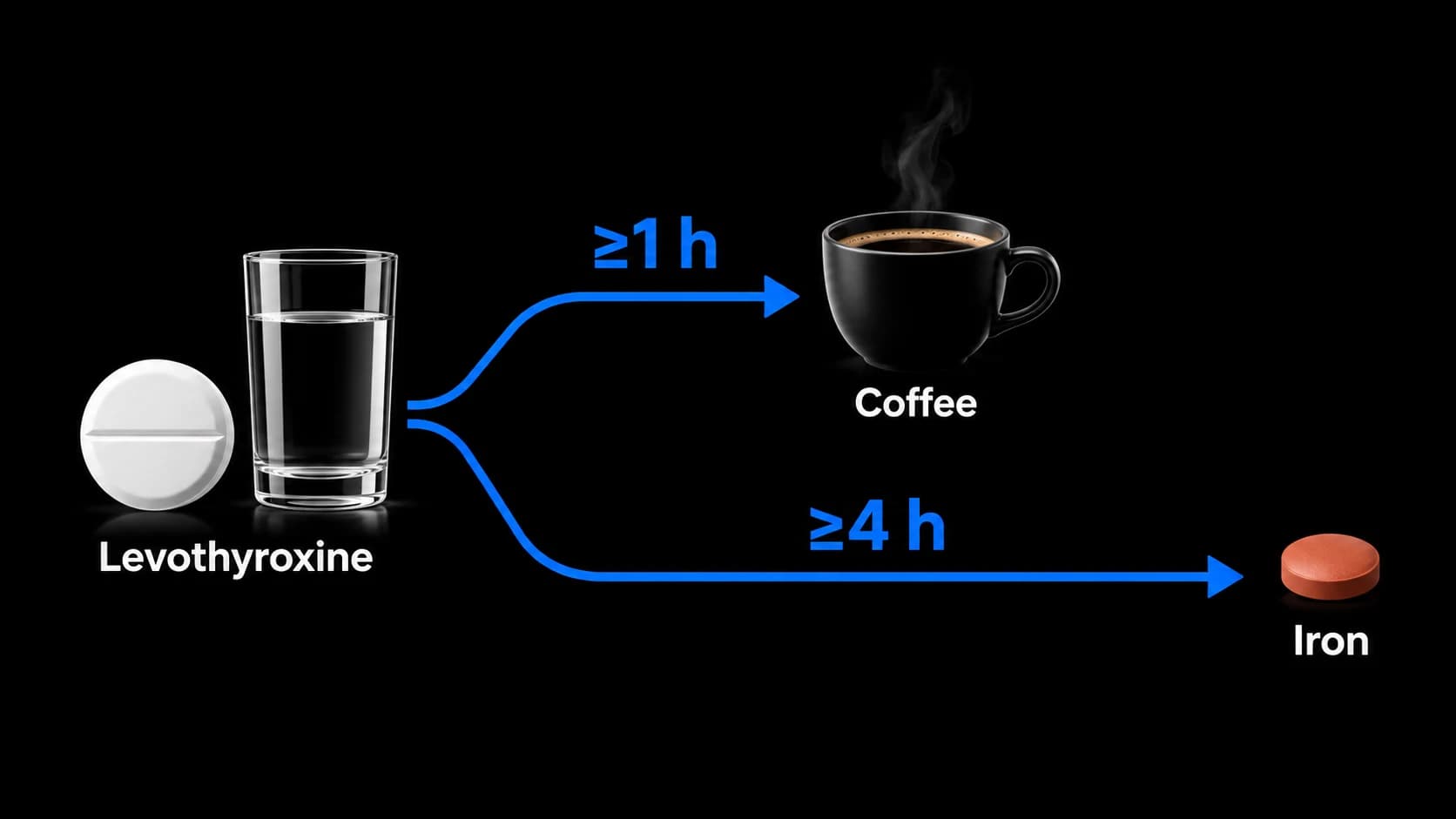
The samples were small, and the test measured T4 over four hours rather than TSH over months. The finding still explains the guideline wording. The ETA table lists coffee with a gap of at least one hour. The NHS lists caffeinated tea and coffee alongside food in its 30 to 60 minute window.24
Milk in coffee adds calcium and protein. The ETA table suggests taking levothyroxine more than one to two hours before a milk serving.2 A smaller splash gives less calcium and protein exposure than a large latte, but that is an inference because trials have not tested splash size. If your coffee contains a full serving of milk, follow the longer interval.
Liquid and soft-gel levothyroxine dissolve without relying on stomach acid. A 2014 review by Vita and colleagues concluded that both formulations can correct tablet malabsorption caused by coffee, certain drugs, or bariatric surgery.8 The ETA suggests considering them first-line for people at risk of malabsorption.2 A formulation change is a prescription decision, and the ETA advises checking TSH and free T4 about six weeks after one.2
04Separate breakfast by at least 30 minutes
Perez and colleagues designed their 2013 trial for people who struggle to delay breakfast. Taking levothyroxine with breakfast raised average TSH from 1.9 to 2.89 mIU/L. The rate of TSH above 3.5 did not differ significantly between regimens. The authors concluded breakfast dosing could suit patients with adherence problems, with closer follow-up, and that fasting dosing is better when a specific TSH target matters.9
Some patients do take levothyroxine with breakfast under a clinician's supervision. The dose is then set to that routine. That arrangement belongs to your prescriber. On a fasting routine, eating right after the pill on some days and waiting on others moves TSH.
Plan a high-protein breakfast around the ingredients as well as the breakfast interval. Milk has separate ETA timing guidance, and the available milk study does not establish a safe gap for yogurt or cottage cheese.217 If you practice intermittent fasting and skip breakfast, the morning window is easy. Keep the first meal at a similar time so the gap stays the same.
05Separate calcium and iron supplements by four hours
Supplemental calcium and iron bind levothyroxine in the gut and form complexes the body cannot absorb. The four-hour rule in patient guidance comes from these supplements.
In Singh's 2000 JAMA study, 20 patients on stable levothyroxine took 1,200 mg of elemental calcium as calcium carbonate with their dose for three months. Mean TSH rose from 1.6 to 2.7 mIU/L, free T4 fell, and 20 percent of patients went above the normal TSH range. Two months after stopping calcium, TSH fell to 1.4.10 A follow-up absorption test in seven volunteers found that 2 g of calcium taken with the pill cut T4 absorption from 84 to 58 percent of the dose.11
In a separate uncontrolled trial, Campbell and colleagues had 14 patients take 300 mg of ferrous sulfate with their thyroid dose for 12 weeks. Mean TSH climbed from 1.6 to 5.4 mU/L, and nine patients reported more hypothyroid symptoms. In the test tube, iron and thyroxine formed a poorly soluble purple complex.12
AACE advises waiting at least four hours between levothyroxine and antacids or supplements, especially calcium or iron.3 The ETA table gives four to six hours for calcium salts and at least four hours for iron.2 Calcium carbonate antacids count as calcium supplements. So do multivitamins with minerals, fortified protein powders with a high calcium dose, and iron in a multivitamin. The magnesium guide lists a four-hour gap for magnesium for the same reason.
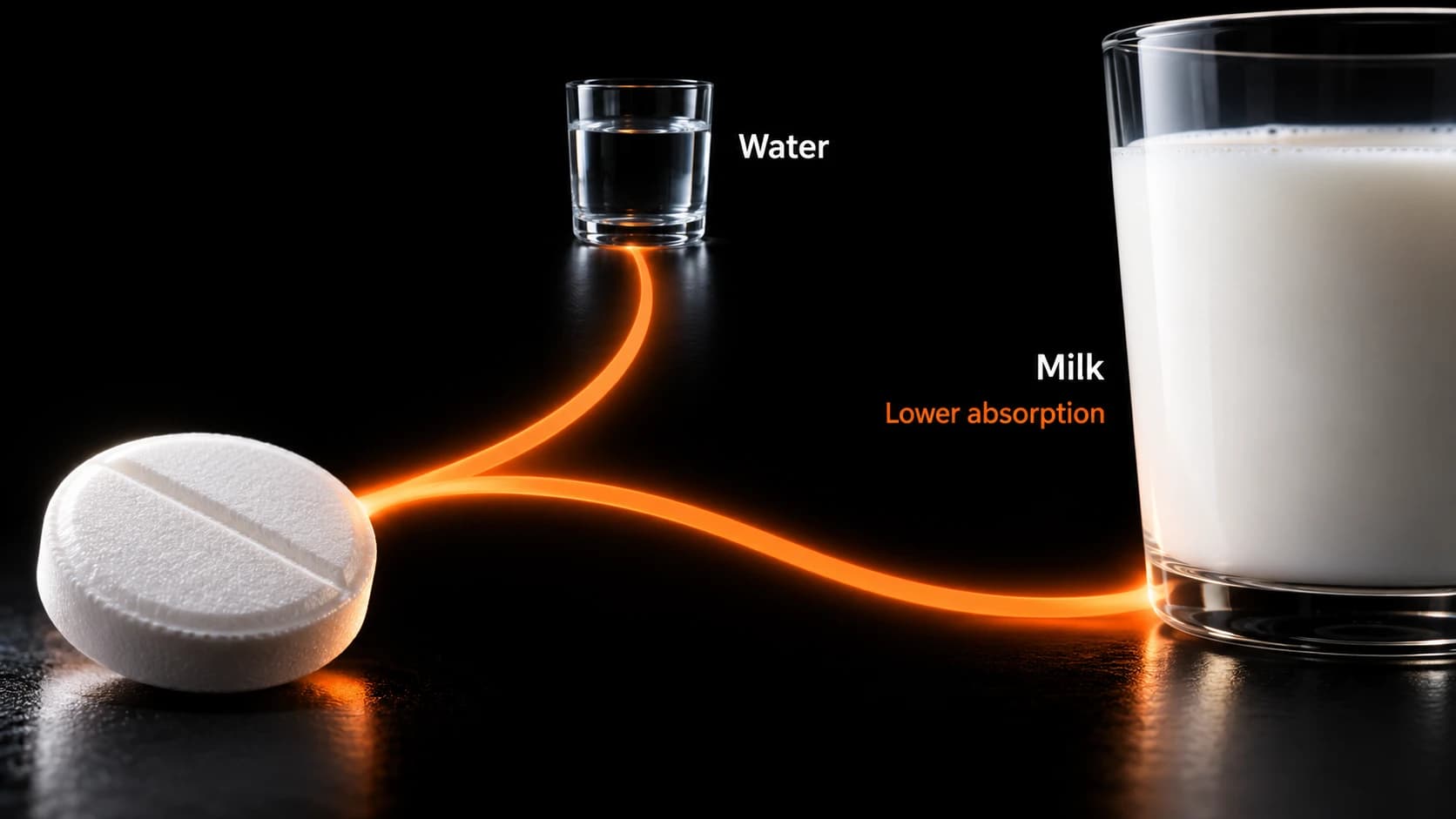
Food calcium can also affect levothyroxine absorption. A 2018 study in ten healthy adults found reduced absorption when the tablet was swallowed with 355 mL of 2% cow's milk. It tested simultaneous ingestion, not yogurt or a 30 to 60 minute gap. The study did not establish the interval needed to avoid the milk interaction.17 The ETA advises taking levothyroxine more than one to two hours before milk.2 If yogurt or cottage cheese is your daily breakfast, ask your pharmacist or prescriber about that routine. Consistent intake helps dose monitoring, but it does not establish that a particular dairy interval is adequate.
Calcium absorption and iron absorption have their own timing rules. Iron repletion often uses alternate-day morning dosing, which collides with a morning thyroid dose. A bedtime levothyroxine routine frees the morning for iron. On a morning routine, iron can go in late morning, four hours after the pill. Iron also absorbs poorly next to calcium, so keep those two apart as well. Ask the clinician who prescribed the iron before you move it.
06Keep soy and fiber intake steady
Soy and fiber appear on most avoid lists. The evidence supports keeping both at a steady level.
For soy, the strongest signal is a 2001 case report of a woman after thyroidectomy. Her TSH would not suppress while she drank a soy protein shake right after her pill. Separating the two brought her labs into range on a lower dose.13 A 2016 trial in 12 postmenopausal women found 60 mg of soy isoflavones taken with levothyroxine left its bioavailability inside bioequivalence limits.14 A 2023 review judged any soy effect likely to have little clinical impact for most tablet users.15 The soy and testosterone guide covers that evidence in more depth. The ETA table recommends at least four hours between levothyroxine and soy and says to avoid soy use if possible.2 AACE emphasizes keeping large soy changes steady and checking thyroid levels.3 The available evidence does not justify an all-soy prohibition. If you use soy protein shakes or eat soy near the dose most days, discuss that pattern with your prescriber before changing it. Tofu at dinner on a morning-dose routine sits outside the timing window.
Fiber can bind levothyroxine. In Benvenga's coffee paper, bran interfered with T4 absorption more than coffee did, although only two patients and two volunteers took that test.7 AACE notes that fiber-rich food can affect absorption and that large changes in fiber or soy may matter.3 The ETA table gives wheat bran a four-hour interval. It also says fiber supplements may affect absorption, with effects that vary by fiber type, amount, and hydration.2 That evidence does not establish a universal four-hour gap for every fiber supplement. If you use psyllium or another fiber supplement, ask your pharmacist or clinician how to time it. Ordinary food fiber remains part of the diet. The fiber intake targets still apply, and a jump from 15 g to 40 g a day is worth mentioning at the next lab visit.
The ETA recommends taking levothyroxine at least four hours before grapefruit juice.2
07Know which interactions need which gap
| Item | Guidance gap from levothyroxine | Main evidence |
|---|---|---|
| Breakfast | 30 to 60 minutes, or dose at bedtime 3 hours after dinner | ETA guidance and crossover trials of 42 to 90 patients2569 |
| Coffee or caffeinated tea | 30 to 60 minutes, ETA suggests 1 hour | Coffee absorption tests in 15 people and caffeine guidance247 |
| Milk or a milky coffee | Take levothyroxine more than 1 to 2 hours before | ETA guidance and milk co-ingestion study in 10 healthy adults217 |
| Calcium supplements and calcium antacids | At least 4 hours, ETA suggests 4 to 6 | Guidance, 20-patient cohort, 7-person absorption study231011 |
| Iron supplements | At least 4 hours | Guidance, 14-patient uncontrolled trial and in vitro binding2312 |
| Magnesium and mineral multivitamins | At least 4 hours | AACE supplement guidance3 |
| Wheat bran | Take levothyroxine at least 4 hours before | ETA table and small absorption tests27 |
| Soy | At least 4 hours before. ETA says avoid if possible | ETA guidance, case report and small isoflavone trial, with uncertain clinical effect2131415 |
| Soy and fiber in ordinary meals | Keep intake steady | AACE patient guidance3 |
| Grapefruit juice | Take levothyroxine at least 4 hours before | ETA guidance2 |
| Iodine supplements, kelp, seaweed | Ask your clinician before starting | NIDDK and AACE patient guidance316 |
Much of this rests on pharmacokinetic studies, case reports, and small cohorts. The ETA's timing recommendation is strong. The evidence behind each food-specific interval is much weaker. The four-hour interval applies to the particular items named in guidance, such as mineral supplements, soy, and wheat bran. It is not a default for every meal or every fiber product.
08Check iodine supplements with your clinician
Iodine acts on the thyroid gland itself. NIDDK warns that large amounts of iodine from kelp, dulse, other seaweeds, or iodine supplements can cause or worsen hypothyroidism, and that some cough syrups contain iodine.16 AACE advises that people with Hashimoto's disease limit iodine-rich foods such as seaweed and talk to their clinician before taking iodine supplements.3
The iodine glossary entry lists the adult target of 150 mcg a day and the upper limit of 1,100 mcg. Kelp products vary widely in iodine content, so the label is the only way to know what a capsule adds. Thyroid support blends often combine iodine, selenium, and biotin. High-dose biotin can push TSH falsely low and free T4 falsely high on some assays, which looks like overtreatment. Bring the bottle to your appointment before you start one.
09Use one of three example routines
Your prescription label and your clinician's instructions take priority over any example here.
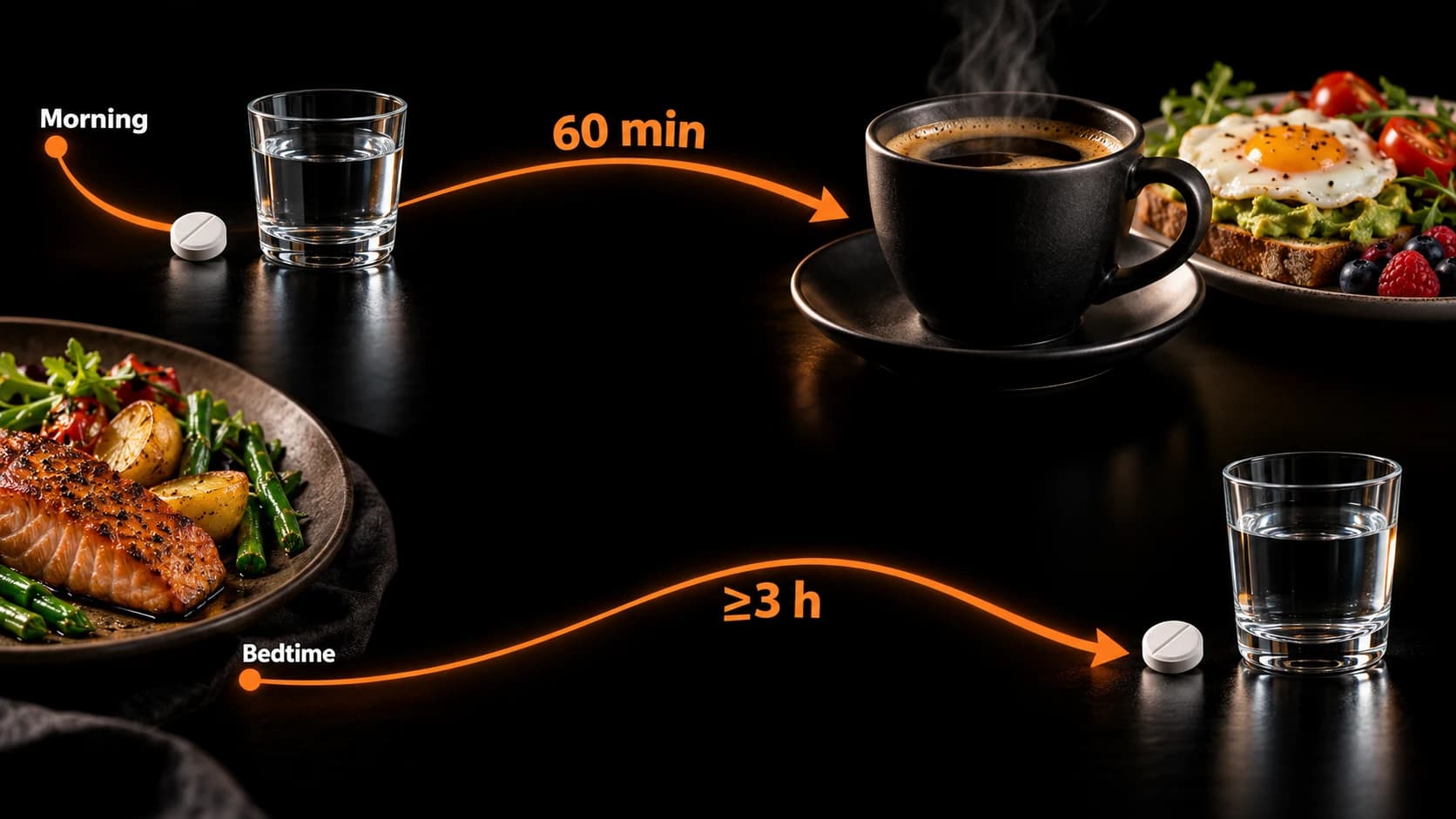
Morning dosing. Take levothyroxine with water on waking at 6:30. Shower, dress, and make coffee after 7:00. Eat breakfast at 7:30. Take iron at 10:30 and calcium or a mineral multivitamin with dinner. This is the default in NHS and AACE guidance.34
Breakfast soon after waking. Early shift workers and people who train before work often cannot wait an hour. One option is to set the alarm 30 minutes earlier, take the pill, and go back to sleep or get ready. The other is to move the dose to bedtime. Taking it with breakfast is also possible, but only as a plan your clinician sets and monitors, because Perez and Bach-Huynh both found higher TSH on that schedule.59
Bedtime dosing. Finish dinner by 7:00. Take levothyroxine with water at 10:00 or later. Eat nothing afterward. Morning coffee and breakfast can start whenever you like. Put iron in the morning and calcium with lunch so both stay at least four hours from the bedtime dose and apart from each other. A late dessert, protein shake, or casein before bed breaks this routine.
| Routine | Levothyroxine | Coffee and breakfast | Iron supplement | Calcium supplement |
|---|---|---|---|---|
| Morning | 6:30 a.m. | 7:00 to 7:30 a.m. | 10:30 a.m. | 7:00 p.m. |
| Early breakfast, earlier alarm | 5:30 a.m. | 6:00 a.m. or later | 9:30 a.m. | 6:30 p.m. |
| Bedtime | 10:30 p.m. | Any time on waking | 7:00 a.m. | 12:30 p.m. |
A missed dose follows the NHS rule. If it is nearly time for the next one, skip the missed dose. Do not double up.4
10Retest after any routine change
AACE describes a TSH check about six to eight weeks after a dose adjustment. NIDDK gives the same interval after starting medication and after each dose adjustment.316 A food or supplement routine can affect absorption, so tell your clinician before switching schedules and ask whether a follow-up TSH check is appropriate.
Talk to your clinician before or soon after any of these changes.
- Moving from morning to bedtime dosing, or the reverse
- Starting or stopping calcium, iron, antacids, or a mineral multivitamin
- Switching brands or moving to a liquid or soft-gel formulation
- A large diet change such as a high-fiber plan or daily soy protein shakes
- Pregnancy or plans for pregnancy, which raise thyroid hormone needs1
- Persistent tiredness or other symptoms despite a stable routine
- Celiac disease, atrophic gastritis, bariatric surgery, or other gut conditions that can reduce absorption2
If you log food and supplements in Fuel, add the time of the thyroid dose to the log. It gives your clinician a record of what changed before the next lab.
Nutrition cannot fix an underdosed thyroid, and food timing is not a reason to adjust your own dose. The routine is the part you control. Write down your current one before the next blood test, and bring it with you.
11References
Footnotes
Jonklaas J, Bianco AC, Bauer AJ, et al. Guidelines for the treatment of hypothyroidism. Prepared by the American Thyroid Association Task Force on Thyroid Hormone Replacement. Thyroid. 2014. PMC
Back to textBack to text 2Back to text 3Centanni M, et al. ETA guidelines for the use of levothyroxine sodium preparations in monotherapy to optimize the treatment of hypothyroidism. Eur Thyroid J. 2025. PMC
Back to textBack to text 2Back to text 3Back to text 4Back to text 5Back to text 6Back to text 7Back to text 8Back to text 9Back to text 10Back to text 11Back to text 12Back to text 13Back to text 14Back to text 15Back to text 16Back to text 17Back to text 18Back to text 19Back to text 20Back to text 21Back to text 22Back to text 23Back to text 24Back to text 25Back to text 26American Association of Clinical Endocrinology. Hypothyroid treatment. AACE
Back to textBack to text 2Back to text 3Back to text 4Back to text 5Back to text 6Back to text 7Back to text 8Back to text 9Back to text 10Back to text 11Back to text 12Back to text 13Back to text 14Back to text 15Back to text 16NHS. Levothyroxine. Page last reviewed 6 July 2026. NHS
Back to textBack to text 2Back to text 3Back to text 4Back to text 5Back to text 6Back to text 7Bach-Huynh TG, Nayak B, Loh J, Soldin S, Jonklaas J. Timing of levothyroxine administration affects serum thyrotropin concentration. J Clin Endocrinol Metab. 2009. PubMed
Back to textBack to text 2Back to text 3Back to text 4Back to text 5Bolk N, Visser TJ, Nijman J, Jongste IJ, Tijssen JG, Berghout A. Effects of evening vs morning levothyroxine intake. A randomized double-blind crossover trial. Arch Intern Med. 2010. PubMed
Back to textBack to text 2Back to text 3Benvenga S, Bartolone L, Pappalardo MA, et al. Altered intestinal absorption of L-thyroxine caused by coffee. Thyroid. 2008. PubMed
Back to textBack to text 2Back to text 3Back to text 4Back to text 5Vita R, Fallahi P, Antonelli A, Benvenga S. The administration of L-thyroxine as soft gel capsule or liquid solution. Expert Opin Drug Deliv. 2014. PubMed
Back to textPerez CL, Araki FS, Graf H, de Carvalho GA. Serum thyrotropin levels following levothyroxine administration at breakfast. Thyroid. 2013. PubMed
Back to textBack to text 2Back to text 3Back to text 4Singh N, Singh PN, Hershman JM. Effect of calcium carbonate on the absorption of levothyroxine. JAMA. 2000. PubMed
Back to textBack to text 2Back to text 3Singh N, Weisler SL, Hershman JM. The acute effect of calcium carbonate on the intestinal absorption of levothyroxine. Thyroid. 2001. PubMed
Back to textBack to text 2Campbell NR, Hasinoff BB, Stalts H, Rao B, Wong NC. Ferrous sulfate reduces thyroxine efficacy in patients with hypothyroidism. Ann Intern Med. 1992. PubMed
Back to textBack to text 2Back to text 3Bell DS, Ovalle F. Use of soy protein supplement and resultant need for increased dose of levothyroxine. Endocr Pract. 2001. PubMed
Back to textBack to text 2Persiani S, Sala F, Manzotti C, et al. Evaluation of levothyroxine bioavailability after oral administration of a fixed combination of soy isoflavones in post-menopausal female volunteers. Drug Res (Stuttg). 2016. PubMed
Back to textBack to text 2Gatta E, Maltese V, Cavadini M, et al. Interference or noninterference between soy and levothyroxine. A narrative review of literature. Endocr Pract. 2023. PubMed
Back to textBack to text 2National Institute of Diabetes and Digestive and Kidney Diseases. Hypothyroidism (underactive thyroid). NIDDK
Back to textBack to text 2Back to text 3Back to text 4Chon DA, Reisman T, Weinreb JE, Hershman JM, Leung AM. Concurrent milk ingestion decreases absorption of levothyroxine. Thyroid. 2018. PMC
Back to textBack to text 2Back to text 3