Flower Child's own nutrition numbers work against its health-halo reputation in a specific, checkable way. Three of its four highest-protein bowls carry at least 1,850 mg of sodium, while two bowls often recommended online as the "healthy default" carry only 12 g of protein each unless you pay extra for a protein add-on.1 The useful exception is Green Chile Beef Colorado, with 47 g of protein and 640 mg of sodium. Flower Child's strongest protein-per-calorie order is an Entrée build rather than a named bowl.
This page ranks Flower Child orders by protein density using the chain's current Winter 2026 Nutritional Information guide, revised January 14, 2026.1 Fuel is not partnered with Flower Child, none of the rankings below were reviewed or compensated, and the macro values come from Flower Child's own published document. A stronger caveat applies here than on most restaurant guides Fuel has published: several dishes visible on live location menus, including a tuna poke and at least one newer wrap, have no matching row in the current nutrition PDF, and this page will not assign those dishes an invented number.12
01How the menu is actually built
Flower Child isn't a build-your-own assembly line the way CAVA or Sweetgreen are. Its bowls, salads, and wraps are fixed named dishes, each with its own baked-in recipe and its own published macro total, and the only place a customer chooses ingredients from scratch is the add-on protein line and the Entrée section.1 That structural difference matters for a macro tracker, because it changes where the real customization lever sits.
An Entrée at Flower Child is one protein choice plus two side choices, priced and ordered as a single ticket item at the counter.1 The nutrition guide does not publish a combined Entrée total anywhere on its pages. What it publishes instead is a per-portion row for every protein (chicken, salmon, steak, shrimp, tofu) and a per-portion row for every side (broccoli, brown rice, sweet potato, mac and cheese, and the rest).1 That means an Entrée's macros have to be assembled by the customer, one official row at a time, and it also means the Entrée is the only corner of the menu where a reader can actually engineer a specific protein target rather than pick the closest bowl and accept whatever ratio the kitchen decided on.
The named bowls, salads, and wraps work the opposite way. Each one is a fixed recipe with a protein baked in (or deliberately left out), and the published number covers the whole dish as served.1 A salad publishes two rows, one with dressing and one without, so the dressing's isolated cost is recoverable by subtraction. A wrap publishes one row that already includes its side salad, so the sandwich alone is smaller than the printed total suggests. A bowl is either protein-inclusive as a fixed recipe or protein-exclusive as a vegetable-and-grain base that assumes you'll add a protein on top.1 Reading a Flower Child order well means knowing which of those four shapes you're looking at before you decide it's a good fit for the day.
02High protein usually brings high sodium
The pattern shows up as soon as you sort the composite bowls by protein. Chicken Yakisoba Noodles tops the category at 52 g protein for 770 kcal and carries 1,850 mg of sodium.1 Chicken Enchilada follows at 47 g protein for 810 kcal, and its 2,310 mg of sodium slightly exceeds the FDA daily value of 2,300 mg.13 Mediterranean Chicken Kabob carries 40 g protein for 660 kcal and 2,020 mg of sodium. Three of the four highest-protein bowls spend at least 80% of the daily value in one order.
The exception worth naming is Green Chile Beef Colorado, new to the Winter 2026 revision. It carries 47 g protein for 750 kcal at only 640 mg of sodium, the best sodium showing of any bowl above 40 g protein and roughly a quarter of the Chicken Enchilada's sodium load for the same protein number.1 If a reader wants the protein ceiling of the composite-bowl category without the sodium event, Green Chile Beef Colorado is the one bowl that delivers both, and it's easy to miss because it's not the bowl fans and food bloggers reach for by reputation.
The Rebel French Dip wrap belongs in this conversation too, and it comes with its own asterisk. It carries 42 g protein for 730 kcal and 2,200 mg sodium, but the dish itself changed between nutrition guide revisions. The Spring 2025 document listed a similarly named wrap, "the rebel," at 810 kcal and 41 g protein. The current Winter 2026 document lists "The Rebel French Dip" at 730 kcal and 42 g protein.1 Whether that's a recipe change, a rename, or both isn't resolvable from the public documents, but the practical lesson holds regardless: a saved Fuel entry for a similarly named item from a year ago may no longer match what the kitchen sends out.
03Protein maximum
The single highest pull among fixed named dishes is Chicken Yakisoba Noodles at 52 g protein for 770 kcal, with 1,850 mg of sodium as the tradeoff.1 Among composite bowls, Chicken Enchilada and Green Chile Beef Colorado tie at 47 g protein, and Green Chile Beef Colorado is the one worth ordering by default given the sodium gap noted above.
The true ceiling, though, isn't a named dish. It's a doubled-protein Entrée, and it comes with a caveat this page isn't going to soften. Grass-Fed Steak (180 kcal, 27 g protein) ordered twice, plus Roasted Broccoli as the accompanying side, totals 610 kcal and 65 g protein from three officially published rows, assuming a second protein add-on is honored at the same per-portion macro as the first.1 Nothing in Flower Child's published materials confirms a formal "double protein" line item, price, or portion. What's confirmed is that protein add-ons exist as a named, priced option on salads, bowls, and Entrées at a market-level menu, and that the per-protein macro value is published and doesn't change based on how many portions you order.1 The arithmetic is real. Whether a specific register, a specific location, and a specific day will actually ring up a second protein add-on on the same ticket is not something this page can confirm, and it can vary by store. Ask before planning a training block around it, and treat the 65 g figure as a derived sum of two identical rows rather than a menu item with its own name.
The sodium for that doubled build also has to be summed rather than looked up, since no combined Entrée row exists. Two Grass-Fed Steak portions at 290 mg each plus Roasted Broccoli's 860 mg puts the plate at roughly 1,440 mg sodium, a derivation and not an official combined value.1 For a single-protein version of the same logic, Grass-Fed Steak plus Roasted Broccoli plus Organic Brown Rice reaches 590 kcal and 41 g protein at a summed 1,300 mg sodium, which beats every named bowl's protein-per-calorie ratio without the double-protein uncertainty attached.1
04Fat loss and protein per calorie
Green Chile Beef Colorado is the strongest fat-loss pick among composite bowls, carrying 6.3 g protein per 100 kcal at 750 kcal total and the comparatively moderate 640 mg sodium already discussed above.1 No other bowl above 40 g protein comes close to that sodium number.
The Entrée route offers a second option built entirely from published component rows: Grass-Fed Steak, Roasted Broccoli, and Organic Brown Rice for 590 kcal and 41 g protein, a 6.9 g-per-100-kcal ratio.1 Trimming the rice out of that build and keeping just steak and broccoli brings it down to 430 kcal and 38 g protein, which is the closest this menu gets to a sub-500-calorie, mid-30s-protein plate using only official numbers. There's no single named dish on the current guide that clears 35 g protein under 500 kcal on its own, so state that range honestly rather than forcing one number lower than the data supports.
05Balanced and training day
Mediterranean Chicken Kabob is the most evenly distributed bowl on the menu for a training day, running 660 kcal with 40 g protein, 47 g carbohydrate, and 35 g fat, which gives a reader real carbohydrate alongside protein instead of the protein-forward, carb-light shape of a bowl like Green Chile Beef Colorado.1 The tradeoff is 2,020 mg of sodium, high enough that it's worth pairing this bowl with a lower-sodium breakfast and dinner on the same day rather than treating it as a neutral middle-of-the-road choice. For guidance on sizing one restaurant meal against the rest of a training day, restaurant, takeout, and travel macro tracking covers the day-shape math this page doesn't repeat.
06Lower sodium
Green Chile Beef Colorado is the standout again here, the only bowl above 40 g protein under 1,000 mg sodium anywhere in the current guide.1 For a lighter meal built from the salad-plus-protein-add-on pattern, Chopped Vegetable without dressing (120 kcal, 4 g protein, 60 mg sodium) plus a Grass-Fed Steak add-on (180 kcal, 27 g protein, 290 mg sodium) sums to 300 kcal, 31 g protein, and 350 mg sodium, built entirely from two official rows.1 That combined number is not a lab-verified low-sodium meal in any medical sense. It's a comparison against the rest of Flower Child's own menu, where nearly every wrap and several soups clear 1,700 mg sodium on their own.1 On a day where sodium is the binding constraint, the reliable default is a salad without dressing plus a protein add-on, not a wrap, no matter how light the wrap sounds on the board.
07The Mother Earth and Forbidden Rice protein problem
Mother Earth and Forbidden Rice are the two bowls most often pointed to online as the "clean" Flower Child order, and the reputation doesn't survive contact with the published numbers. Mother Earth is 560 kcal with 12 g protein and 1,520 mg sodium. Forbidden Rice is 670 kcal with 12 g protein and 960 mg sodium.1 Both are vegetable-and-grain builds with no meat, fish, or tofu in the base recipe, which means either one functions as a 12 g-protein order unless a protein add-on goes on top, and that add-on costs an additional few dollars at the counter on top of the bowl price.1 Glow Bowl belongs in the same category at 520 kcal and 10 g protein, the weakest protein-per-calorie composite bowl currently on the menu.1
None of this makes the three bowls bad orders. Forbidden Rice, in particular, is the lowest-sodium named bowl on the entire guide.1 It makes them mislabeled if a reader assumes the word "healthy" implies a meaningful protein number, which is exactly the assumption the branding invites and the nutrition sheet doesn't support.
08Plant-forward protein
Organic Non-GMO Tofu is the lowest-sodium protein on the published list at 150 kcal, 15 g protein, and 170 mg sodium.1 Paired with Chopped Vegetable without dressing (120 kcal, 4 g protein, 60 mg sodium), the combination reaches 270 kcal and 19 g protein at 230 mg sodium, entirely from official rows.1
The Black Bean Falafel Wrap is the highest-protein packaged vegetarian item on the menu at 21 g protein, but it carries 2,020 mg sodium and 92 g carbohydrate in a single wrap, which makes it a carbohydrate-forward order rather than a lean plant-protein one.1 The honest ceiling for a plant-based Flower Child order without stacking multiple tofu add-ons sits in the high teens to low twenties on protein. There's no first-party confirmation of a multi-tofu-add-on order the way there's confirmation of a single protein add-on, so treat anything above that range as unverified rather than assumed.
09GLP-1 and low appetite
A single protein portion paired with one side, and nothing else, is the shape that works when finishing a full bowl isn't realistic. Grass-Fed Steak or Sustainable Salmon alone (180 to 190 kcal, 24 to 27 g protein) plus Roasted Broccoli (250 kcal, 11 g protein) lands at 430 to 440 kcal and 35 to 38 g protein, entirely from official rows and without a wrap's bread volume or a soup's low protein return per bite.1 For a reader managing appetite from a GLP-1 receptor agonist, that's a plate sized to be finishable rather than a bowl sized to be a normal restaurant portion.
This is ordering guidance, not a promise that any specific plate will get finished on any specific day, and it isn't medical advice. Flower Child publishes calories and macros for each component but not gram weights or plate volume, so the recommendation is directionally sound without being volume-verified.1 If even that plate is too much, log what actually gets eaten rather than what got ordered. A half-eaten Grass-Fed Steak Entrée logged as a half portion is more useful in Fuel than the full order logged as finished. Sustainable Salmon carries a raw or undercooked-risk disclosure on both nutrition guide revisions reviewed, which is worth knowing before ordering it as the default low-appetite protein rather than assuming it's served fully cooked.1
Sweet Potato Fries and any wrap are the two things to avoid pairing with a low-appetite plate. Both are calorie- and carbohydrate-dense with a poor protein return relative to their size, which means they compete with the protein for stomach space instead of supporting it.
10Reading a salad's dressing cost by subtraction
Flower Child doesn't publish a standalone dressing macro table the way it publishes protein and side rows. The only way to isolate a dressing's cost is to subtract a salad's "without dressing" row from its "with dressing" row, since every salad on the guide publishes both.1
Turkey and Avocado Cobb runs 740 kcal with dressing and 420 kcal without, which means the dressing itself costs 320 kcal, 33 g fat, and 520 mg sodium, the single largest hidden dressing cost on the menu found by this method.1 Ginger Miso Crunch runs the opposite way. Its dressing costs only 130 kcal and 9 g fat by the same subtraction, but it adds 1,140 mg sodium, which flips the usual "dressing is a fat problem" framing into a sodium problem specifically for this one salad.1 The lemon-avocado dressing is marketed on the menu as the low-calorie, sugar-free, dairy-free option, but it has no independently published macro row in either nutrition guide revision reviewed. Any specific number attached to it here would be invented, so the honest statement is that the marketing claim exists and the macro value doesn't.1
The practical swap that falls out of this math: order a salad without dressing plus a protein add-on rather than eating it as served with a heavy dressing. On Turkey and Avocado Cobb, that trade swaps 320 kcal of dressing fat for 27 to 29 g of additional protein from a Grass-Fed Steak or All-Natural Chicken add-on, at a similar or lower total calorie cost.1
11Sides worth ordering and sides that undo the meal
Sweet Potato Fries is the clearest trap on the side list. It reads as a vegetable side but delivers 460 kcal and 29 g fat for only 5 g protein and 1,500 mg sodium.1 Cauliflower Risotto is a different kind of trap, disguised as light because of its calorie count. It's only 110 kcal, but it carries 1,320 mg sodium, nearly as much sodium as Roasted Brussels Sprouts at a third of the calories.1 Organic Brown Rice is the cleanest carbohydrate side on the list by both measures, at 160 kcal and 150 mg sodium.1
The swap that solves both traps at once, depending on the actual constraint: replace Sweet Potato Fries with Organic Brown Rice to cut roughly 300 kcal and 26 g of fat, or replace it with Cauliflower Risotto specifically to cut calories while accepting a comparable sodium load. Match the swap to whichever number is actually tight that day, since the two sides solve different problems.
The Kinda Spicy Green Chili Queso deserves its own mention outside the sides list because it's ordered as a shared starter, not a side, and it's easy to underestimate for that reason. It carries 760 kcal, 49 g fat, and 2,110 mg sodium for 24 g protein before the rest of the meal starts.1 There's no lower-sodium queso alternative published on the current guide, so the honest swap on a sodium-limited day is to skip the starter category entirely rather than look for a lighter version that doesn't exist.
12What the menu can't tell you yet
Flower Child's nutrition guide revises seasonally, and the current Winter 2026 version doesn't cover everything a customer can actually order at a store. The Winter 2026 document added a fall-spiced soup and a pumpkin muffin dessert relative to the prior Spring 2025 revision, and dropped a turkey chili soup and an Italian turkey salami salad that appeared in that earlier document.1 Seasonal items move in and out of the published guide without a public rotation calendar, so a dish that had a macro number six months ago may not have one now, and vice versa.
Separately, a live location menu (checked in Salt Lake City) carries dishes with no matching row in either nutrition guide reviewed, including a tuna poke, a newer wrap, and at least one bowl described differently on the live menu than any bowl in the PDF.12 Whether that's a market-specific menu, a lag between the live menu and the published nutrition document, or both, isn't resolvable from public sources. What matters for a Fuel user is simpler: if a dish isn't in the current guide, don't assign it a number borrowed from something similar-sounding. Log it as an unverified custom entry instead, note that no official macro source exists for it, and move on. A wrong-but-confident number is worse than an honest gap, because the wrong number gets compounded across every future meal that reuses the saved entry.
13Where Flower Child actually has a location
Flower Child reads like a chain that's everywhere the health-conscious fast-casual crowd already shops, and the footprint mostly backs that up, with two specific gaps worth naming before a reader assumes coverage that isn't there. There is currently no open Flower Child location inside Los Angeles city proper. The former Santa Monica location has stopped appearing as an operating store on third-party listings, with no official closure statement located, so the accurate description is that it no longer appears to be operating rather than a confirmed permanent closure.4 Newport Beach in Orange County and Del Mar in San Diego County are both open, but neither sits inside Los Angeles city limits or its immediate metro core.4
The same pattern holds in Washington, DC. There is no open Flower Child location inside DC city limits; the former Foggy Bottom location closed by mid-2024 according to local reporting, with no reopening documented since.5 The surrounding DMV metro is a different story. Tysons/McLean, Virginia and Bethesda, Maryland both have open locations, but both sit outside DC proper in Northern Virginia and Montgomery County, Maryland respectively, not inside the city itself.4
Everywhere else this brief checked, the footprint is closer to what the brand's reputation implies. Dallas-Fort Worth has open locations across Dallas, Addison, Southlake, and Fort Worth itself. Houston has an open location inside Houston's Uptown neighborhood, which sits inside city limits, plus a second location in The Woodlands, a separate incorporated community north of the city and outside it. Atlanta has an open location in Buckhead, a neighborhood inside Atlanta city limits.4 A Frisco, Texas location has been announced but isn't open. Press coverage in 2025 pointed to an early-2026 opening, while a separate permit-based report placed construction start closer to 2027, so treat Frisco as announced with an uncertain timeline rather than resolved to either date.6
14How to log a Flower Child order in Fuel
Named bowls, salads, and wraps that match a row in the current Winter 2026 guide can be saved as a single Fuel custom entry and reused, the same pattern already established for CAVA, Sweetgreen, and Panera on this site. An Entrée cannot be logged that way, because the guide never publishes a combined Entrée total. Log it as two or three separate component entries instead: the protein row, plus each side row, added together the same way the goal-specific builds above were assembled.1
Log a salad's dressing using the with/without-dressing subtraction method whenever the actual pour differs from the default, which is often. Treat the "without dressing" row as the base number and add back only the dressing amount that was actually used, rather than logging the full "with dressing" total for a salad ordered with dressing on the side. Any dish observed on a live menu without a matching PDF row, including the items named in the section above, should be logged as a custom, unverified meal through Eat Out or a manual entry, flagged explicitly as having no official macro source rather than logged with an invented number.12
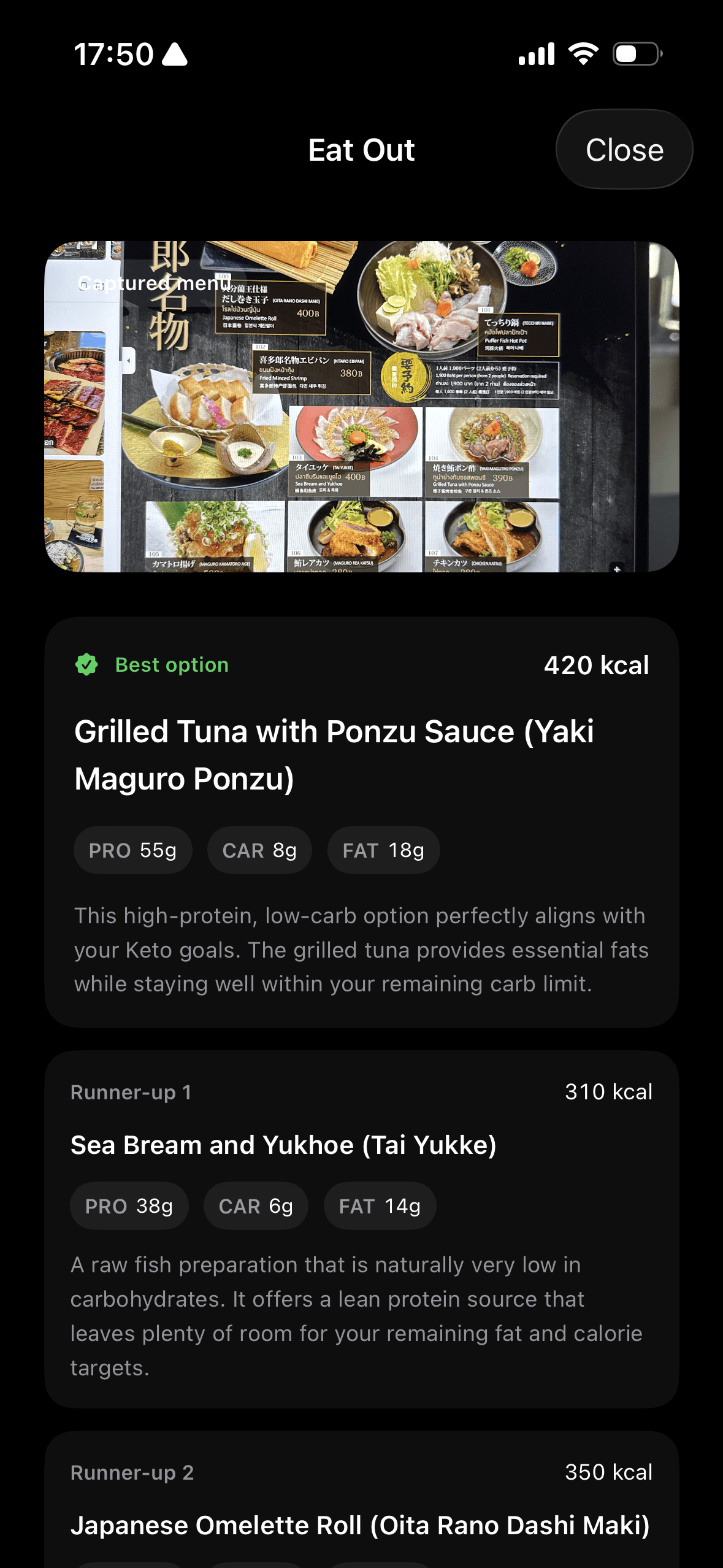
Eat Out — Scan any menu and Fuel ranks the options for you.
See how Eat Out works →Several Flower Child bowls and wraps clear 1,800 to 2,300 mg of sodium in a single serving, so the sodium line belongs in the decision rather than being treated as a footnote.13 Because the nutrition guide revises seasonally, and because at least one wrap's macro value moved between the Spring 2025 and Winter 2026 revisions under a similar name, re-verify any saved Flower Child entry against the current guide every few months, matching the re-verification cadence already recommended for macro tracking mistakes and food database accuracy more broadly.
Portion variance at the protein-scoop and dressing-pour level is real and unquantified in Flower Child's own materials. Build in the same kind of upward adjustment allowance recommended for macro meal planning whenever a hand-poured protein or dressing looks larger than a single published portion. For the broader question of sizing one restaurant meal against a full day's targets, restaurant, takeout, and travel macro tracking and how to count macros cover the mechanics this page doesn't repeat. Flower Child sits in the same upscale fast-casual category as True Food Kitchen, and the same protein-first ordering logic applies across both.
15The decision rule
If protein is the only variable that matters today, build the Entrée: Grass-Fed Steak, Roasted Broccoli, Organic Brown Rice, and treat a doubled protein add-on as a possibility to confirm in person rather than a guarantee to plan around. If sodium is the binding constraint, Green Chile Beef Colorado is the one bowl on the entire menu that delivers 47 g protein without the sodium spend that comes with the Chicken Enchilada or the Mediterranean Chicken Kabob. If the day already has low appetite built into it, a single protein portion plus one side, logged honestly by the portion actually eaten, beats any full bowl ordered on the assumption it'll get finished.
Flower Child's branding is a poor shortcut for choosing by macros. The bowls fans call "the clean order" are among the lowest-protein items on the list, while three of the four highest-protein bowls carry at least 1,850 mg of sodium. Green Chile Beef Colorado proves the tradeoff is avoidable. Read the published nutrition guide before the counter, then choose the order that matches the constraint you actually have.
Footnotes
Flower Child. Nutritional Information (PDF), revised January 14, 2026. Direct PDF. All Winter 2026 calorie, protein, fat, and sodium values used above come from this document unless otherwise noted. Flower Child states its menu changes seasonally and that item availability varies by location.
Back to textBack to text 2Back to text 3Back to text 4Back to text 5Back to text 6Back to text 7Back to text 8Back to text 9Back to text 10Back to text 11Back to text 12Back to text 13Back to text 14Back to text 15Back to text 16Back to text 17Back to text 18Back to text 19Back to text 20Back to text 21Back to text 22Back to text 23Back to text 24Back to text 25Back to text 26Back to text 27Back to text 28Back to text 29Back to text 30Back to text 31Back to text 32Back to text 33Back to text 34Back to text 35Back to text 36Back to text 37Back to text 38Back to text 39Back to text 40Back to text 41Back to text 42Back to text 43Back to text 44Back to text 45Back to text 46Back to text 47Back to text 48Back to text 49Back to text 50Back to text 51Back to text 52Back to text 53Flower Child. Salt Lake City location menu. iamaflowerchild.com. Supports the live-menu items with no matching row in the current nutrition PDF, including a tuna poke and a newer wrap not otherwise named here since they carry no official macro value.
Back to textBack to text 2Back to text 3Back to text 4U.S. Food and Drug Administration. Daily Value on the Nutrition and Supplement Facts Labels. Sodium Daily Value of
Back to textBack to text 2Back to text 32,300 mg/day. FDAFlower Child. Individual location pages for Newport Beach, Del Mar, Tysons/McLean VA, Bethesda MD, Fort Worth TX, Dallas TX, Southlake TX, Houston TX, and Atlanta GA. iamaflowerchild.com/locations. Supports open-location confirmation and city-proper-versus-metro distinctions above.
Back to textBack to text 2Back to text 3Back to text 4PoPville. "Flower Child Closed in Foggy Bottom." popville.com. Supports the Foggy Bottom, DC closure timeline.
Back to textCommunity Impact. "Flower Child set to offer salads, wraps in Frisco." communityimpact.com. Supports the Frisco, Texas announced-but-unopened status and the timeline conflict noted above.
Back to text