DIG's Nutrition Guide hides a greater than tenfold spread in protein density behind a menu that looks uniformly "healthy." Herb Roasted Chicken delivers 14.1 g of protein per 100 calories, the best ratio on the current board, while the seasonal Feta Grain Bowl delivers 1.33 g per 100 calories on the same menu, worse than several plates that read as heavier.1 The gap does not show up on the counter menu board. It shows up only when you read the PDF DIG itself publishes, which is also the only place a "double protein" order can be calculated honestly, since DIG never publishes a combined number for one.
Fuel is not partnered with or compensated by DIG or Dig Inn. Every macro value below comes from DIG's own Nutrition Guide PDF, last updated March 3, 2026, unless marked otherwise.1 DIG rotates its menu seasonally and states plainly that it cannot guarantee full separation of allergens in a scratch kitchen, so treat every number here as a planning anchor rather than a receipt.1
01How DIG builds a menu from scratch every day
DIG runs two ordering paths. Chef's Specials, Seasonal Specials, All Day Deals, and Salads are fixed composed plates ordered as listed. The Market Line is a build-your-own bowl assembled from Sides, Mains, Extras, and Sauce. Every Market Line Sides and Mains value in DIG's Nutrition Guide PDF is a single BYO-bowl serving unless stated otherwise, and DIG's own disclaimer draws three exceptions worth reading before you order: a la carte vegetable sides are 1.5 servings, Large Sides are four servings each, and catering trays are ten servings each. A la carte protein portions "vary by item" with no fixed multiplier published.1 That last line matters more than it looks. It means the protein serving inside a composed bowl is not guaranteed to match the a la carte single-item row used elsewhere in this piece, a real limit on how precisely any custom build can be reconstructed from the PDF alone.
DIG also rotates its roster seasonally rather than holding a fixed lineup. The March 3, 2026 PDF lists seven Market Line proteins, one grain base fewer than the December 23, 2025 snapshot, and swaps a full slate of Seasonal Specials from a winter Tarragon Mustard theme to a spring Lemon Piccata theme.15 Some Chef's Specials persist across both snapshots, but several Market Line Sides and every Seasonal Special changed. Any saved Fuel entry needs a re-check when the menu rotates rather than a permanent save.
For how to size the rest of the day around one DIG meal, restaurant, takeout, travel, and weekend macro tracking covers the framing this piece assumes.
02The protein-per-calorie ranking
The table below ranks DIG's published items by protein per 100 calories. Every row is an official single-component or composed-item value from the March 3, 2026 PDF unless flagged Derived, which means it sums two or more official rows into a total DIG itself does not publish.
| Item | Calories | Protein | Sodium | Protein/100 kcal | Status |
|---|---|---|---|---|---|
| Herb Roasted Chicken (single protein) | 170 | 24 g | 420 mg | 14.1 | Official, single component |
| Charred Chicken (single protein) | 230 | 28 g | 740 mg | 12.2 | Official, single component |
| Hot Honey Chicken (single protein) | 280 | 28 g | 910 mg | 10.0 | Official, single component |
| Charred Chicken & Rice | 670 | 60 g | 1,910 mg | 8.96 | Official, highest-protein composed item |
| Seared Wild Salmon (single protein) | 270 | 23 g | 770 mg | 8.5 | Official, single component |
| Crispy Chicken (single protein) | 320 | 24 g | 840 mg | 7.5 | Official, single component |
| Fan Faves Plate | 390 | 29 g | 1,130 mg | 7.4 | Official, strongest under-400-calorie plate |
| Crispy Tofu (single protein) | 280 | 19 g | 770 mg | 6.8 | Official, plant-forward anchor |
| Kale Caesar Salad with Crispy Chicken | 860 | 36 g | 1,980 mg | 4.19 | Official, composed |
| Feta Grain Bowl | 600 | 8 g | 1,095 mg | 1.33 | Official, worst ratio on current menu |
Charred Chicken & Rice leads every composed plate on the board by a wide margin and carries 1,910 mg of sodium, which is the subject of the next section.1
03Protein maximum
Charred Chicken & Rice is the single highest-protein composed item on either PDF snapshot checked: 670 cal, 60 g protein, 1,910 mg sodium, 8.96 g protein per 100 kcal.1 It beats every Chef's Special and Seasonal Plate on a straight protein basis. The watch-out is sodium. 1,910 mg is 83% of the FDA's 2,300 mg Daily Value in one order, so pair it with a genuinely low-sodium rest of day.2
If you are building your own bowl instead of ordering the composed plate, doubling Herb Roasted Chicken gets you a better ratio at lower sodium. Two official 3.3 oz portions sum to 340 cal, 48 g protein, and 840 mg sodium, or 14.1 g protein per 100 kcal against 8.96 for Charred Chicken & Rice.1 That total is Fuel's arithmetic, doubling one official row, not a DIG-published double-protein SKU, and the next section explains exactly why that distinction holds up.
04The double protein problem DIG doesn't publish a number for
No official DIG page or PDF publishes a nutrition value for a "double" or "extra" protein add-on, and no official DIG source publishes a standing price for one.1 The only confirmed evidence that double protein is orderable at all is a dated DIG/Dig Inn Facebook promotional post offering a free double-protein portion through the DIG app with a promo code, on chicken, meatballs, and tofu builds.3 That confirms the mechanism exists in the app during a promotion. It does not confirm a standing, non-promotional price or a standing nutrition entry, and no evidence found in this research pass documents whether the same double portion can be ordered at the counter in-store.
Third-party databases do not close the gap, they widen it. A MyFoodDiary listing for "Dig Inn More Protein – Charred Chicken" lists 232 cal, 25 g protein, and 302 mg sodium for a 4 oz portion, against DIG's own single-portion Charred Chicken value of 230 cal, 28 g protein, and 740 mg sodium for a comparable 4.3 oz portion.3 The sodium fields alone differ by more than 2x for what should be a similarly sized serving, which is either a miscoded field or a genuinely different, unverifiable preparation. Either way, it is not a number to log.
The only defensible double-protein total is DIG's own official single-portion value, doubled, and labeled as a derivation. Herb Roasted Chicken × 2 is 340 cal, 48 g protein, 840 mg sodium from 170 cal / 24 g / 420 mg × 2.1 Present it that way every time, never as a scraped or assumed DIG total.
05Fat loss and protein density
Herb Roasted Chicken alone is the anchor for a fat-loss day: 170 cal, 24 g protein, 14.1 g per 100 kcal, the best ratio of anything on the current menu.1 Build around it with Farm Greens with Mint (10 cal) and Tomatoes & Cucumbers (25 cal) to add real plate volume for almost no calorie cost. The Derived total, summing those three official rows, lands near 205 cal and 25 g protein before sauce.1 That falls within the International Society of Sports Nutrition's per-meal protein dosing range of roughly 0.25 to 0.40 g/kg, which lands between 20 and 40 g for most adults, well under 250 cal.6
The trap is the sauce, not the protein. Garlic Aioli, Hot Honey, Pesto, Sriracha, and Balsamic Vinaigrette each add 50 to 130 cal for no meaningful protein.1 Ask for sauce on the side or use it sparingly, since none of them buy anything material toward the day's protein target.
06Balanced meal
Fan Faves Plate is the strongest all-rounder under 400 calories on the current menu: 390 cal, 29 g protein, 19 g carbs, 28 g fat, 5 g fiber, 7.4 g protein per 100 kcal.1 It clears the ISSN's 20 to 40 g per-meal protein-dosing range in one order with no custom build required.6 The sodium is real at 1,130 mg, nearly half the daily FDA value, so this is a lunch that needs a lighter dinner behind it rather than another restaurant meal.2
07Lower sodium
Build Herb Roasted Chicken, Roasted Sweet Potatoes, and Farm Greens with Mint. The Derived total, summing three official single-item rows, is 170 + 260 + 10 = 440 cal, 24 + 3 + <1 = 27–28 g protein, and 420 + 220 + 10 = 650 mg sodium.1 That is roughly 24 mg of sodium per gram of protein, against about 32 mg per gram in the Charred Chicken & Rice pick above. This is not an official DIG combined value, and any topping or sauce added at the counter changes the total.
Several DIG items exceed 1,900 mg sodium in a single order: Charred Chicken & Rice, Spicy Salmon Bowl, Hot Honey Chicken Bowl, Kale Caesar Salad with Crispy Chicken, and Lemon Piccata Chicken Plate all clear that mark on the current menu.1 Plan the rest of the day's sodium around that meal using the same approach covered in restaurant, takeout, travel, and weekend macro tracking.
08Plant-forward
Crispy Tofu is the current menu's clearest vegan protein anchor: 280 cal, 19 g protein, 770 mg sodium, 6.8 g per 100 kcal.1 Add Marinated Cannellini Beans (160 cal, 5 g protein, 520 mg sodium) for a fiber and protein bump. The Derived total is 440 cal, 24 g protein, and 1,290 mg sodium, summing two official rows rather than a DIG-published combined figure.1
Braised Chickpeas & Lentils appeared as a lower-sodium plant protein (160 cal, 5 g protein, 660 mg sodium) in the December 23, 2025 PDF but does not appear in the March 3, 2026 revision.5 Its current availability is unverified. Do not order in expecting it without checking the live menu first. For the broader question of hitting protein targets without meat, vegetarian protein during a cut covers the pattern this pick fits into.
09GLP-1 and low-appetite ordering
Herb Roasted Chicken plus a small moisture-adding sauce is a low-volume, protein-dense pairing built for a day when finishing the meal is the actual constraint. Herb Roasted Chicken plus Garlic Aioli totals 250 cal, about 24 g protein, and 520 mg sodium in a 3.3 oz protein portion plus a 0.8 oz sauce, very little total food volume to work through.1
No official DIG statement or guide addresses GLP-1 users specifically. This pick is Fuel's inference from portion size and protein density data, not a DIG-branded recommendation, and it should be read that way rather than as medical guidance. For the muscle-preservation side of eating on a GLP-1 receptor agonist, including how protein distribution across the day interacts with reduced appetite, pair this section with how to preserve muscle on GLP-1 medications and Fuel's GLP-1 support feature for logging on lower-appetite days.
10Traps and swaps across the Market Line
The Kale Caesar Salad without added protein is the clearest trap on the menu: 550 cal, 47 g fat, and only 12 g protein, or 2.18 g per 100 kcal, worse than several composed plates that read as heavier.1 Adding Crispy Chicken moves the dish to 860 cal and 36 g protein, a 310 cal cost that buys 24 g of protein, a reasonable trade at 12.9 kcal per added gram.1 The Feta Grain Bowl is the single worst ratio currently published on the whole menu at 600 cal for 8 g protein. Swapping to the Cheesy Cauliflower Chicken Plate instead gets 660 cal for 38 g protein, a near-identical calorie cost for almost five times the protein.1
Sriracha is the sodium trap among sauces at 440 mg for 20 cal, the worst sodium-per-calorie ratio of any sauce on the guide.1 Swapping to Garlic Aioli trades 440 mg sodium for 100 mg at a 60 cal cost, a strong trade on a sodium-restricted day. The single largest lever on any custom bowl is the base swap: replacing Roasted Sweet Potatoes (260 cal, 220 mg sodium) with Farm Greens with Mint (10 cal, 10 mg sodium) saves 250 cal and 210 mg sodium before any protein or sauce decision.1
11March menu versus December menu
Cross-checking the March 3, 2026 PDF against a December 23, 2025 snapshot of the same document confirms real seasonal drift, not a typo Fuel is correcting on DIG's behalf. The clearest example is the Vegan Favorites Plate, an All Day Deal that persists under the same name across both snapshots with different macros: 510 cal and 1,820 mg sodium in December versus 560 cal and 1,190 mg sodium in March, calories moving up while sodium moved down for the same item name.15 Treat that as confirmed document drift between two dated revisions of the same official source, not an error in either one.
The practical implication is that any saved Fuel entry needs a re-check against the current PDF when the menu rotates. Several Market Line Sides changed, and Seasonal Specials rotated fully from a winter Tarragon Mustard theme to a spring Lemon Piccata theme between the two dates.15
12The rebrand and why the name on your receipt matters
The chain traded as "Dig" from 2019 until June 25, 2025, when it reverted to its original name, Dig Inn, a change confirmed by an official PR Newswire release and corroborated independently by Marketing Brew's coverage the following month.47 DIG's own current site displays both names, "DIG" in the header navigation and "Dig Inn" in the logo and legal footer, on the same page.1 The practical consequence is that reviews, delivery-app listings, and menu databases published before June 2025 may reference a "Dig"-branded menu era that no longer matches what a live location serves. Prefer content dated after the rebrand, and treat older "Dig"-branded reviews as historical rather than current.
13How to log a DIG order in Fuel
For any Chef's Special, Seasonal Special, All Day Deal, or Salad ordered as listed and unmodified, save DIG's official PDF value as a custom Fuel entry and reuse it. For a Market Line build-your-own bowl, log each component, base, protein, sides taken, and sauce, as its own line using the official per-component values above, since DIG does not publish a combined as-built total for any custom bowl to save as a single entry.1
Watch two serving-size details specific to DIG. A la carte vegetable sides are 1.5 servings and Large Sides are four servings each, so a side ordered on its own rather than inside a bowl is very likely more food than the base serving row implies. Multiply the published single-serving value by 1.5 for an a la carte vegetable side or by 4 for a Large Side when logging, rather than assuming either portion matches the BYO-bowl serving row.1 Sauces are listed at 0.8 oz and add no meaningful protein, so any sauce swap or on-the-side request should be logged as its own line at the amount actually used, not folded silently into the main item.1
Treat any pre-populated database entry sourced from a third-party aggregator as unverified until cross-checked against the current diginn.com nutrition PDF, the same discipline covered in food database accuracy and common macro tracking mistakes. DIG's own allergen disclaimer states plainly that a scratch kitchen "can't guarantee the total separation of foods with allergens and foods without," and recommends that anyone with a severe food allergy not dine there for their own safety, a stronger warning than the more procedural allergen language typical of larger chains.1 Read it directly rather than assuming DIG's allergen handling matches a bigger chain's.
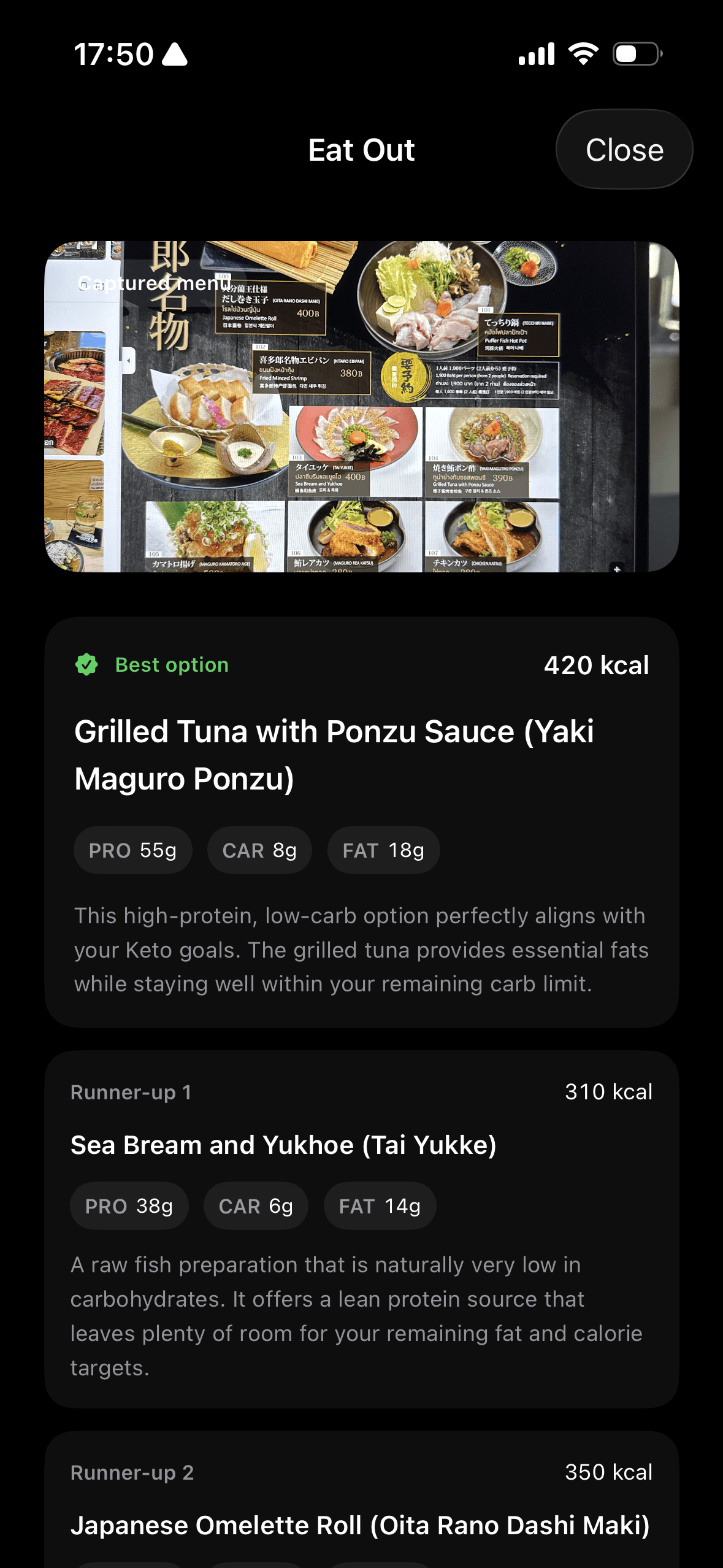
Eat Out — Scan any menu and Fuel ranks the options for you.
See how Eat Out works →Use Eat Out to rank DIG's current board against the calories and macros left in your day. It scans from the menu you are looking at, which is more useful for an in-the-moment decision than working from memory, and it carries the same accuracy caveats as any other restaurant estimate.
14The decision rule
Walking in without a plan, default to Herb Roasted Chicken as the protein base, Roasted Sweet Potatoes or Farm Greens with Mint depending on how much sodium room the rest of the day has, and log the double-protein math yourself if you take the app's promotional add-on rather than trusting a scraped total. Herb Roasted Chicken wins on protein density, while Charred Chicken & Rice provides the most total protein among composed orders at the cost of most of a day's sodium budget. If the menu board tempts you toward a "light" seasonal plate, check the protein-per-calorie column before you order, since the Feta Grain Bowl and the plain Kale Caesar Salad both fail that test while sounding like the healthy choice.
The name on the door changed twice since 2019, and the menu itself changes every season. What does not change is the read that matters, protein per calorie against the sodium the rest of your day can absorb, and that number lives in the PDF, not in the plate's name.
Footnotes
DIG (Dig Inn). DIG INN NUTRITION (PDF), "Last Updated: March 3, 2026." Direct PDF. Accessed 2026-07-16. Supports all "current" calorie, protein, carb, fat, fiber, and sodium values in this article unless marked otherwise, plus the serving-definition and allergen disclaimer language quoted directly. See also DIG's Nutrition page, accessed 2026-07-16, for the same disclaimer and allergen-icon context. DIG updates this guide seasonally, and portions or recipes may vary at a visit.
Back to textBack to text 2Back to text 3Back to text 4Back to text 5Back to text 6Back to text 7Back to text 8Back to text 9Back to text 10Back to text 11Back to text 12Back to text 13Back to text 14Back to text 15Back to text 16Back to text 17Back to text 18Back to text 19Back to text 20Back to text 21Back to text 22Back to text 23Back to text 24Back to text 25Back to text 26Back to text 27Back to text 28Back to text 29Back to text 30Back to text 31Back to text 32Back to text 33Back to text 34Back to text 35Back to text 36U.S. Food and Drug Administration. Sodium in Your Diet. Sodium Daily Value of
Back to textBack to text 2Back to text 32,300 mg/dayfor adults. FDAMyFoodDiary. "Dig Inn More Protein – Charred Chicken." myfooddiary.com. Accessed 2026-07-16. Cited only to document a conflict with DIG's own official single-portion Charred Chicken value, not as a trusted nutrition figure. The double-protein ordering mechanism itself is confirmed only by a dated DIG/Dig Inn Facebook promotional post offering a free double-protein portion via the DIG app with promo code PROTEIN, on chicken, meatballs, and tofu builds, which establishes app availability during a promotion and not a standing policy or price.
Back to textBack to text 2Back to text 3PR Newswire / DIG (Dig Inn). "Dig Inn Is Back: Brand Returns to Roots With New Summer Menu." PR Newswire. Published 2025-06-25. Supports the rebrand date from "Dig" back to "Dig Inn."
Back to textBack to text 2DIG (Dig Inn). DIG INN NUTRITION (PDF), "Last Updated: December 23, 2025." Direct PDF. Accessed 2026-07-16. Used only for the stated March-versus-December menu drift comparison, not as a source for current values.
Back to textBack to text 2Back to text 3Back to text 4Jäger R, Kerksick CM, Campbell BI, et al. International Society of Sports Nutrition Position Stand: Protein and Exercise. Journal of the International Society of Sports Nutrition. 2017;14:20. JISSN. Supports the per-meal protein dosing range of
Back to textBack to text 20.25to0.40 g/kgreferenced in the fat-loss and balanced-meal sections.Marketing Brew. "'Dig Inn' is back—here's why." marketingbrew.com. Published 2025-07-15. Corroborates the June 25, 2025 rebrand date and CMO quote independently of the PR Newswire release.
Back to text