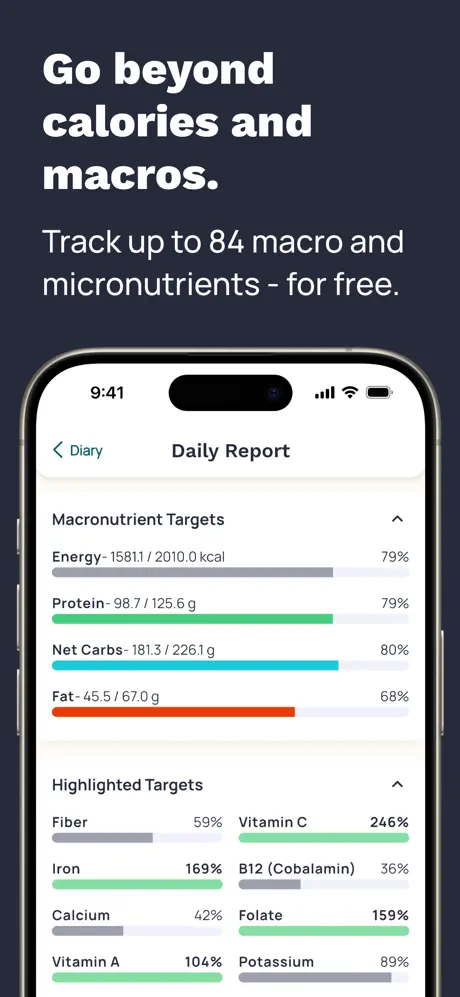
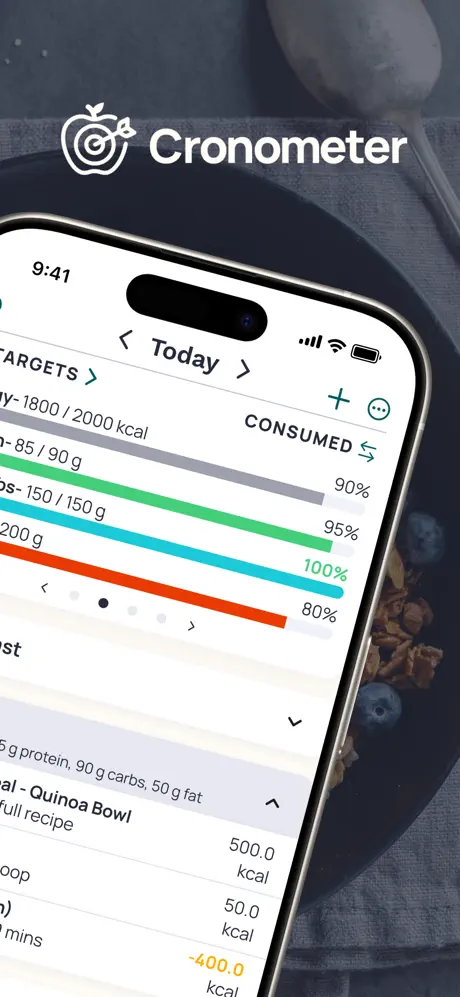
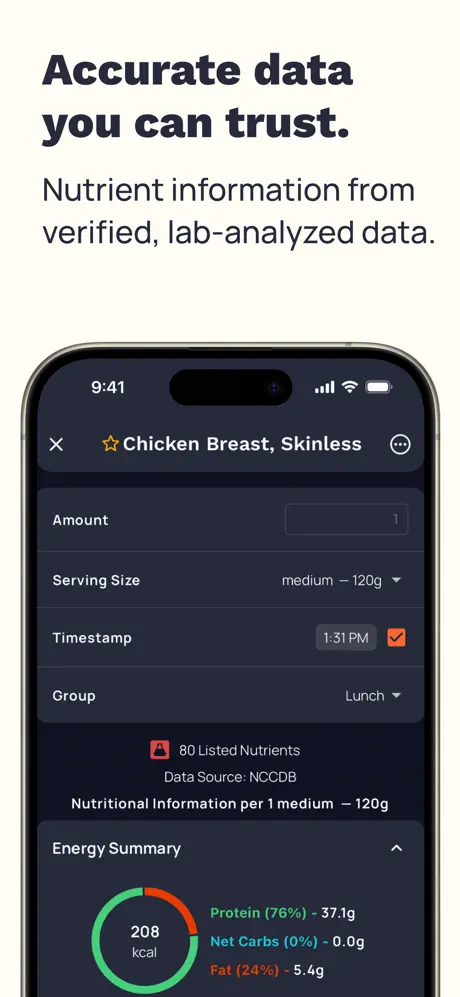
Cronometer is the most data-correct nutrition tracker on the App Store. The database draws from USDA FoodData Central and the Nutrition Coordinating Center Food and Nutrient Database (NCCDB) curated by the University of Minnesota, the same source clinical dietitians and academic studies rely on. The NCCDB alone contributes around 17,000 entries with 70 nutrients each, supplemented by the Canadian Nutrient File and the Irish Food Composition Database for regional accuracy. A 2025 peer-reviewed validation study in the Journal of Human Nutrition and Dietetics tested Cronometer against a reference standard (ESHA Food Processor with the 2015 Canadian Nutrient File) using three-day food records from Canadian endurance athletes and found good inter-rater reliability and validity on most nutrients, with fibre, vitamin A, and vitamin D as the documented exceptions (PMC12550805).
Each food carries 82 to 84 nutrients including all 13 essential vitamins, 17 minerals, the 9 essential amino acids, and individual fatty acid subtypes (omega-3 EPA and DHA broken out from ALA, omega-6 lines, saturated and trans fractions). For a vegan athlete checking B12 and zinc, an endurance runner watching iron and vitamin D, or anyone working through a documented deficiency with a registered dietitian, that depth is the reason Cronometer exists. Crowd-sourced apps cannot match it because crowd entries rarely carry full micronutrient panels.
01Device integrations and lab-style tracking
Cronometer is unusually generous with device sync. It connects to Dexcom G6 and G7 continuous glucose monitors, WHOOP, Oura, Garmin, Fitbit, Withings, Polar, Suunto, Apple Health, Samsung Health, and Ketomojo (Devices Integration Overview). The Dexcom path is the real differentiator. If you are running a metabolic experiment with a CGM and want food logs lined up with glucose curves on the same timeline, no other consumer nutrition app makes that as direct. One important caveat from Cronometer support: connecting two activity sources at once corrupts your activity totals, so pick a single device for calories-out and let the others contribute biometrics.
02Gold pricing and unlocked features
Cronometer Gold runs roughly $9.99 per month or about $39.99 to $59.88 per year depending on promotion. Gold removes ads, raises the historical view past the free 7-day cap, and unlocks the fasting timer, custom biometrics, Oracle Nutrient Search (find foods rich in a specific nutrient), the recipe importer that ingests URLs from cooking sites, meal automation and repeat scheduling, photo logging that identifies ingredients from a snapshot, and printable reports for a dietitian or doctor. The free tier still includes the full 82 to 84 nutrient dataset, which is unusual in the category. Most competitors paywall micronutrients entirely.
03Logging friction and usability complaints
The 2025 free-tier ad backlash is real. Cronometer added full-screen video ads to the free mobile app, and forum threads and App Store reviews describe unskippable spots that interrupt meal logging and push users toward Gold or off the app entirely (Cronometer Forums). Search ergonomics are the other recurring complaint. Results omit calorie counts in the list view and default to a 100g serving size, so logging a banana means tapping into the entry, switching the unit, then confirming. Across a full day that friction adds up.
04Who should choose Cronometer
Cronometer is the most data-correct nutrition tracker available, and the 2025 peer-reviewed validation gives it citation-grade legitimacy that crowd-sourced apps cannot claim.
It is best for the user who treats food logging as a measurement instrument: vegan athletes, endurance athletes on a structured plan, deficiency-recovery cases, and CGM-driven quantified-self experimenters. If you need a number you can defend to a dietitian, Cronometer is the answer.
Where Cronometer lags is the daily-logging experience and the coaching loop. Search omits calorie counts and defaults to 100g, the diary hides remaining macros, and free-tier video ads now interrupt meal entry. Fuel is built for Apple users who want the best AI in food logging: photograph a meal or a label, describe it in voice or text, and correct any item with natural-language correction ("the chicken was 8 ounces, no rice"). A real coach checks in throughout the day rather than after the fact. A live daily health score breaks performance into five dimensions (calories pacing, macro quality, micronutrient coverage, limits, and movement) instead of a single ring. A morning recap sets the day, and an in-depth weekly review delivers an explicit action plan for the next seven days. Apple Health, Apple Watch, and Siri are first-class with no re-import dead ends, and the AI runs on-device where possible so your food data stays private. If Cronometer is the laboratory instrument, Fuel is the coach you carry with you.