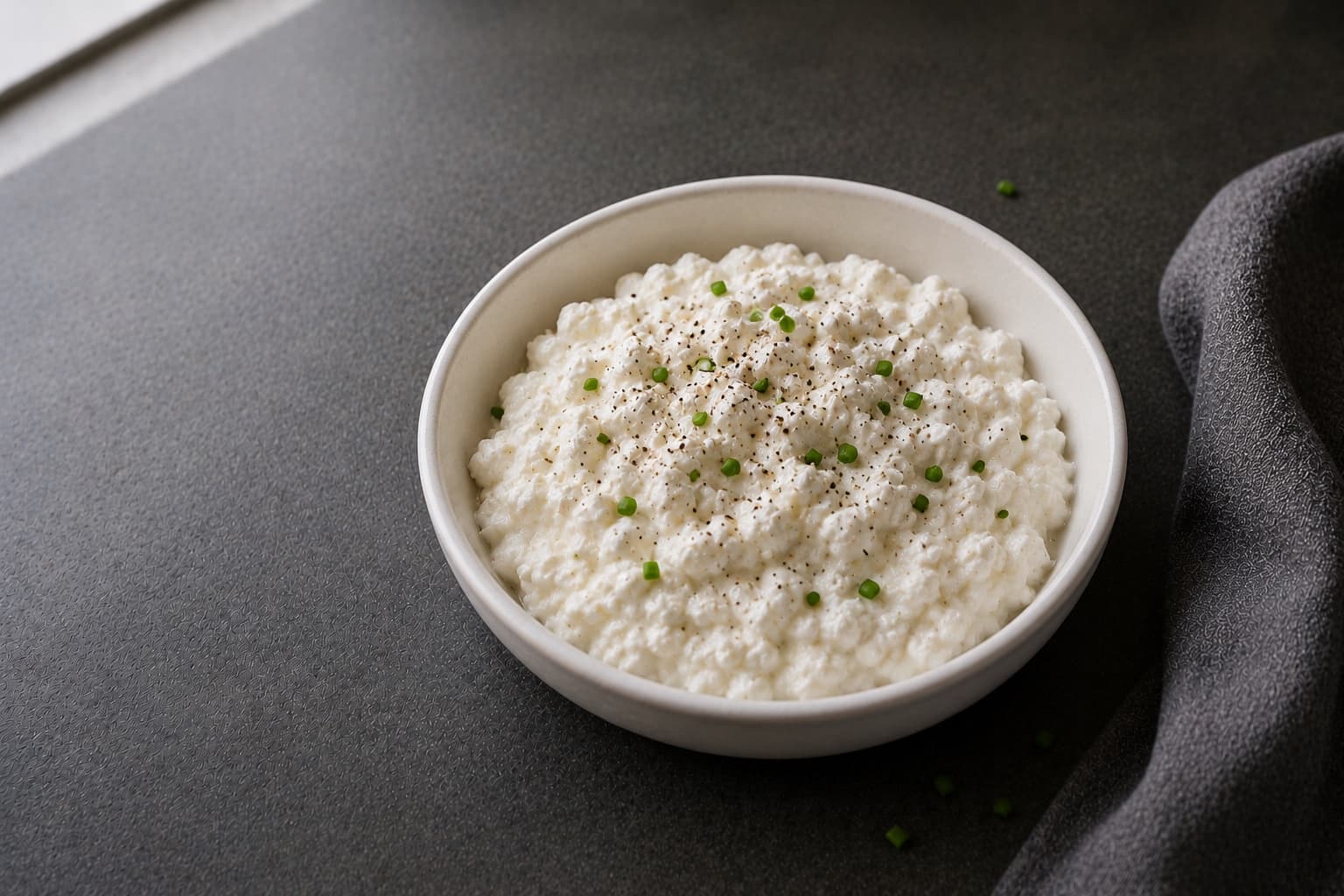
Why this page exists
Ounce for ounce, the case for cottage cheese over Greek yogurt comes down to a ratio most trackers never show. The 1% cottage cheese record on this page carries 12.4 g of protein for 72 calories per 100 g. Plain nonfat Greek yogurt carries 10.3 g for 61 calories in the same 100 g. Scale the yogurt up to match the cottage cheese record's calorie count and it produces about 27.5 g of protein against the cottage cheese's 28 g at 163 calories, using each record's own published cup portion. Cottage cheese does not need to win by much. It needs a spoon.
Everything below is scaled from the four records on this page. The serving control changes the amount, the fat-level selector changes which record you are reading, and every figure carries the FDC identifier it came from.
What is in a serving
Every figure below is scaled from the USDA record named at the bottom of this panel.
Serving basisgrams
100 gof 2% Lowfat
- Calories
- 84 cal
- Protein
- 11 g
- Carbs
- 4.3 g
- Fat
- 2.3 g
| Nutrient | Per serving100 g | Per 100 greference |
|---|---|---|
| Calories | 84 cal | 84 cal |
| Protein | 11 g | 11 g |
| Carbs | 4.3 g | 4.3 g |
| Fat | 2.3 g | 2.3 g |
| Fiber | not reportedUnavailable. This record does not report fiber. | not reportedUnavailable. This record does not report fiber. |
| Sugar | 4.1 g | 4.1 g |
| Sodium | 321 mg | 321 mg |
Fiber is not reported on 2% Lowfat.
A nutrient the record does not measure shows as — and never as 0. A zero here is a measured zero.
FDC 328841USDA Foundation FoodsCheese, cottage, lowfat, 2% milkfatPublished April 1, 2019
The records behind this page
One food family, 4 source records. The figures are per 100 g, which is the basis the USDA publishes and the only fair way to compare records whose servings differ.
| Record | Caloriescal | Proteing | Carbsg | Fatg | Fiberg | Sugarg | Sodiummg |
|---|---|---|---|---|---|---|---|
| Cheese, Cottage, Lowfat, 2% MilkfatFDC 328841FoundationShown by default | 84 | 11 | 4.3 | 2.3 | not reportedUnavailable. This record does not report fiber. | 4.1 | 321 |
| Cheese, Cottage, Lowfat, 1% MilkfatFDC 173417SR Legacy | 72 | 12.4 | 2.7 | 1 | 0 | 2.7 | 406 |
| Cheese, Cottage, Nonfat, Uncreamed, Dry, Large or Small CurdFDC 172181SR LegacyDry | 72 | 10.3 | 6.7 | 0.3 | 0 | 1.9 | 372 |
| Cottage Cheese, Full Fat, Large or Small CurdFDC 2346384Foundation | 103 | 11.6 | 4.6 | 4.2 | not reportedUnavailable. This record does not report fiber. | not reportedUnavailable. This record does not report sugar. | 350 |
Logging cottage cheese without guessing
Match the fat level to the tub in your hand. Per 100 g, protein moves in a narrow band across the four records while calories and fat do not. Nonfat dry curd runs 72 calories with 10.3 g of protein and 0.3 g of fat. The 1% record also runs 72 calories but carries 12.4 g of protein and 1 g of fat, the tightest protein-to-calorie combination on the page. The 2% record runs 84 calories, 11 g of protein, and 2.3 g of fat. Full fat runs 103 calories, 11.6 g of protein, and 4.2 g of fat. A tracker that offers one generic "cottage cheese" entry is hiding a 31-calorie, 3.9-gram-fat spread for almost the same protein, and the label on the tub is the only way to know which record you actually bought.
Cottage cheese sits in whey, and draining changes the math. The curd carries liquid whey around it, and some readers pour it off before eating. Draining removes water weight without removing protein, which concentrates the protein per gram of what is left in the bowl. None of the records on this page report a drained weight, so there is no record to log a drained serving against directly. Weigh the tub as purchased, log that record, and if you drain it, weigh what remains and treat the difference as water rather than as a different food.
Sodium runs from moderate to fairly high, and it moves independently of fat. The four records span 321 mg (2%) to 406 mg (1%) per 100 g, with nonfat dry curd at 372 mg and full fat at 350 mg. A single 100 g serving can cost close to a fifth of a common 2,000 mg daily sodium target. A reader watching sodium for blood pressure reasons should check which record they are logging, since the leanest tub here carries more sodium than the full-fat one, the opposite of what a fat-based guess would predict.
The dry curd record describes a manufacturing state, not a step a reader performs at home. "Nonfat, uncreamed, dry" is how the USDA labeled the product as sold. If the container in the fridge lists a creaming mixture or added cream on the label, it is not this record even at 0% fat, and the 2% or 1% record is the closer match for a creamed low-fat tub.
Where cottage cheese fits, and where it does not
Before sleep, with the numbers this page cannot give you. Dairy protein is largely casein, and cottage cheese is a casein-dominant food the way Greek yogurt is. Casein digests slowly enough to extend amino acid delivery across the overnight fast, which is what pre-sleep protein timing is built around. These records report total protein only and never split it into fractions, so the mechanism belongs in those two entries. What this page can tell you is the protein total in the serving you are about to eat before bed.
Low appetite, where volume is the constraint. At 11 g of protein per 100 g, cold and spoonable, the 2% record sits in the same class as Greek yogurt for readers whose appetite is suppressed rather than their schedule. The low-appetite meal templates lean on foods with this profile for exactly that reason. Weigh it into a bowl rather than eating from the tub, because a suppressed appetite plus an unweighed container is how half a serving gets logged as a whole one.
A complete protein with a strong leucine profile, and the direct swap for a reader who dislikes yogurt. Cottage cheese and Greek yogurt draw from the same dairy protein pool, but the curd texture is nothing like a strained, smooth cup. For a reader who has never liked Greek yogurt on taste or texture grounds, cottage cheese delivers a comparable protein quality profile at a comparable protein density without asking them to eat something they avoid. The leucine threshold work still applies here the same way it does to yogurt: one serving rarely clears a 25 to 30 g per-meal target on its own, and a 226 g cup of the 1% record at 28 g protein is the single record on this page that comes closest.
Where it does not fit. A reader managing sodium closely on a given day should treat any of these four records as a real contributor, not a rounding error, particularly the 1% record at 406 mg per 100 g. And a reader who wants a fast pre-workout carbohydrate hit is in the wrong aisle. Every record here is protein-forward and carbohydrate-light, which is the opposite of what race-morning or pre-interval fueling asks for.
The decision rule is short. Pick the fat level that matches your calorie budget, not the one on the shelf closest to the door. Weigh it in grams. Log the record that matches the tub, and if you drain it, weigh what is left rather than trusting the label's serving size.
Where it fits against a goal
Breakfast protein anchor
226 g of Cheese, Cottage, Lowfat, 1% MilkfatFDC 173417
- Protein
- 28 g
- Calories
- 163 cal
The 1% record is the best protein-per-calorie combination among the four fat levels on this page. Its own USDA cup portion, 226 g, works out to 28 g of protein for 163 calories, a better ratio than the 2% or full-fat record carries at the same weight. Buy this fat level when a single serving needs to do the most protein work for the least calorie cost.
Low appetite and GLP-1 days
100 g of Cheese, Cottage, Lowfat, 2% MilkfatFDC 328841
- Protein
- 11 g
- Calories
- 84 cal
11 g of protein per 100 g of cold, spoonable food that needs no chewing and no cooking. When appetite is the binding constraint, that ratio matters more than the calorie count. Weigh a serving into a bowl and stop there.
Cutting on a fixed calorie budget
145 g of Cheese, Cottage, Nonfat, Uncreamed, Dry, Large or Small CurdFDC 172181
- Calories
- 104 cal
- Fat
- 0.4 g
Per 100 g, the nonfat dry curd record spends 72 calories and 0.3 g of fat against the full-fat record's 103 calories and 4.2 g, a 31-calorie gap for the same gram of curd. A cup of the nonfat record, weighed at 145 g by the USDA's own portion, lands at 104 calories. If the calorie budget is what keeps slipping, this is the tub to buy instead of the one marked full-fat.
Eating enough to gain
110 g of Cottage Cheese, Full Fat, Large or Small CurdFDC 2346384
- Calories
- 113 cal
- Fat
- 4.6 g
The full-fat record carries more than 14 times the fat of the nonfat dry curd record per 100 g. That is the tub to reach for when the problem is getting calories in rather than managing them down. A single 110 g reference portion lands at 113 calories and 4.6 g of fat alongside 12.8 g of protein.
Methodology
Where the numbers come from
Every figure on this page is scaled from a per-100 g value in a USDA record by one shared function, so the numbers here and the numbers on a meal page that uses this ingredient cannot disagree. Values are rounded once, at the point of display.
- FDC 328841Cheese, cottage, lowfat, 2% milkfatUSDA Foundation Foods
- FDC 173417Cheese, cottage, lowfat, 1% milkfatUSDA SR Legacy
- FDC 172181Cheese, cottage, nonfat, uncreamed, dry, large or small curdUSDA SR Legacy
- FDC 2346384Cottage cheese, full fat, large or small curdUSDA Foundation Foods
Unavailable values
A nutrient a record does not measure is shown as unavailable and never as zero. Across the 405 records in this dataset, 165 report no fiber and 228 report no sugar, so the distinction is not a rare edge case. A zero on this page means the analysis measured zero.
Source coverage
Every claim on this page resolves to one of the records listed here. This family has no open source gaps.
Datasets
- USDA FoodData Central Foundation FoodsExport 2026-04-30 · 363 of 395 entries normalized
- USDA FoodData Central SR LegacyExport 2018-04 · 42 of 7793 entries normalized