
Key Takeaways
MyFitnessPal and Noom are the two most recognized names in nutrition apps. MyFitnessPal is a calorie counter built on the world's largest food database. Noom is a behavioral coaching program that happens to include food logging. One treats weight management as a math problem. The other treats it as a psychology problem. The choice depends on whether you believe your barrier is tracking accuracy or the habits and patterns that undermine your consistency.
01About MyFitnessPal
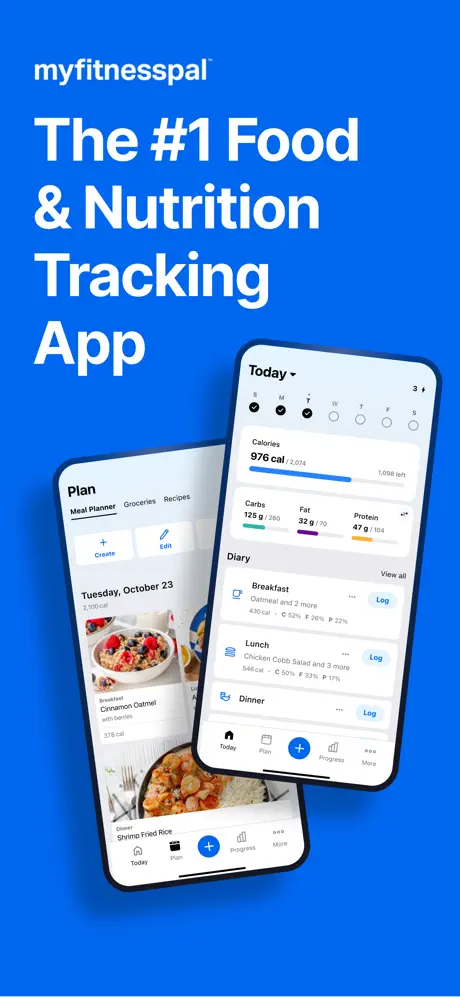
MyFitnessPal is the most widely used nutrition tracking app in the world. Launched in 2005, it built its dominance on a crowd-sourced food database that now contains over 14 million entries. This is the largest in the category by a wide margin. The core experience is designed around logging: search for a food, select the correct entry, choose a serving size, and track your daily calorie and macro totals against a target.
MyFitnessPal offers a functional free tier with ads, plus a $19.99/month Premium subscription that unlocks barcode scanning, detailed nutrient insights, and an ad-free experience. The app includes a recipe importer that pulls nutritional data from URLs, meal copying between days for repeat eating patterns, community forums, and basic Apple Watch logging. Third-party integrations are broad. MyFitnessPal connects with more fitness devices and health platforms than nearly any competitor. MyFitnessPal's value proposition is straightforward: it gives you the tools to count calories as accurately and conveniently as possible. What you do with those numbers is up to you. The app does not analyze trends, suggest adjustments, or guide behavior. It records and displays.
02About Noom
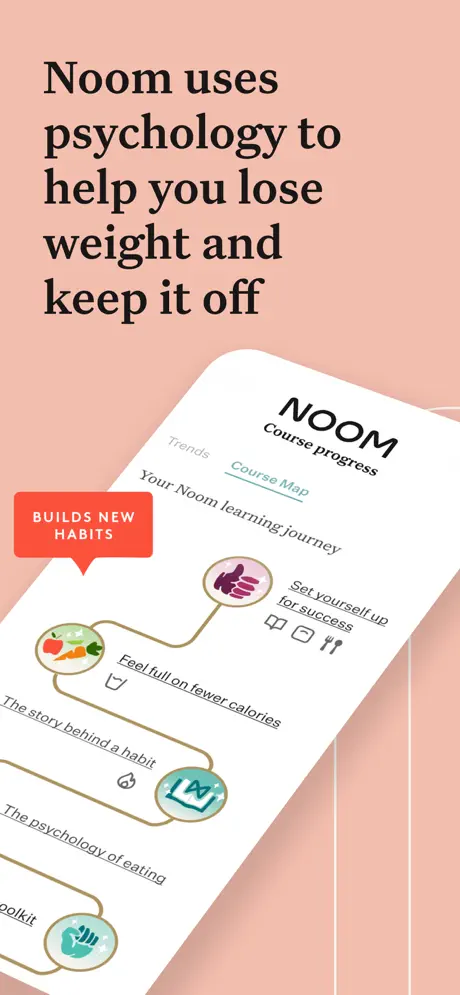
Noom is a behavioral psychology coaching program delivered through a mobile app. Unlike traditional calorie counters, Noom's core product is a structured curriculum of daily psychology-based lessons designed to change your relationship with food. Drawing on cognitive behavioral therapy principles, Noom's content explores why you eat the way you do, how stress and emotions drive food choices, and what psychological patterns sustain unhealthy habits.
Noom includes access to a human coach for accountability and guidance, plus daily content modules that build awareness over weeks and months. The food logging component is minimal by design. Manual search only. No barcode scanning, no photo logging, no meal copying between days. The app costs approximately $70 per month, making it the most expensive mainstream nutrition app by a factor of three or more. Noom has no Apple Watch integration and no meaningful free tier.
03Calorie logging vs behavior coaching
Winner: Depends on your need
This comparison is about which problem you are trying to solve.
MyFitnessPal's implicit assumption is that weight management is an information problem. If you know exactly how many calories you eat and how many you burn, you can engineer a deficit and lose weight. The app excels at providing that information: a massive database, barcode scanning (at Premium), and detailed macro breakdowns. The assumption is that good data leads to good decisions.
Noom's implicit assumption is that weight management is a behavior problem. Plenty of people know what they should eat. The challenge is sustaining the right choices when stress hits, when social pressure mounts, when emotional eating patterns override rational knowledge. Noom's psychology curriculum attacks that behavioral layer (the habits, triggers, and cognitive distortions that sabotage even well-informed dieters). The assumption is that self-awareness leads to lasting change.
Neither assumption is wrong. Both are incomplete. Many people need both good data and behavioral support. They need accurate tracking to understand what they eat and psychological tools to change why they eat it. But if forced to choose one lens, the right answer depends on your personal barrier. Users who have successfully lost weight by counting calories before but lost motivation over time may benefit from Noom's behavioral approach. Users who have never tracked consistently may benefit from MyFitnessPal's logging tools first.
04How each app handles food logging
Winner: MyFitnessPal
MyFitnessPal is the far superior logging tool. Its 14-million-entry database covers virtually any commercially available food product. Barcode scanning (Premium only at $19.99/month) is fast and accurate. The recipe importer can pull nutritional data from URLs. Meal copying lets you replicate yesterday's breakfast with a single tap. Quick-add options let you log a rough calorie estimate when precision does not matter. The logging infrastructure is mature, refined over nearly two decades of iteration.
Noom's food logging is deliberately minimal. Manual search is the only input method. There is no barcode scanning, no photo logging, no voice input, and no meal copying between days. Manual entries behave inconsistently, with users reporting that saved foods do not always appear in subsequent searches. The logging experience reflects Noom's philosophy that tracking is secondary to behavior change, but the result is a logging tool that adds friction to every meal.
For users who care about logging convenience and data accuracy (which is to say, most people who use a nutrition app daily), MyFitnessPal is categorically better as a logging tool. The gap is wide enough that some users subscribe to Noom for its coaching but log their food in MyFitnessPal separately, using two apps to cover what neither delivers alone.
05Coaching style and daily feedback
Winner: Noom
Noom wins this dimension decisively. Its psychology-based curriculum is research-backed and genuinely distinctive in the nutrition-app category. Daily lessons explore emotional eating patterns, stress responses, cognitive biases around food, and the psychological mechanics of habit formation. A human coach provides periodic check-ins and accountability. The content is substantial. It offers structured psychological education, not generic motivational quotes.
MyFitnessPal has no coaching whatsoever. It sets a static calorie target during onboarding and never adjusts it. There are no lessons, no behavioral content, no adaptive guidance, and no human support. The app assumes you know what to do with your calorie data and leaves execution entirely to you.
For users whose weight management challenge is behavioral (they understand nutrition but cannot sustain habits), Noom addresses the root cause. MyFitnessPal does not even acknowledge that the root cause exists. The gap is not incremental. MyFitnessPal has zero coaching features. No lessons, no behavioral content, no check-ins, no adaptive guidance. It is a pure information tool. Whether that is a strength or a limitation depends entirely on whether information alone is sufficient for your goals.
06Crashes and day-to-day stability
Winner: MyFitnessPal
MyFitnessPal is a functional application with the normal range of bugs and sync issues. Wearable sync double-counting is the most commonly reported problem. Step counts and activity calories may import incorrectly, inflating your daily calorie balance. The issue is annoying but does not prevent you from using the core logging features.
Noom's reliability problems are more severe. The app frequently fails to load entirely, presenting blank screens or error states that block access to lessons, logging, and coaching content. The standard troubleshooting recommendation is to reinstall the app. This resets all user preferences, including notification settings, lesson progress markers, and coaching configurations. Customer service is unreachable for many users who encounter these issues.
For an app that costs $70 per month and depends on daily engagement with psychology content, the inability to reliably open the app is a fundamental execution failure. The coaching philosophy may be excellent, but a coach who sometimes does not show up is not reliable. And when the app does require reinstallation, losing your lesson progress and notification preferences means you are reset to square one. The cumulative effect on user trust is significant.
07Free tiers and paid walls
Winner: MyFitnessPal
MyFitnessPal's free tier is functional enough to evaluate whether calorie counting works for you. Premium at $19.99/month unlocks the full feature set. The value is clear: you are paying for a comprehensive logging tool.
Noom at approximately $70 per month (with no meaningful free tier) requires a significant financial commitment before you can evaluate whether behavioral coaching resonates with your needs. The price is partially justified by human coach access, which is expensive to deliver. But the combination of high price, unreliable app performance, and unreachable customer support makes the value proposition precarious. If the app fails to load on a day you need coaching most, you have paid $70 for the month and received nothing.
MyFitnessPal is roughly one-third the price with a product that reliably works. Over a year, MyFitnessPal Premium costs $239.88 while Noom costs approximately $840. This $600 difference buys significantly more daily functionality but zero coaching. Noom's coaching may justify the premium for the right user (someone whose primary barrier is behavioral rather than informational), but the risk-reward ratio favors MyFitnessPal for most people, especially given Noom's reliability issues and unreachable support.
08Apple Watch and Wearables
Winner: MyFitnessPal
MyFitnessPal offers basic Apple Watch logging. It is limited, but present. You can check your daily calorie balance and log quick entries from your wrist. Noom does not have an Apple Watch app at all. For users who want any form of wrist-based interaction with their nutrition app, MyFitnessPal is the only option between the two. Neither delivers a compelling wearable experience (no progress rings, no comprehensive daily summaries, no coaching nudges), but MyFitnessPal at least shows up on the platform. For a coaching app like Noom, the absence of Watch-based reminders or lesson prompts is a missed opportunity for the kind of frequent touchpoints that behavioral change programs benefit from.
09Who should pick MyFitnessPal
MyFitnessPal is the right choice if you want the most comprehensive food logging tool available, you are comfortable managing your own calorie targets without coaching, and you prefer a low barrier to entry. You may use the free tier to evaluate the experience or pay $19.99/month for barcode scanning and an ad-free interface. Your challenge is tracking accuracy and convenience, not habit formation. You may be managing a straightforward calorie deficit, supporting a fitness goal, or simply want visibility into what you eat each day without a coaching layer telling you what to change.
10Who should pick Noom
Noom is the right choice if your weight management challenge is fundamentally behavioral. You understand nutrition, you have tried calorie counting, and the barrier is the patterns, emotional triggers, and habits that override your knowledge. You value human coaching and psychological curriculum over logging convenience. You are willing to invest $70 per month and daily time in psychology content. You can tolerate an app that sometimes fails to load and customer support that may not respond. The coaching content is genuine and the psychological framework is research-backed. The delivery requires patience and a tolerance for technical friction that a product at this price should not require.
11Final pick based on your priority
MyFitnessPal is the better logging tool at a lower price with more reliable execution. Noom is the better coaching program with a genuine behavioral approach that no calorie counter can replicate. If you need accurate calorie tracking with the broadest database, MyFitnessPal. If you need behavioral coaching and can afford the premium despite the reliability risks, Noom. The 3.5x price gap and the app reliability difference make MyFitnessPal the safer choice for most users. Noom addresses a problem that MyFitnessPal does not even attempt. For users who have successfully counted calories in MyFitnessPal but repeatedly fallen off track due to stress eating, emotional patterns, or habit loops, Noom's coaching may address the actual bottleneck. For everyone else, MyFitnessPal's logging tools at a lower price with more reliable delivery is the pragmatic choice. The two apps are not really competitors. They are solutions to different problems that happen to share the nutrition-app category.
Looking for excellent logging and daily coaching in one app that actually works? Fuel delivers AI-powered logging, a daily health score, morning recaps, and weekly coaching without the reliability failures or the $70 price tag.
Frequently Asked Questions
Is MyFitnessPal or Noom better for weight loss?
They address weight loss from opposite angles. MyFitnessPal provides the tools to count calories accurately. Noom provides psychology-based coaching to change your habits and treats food logging as secondary. The right choice depends on whether your barrier is tracking accuracy or behavioral patterns.
Is Noom worth $70 a month?
Noom's price reflects human coach access and a structured psychology curriculum. Some users find it transformative. But the app reliability issues (frequent load failures, unreachable support, preference resets on reinstall) make the value proposition risky at that price point. MyFitnessPal Premium at $19.99/mo is one-third the cost with significantly better logging tools.
Does Noom have barcode scanning?
No. Noom offers only basic manual food search. There is no barcode scanning, no photo logging, no voice input, and no meal copying. Food logging is treated as secondary to the behavioral coaching content.
Can I use MyFitnessPal for free?
Yes. MyFitnessPal offers a functional free tier with calorie tracking and manual food search. However, the free tier includes intrusive ads and locks barcode scanning behind the $19.99/mo Premium subscription.
Does Noom work with Apple Watch?
No. Noom does not offer an Apple Watch app. MyFitnessPal provides basic Apple Watch logging. Neither delivers a full wrist companion experience.