App Comparison
MyFitnessPal vs MyNetDiary
Fuel Nutrition Team • March 22, 2026
MyFitnessPal

MyNetDiary
Database
Barcode scanning
Ads
App stability
Social features
Subscription management
Apple Watch
Coaching
Price
Key Takeaways
MyFitnessPal and MyNetDiary are both veteran nutrition trackers that have earned loyal user bases over many years — but they have earned them for different reasons. MyFitnessPal is the database giant, trading on unmatched food coverage and brand recognition. MyNetDiary is the practical workhorse, valued for free barcode scanning, a cleaner interface, and a price that does not punish you for wanting basic features. Neither offers coaching. Both have reliability issues. The choice comes down to whether you prioritize database scale or daily value.
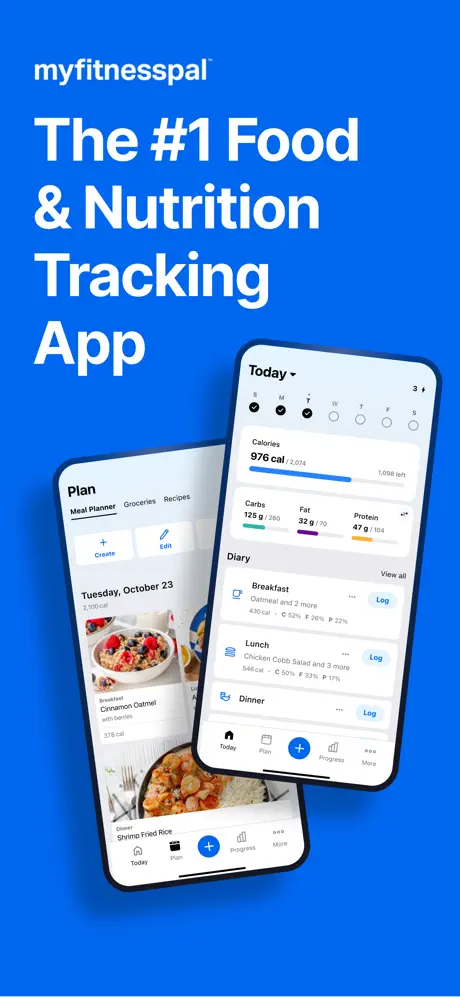
MyFitnessPal is the most recognized nutrition tracking app in the world. Launched in 2005, it built its reputation on a crowd-sourced food database that now exceeds 14 million entries — the largest in the category by a significant margin. The core experience is straightforward: search for a food, log it, and track your daily calorie and macro totals against a target set during onboarding. The app has been the default first nutrition app for millions of users, and its brand recognition is unmatched in the category.
MyFitnessPal offers a functional free tier supported by ads, including graphic food imagery that surfaces in the log feed — a design choice many users find jarring in a health-focused context. The $19.99/month Premium subscription unlocks barcode scanning, nutrient insights, and an ad-free experience. The app has community forums, a recipe importer that pulls nutritional data from URLs, meal copying between days, and basic Apple Watch logging. Third-party integrations are extensive — MyFitnessPal connects with more fitness devices and health platforms than nearly any competitor. MyFitnessPal's strength is its ecosystem — wide integrations, a massive user community, and the simple fact that more people have used it than any other nutrition app. Its weakness is that ecosystem breadth has not translated into product depth — the core experience has not fundamentally evolved in years.
MyNetDiary is a nutrition tracking app that has built a quieter but dedicated following among users who value accuracy and a no-nonsense daily experience. Its database is smaller than MyFitnessPal's but more curated, with entries that tend to be reasonably accurate and reliable. The app includes barcode scanning in all tiers — free and premium — making it immediately more functional at the entry level than MyFitnessPal.
MyNetDiary Premium costs $8.99 per month. The app has minimal ads, an Apple Watch app, and a cloud-based social system with a follower feature. The interface is clean and focused on tracking. MyNetDiary does not have the brand recognition of MyFitnessPal, but users who have tried both often cite it as the better daily experience — when it works. The app has a known stability issue: it freezes mid-log when users tap the log button or switch between meals and snacks, a friction point in a tool designed for frequent daily use. MyNetDiary also has a cloud-based social system with a follower feature, though the lack of block or removal controls raises privacy concerns for users tracking sensitive health data.
Winner: MyFitnessPal
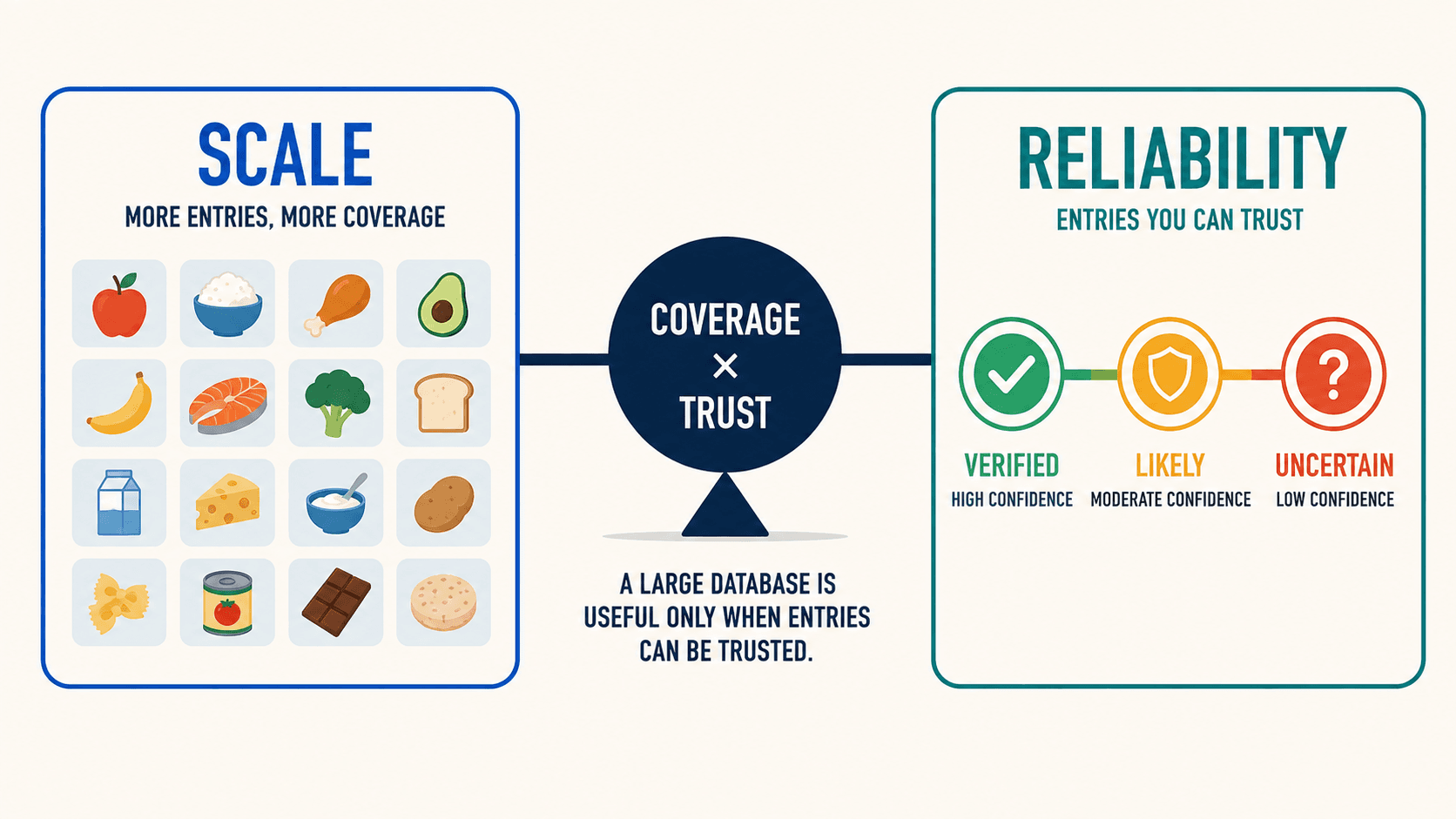
MyFitnessPal's 14-million-entry database is the largest in the nutrition-app category. If you eat commercially packaged food — particularly in the United States — you will almost certainly find what you are looking for. The crowd-sourced model means accuracy varies entry to entry. Users report duplicate entries for the same product with different macro values, incorrect data that has persisted for years, and limited serving-size options. But the scale compensates: among several entries for the same food, you can usually find one that is correct.
MyNetDiary's database is smaller but more curated. Entries tend to be reasonably accurate, and the experience of searching for common foods is reliable. Where MyNetDiary falls short is coverage — niche products, regional brands, and restaurant items may not appear in the database. For users with varied diets that include obscure or imported products, MyFitnessPal's scale provides a meaningful advantage.
The trade-off is clear: MyFitnessPal has more entries with more variance in accuracy; MyNetDiary has fewer entries with better per-entry reliability. For users who eat a standard diet of common branded products, both databases perform adequately. The differentiation matters most for users with varied, niche, or international diets — where MyFitnessPal's scale provides a genuine coverage advantage that MyNetDiary's curation cannot match.
Winner: MyNetDiary
This is the comparison's starkest functional difference. MyNetDiary includes barcode scanning in every tier, including the free version. You download the app, scan a product, and log it immediately.
MyFitnessPal locks barcode scanning behind its $19.99/month Premium subscription. On the free tier, you must search for foods manually by name — a daily friction that adds up quickly for users who eat packaged products regularly. Barcode scanning is one of the most frequently used features in nutrition tracking, and paywalling it is one of MyFitnessPal's most criticized monetization decisions.
For users who consider barcode scanning a daily necessity and do not want to pay $19.99 per month for the privilege, MyNetDiary wins this comparison decisively. Barcode scanning transforms daily logging from a multi-step search-and-select process into a single scan. When you eat packaged food three or four times a day, the time savings compound quickly — and paying nearly $20 per month for that convenience in MyFitnessPal feels disproportionate when MyNetDiary includes it for free.
Winner: MyNetDiary
MyFitnessPal's free tier is cluttered with intrusive advertisements, including graphic food imagery that surfaces in the food log feed. For a health-focused app that users open several times per day, the ad experience feels aggressive and counterproductive. The $19.99/month Premium subscription removes ads and unlocks core features, but the price is steep relative to what most nutrition apps charge.
MyNetDiary's monetization is lighter. Ads are minimal in the free tier, and there is no aggressive upsell pressure during daily use. Premium at $8.99/month is less than half of MyFitnessPal Premium. The daily experience feels more focused on tracking and less focused on conversion.
The caveat: multiple users report that MyNetDiary's subscription is difficult to cancel. In-app cancellation pathways may not work as expected, leading users to continue being charged after they believe they have unsubscribed. If you subscribe, confirm that you can manage the subscription through your device's app store settings rather than relying on in-app options. This friction is not a deal-breaker, but it is worth knowing before committing — particularly for users who want to evaluate MyNetDiary for a month before deciding.
Winner: Tie — both have issues
Neither app delivers consistently reliable performance, but the failure modes differ.
MyFitnessPal's primary reliability issue is sync. Users report double-counting when the app syncs calorie data with third-party wearables and fitness apps. Step counts may import twice, activity calories may inflate daily totals, and the resulting calorie-balance number becomes untrustworthy. For an app that depends on accurate daily totals, sync errors directly undermine the core value proposition.
MyNetDiary's primary reliability issue is mid-action freezing. The app freezes when users tap the log button or switch between meals and snacks — the most common interactions in a food logging tool. For an app you use multiple times per day, a freeze during the most frequent action is the worst possible place for a stability problem. The freeze resolves after a few seconds, but the friction accumulates across a day of logging.
Both issues are disruptive. MyFitnessPal's sync problems corrupt your data silently — you may not realize your daily calorie balance is wrong until you review the numbers closely. MyNetDiary's freezes interrupt your workflow loudly — every logging session carries the risk of a multi-second hang that disrupts your momentum. Neither is acceptable in a mature product, but neither is severe enough to make the app unusable. Users of both apps learn to work around the limitations, which speaks to how entrenched these tools are in daily routines despite their imperfections.
Winner: MyFitnessPal
MyFitnessPal offers community forums where users can share experiences, ask questions, and find accountability partners. The social layer is optional and does not interfere with the core tracking experience. You can use MyFitnessPal as a purely solo tool.
MyNetDiary has a cloud-based follower system, but with a notable gap: there are no block or removal controls. If someone follows your account, you cannot block them or remove them from your followers. For a health app that may contain sensitive data about your weight, food intake, and body measurements, the inability to control who has access to your activity is a privacy concern that MyNetDiary has not addressed. Users who are sensitive about their health data — particularly those tracking weight loss or managing eating disorders — should be aware of this gap before engaging with MyNetDiary's social features.
Winner: MyNetDiary (marginally)
Both apps offer Apple Watch support, but neither provides a full companion experience. MyFitnessPal offers basic logging from the wrist. MyNetDiary's Apple Watch app is slightly more developed but still limited. For users who want a substantial wrist experience — quick logging, daily summaries, progress rings, water tracking — neither app delivers. The Watch support in both cases is a checkbox feature rather than a genuine extension of the core product. Given that Apple Watch has become a central hub for health tracking for millions of users, the shallow Watch integration in both apps represents a shared missed opportunity to meet users where they already are. Users who want to check calorie progress or log meals from their wrist will find both apps lacking compared to dedicated health platforms.
MyFitnessPal is the right choice if you need the largest possible food database, value wide third-party integrations, and are willing to pay $19.99 per month for barcode scanning and an ad-free experience. You eat a varied diet with many branded products — including niche, regional, and international items — and want the confidence that almost any food will be in the database. You value the community ecosystem, the recipe importer, and the breadth of fitness-app integrations that come with the category's most established product. You do not need coaching or adaptive goals — you want a comprehensive calorie ledger with the broadest possible coverage.
MyNetDiary is the right choice if you want free barcode scanning, a cleaner daily experience with fewer ads, and a premium subscription at less than half of MyFitnessPal's price. You value per-entry accuracy over database scale, you eat a diet of common products that MyNetDiary's smaller database covers well, and you are comfortable managing an occasional mid-log freeze. You prefer a tracker that feels focused on tracking rather than on monetization. Over a year, MyNetDiary Premium at $8.99/month costs $107.88 — compared to MyFitnessPal Premium at $239.88. That $132 annual difference buys you the same core functionality with less friction at the barcode scanner and fewer ads disrupting your daily workflow.
MyFitnessPal wins on database scale and ecosystem breadth. MyNetDiary wins on value — free barcode scanning, cheaper premium, fewer ads, and reasonably accurate data. Both are passive calorie counters that stop at showing you numbers without telling you what to do with them. Both have reliability issues that add friction to daily use. Both lack adaptive goals, AI-powered logging, or any form of coaching. If database coverage is your top priority and you eat a highly varied diet, MyFitnessPal's 14-million-entry scale is hard to match. If daily value and scanning access matter more than database breadth, MyNetDiary at less than half the price is the smarter choice — especially for users whose diets consist of common products that both databases cover well. Neither will coach you, and neither will tell you what to change when progress stalls.
Looking for tracking that goes beyond database lookup? Fuel delivers AI-powered logging, daily coaching, full Apple Watch support, and a coached free week — no ads, no database dependency, no mid-log freezes.
Neither app offers coaching or adaptive goal adjustment — both provide static calorie targets and leave execution to you. MyFitnessPal has the larger database for logging convenience. MyNetDiary offers free barcode scanning and a cheaper premium. Neither will analyze your data and tell you what to change.
MyFitnessPal Premium costs $19.99/mo, with barcode scanning as its most sought-after paywalled feature. MyNetDiary includes barcode scanning for free in all tiers and charges $8.99/mo for its premium — less than half of MFP's price.
MyNetDiary's database is smaller than MyFitnessPal's but reasonably accurate and more curated. It may lack niche or highly regional products, but entries tend to be reliable. Barcode scanning is available in all tiers, compensating for the smaller search database.
Multiple users report that MyNetDiary's subscription is difficult to cancel. If you subscribe, verify that you can manage the subscription through your device's app store settings rather than relying on in-app cancellation options.
No. Neither MyFitnessPal nor MyNetDiary offers coaching, adaptive goals, or daily feedback. Both are passive calorie trackers that display your numbers without guidance on what to do with them.