
Key Takeaways
FatSecret and Fuel represent two generations of nutrition tracking. FatSecret is a free calorie counter built around manual search, barcode scanning, and a community database with known accuracy problems. Fuel is an AI coaching system that logs meals from photos, voice, and text, then delivers a daily health score, morning recap, weekly action plan, and adaptive goal timeline. FatSecret gives you a food diary. Fuel gives you a system that acts on the data.
01About Fuel
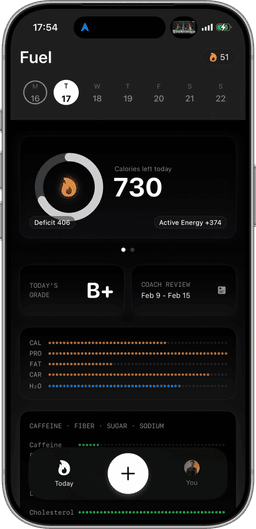
Fuel is an AI-powered nutrition coaching app designed for the Apple ecosystem. You log meals by photographing the nutrition label, describing what you ate in plain text, or speaking it aloud, then refine with natural language corrections until the entry matches what you actually consumed. A daily health score tracks five dimensions in real time: calorie pacing, macro quality, micronutrient coverage, limits, and movement. Every morning, a personalized recap reviews how yesterday landed and what to focus on today. A weekly review delivers an explicit action plan based on your actual patterns. A living plan timeline recalculates your goal date from real adherence, not a static projection. Data stays on-device by default. There are no ads. A full Apple Watch companion app puts logging, favorites, your calories ring, water tracking, and streaks on your wrist. Bidirectional Apple Health sync reads activity and writes food, nutrients, and workouts back without double-counting.
02About FatSecret
FatSecret is a free, ad-supported calorie tracking app available on iOS and Android. The core workflow is search-and-select: type a food name, scroll through database results, pick a serving size, and log it. A barcode scanner handles packaged foods, though scan failures force you to back all the way out of the scanner flow and navigate manually to add the item. Recent foods are organized by meal context, so breakfast items logged under breakfast are not searchable when logging lunch, and there is no search within the recents list, only scrolling. A recipe tool lets you create custom entries but requires sharing settings and metadata inputs before saving, and you cannot edit nutritional values directly in the cookbook view. FatSecret provides calorie and basic macro targets but no coaching, no health score, no adaptive goals, and no daily feedback beyond the numbers. A Premium subscription removes ads and adds some features.
03How each app handles food logging
FatSecret's logging workflow starts with a manual database search. You type what you ate, scroll through a list of results, and select the closest match. The experience is functional when the database cooperates, but friction appears quickly. Recent foods are locked by meal context: if you logged Greek yogurt under breakfast, it will not appear in your recents when logging a snack. There is no search within the recents list, only an undifferentiated scroll. For packaged foods, the barcode scanner works when it recognizes the product, but when a scan fails, the app offers no fallback within the scanning flow. You must exit the scanner entirely, navigate back to the search screen, and find the item manually. This back-and-forth adds real time to every failed scan.
Fuel eliminates the search-and-select cycle entirely. Photograph the nutrition label, describe the meal in text, or speak it. The AI extracts the nutritional data and creates the entry. Where Fuel separates from every other logging tool is natural language correction: "That was 150g not 200g," "remove the cheese," "add a tablespoon of olive oil." You refine conversationally until the entry matches reality. No recents list to scroll, no barcode failures to navigate around, no meal-context locks.
Winner: Fuel. Photo-first logging with natural language corrections eliminates the search friction, barcode failure loops, and meal-locked recents that define FatSecret's daily experience.
04Database noise and accuracy sources
FatSecret's food database suffers from frequent inaccuracies in calorie and macro data. This is a routine occurrence, with users regularly encountering entries where the numbers simply do not match the product's actual nutrition label. The expected correction path does not function: users report submitting error tickets that are never acknowledged and never resolved, leaving incorrect entries in place indefinitely. When your calorie target depends on accurate data, a database that cannot be corrected undermines the entire purpose of tracking.
Fuel does not depend on a crowd-sourced or community-maintained database. When you photograph a nutrition label, the AI reads the manufacturer's exact numbers. When you describe a meal in text or voice, the AI estimates based on your description and you correct conversationally. Your data is never dependent on an entry someone else submitted, and you never need a support ticket to fix incorrect information. Accuracy comes from the source, not the database.
Winner: Fuel. Source-level accuracy from photos and natural language beats a database with known inaccuracies and no functional correction path.
05Search & Navigation
Search UX is where FatSecret's age shows most clearly. The recents system, one of the most-used features in any food logger, is organized by meal type. Foods you logged for dinner do not appear when you search recents for lunch. Within a meal's recents, there is no search filter: you scroll through every item you have ever logged under that meal type, in order, hoping to find the one you want. For users who eat varied diets, this list becomes unusable within weeks. The general food search returns database results with no way to distinguish verified entries from user-submitted ones, and the same food may appear multiple times with different macro values.
Fuel does not have a recents problem because the logging paradigm is different. You describe what you ate by photo, voice, or text, and the AI processes it. There is no list to scroll, no meal-context lock, and no ambiguity about which "chicken breast" entry is correct. If you eat the same meal regularly, you can save it as a favorite and log it with a single tap from the app or Apple Watch. The experience scales with dietary variety instead of collapsing under it.
Winner: Fuel. Describing what you ate is fundamentally faster and more reliable than navigating meal-locked recents and ambiguous search results.
06Recipe Workflow
FatSecret includes a recipe creation tool, but the workflow introduces unnecessary friction. Before you can save a recipe, the app prompts you for sharing settings and metadata, fields that have nothing to do with nutrition tracking but cannot be skipped. Once a recipe is saved to your cookbook, you cannot edit the nutritional values directly from the cookbook view. If a recipe's macros need correction, you have to navigate back into the recipe editor, modify ingredients, and hope the database entries are accurate. For users who batch-cook or meal-prep, this friction compounds quickly.
Fuel's recipe library includes 100+ professionally designed, macro-optimized recipes with portion scaling from half to double servings. Browse by goal, dietary preference, or macro target, then scale and log directly. No sharing forms, no metadata prompts, no multi-screen editing required. The focus stays on nutrition, not on the app's content management needs.
Winner: Fuel. A recipe workflow designed for logging rather than content publishing removes the friction that makes FatSecret's approach tedious for regular use.
07Coaching style and daily feedback
FatSecret is a calorie tracker. It displays calories consumed, a basic macro breakdown, and a calorie budget. There is no coaching layer, no daily health score, no morning recap, no weekly review, no action plan, and no adaptive goals. When you have a bad day, FatSecret shows you a red number. When you have a good week, it shows you a green number. The interpretation, motivation, and behavior change are entirely on you.
Fuel is a coaching system built on top of tracking. A daily health score updates in real time across five dimensions: calorie pacing, macro quality, micronutrient coverage, limits, and movement. Every morning, a personalized recap reviews how the previous day landed across calories, patterns, trends, and specific actions to take today. A weekly review with an explicit action plan identifies what worked, what did not, and what to change. A living plan timeline recalculates your goal date based on actual adherence, so your projected outcome always reflects reality rather than an optimistic calculation from day one. This is the difference between a diary and a coach. One records what happened. The other changes what happens next.
Winner: Fuel. Five-dimension coaching with daily recaps, weekly action plans, and adaptive timelines is a category apart from static calorie display.
08Apple Watch & Health Integration
FatSecret does not offer an Apple Watch app. If you want to log a meal, check your progress, or track water from your wrist, there is no option. Apple Health integration exists but is limited, with no bidirectional sync that writes detailed nutrient data back.
Fuel treats Apple Watch and Apple Health as primary surfaces. The Watch companion app supports quick logging, favorites, a calories ring, water tracking, and streaks. Apple Health sync is fully bidirectional: Fuel reads activity, steps, and workouts from Health, and writes food, individual nutrients, liquids, and workout data back. No re-import gaps, no double-counting, no sync conflicts. For users who live in the Apple ecosystem, Fuel integrates at a level FatSecret does not attempt.
Winner: Fuel. Full Watch companion app and reliable bidirectional Apple Health sync vs. no Watch app and limited Health integration.
09Pricing & Ads
FatSecret's strongest pitch is price: the core tracking experience is free. You can log food, scan barcodes, create recipes, and view macros without paying. The trade-off is ads. FatSecret's free tier is ad-supported, and there is no way to remove ads without upgrading to Premium. The ads appear throughout the app and add visual noise to a workflow that should be focused and fast.
Fuel's free tier includes one full coached week with daily and weekly reviews, AI logging for up to 7 meals per week, and a preview of plan progress, enough to evaluate the complete system before committing. Fuel Pro is $24.99/month and unlocks unlimited AI logging, full coaching, and all features. There are no ads on any tier. Your data is stored on-device by default, not monetized.
Winner: FatSecret on price. Free is hard to beat. But Fuel's ad-free experience and coaching features justify the premium for users who want more than a calorie diary.
10Who should pick Fuel vs FatSecret
Choose Fuel if you want a nutrition coaching system rather than a calorie counter. If you are in the Apple ecosystem, want AI-powered logging without database frustration, care about privacy, and want daily feedback that tells you what to do, Fuel is the structural upgrade. It is especially strong for users who have tried FatSecret and found themselves fighting the search UX, questioning database accuracy, and tracking calories without making progress.
Choose FatSecret if you need free basic calorie tracking on any platform and are willing to work around the limitations. FatSecret's cross-platform availability and zero cost make it accessible, and for users on Android there is no Fuel option today. If your primary requirement is a food diary rather than coaching, and you can tolerate the search friction, barcode failure loops, and database inaccuracies, FatSecret handles the basics. Just understand that a calorie diary without a coaching layer has a ceiling, and you may reach it faster than you expect.
11Final pick based on your priority
FatSecret earned its user base by being free and functional when the alternatives were expensive and complicated. That value proposition made sense in 2012. In 2026, the friction has compounded: recents are locked by meal context with no search, barcode failures dump you out of the workflow entirely, database inaccuracies persist with no correction path, the recipe tool prioritizes sharing metadata over nutrition editing, and there is no coaching layer whatsoever. The app tracks what you eat and stops there. For users who have been tracking for months without progress, FatSecret's limitations are structural barriers to the behavior change that tracking is supposed to enable.
Fuel replaces the entire paradigm. Photo, voice, and text logging with natural language corrections eliminate the database dependency and the search friction that defines traditional trackers. A five-dimension daily health score, morning recap, weekly review with action plan, and living plan timeline turn data into daily coaching. A full Apple Watch companion app and bidirectional Apple Health sync make the system feel native to how you already use your devices. Data stays on-device by default. There are no ads on any tier.
The cost is $24.99/month, real money, but in exchange for a system that does what FatSecret's free tier structurally cannot: coach you toward your goals instead of handing you a food diary and hoping for the best. The free tier gives you a full coached week and 7 AI-logged meals per week to evaluate the complete experience before subscribing. For anyone who has spent months logging in FatSecret without seeing the results they expected, the real question is whether a calorie diary alone was ever going to be enough.
Frequently Asked Questions
Is Fuel or FatSecret better for weight loss?
Both apps track calories, but they approach weight loss differently. FatSecret provides a calorie target and a food diary, with execution entirely on you. Fuel adds a five-dimension daily health score, morning recap, weekly review with action plans, and a living plan timeline that recalculates your goal date based on real adherence. Fuel turns tracking into coaching. FatSecret stops at the numbers.
Is FatSecret really free?
FatSecret offers a free tier with ads that covers basic food logging, barcode scanning, and a food diary. A Premium subscription removes ads and adds additional features. However, the free tier comes with UX friction including locked recents, forced recipe metadata, and database inaccuracies with no correction path.
Does FatSecret have an Apple Watch app?
No. FatSecret does not offer an Apple Watch app. Fuel provides a full Apple Watch companion app with quick log, favorites, a calories ring, water tracking, and streaks.
How much does Fuel cost compared to FatSecret?
FatSecret's core features are free with ads. Fuel's free tier includes one full coached week plus AI logging for up to 7 meals per week. Fuel Pro costs $24.99/month and includes unlimited AI logging, daily coaching, weekly reviews, and the full Apple Watch app, with no ads on any tier.
Can I log food by photo in FatSecret?
No. FatSecret requires manual database search or barcode scanning. Fuel's primary logging method is photo-based. Photograph a nutrition label or your meal, and AI extracts the data. You can also log by voice or text and refine with natural language corrections.
How accurate is FatSecret's food database?
FatSecret's database contains frequent inaccuracies in calorie and macro data. Users report submitting correction requests that go unacknowledged, leaving incorrect entries in place indefinitely. Fuel bypasses database accuracy issues entirely by reading nutrition directly from photos and labels.