
Key Takeaways Cronometer delivers USDA-verified data with 80+ micronutrients, free barcode scanning, and no ads for $5.49/mo. MyFitnessPal offers the largest food database in the category with 14M+ entries but paywalls barcode scanning at $19.99/mo and wraps the free tier in intrusive advertising. Cronometer wins on accuracy and value. MyFitnessPal wins on database coverage.
01About Cronometer
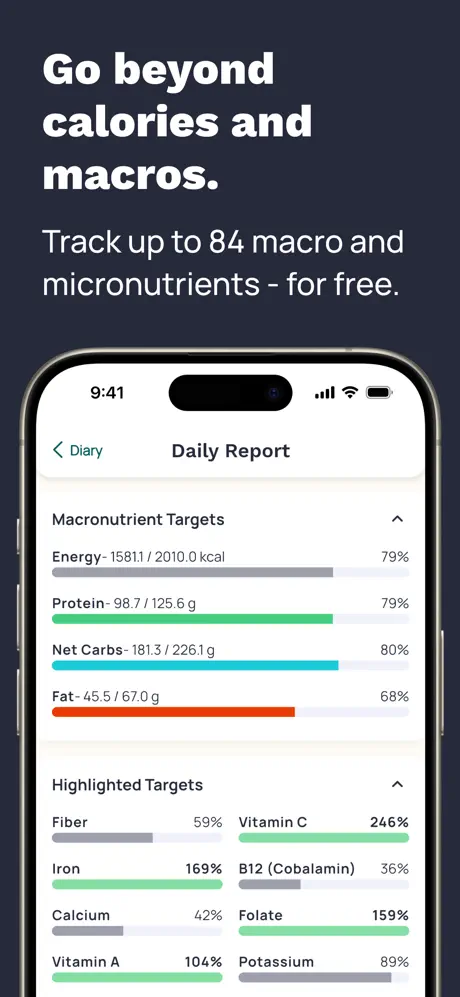
Cronometer is a nutrition tracking app built on the USDA National Nutrient Database and verified institutional sources. It is the most data-accurate consumer nutrition tracker available. Every food entry has been verified against published nutritional research, and the app tracks over 80 micronutrients including full amino acid profiles, individual B vitamins, trace minerals like selenium and manganese, omega fatty acid breakdowns, and the complete vitamin spectrum.
The app provides free barcode scanning that pulls from its verified database, a functional free tier with no ads, and a Gold subscription at $5.49 per month for advanced reporting. The interface is data-dense and functional, designed for users who want to see every nutrient rather than a simplified dashboard.
Cronometer's trade-offs are consistent: a smaller database than crowd-sourced competitors (some brand-name products may be missing), no Apple Watch app, no coaching or adaptive goals, a Daily Report that scroll-resets on every interaction, and a display model that shows consumed totals without remaining calculations. You get unmatched data accuracy and depth in exchange for a more demanding daily experience.
02About MyFitnessPal
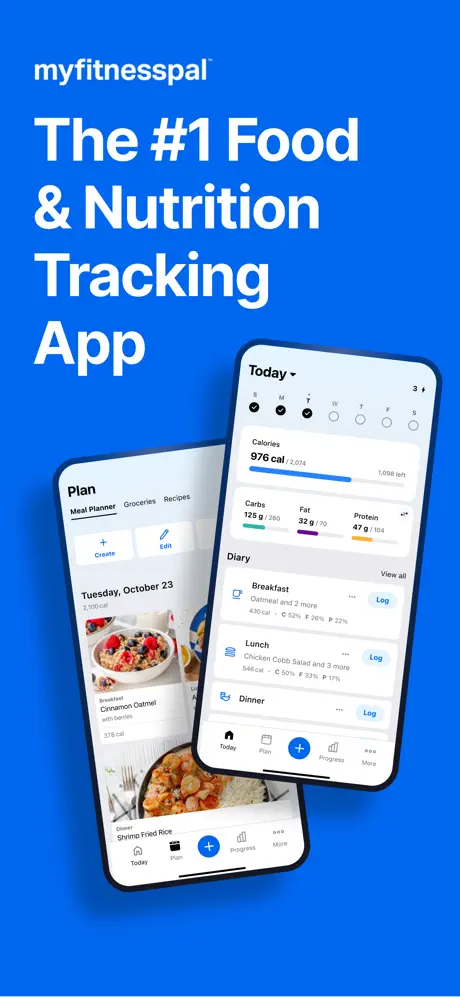
MyFitnessPal is the most widely recognized nutrition tracking app in the world, with over 14 million entries in its food database. This is the largest in the category. It has been the default recommendation for calorie counting for over a decade, built on the premise that a massive database means you can find anything you eat.
That database is crowd-sourced, which is both its greatest strength and its most persistent weakness. Coverage is unmatched, with almost any packaged food, restaurant meal, or generic item able to be found. But quality varies entry to entry because anyone can contribute data. Users regularly encounter duplicate entries for the same product with different nutritional values, incorrect macro data, outdated formulations for reformulated products, and serving sizes that do not match the actual package.
MyFitnessPal's monetization has become aggressive in recent years. The barcode scanner (arguably the most essential feature of any food tracking app) is now locked behind the Premium subscription at $19.99 per month. The free tier includes intrusive advertising, including graphic food imagery that surfaces in your log feed. Basic Apple Watch logging is available, and the app integrates with a wide ecosystem of fitness devices and apps.
Like Cronometer, MyFitnessPal provides no coaching, just a static calorie target based on your goal. The target does not adapt to your actual behavior, progress, or metabolic changes over time. Apple Health sync is partial, with documented double-counting issues when used alongside certain wearables.
03Verified database quality vs database scale
Winner: Context-dependent
This is the core trade-off between these two apps, and neither approach is universally better.
Cronometer's database is smaller but trustworthy. Every entry comes from USDA-verified or equivalent institutional sources with laboratory-measured values. You might not find a specific artisanal granola brand, but what you do find is accurate. The nutritional data for whole foods, common ingredients, and major brands is comprehensive and reliable.
MyFitnessPal's database is massive but inconsistent. You can find almost anything, from a specific flavor of a regional protein bar to a restaurant chain's seasonal menu item to a foreign snack food. But the accuracy of that entry is unknowable without cross-referencing the package label yourself. For users who eat primarily packaged foods from diverse brands and want to log quickly, the breadth is valuable. For users who need to trust the numbers, the inconsistency is a problem.
The practical question: do you need to find everything, or do you need everything you find to be right?
For users who eat primarily whole foods and common ingredients, Cronometer's verified database covers nearly everything they need. The coverage gap becomes noticeable mainly with niche packaged products, regional brands, and restaurant-specific menu items. For users whose diet includes a wide variety of packaged and restaurant foods, MyFitnessPal's breadth reduces the friction of manual entry, even though the accuracy of any given entry may be uncertain.
04Micronutrient depth vs macros only
Winner: Cronometer
Cronometer tracks over 80 micronutrients with institutional-grade verified accuracy. This includes every vitamin from A through K with individual B-vitamin subtypes, essential and trace minerals including selenium, chromium, manganese, and molybdenum, all essential amino acids and most non-essential ones, and omega-3 and omega-6 fatty acid ratios.
MyFitnessPal offers limited micronutrient visibility, mostly locked behind Premium, and the data comes from the same crowd-sourced database. Whatever micronutrient data does exist may not be accurate. The focus is firmly on calories and macros.
For users tracking nutrition at the micronutrient level (managing a deficiency, optimizing for specific health markers, or monitoring amino acid intake for athletic performance), Cronometer is in a fundamentally different category. This is not a feature gap. It is a category difference.
If you want to know whether your plant-based diet provides adequate B12, whether your zinc-to-copper ratio is balanced, or how your daily selenium intake compares to recommended levels, Cronometer answers those questions with verified data. MyFitnessPal cannot even surface the questions, let alone provide trustworthy answers.
05Barcode Scanning and Logging
Winner: Cronometer
MyFitnessPal used to include barcode scanning in its free tier. It has since moved the scanner behind a $19.99 per month Premium paywall, which changes the equation dramatically.
Cronometer offers free barcode scanning that returns verified data. You scan a product, get accurate institutional-grade nutritional information, and log it. No paywall, no subscription required for the scanner itself.
MyFitnessPal charges $19.99 per month for barcode scanning that returns crowd-sourced data of variable accuracy. You pay nearly four times what Cronometer Gold costs for a scanner that may not even give you the right numbers.
For users who rely on barcode scanning as their primary logging method, Cronometer is the clear winner on both access and accuracy.
The barcode paywall is worth emphasizing because scanning is a basic utility that every other major nutrition app provides for free or at a fraction of the cost. Paywalling it at $19.99 per month fundamentally changes MyFitnessPal's value proposition for the millions of users who relied on it as a free feature for years.
06Advertising and Monetization
Winner: Cronometer
Cronometer has no ads in its free tier. The Gold upgrade adds features without removing annoyances because there are no annoyances to remove.
MyFitnessPal's free tier is saturated with advertising. Banner ads appear throughout the interface. Graphic food imagery (photos of meals from advertisers) surfaces in the log feed, which is the screen you look at most often. The experience feels like it is designed to be uncomfortable enough to push you toward Premium, where the ads disappear.
For an app you open multiple times per day, the advertising environment matters. Cronometer lets you focus on your data. MyFitnessPal's free tier constantly competes for your attention.
The graphic food imagery in the log feed deserves specific mention. When you are logging meals and trying to be mindful about eating, seeing advertisement photos of indulgent food directly in your tracking interface works against the purpose of the app. It is a monetization choice that actively undermines the user's goal.
07Apple Watch logging and Health sync
Winner: MyFitnessPal (slight)
MyFitnessPal offers basic Apple Watch logging that lets you log foods and view calorie progress from the wrist. Detailed tracking still requires the phone, but it exists.
Cronometer has no Apple Watch app at all. Its Apple Health sync is partial, with documented re-import gaps where historical data fails to backfill after sync interruptions.
MyFitnessPal's Apple Health sync also has issues (documented double-counting with certain wearables where exercise calories get added twice, inflating your daily budget), but it offers at least basic Watch access, which Cronometer does not.
Neither app delivers a strong Apple ecosystem experience. MyFitnessPal's edge here is real but modest.
08Coaching style and daily feedback
Winner: Draw
Neither app offers coaching. Cronometer displays verified data without interpreting it. MyFitnessPal sets a static calorie target without adapting it. Neither provides actionable daily guidance, adaptive goals based on your behavior, or any form of coaching loop.
Both apps assume you will figure out what to do with the data on your own. For users who want guidance alongside their numbers (actionable recommendations about what to eat next, adaptive targets that respond to your behavior, or explanations of what your data means), both apps leave the same gap. Data without interpretation requires the user to be their own nutritionist.
09Free tiers and paid walls
Winner: Cronometer
Cronometer Gold costs $5.49 per month and includes verified data, 80+ micronutrients, free barcode scanning, and no ads. The free tier is usable for daily tracking.
MyFitnessPal Premium costs $19.99 per month (more than three and a half times the price) for crowd-sourced data, basic micronutrient visibility, barcode scanning that should arguably be a free feature, and ad removal. The free tier is functional for manual food search but is cluttered with advertising.
On pure value, Cronometer delivers more accurate data, deeper nutrient tracking, and a cleaner experience at a fraction of the cost. MyFitnessPal's price point is justifiable only if the 14M-entry database coverage is something you genuinely need and cannot substitute with manual entry in Cronometer.
The value comparison becomes even more stark when you consider that MyFitnessPal was a free product for most of its history. Many long-time users feel that features they relied on for years (particularly barcode scanning) were taken away and sold back to them at a premium. Cronometer's pricing model has been more consistent, and the free tier has never been deliberately degraded to push upgrades.
10Who should pick Cronometer
Cronometer is the right choice for users who need verified data accuracy and micronutrient depth. If you care about nutrition beyond calories and macros, if you are managing a health condition through diet, if you are optimizing athletic nutrition at a granular level, or if you simply want to trust every number you see, Cronometer is unmatched. It is also the better value, offering more accurate data, free barcode scanning, no ads, at roughly a quarter of MyFitnessPal Premium's price.
11Who should pick MyFitnessPal
MyFitnessPal is the right choice for users who need the broadest possible food coverage and prioritize finding any food quickly over per-entry accuracy. If you eat a diverse range of packaged foods, frequently dine at restaurant chains, and want the highest probability of finding an exact match without manual entry, MyFitnessPal's 14M-entry database is hard to beat. The community ecosystem and third-party integrations also add value for users embedded in that world. The social features (friends lists, challenges, and community forums) give MyFitnessPal a network effect that Cronometer lacks entirely. Just understand the accuracy trade-offs and the aggressive monetization that come with the platform.
12Final pick based on your priority
Cronometer and MyFitnessPal optimize for different things. Cronometer gives you verified data you can trust at the food level, with micronutrient depth that no competitor matches, at a price that makes MyFitnessPal Premium look expensive. MyFitnessPal gives you the largest database and the highest chance of finding any food instantly, but the data quality is inconsistent and the monetization is heavy. For most health-conscious users, Cronometer delivers more value at a lower price. For users who need database breadth above all else and are willing to pay for the convenience of finding any food instantly, MyFitnessPal's scale remains unmatched in the category.
Neither app offers coaching, adaptive goals, or a strong Apple ecosystem experience. If you want accurate data with AI logging, daily coaching, and full Apple Watch support at a fraction of MyFitnessPal's price, Fuel delivers adaptive daily guidance without database anxiety or upsell pressure.