

Key Takeaways
- Carb Manager is the better keto toolkit with meal plans, net carb tracking, and a recipe library that MacroFactor does not offer. - MacroFactor is the better coaching tool with an adaptive expenditure model that recalibrates your targets based on real body data. Something Carb Manager cannot do. - Carb Manager still lacks an Apple Watch companion, while MacroFactor now offers a narrower Watch app, but MacroFactor's lack of a free tier and weak international database remain significant barriers for some users.
01About Carb Manager
Carb Manager is a nutrition tracking app purpose-built for keto and low-carb diets. It centers on net carb tracking with proper fiber and sugar alcohol subtraction, ketosis targets that monitor your daily carb range, a weekly meal plan builder with a large keto recipe library, and free barcode scanning on all tiers. The app provides a structured, prescriptive framework for keto adherents: here are the targets, here are the meals, here are the recipes, now execute. Carb Manager Premium costs $7.99 per month and a functional free tier covers basic tracking and barcode scanning. There is no adaptive coaching, no Apple Watch app, and limited value outside of keto.
02About MacroFactor
MacroFactor is a macro tracking app built around an adaptive expenditure model that fundamentally differentiates it from every other nutrition tracker on the market. Rather than giving you a static calorie target calculated from a formula, MacroFactor uses your logged food intake and body weight trends over time to estimate your true energy expenditure, then continuously recalibrates your macro targets to match what your body is actually doing. The app is entirely diet-agnostic, works for any macro split or dietary framework with equal effectiveness. MacroFactor costs $11.99 per month with no free tier and no trial period. There are no meal plans, no recipes, and the food database has documented gaps outside North America. MacroFactor now has a Watch app with core logging and weight tracking, though the wearable story is still narrower than more Apple-centric products.
03Prescriptive keto framework vs adaptive targets
This is the fundamental and most important difference between these two apps, and it shapes every other comparison point. Carb Manager gives you a prescriptive keto framework: follow these net carb targets, use these meal plans, cook these recipes, and check your ketosis compliance. The targets are static. Set once based on your stated goals and profile, they are adjusted only if you manually change them. The app tells you what to do and provides tools to help you do it, but it does not learn from your results or adjust its guidance based on how your body actually responds.
MacroFactor gives you adaptive intelligence that evolves with your body. Log your food and weight consistently, and the app will model your actual energy expenditure. Not an estimate from a formula, it's a calculated value derived from your real data. If the formula says you should maintain at 2,200 calories but your weight trend shows maintenance at 2,400, MacroFactor adjusts to reality. This kind of responsive, data-driven coaching is unique among mainstream nutrition trackers. The trade-off is that MacroFactor does not tell you what to eat. It tells you how much to eat and trusts you to figure out the composition yourself.
Winner MacroFactor. Adaptive coaching that responds to your body's actual metabolism is a fundamentally more powerful approach than static targets based on formulas.
04Meal Planning and Recipe Support
Carb Manager's meal plan builder is its strongest differentiating feature and one that MacroFactor deliberately does not offer. Users can generate weekly keto meal plans tuned to their macro targets, browse a large library of keto-specific recipes with complete nutritional breakdowns already calculated, and produce consolidated shopping lists that cover every ingredient for the week. For keto adherents who struggle with meal variety, who want structured eating guidance, or who simply want someone else to solve the daily puzzle of what to eat while staying in ketosis, this feature addresses a genuine and persistent need.
The execution has well-documented shortcomings. The plan builder crashes mid-session, losing progress without recovery. Preference filters do not work reliably. Dietary restrictions like "no seafood" or "no dairy" may still surface excluded ingredients. The multi-step workflow for customizing a weekly plan involves more taps and screen changes than the task warrants. Despite these issues, an imperfect meal planner is a tangible feature that many users rely on and that MacroFactor simply does not provide at any level.
MacroFactor's deliberate omission of meal planning reflects its philosophy: the app focuses on making your nutritional targets intelligent and accurate, then trusts you to fill those targets however you choose. This approach works well for experienced meal preppers and trackers who enjoy building their own meals. It fails users who want any guidance on what to cook or eat.
Winner Carb Manager. Having a meal planner with recipes and shopping lists, even an imperfect one, is a significant practical advantage for users who want dietary structure.
05Food Database and Logging Experience
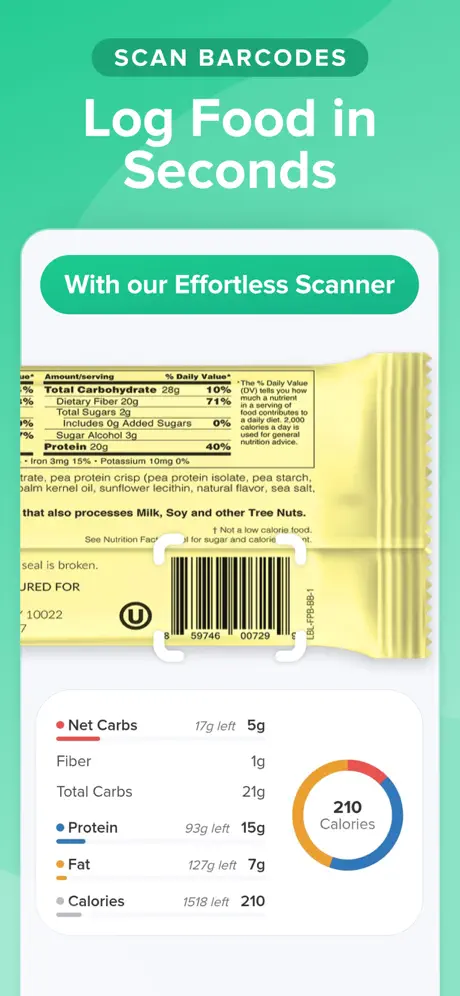
Both apps use database search and barcode scanning as their primary logging methods. Carb Manager's database combines crowd-sourced entries with curated keto items, and barcode scanning is free on all tiers including the free version. Keto-specific products are well-represented, and net carb calculations are handled automatically when you scan or select foods. The logging experience is manual and somewhat tedious. Copying meals from previous days requires multiple taps with no bulk option, but the data for keto foods is reliable and well-maintained.
MacroFactor's database is competent within North America but has meaningful coverage gaps internationally. European users in particular report that many regional foods, supermarket products, and restaurant items are missing, making the app difficult to use without extensive manual entry. Adding custom foods works but defeats the purpose of using a database-driven tracker for speed. Within the US and Canada, the logging experience is solid and the barcode scanner handles most packaged products. But for users outside those markets, the database limitations represent a practical barrier that may make MacroFactor unworkable as a daily tool.
Winner Carb Manager. Free barcode scanning on all tiers and broader international coverage give it a more accessible logging experience for a wider audience.
06Free Tier and Pricing Accessibility
Carb Manager offers a functional free tier that includes basic calorie and macro tracking, barcode scanning, and limited recipe access. Users can evaluate the core tracking experience, scan their groceries, and decide whether the keto-specific premium features (meal planning, expanded recipes, advanced analytics) justify the $7.99 monthly upgrade. This lowers the barrier to entry and gives prospective users a risk-free path to adoption.
MacroFactor has no free tier at all. The app costs $11.99 per month from day one, and there is no trial period to evaluate the adaptive expenditure model before committing financially. This is particularly notable because MacroFactor's core value proposition (the adaptive model) requires several weeks of consistent logging and regular weigh-ins before it generates meaningful results. Users are asked to pay $11.99 per month for weeks before the app's unique feature becomes useful. For an app that positions itself as data-driven and evidence-based, asking users to commit financially without evidence that the model works for them is a significant friction point.
Winner Carb Manager. A functional free tier and lower monthly price make it dramatically more accessible than MacroFactor's fully paywalled entry point.
07Apple Watch and Wearable Support
Carb Manager still does not offer an Apple Watch companion app. MacroFactor now has a Watch app with core logging and weight tracking, which gives it a practical wrist presence even if the experience remains limited. In a category where Apple Watch integration is increasingly common and expected, that is now a real advantage over Carb Manager's phone-only workflow.
Winner MacroFactor. Limited Watch utility is still better than none.
08Ease of first week vs steep setup
Carb Manager's interface is organized around keto concepts that most keto adherents already understand: net carbs, ketosis ranges, macro ratios. The learning curve is modest for users who are familiar with low-carb eating. New keto users may need to learn the terminology, but the app does not require any technical sophistication beyond basic nutrition literacy. The meal plan builder adds complexity, but using it is optional. The core tracking experience is accessible from day one.
MacroFactor's adaptive model introduces a steeper learning curve. Understanding how the expenditure algorithm works, why your targets change week to week, and how to interpret the trend analytics requires a level of engagement that casual trackers may not want to invest. MacroFactor is built for users who are willing to trust a system they may not fully understand at first and to log consistently for weeks before the model generates meaningful adaptive results. The app rewards patience and consistency with increasingly accurate and personalized coaching, but the onboarding period where you are paying $11.99 per month without seeing the model's full value can feel like a leap of faith.
Winner Carb Manager. Simpler onboarding and immediate value from day one, while MacroFactor requires weeks of consistent use before its core feature delivers meaningful results.
09International Usability and Database Coverage
Carb Manager's crowd-sourced database, while not perfectly global, includes enough international products and food entries to be functional outside North America. The keto community is worldwide, and contributed entries from users in Europe, Australia, and other regions cover popular low-carb products and regional staples. The experience may not be as seamless as for US users, but it is workable for daily tracking without requiring extensive custom food creation.
MacroFactor's database struggles meaningfully outside North America. European users report that common supermarket products, regional foods, and restaurant menu items are frequently missing. Using the app requires adding many foods manually, which is time-consuming and undermines the efficiency that a database-driven tracker is supposed to provide. For users not based in the US or Canada, this limitation may disqualify MacroFactor entirely, regardless of how compelling the adaptive coaching model is.
Winner Carb Manager. Functional internationally where MacroFactor is not, giving it a broader addressable audience.
10Who should pick Carb Manager vs MacroFactor
Choose Carb Manager if you are committed to keto and want a complete, structured toolkit (meal plans, recipes, net carb tracking, and ketosis targets) at $7.99 per month with a free tier to get started. The app gives you a dietary framework to follow and tools to execute it effectively. Accept the meal planner's documented stability issues and the static nature of the macro targets that do not adapt to your body's actual response.
Choose MacroFactor if you are a serious, experienced tracker on any diet who wants scientifically grounded adaptive coaching that recalibrates to your body's actual metabolism. The expenditure model is genuinely unique and powerful for users who log consistently and weigh in regularly. Accept the $11.99 monthly cost with no free trial, the absence of meal planning or recipe guidance, and the database gaps that may make the app unusable if you live outside North America.
11Final pick based on your priority
Carb Manager and MacroFactor represent two fundamentally different approaches to nutrition tracking that serve different users with different needs. Carb Manager is the structured keto toolkit: prescriptive, meal-plan-driven, accessible in price, and focused on helping you follow a specific dietary framework with dedicated tools. MacroFactor is the adaptive coaching engine: responsive, data-driven, diet-agnostic, and focused on making your nutritional targets match your body's reality rather than a formula's estimate. Neither is objectively better. The right choice depends entirely on whether you need a framework to follow or intelligent targets that evolve.
Both apps share notable gaps around AI-powered logging and limited appeal beyond their core audiences. Carb Manager's value collapses outside keto. MacroFactor's value collapses outside North America. MacroFactor now has a narrower Watch app, but neither product offers a broad Apple ecosystem experience.
Looking for adaptive coaching with meal planning flexibility and global coverage? Fuel combines a living plan timeline with AI logging, Apple Watch support, and a coached free week. No geographic limitations and no diet-specific constraints.
Frequently Asked Questions
Is Carb Manager or MacroFactor better for keto?
Carb Manager is better for keto specifically. It offers net carb tracking, ketosis targets, keto meal plans, and a keto recipe library. Tools MacroFactor does not have. MacroFactor can track a keto diet, but it treats keto the same as any other macro split without specialized tooling.
Does MacroFactor really adjust your calories automatically?
Yes. MacroFactor's adaptive expenditure model uses your logged food intake and body weight trends to estimate your true energy expenditure, then recalibrates your macro targets over time. No other mainstream tracker does this, and the model requires consistent logging and regular weigh-ins to be accurate.
Which app has a free version?
Only Carb Manager offers a free tier. MacroFactor is fully paywalled at $11.99/month with no free option. You can evaluate MacroFactor's approach before committing, but you cannot use the app without paying.
Do either app work with Apple Watch?
MacroFactor now offers a Watch app with core logging and weight tracking. Carb Manager still does not offer an Apple Watch companion app.
Is MacroFactor usable outside the US?
MacroFactor's database has meaningful gaps outside North America. European users in particular report it as difficult to use without extensive manual entry. Carb Manager's database is also US-focused but less problematic internationally due to its crowd-sourced entries.