
Key Takeaways
- Carb Manager is the stronger choice for committed keto users who want a structured meal planning ecosystem with reliable net carb tracking and free barcode scanning. - Lifesum offers broader diet flexibility and AI-powered logging, but the AI pivot has introduced reliability issues that undermine the daily tracking experience. - Neither app offers coaching, adaptive goals, or Apple Watch support. Lifesum's higher price point makes the value gap wider for keto users.
01About Carb Manager
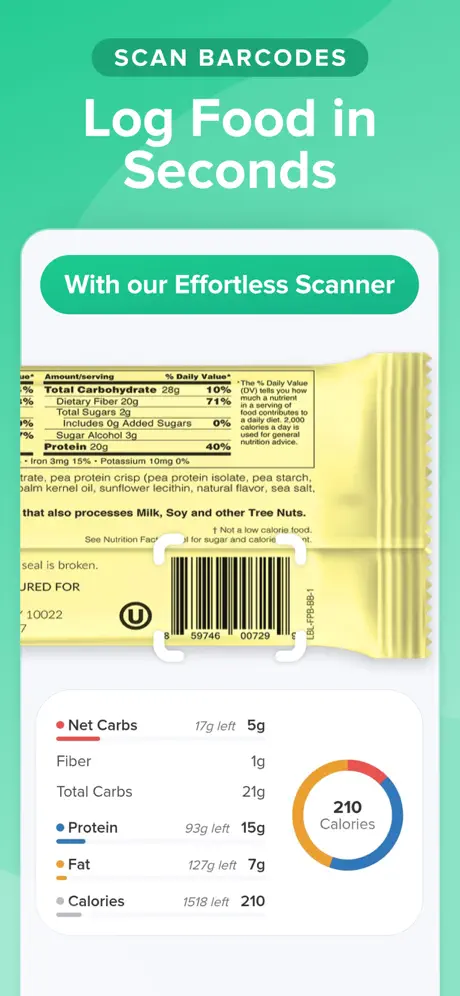
Carb Manager is a nutrition tracking app designed specifically for keto and low-carb diets. It features net carb tracking that properly subtracts fiber and sugar alcohols, ketosis targets that monitor whether you stay in your desired carb range, a weekly meal plan builder with a large keto recipe library, and free barcode scanning on all tiers. The app's value is concentrated in its keto-specific tooling. Meal plans, recipes, and macro targets are all tuned for low-carb eating, with proper handling of the nuances that matter to keto adherents. Carb Manager Premium costs $7.99 per month and unlocks the full meal planning suite and expanded recipe access. The app does not offer coaching, AI-powered logging, or an Apple Watch companion.
02About Lifesum
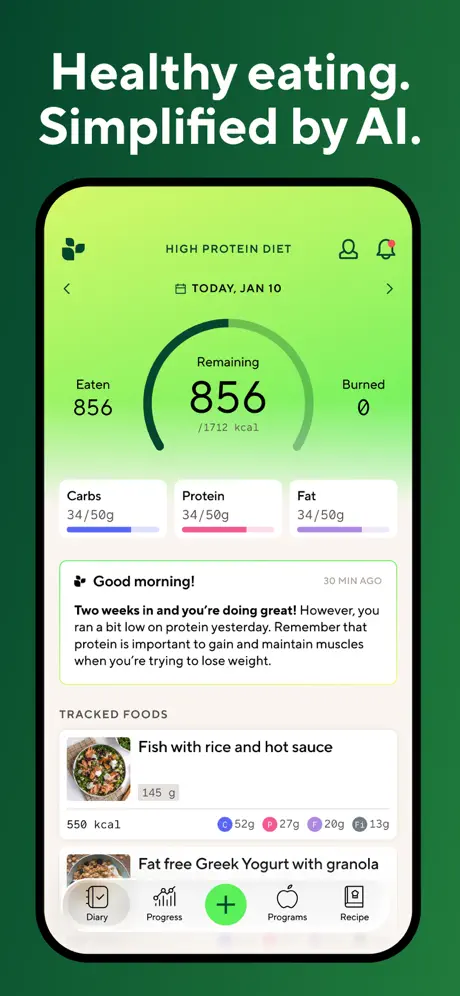
Lifesum is a nutrition and lifestyle tracking app that recently pivoted to AI-powered food logging as its core differentiator. The app offers multiple diet plan options (including keto, Mediterranean, high-protein, Scandinavian, and general calorie counting) along with lifestyle scoring that evaluates your overall wellness habits and an approachable visual design that makes the experience feel less clinical than many competitors. Lifesum's AI logging uses text input to identify foods and log them without manual database search. The app costs $9.99 per month for Premium, which unlocks diet plans, recipes, and extended tracking features. Lifesum does not offer coaching, adaptive goals, or an Apple Watch companion.
03Food Logging Speed and Accuracy
Carb Manager uses traditional database search paired with free barcode scanning. The logging process is manual. You search for a food item, select it from results, confirm the serving size, and the entry is added to your log. It is not fast by modern standards, but it produces reliable numbers you can trust. Keto-specific entries include proper net carb calculations with fiber and sugar alcohol subtraction already handled, so you do not need to do the math yourself. Barcode scanning is available on the free tier, which matters because scanning is the fastest way to log packaged foods and many competitors lock it behind premium subscriptions.
Lifesum's AI text logging is conceptually faster and more modern. Type a description of what you ate and the AI identifies the food and logs the entry automatically. In practice, the execution undermines the concept. Accuracy is inconsistent. The AI sometimes misidentifies foods, assigns incorrect portion sizes, or generates calorie counts that do not match the actual item. More critically, the ability to correct AI-generated entries was removed in the AI update, which means errors persist in your daily totals with no way to fix them. Meal structure was replaced with a flat list that sometimes assigns foods to the wrong meal slot. A breakfast item appears under dinner, or a snack is counted as lunch. The tracker also breaks after app updates, requiring full reinstallation to restore functionality.
Winner Carb Manager. Slower but reliable logging beats faster logging you cannot correct when it makes mistakes.
04Dietary Framework and Flexibility
Lifesum offers meaningfully broader dietary flexibility. Multiple diet plan options (keto, Mediterranean, high-protein, Scandinavian, and general calorie counting among them) give users the ability to experiment with different nutritional frameworks or switch approaches over time without changing apps. The lifestyle scoring feature adds a wellness dimension beyond pure nutrition tracking, evaluating hydration, meal timing, and food quality alongside calorie counts. For users who are not committed to a single dietary approach and want to explore what works best for their body, Lifesum's breadth is a genuine advantage.
Carb Manager is narrowly and intentionally focused on keto and low-carb eating. Within that niche, the tooling runs deep and the experience is purposeful. Every feature from net carb calculations to recipe suggestions to meal plan generation is organized around helping you succeed on a low-carb diet. But if your dietary needs change, if you want to try Mediterranean eating for heart health or simply count calories without the keto overlay, much of Carb Manager's premium value becomes irrelevant. The general tracking capability exists but feels like an afterthought compared to the keto-specific experience. Users who are uncertain about their long-term dietary approach may find Carb Manager's narrow focus limiting.
Winner Lifesum. More diet plan options and greater flexibility for users whose dietary approach may evolve over time.
05Meal Planning and Recipes
Carb Manager's meal plan builder is its most distinctive and differentiated feature. Users can generate weekly meal plans tuned to their keto macro targets, browse keto-specific recipes with complete nutritional breakdowns, and produce shopping lists that consolidate ingredients across the week. The concept fills a genuine gap in nutrition apps. Structured weekly meal planning removes daily decision fatigue and ensures macro compliance. The execution is unfortunately inconsistent: the builder crashes mid-session and loses progress, preference filters do not always work (marking "no seafood" can still surface salmon and shrimp recipes), and the multi-step workflow requires more taps than necessary. When it works, the planner saves significant time and mental energy. When it fails, it wastes both.
Lifesum offers diet plans and recipes behind its Premium subscription. These plans provide general guidelines for different dietary approaches and include recipe suggestions, but they are less specialized than Carb Manager's keto meal plans and less integrated into the daily logging workflow. Recipes are available for browsing but are not organized into structured weekly meal plans with shopping lists and macro alignment. For users who want general meal inspiration rather than a structured weekly cadence, Lifesum's approach is adequate but shallower than what Carb Manager provides.
Winner Carb Manager. A flawed meal planner with structured weekly plans and shopping lists is still more useful than diet plans that lack that organizational depth.
06Crashes and day-to-day stability
Carb Manager's core tracking experience is generally stable. The meal plan builder has well-documented stability issues, but the fundamental daily workflow (searching for foods, scanning barcodes, reviewing daily totals, checking macro progress) works reliably day to day. App updates do not typically break core functionality, and users can count on the logging experience being available when they need it. The stability issues are concentrated in the meal planning feature rather than spread across the entire application.
Lifesum's stability took a meaningful hit with the AI pivot. Users report that the AI tracker breaks after routine app updates, requiring a full reinstallation to restore logging functionality. Reinstalling can reset preferences and logged data, compounding the frustration. When the app works, the experience is pleasant. Lifesum's design is approachable, the interface is visually clean, and the daily flow is inviting. But a nutrition tracker needs to work every single day to be useful. Consistency in a tracking habit depends on the tool being available without friction, and an app that breaks after updates introduces unpredictable gaps in the tracking experience that are hard to recover from.
Winner Carb Manager. The core tracking must work reliably every day, and Carb Manager delivers that consistency where Lifesum currently does not.
07Apple Watch and Wearable Support
Neither Carb Manager nor Lifesum offers an Apple Watch companion app. This is a shared gap that affects users who want quick logging or nutrition data accessible from their wrist throughout the day. Both apps have limited Apple Health integration but neither extends meaningfully to wearable devices in a way that enhances the tracking experience. For users who consider Apple Watch support a requirement or who want to check daily progress without pulling out their phone during meals, both apps fall equally short. This gap is increasingly notable as competitors add wearable features.
Winner Draw. Neither app supports Apple Watch.
08Data Correction and Error Handling
When a food logging system makes a mistake (whether through AI misidentification, a wrong database entry, or an incorrect serving size), the ability to correct that error quickly and easily is essential. Carb Manager handles this straightforwardly: because logging is manual and database-driven, every entry can be edited after the fact. If a barcode scan returns the wrong product, you delete it and search again. If a serving size is wrong, you tap the entry and change it. The correction workflow is not elegant, but it works.
Lifesum's AI logging creates a fundamentally different problem. The AI update removed the ability to correct AI-generated entries after they are logged. If the AI misidentifies your food, assigns the wrong portion, or generates an incorrect calorie count, that error sits in your daily log permanently. Over the course of a day with multiple AI-logged meals, these uncorrectable errors can compound into daily totals that do not reflect what you actually ate. For a tool whose entire purpose is accurate food tracking, the inability to fix mistakes is a serious design flaw that undermines the core value proposition of the AI approach.
Winner Carb Manager. Every entry can be corrected, while Lifesum's AI entries cannot be fixed after logging.
09Free tiers and paid walls
Carb Manager Premium costs $7.99 per month. Lifesum Premium costs $9.99 per month. The $2 monthly difference adds up to $24 per year, and Carb Manager includes free barcode scanning on its free tier, a practical advantage for daily logging. For keto users specifically, Carb Manager delivers more relevant features at a lower price: meal plans, keto recipes, net carb tracking, and ketosis targets are all included. For general diet users, Lifesum's broader diet plan options and AI logging concept may justify the premium, though the AI stability issues reduce the value you actually realize from that higher price.
Both apps offer functional free tiers, though the most valuable features on each side (meal planning for Carb Manager, diet plans and full recipe access for Lifesum) require the paid subscription. Neither free tier feels aggressively crippled, but both clearly save the best tools for paying customers.
Winner Carb Manager. Lower price with free barcode scanning and more stable premium features makes the better value proposition.
10Who should pick Carb Manager vs Lifesum
Choose Carb Manager if you follow a keto or low-carb diet and want a structured ecosystem built specifically for that approach. The meal plan builder, keto recipe library, net carb tracking, free barcode scanning, and stable core tracking create a toolkit that general-purpose apps do not replicate. Accept the meal planner's documented stability issues and the reality that the app's value diminishes if you move away from keto eating.
Choose Lifesum if you want broader dietary flexibility and are drawn to AI-powered logging as a modern approach to food tracking. Multiple diet plan options and lifestyle scoring offer a wider wellness perspective that accommodates dietary experimentation. Accept that the AI logging has accuracy gaps you cannot correct, that the app may break after routine updates, and that the $9.99 monthly price buys a less stable premium experience.
11Final pick based on your priority
Carb Manager is the better value for keto-committed users. Purpose-built tools, reliable core tracking, free barcode scanning, and a lower monthly price make a straightforward case. Lifesum offers more dietary range and a forward-looking AI logging concept, but the execution has not caught up to the ambition. Uncorrectable AI entries, post-update breakage, and a higher price point create friction that offsets the flexibility advantage for many users.
Neither app offers coaching, adaptive goals, or Apple Watch integration. Both leave users to interpret data and make adjustments on their own, with no daily feedback loop to guide behavior change or adapt targets based on real progress.
Looking for AI logging that works with corrections built in? Fuel delivers correctable AI logging, adaptive coaching, and Apple Watch support across any dietary framework, at a lower price than either app.
Frequently Asked Questions
Is Carb Manager or Lifesum better for keto?
Carb Manager is significantly better for keto. It offers purpose-built net carb tracking, ketosis targets, keto meal plans, and a keto recipe library. Lifesum includes keto as one of several diet plan options but does not offer the same depth of keto-specific tooling.
Does Lifesum AI logging actually work?
Lifesum's AI text logging is fast in concept but has accuracy concerns. The ability to correct AI-generated entries was removed in the AI update, and meal structure was replaced with a flat list that can assign foods to the wrong meal slots. Users report the tracker breaking after app updates.
Which app is cheaper, Carb Manager or Lifesum?
Carb Manager Premium costs $7.99/month. Lifesum Premium costs $9.99/month. Both offer free tiers, but Carb Manager is $2/month cheaper at the premium level and includes free barcode scanning that Lifesum does not emphasize.
Do Carb Manager or Lifesum work with Apple Watch?
No. Neither app offers an Apple Watch companion. Users who want wrist-based nutrition logging need to look at other options.
Can I use Carb Manager for non-keto diets?
Yes, but much of its value (net carb tracking, ketosis targets, keto recipes, keto meal plans) is keto-specific. If you follow a different dietary framework, the app still tracks calories and macros but you lose the specialized features that justify its premium.