
App Comparison
Cal AI vs YAZIO
Fuel Nutrition Team • March 22, 2026
Cal AI

YAZIO

Core approach
Food logging
UI polish
Fasting
Data integrity
Gamification
Apple Watch
Price
Cal AI and YAZIO take different approaches to the same goal: make calorie tracking easy enough that people actually stick with it. Cal AI eliminates logging steps with photo AI — snap a picture and skip the database entirely. YAZIO polishes the traditional tracking interface until it feels effortless, then layers on fasting tools and gamification. Both have data integrity problems that undermine trust in the numbers they display, but the daily experiences they offer and the users they serve diverge significantly.
Key Takeaways
- Cal AI is the fastest logger but produces AI estimates that are frequently inaccurate, with corrections that do not persist and no features beyond basic tracking. - YAZIO offers one of the most polished tracking experiences in the category with fasting tools and gamification, but has data integrity issues including phantom entries and values that do not match package labels. - Neither app offers coaching or adaptive goals, but YAZIO provides a broader daily wellness experience.
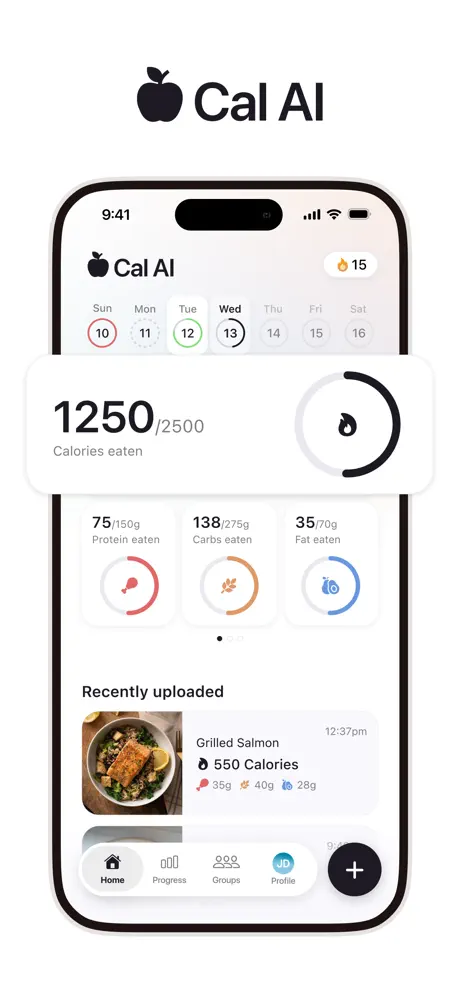
Cal AI is a photo-first calorie tracking app that uses AI to estimate macronutrients from pictures of your food. The product is built entirely around the camera-to-calories pipeline: take a photo, get numbers. Cal AI was acquired by MyFitnessPal in December 2025 and continues operating as a standalone product. It targets users who find traditional food logging too tedious, offering the lowest possible effort per meal at the cost of accuracy. Users report the AI frequently misidentifies dishes, assigns incorrect portion sizes, produces macro math errors, and does not retain corrections between sessions.
YAZIO is a European-origin calorie tracking app known for its visual polish and broad feature set. The app uses database search and barcode scanning for food logging, wrapped in one of the cleanest, most visually appealing interfaces in the category. YAZIO includes intermittent fasting timers (16:8, 14:10, and custom schedules), a gamification system with "diamond chests" for consistent tracking, and a recipe section. Pro is $6.99/month. The app's main weaknesses are data integrity issues — nutrition values that do not match package labels, phantom entries that appear without user input, and a calendar that breaks after updates.
Cal AI's photo logging is the fastest input method in nutrition tracking. No database navigation, no barcode scanning, no portion selection. Point the camera, tap, and the AI returns calorie and macro estimates in seconds. For users who eat homemade or unpackaged meals where there is no barcode to scan, this approach eliminates the most time-consuming parts of logging. The failure mode is accuracy: the AI confuses visually similar dishes, defaults to generic portion sizes, and produces macro splits where the grams do not add up to the stated calorie total.
YAZIO's logging is traditional but refined. The food search is fast, the interface is clean, and barcode scanning works for packaged products. Selecting a food, choosing a serving size, and confirming the entry takes more taps than a photo snap — typically 10-15 seconds per item versus Cal AI's 3-5 seconds. But you can see exactly what you are logging, verify the nutritional data, and adjust portions to match what you actually ate. The extra effort produces more intentional entries.
Winner: Cal AI — for pure speed. YAZIO is slower but gives you more control and transparency over each entry.
Both apps have data integrity problems, but the nature of those problems differs. Cal AI's issues stem from its AI estimation approach. The AI is guessing what food is in your photo and how much of it there is, then producing approximate nutritional values. These guesses are frequently wrong — wrong food, wrong portion, wrong macros. The data is unreliable not because of a database error but because the entire input method is probabilistic.
YAZIO's issues are database-level. Users report nutrition values that do not match what is printed on the product's own packaging. Custom food entries sometimes trigger dead-end errors that prevent the entry from being saved. Most concerning are phantom entries — food items that appear in daily logs without the user adding them, inflating calorie and macro totals. These phantom entries are particularly problematic because a user reviewing their daily log may not notice that an entry they did not make is skewing their totals.
Winner: Tie — both have significant data integrity issues. Cal AI's are inherent to AI estimation; YAZIO's are database and software bugs. Neither inspires full confidence.
YAZIO includes an integrated intermittent fasting timer that supports 16:8, 14:10, and fully custom fasting windows. The timer displays your fasting progress visually, sends notifications when your eating window opens and closes, and records fasting history alongside your nutrition data in a unified timeline. For users who practice intermittent fasting, having this integrated into their calorie tracker eliminates the need for a separate fasting app and creates a single view of both what you eat and when you eat it. The feature is straightforward and works as described, with clean visual indicators that show your current fasting state at a glance.
YAZIO also includes a gamification system with "diamond chests" that reward consistent tracking behavior — logging streaks, meeting calorie targets, and staying within fasting windows. The concept is engaging and adds a motivational layer that pure tracking tools lack. However, users report the chest rewards do not always trigger as described — sometimes the reward mechanism fails silently, and earned rewards do not appear. There is also a recipe section that provides meal ideas linked directly to the tracker for easy logging.
Cal AI has no fasting tools, no gamification, no recipes, and no wellness features beyond photo-based calorie estimation. If intermittent fasting is part of your routine, Cal AI requires a separate app to track it. If you are motivated by streaks and rewards, Cal AI provides no such engagement layer.
Winner: YAZIO — integrated fasting tools and gamification add genuine daily value, even with the gamification reliability issues.
YAZIO is one of the most visually polished calorie trackers on the market. The color scheme is modern and inviting, the typography is clean and readable, and the daily dashboard presents calorie, macro, and fasting information in a layout that feels organized and welcoming rather than clinical. Charts are well-designed and easy to interpret at a glance, progress indicators use intuitive visual metaphors, and the overall aesthetic is a cut above most competitors in the health and fitness space. For users who interact with their tracker three to five times daily, interface quality materially affects the experience and can influence whether tracking feels like a chore or a natural part of the day.
Cal AI's interface is minimal by design. The camera view is the primary screen, and the calorie display is clean but sparse. There is less visual design to evaluate because there are fewer features to display — no fasting dashboard, no progress charts, no gamification elements, no recipe cards. The minimalism is effective for its narrow purpose but offers little visual reward for consistent use and no sense of progression over time.
Winner: YAZIO — one of the best-designed tracker interfaces in the category, and the polish contributes meaningfully to daily engagement.
YAZIO offers a basic Apple Watch app that displays daily calorie and macro summaries. It is not a full logging tool — you cannot log food from your wrist — but it provides at-a-glance access to your daily progress. Apple Health integration syncs calorie data and basic health metrics.
Cal AI's Apple Watch app is consistently described by users as non-functional. Apple Health sync is partial — water data flows but food data does not. For users who rely on their Apple Watch as a health dashboard, Cal AI is effectively absent.
Winner: YAZIO — basic but functional Apple Watch integration beats a non-functional one.
YAZIO offers a free tier with core tracking, database search, and barcode scanning. Pro at $6.99/month adds the fasting timer, advanced statistics, full recipe access, and an ad-lite experience. This is one of the more affordable paid tiers in the category, especially given the breadth of features included.
Cal AI is a free download, but it has a hard paywall during onboarding and there is no access to the app otherwise. In current testing, the annual offer shown varies between $19.99/year and $29.99/year. That is a lower nominal price than YAZIO Pro, but substantially worse value. No fasting tools, no recipes, no gamification, no database search.
Winner: YAZIO — a free tier plus an affordable Pro subscription with meaningfully more features.
Both apps experience issues around updates, but the patterns differ in ways that affect how you plan your daily tracking routine. Cal AI's issues are consistent and predictable — the same accuracy and correction problems persist regardless of app version. You know what to expect each day: fast logging with approximate results. This is the odd advantage of having fewer features: there is less that can break, and the problems you encounter today will be the same problems you encounter next month.
YAZIO's issues are more update-dependent and unpredictable. Users report the calendar view breaking after updates, requiring the app to be reinstalled to restore functionality — and reinstallation can reset customized settings. Phantom entries tend to surface more frequently after updates, inflating daily totals without user action. The gamification system's reliability varies between versions, with diamond chests sometimes failing to trigger after earning them through consistent behavior. When YAZIO is working well — which is most of the time between disruptive updates — it offers a substantially richer daily experience than Cal AI. When an update breaks something, the experience can range from mildly annoying to genuinely disruptive.
Winner: Cal AI — narrowly, for consistency. YAZIO's richer feature set comes with more update-related fragility.
Choose Cal AI if logging friction is your absolute primary barrier and you need the fastest possible input method. Cal AI suits users who would not track at all if it required typing or scanning, and who are comfortable with approximate numbers that may not match what they actually ate. It is a single-purpose tool that does one thing quickly, with known accuracy limitations. If you want nothing more than a fast calorie estimate and have no need for fasting tools, gamification, or a polished interface, Cal AI delivers that narrow value without extra complexity.
Choose YAZIO if you want a polished, full-featured tracking experience with fasting tools, gamification, barcode scanning, and one of the best-designed interfaces in the category. YAZIO is the better choice for users who practice intermittent fasting and want their fasting timer integrated with their nutrition log, who enjoy visual polish and motivational features in their daily apps, and who are willing to verify occasional data inconsistencies against package labels. At $6.99/month Pro with a functional free tier, YAZIO offers substantially more functionality per dollar than Cal AI. The data integrity issues — particularly phantom entries and mismatched nutrition values — are worth knowing about, but they are the kind of problems you can catch with occasional verification rather than problems that undermine the entire tracking experience.
For most users weighing these two options, YAZIO is the more complete product. It offers a broader feature set — fasting tools, gamification, recipes, barcode scanning, and a polished interface — at an affordable price. The data integrity issues are real and should not be dismissed, but they are the kind of problems you can catch and correct by checking against package labels. The phantom entries issue deserves attention, but the core tracking experience is solid when the app is functioning correctly.
Cal AI is faster for the logging step itself, but offers nothing else. The accuracy problems mean that speed advantage produces unreliable data, and the absence of fasting tools, gamification, or any feature beyond the photo estimator makes it a narrower product at a lower nominal price but substantially worse value. The December 2025 acquisition by MyFitnessPal also introduces road map uncertainty.
Neither app offers coaching or adaptive goals. Both leave you with numbers and no guidance on what to do with them.
Looking for AI logging speed with data you can trust, plus coaching and fasting support? Fuel combines correctable photo logging with a daily coaching loop and Apple ecosystem integration, without the data integrity issues.
No. YAZIO uses traditional database search and barcode scanning for food logging. It does not offer photo-based AI estimation. The logging is slower than Cal AI but gives you more control over what gets recorded.
YAZIO includes fasting timers for 16:8, 14:10, and custom schedules. The feature works as a basic timer with notifications. It is useful for users who want fasting tracking integrated with their calorie counter rather than using a separate app.
Users report discrepancies between YAZIO's database entries and the nutrition information on product packaging. This may result from outdated data, regional product variations, or data entry errors. Cross-referencing with package labels is recommended.
Phantom entries are food items that appear in users' daily logs without being manually added, inflating daily calorie and macro totals. This is a known data integrity issue that YAZIO users have reported, particularly after app updates.
YAZIO offers basic Apple Watch integration for viewing daily totals. Cal AI's Apple Watch app is described as non-functional by users. YAZIO has the clear edge here, though neither provides a comprehensive wrist-based logging experience.