The calorie number your watch shows after a HYROX session has never been checked against a lab measurement in HYROX. As of 24 September 2026, I found no published study that validates wrist-watch energy expenditure in a HYROX race or a HYROX-style session, and no study that reports lab-measured calories for a full race. Plan food from the session on the calendar and the weeks around it, and keep the post-workout calorie figure out of the arithmetic.
A Europe PMC search for "HYROX" on 24 September 2026 returned 16 records covering physiology, pacing, performance trends, injury, sleep and reviews. None compared a wearable's calorie estimate with a criterion measure.19 The studies that do test watch calories used walking, running, cycling and barbell lifting. They show where watches struggle. They cannot put a size or a direction on the error in a session where 1 km runs alternate with sleds, carries, lunges, burpees and wall balls.
01What a HYROX session asks a watch to estimate
The Season 26/27 singles rulebook defines a race as eight 1 km runs, each followed by one station. The stations, in order, are SkiErg 1000 m, sled push, sled pull, burpee broad jumps, rowing 1000 m, farmers carry, sandbag lunges and 100 wall balls. Men Open and Women Pro push a 152 kg sled and pull 103 kg, with the sled included in both masses.1 Training sessions borrow the same pieces in different amounts.

The only published physiology study of a full simulated race comes from Brandt and colleagues in 2025. They took 11 recreational HYROX athletes, three of them women, through an Open-standard simulation. Runs took a median 51.2 minutes and stations 32.8 minutes, inside a median finish of 86.5 minutes. Mean heart rate on the stations was 173.7 bpm against 168.9 bpm on the runs, and the highest heart rate, blood lactate and effort ratings all came at the wall balls.2 Heart rate came from a chest strap, and lactate was drawn after each segment. The team measured no oxygen uptake or energy expenditure during the race, and they list treadmill running and a non-competition sled among the limitations.
So the one study that describes the workload has no calorie figure to grade a watch against. More than half an hour of the median simulation was station work, including sled pushing and pulling, carries, lunges and wall balls, with mean heart rate above the running mean. Even the lab reference is shaky for that kind of work. Mitchell and colleagues' 2024 scoping review of 166 resistance-exercise studies found that reported energy costs varied widely, and that pairing indirect calorimetry with blood lactate captured more of the cost than gas analysis alone, at the price of cumbersome equipment and technical expertise.3 A true calorie count for a sled push is hard to pin down with a metabolic cart. A wrist sensor has a harder job.
02Why accurate heart rate does not mean accurate calories
An ECG-like heart-rate trace still tells you little about calorie accuracy. Lee and colleagues tested an Apple Watch Series 7, Galaxy Watch 4, Fitbit Charge 5 and Garmin Vivosmart 5 on 62 healthy young men, against ECG for heart rate and indirect calorimetry for energy. In a 34 minute session of bench press, squat, T-bar row and deadlift at a 10-rep max, heart rate from every watch correlated with ECG at r = 0.96 to 0.97. Energy expenditure from the same watches, in the same session, correlated at r = 0.10 to 0.34, with reliability (ICC) below 0.45.4
The Fitbit's mean bias in that lifting session was about −5 kcal, which looks excellent until you see its correlation of 0.10. A near-zero group bias sat on top of individual estimates that barely tracked the measured cost. All four watches underestimated energy in both the lifting and the graded endurance protocol. That direction belongs to Lee's lab, Lee's fixed-tempo barbell sets and Lee's sample of men. It says nothing about whether a watch over- or under-counts a sled pull.
Other groups found the same split. Hajj-Boutros and colleagues tested the Apple Watch 6, Polar Vantage V and Fitbit Sense on 60 young adults across sitting, walking, running, resistance exercise and cycling. Apple Watch 6 heart rate had a coefficient of variation below 5% in all five activities, while calorie accuracy was poor for all three devices in all five, with coefficients of variation from 13.44% to 29.66%. The authors told coaches and the public to proceed with caution before using those numbers in nutrition programs.5 Choe and Kang's 2025 meta-analysis of 56 studies found Apple Watch heart rate generally accurate, while every energy-expenditure subgroup exceeded a 10% validity threshold.6 Fuller and colleagues' 2020 review of 158 publications across nine brands concluded that no brand was accurate for energy expenditure.7
Calories are a model output, and heart rate is one input. A watch that nails your wall-ball heart rate has still given you an unverified calorie figure.
03What running, cycling and lifting studies can and cannot say about HYROX
The rest of the validation literature points the same way and still stops short of HYROX. Each result belongs to one device, one sample and one activity, and means nothing outside that context.
| Study | Sample and devices | Activity | Calorie finding |
|---|---|---|---|
| Boudreaux 20188 | 50 adults, eight monitors including Apple Watch Series 2 | Graded cycling, 10-rep-max lifting | No device met a 10% error threshold for calories in either activity |
| Reddy 20189 | 20 adults, Fitbit Charge 2 and Garmin vívosmart HR+ | Daily activities, resistance circuit, HIIT, cycling | Across the activity battery, mean relative error −19.3% (SD 28.9) Fitbit and −1.6% (SD 30.6) Garmin; both correlated poorly |
| Gilgen-Ammann 201910 | 30 adults, Polar Vantage | Seven activities from sitting to household chores | Error 9.1% sitting and reading, 31.4% household chores |
| Sun 202311 | 11 young men, Apple Watch 6 and Polar A370 | Rest, treadmill and ground running | Apple Watch 6 error ranged from 13.40% to 50.34% across conditions |
| Ferreira 202612 | 148 adults, Galaxy Watch 6 and 7 | 27 minute treadmill walk-run intervals | MAPE 10.10% (Watch 6) and 12.55% (Watch 7), rated moderate validity |
Two patterns recur. O'Driscoll and colleagues' 2020 meta-analysis of 60 studies found that accuracy depended on activity type, with large heterogeneity between studies.13 Nonsteady and arm-heavy work also looks worse. Gilgen-Ammann's group reported poorer estimates in "nonsteady activities that require wrist and arm movement," and Reddy's group found larger heart-rate error during high-intensity activity without repetitive wrist motion and when exercise mode was off.910
Running offers no safe anchor either. The Galaxy Watch result is the best case in the table, and it covers one brand on a treadmill in healthy, lean adults. Sun's Apple Watch 6 result, from 11 young men, spans a range so wide it cannot anchor anything.1112 A vendor white paper from Firstbeat adds a mechanism. Its heart-rate method estimates only aerobic energy, which the company says may underestimate short anaerobic efforts, and conventional heart-rate methods assume steady state and can be moved by non-metabolic rises in heart rate.14 That paper is vendor-authored, dates to 2012, tested no loaded work, and does not tell you which current watches use its method.
Stitching these percentages into a HYROX error bar would be invention. The fair inference is narrower. HYROX stations resemble the loaded, arm-heavy, nonsteady conditions where wrist estimates did worst in other studies, so the HYROX calorie number deserves no more trust than the running number. No study says how wrong it is or in which direction.
04What Apple documents about its own estimate
Apple's documentation describes Apple Watch only, and it speaks for no other brand. Apple says the watch uses your height, weight, gender and age to calculate calories, that you should choose the Workout app option that best matches what you are doing, and that heart rate is "one of many factors" the watch uses.15 Its calibration route is an Outdoor Walk or Outdoor Run of about 20 minutes, which Apple says can improve calorie calculations in the Workout and Activity apps. Apple documents no equivalent calibration for sleds, carries or wall balls.16 Neither page publishes an accuracy figure for any workout type.
If you train with an Apple Watch, keep the profile current and pick the closest workout type. Those steps follow Apple's own advice, and they still leave the HYROX number unvalidated. General watch setup and the multiweek calibration process sit in Apple Watch-based calorie targets. Even the modest use of comparing one HYROX session with another on the same watch rests on an assumption no study has tested in this format.
05Plan intake from the session on the calendar
The watch reports after the session ends. Every useful fueling decision happens before it, during it, or in the hours after, so the plan has to come from what you intend to do. Before a HYROX workout, write down its planned duration, how many runs and stations it includes, the sled loads and which stations close it out, and what the next day of training looks like. Those inputs, read against established sports-nutrition guidance, set the intake. The duration bands for carbohydrate before and during a session are mapped onto finish time in HYROX race nutrition by finish time. Day-type carbohydrate for weeks that mix lifting and running is in hybrid athlete nutrition.
When the next session is longer. A full race simulation is a good time to rehearse the race-day plan from the finish-time guide. For an ordinary longer workout, use its planned duration to select the training guidance that fits; do not import a race-day target just because the watch reports a bigger number afterward. Either way, the clock and work decide the plan before the watch records anything.
When the next session is harder at the same length. Race-weight or heavier sleds, compromised running at goal pace, or stations stacked with no easy running between them raise the demand without adding minutes. Treat that day as a high-demand training day in the hybrid framework and plan its carbohydrate there. A bigger calorie readout afterward adds no information you did not already have from the session design.
When another hard session follows. A simulation on Saturday followed by intervals or heavy lifting on Sunday changes the priority to recovery. Start eating soon after the first session, with carbohydrate to refill glycogen, protein spread through the rest of the day, and fluid and sodium matched to what you lost. The targets and the reasoning are in recovery nutrition when your watch says you are not ready. The first session's calorie figure does not tell you how much of the gap to close.
| Next HYROX session | Plan intake from | Leave out |
|---|---|---|
| Longer than usual, or a full simulation | Planned clock time and the matching race-guide row | Last week's calorie figure for a shorter session |
| Harder at the same length | Session design, treated as a high-demand training day | Waiting for a higher readout to justify carbohydrate |
| Followed by another hard session | Recovery targets for the gap before the next session | Eating back the first session's estimate |
06Why eating back one session estimate misfires
On a cut, the pull is to subtract the watch figure from the day's deficit or add it back as a food allowance. Either move carries the estimate's unknown error straight into the food plan. Burke and colleagues' 2018 review of energy availability, which is intake minus the energy cost of exercise relative to fat-free mass, found no universal protocol for the calculation and residual error in each component, even in research settings.17 A consumer watch estimate for a mixed session adds a component nobody has validated.
The two failure directions cost different things. If the estimate runs low and you eat to it across a block of hard sessions, you drift toward low energy availability. The 2023 IOC consensus on Relative Energy Deficiency in Sport ties low energy availability to health and performance harm in both female and male athletes.18 If the estimate runs high, the extra food may push the scale trend upward over the following weeks. Because the direction for HYROX is unknown, you cannot correct for it by shaving a fixed percentage off the readout.
07Tie the broader target to weeks of evidence
Set the daily baseline from an intake you can repeat, then judge it against body-weight trend, training quality and recovery across several weeks. The mechanics of that audit are in the Apple Watch calorie targets pillar, and they work with any device or with none. What HYROX training changes is the size and frequency of the demand. Adjust the baseline for repeated demand and ignore single readings.
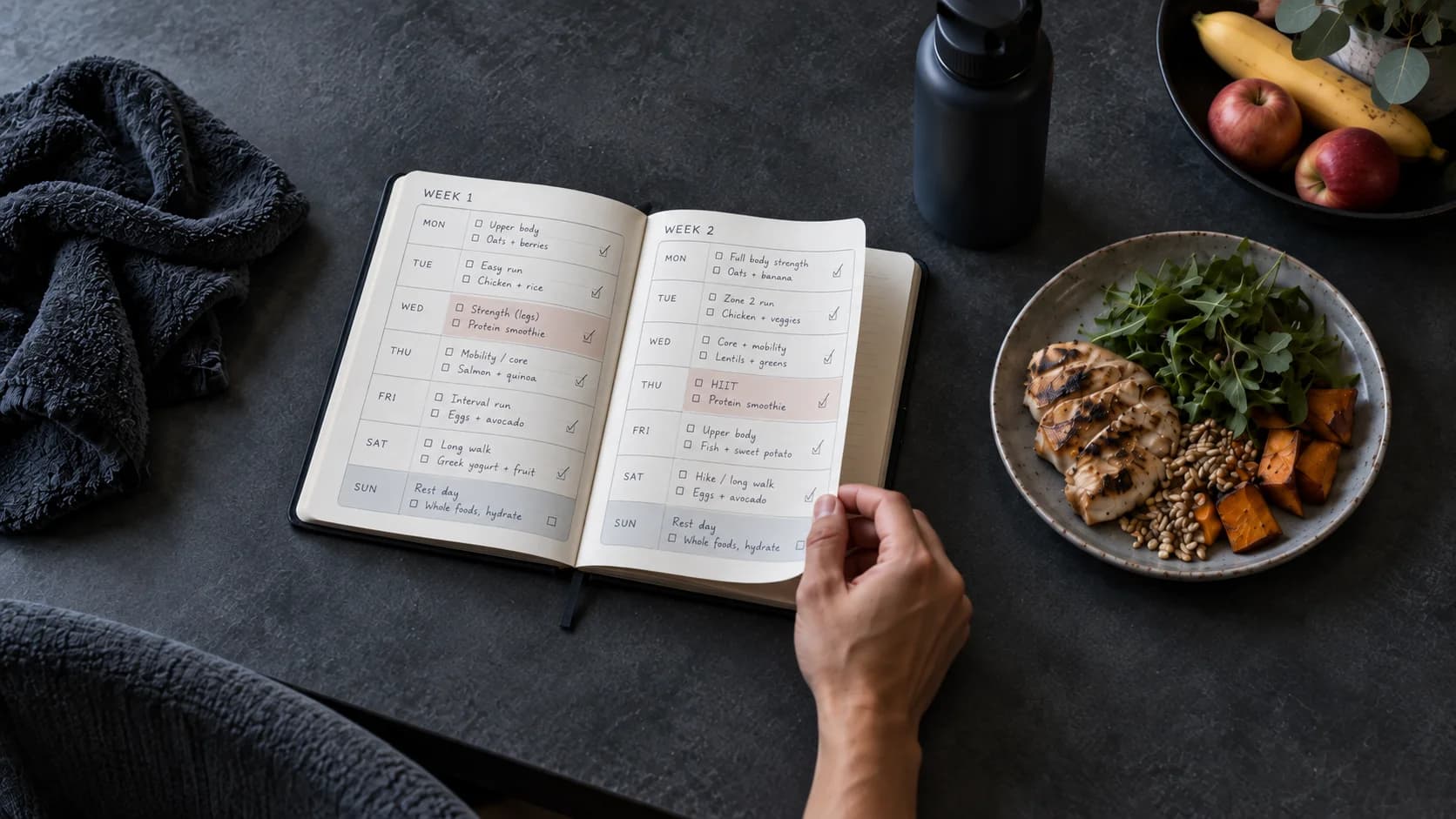
If a block adds a second simulation each week, or lengthens the station work for several weeks running, raise planned intake on those days and check the trend after a few weeks. If weight falls faster than the plan intends, session quality slips, or recovery markers and appetite start to look like the under-fueling pattern, add food before you cut training. One unusually high or low calorie readout after a single workout changes nothing in that plan.
The watch can still log the session and its heart-rate trace, but no evidence reviewed here checks that trace against a criterion measure at each HYROX station. Its calorie figure remains an unvalidated estimate. Plan your fueling from the next session's duration and load and from what you have scheduled the day after it. Then let several weeks of scale, training and recovery data tell you whether the baseline was right.
Footnotes
HYROX. HYROX EN Single Rulebook, Season 26/27. Race format, station order, and division loads including sled mass. hyrox.com
Back to textBrandt T, Ebel C, Lebahn C, Schmidt A. Acute physiological responses and performance determinants in Hyrox©, a new running-focused high intensity functional fitness trend. Front Physiol. 2025, 16, 1519240. PMC
Back to textMitchell L, Wilson L, Duthie G, Pumpa K, Weakley J, Scott C, Slater G. Methods to assess energy expenditure of resistance exercise. A systematic scoping review. Sports Med. 2024, 54(9), 2357-2372. PMC
Back to textLee TH, Jun DU, Bae JY, Roh HT, Cho SY. Comparative validity of smartwatch-derived heart rate and energy expenditure during endurance and resistance exercise. Sensors (Basel). 2026, 26(8), 2526. PMC
Back to textHajj-Boutros G, Landry-Duval MA, Comtois AS, Gouspillou G, Karelis AD. Wrist-worn devices for the measurement of heart rate and energy expenditure. A validation study for the Apple Watch 6, Polar Vantage V and Fitbit Sense. Eur J Sport Sci. 2023, 23(2), 165-177. Taylor & Francis
Back to textChoe JP, Kang M. Apple Watch accuracy in monitoring health metrics. A systematic review and meta-analysis. Physiol Meas. 2025, 46(4). DOI
Back to textFuller D, Colwell E, Low J, et al. Reliability and validity of commercially available wearable devices for measuring steps, energy expenditure, and heart rate. Systematic review. JMIR Mhealth Uhealth. 2020, 8(9), e18694. JMIR
Back to textBoudreaux BD, Hebert EP, Hollander DB, et al. Validity of wearable activity monitors during cycling and resistance exercise. Med Sci Sports Exerc. 2018, 50(3), 624-633. PubMed
Back to textReddy RK, Pooni R, Zaharieva DP, et al. Accuracy of wrist-worn activity monitors during common daily physical activities and types of structured exercise. Evaluation study. JMIR Mhealth Uhealth. 2018, 6(12), e10338. JMIR
Back to textBack to text 2Gilgen-Ammann R, Schweizer T, Wyss T. Accuracy of the multisensory wristwatch Polar Vantage's estimation of energy expenditure in various activities. Instrument validation study. JMIR Mhealth Uhealth. 2019, 7(10), e14534. PMC
Back to textBack to text 2Sun X, Wang Z, Fu X, Zhao C, Wang F, He H. Validity of Apple Watch 6 and Polar A370 for monitoring energy expenditure while resting or performing light to vigorous physical activity. J Sci Med Sport. 2023, 26(9), 482-486. JSAMS
Back to textBack to text 2Ferreira ARP, Inoue A, Barbosa RLM, et al. Validity of Galaxy Watch for estimating energy expenditure during intermittent running. Cross-sectional study. JMIR Form Res. 2026, 10, e83090. JMIR
Back to textBack to text 2O'Driscoll R, Turicchi J, Beaulieu K, et al. How well do activity monitors estimate energy expenditure? A systematic review and meta-analysis of the validity of current technologies. Br J Sports Med. 2020, 54(6), 332-340. BJSM
Back to textFirstbeat Technologies. An energy expenditure estimation method based on heart rate measurement. White paper, 2007, updated 2012. Firstbeat
Back to textApple. Get the most accurate measurements using your Apple Watch. Apple Support article 105002. Apple Support
Back to textApple. Calibrate your Apple Watch for improved Workout and Activity accuracy. Apple Support article 105048. Apple Support
Back to textBurke LM, Lundy B, Fahrenholtz IL, Melin AK. Pitfalls of conducting and interpreting estimates of energy availability in free-living athletes. Int J Sport Nutr Exerc Metab. 2018, 28(4), 350-363. DOI
Back to textMountjoy M, Ackerman KE, Bailey DM, et al. 2023 International Olympic Committee's (IOC) consensus statement on Relative Energy Deficiency in Sport (REDs). Br J Sports Med. 2023, 57(17), 1073-1097. BJSM
Back to textEurope PMC literature search for "HYROX", checked 24 September 2026. Search results
Back to text