The breakfast that carries you through an easy Tuesday run may not cover a full HYROX simulation. In the only peer-reviewed HYROX physiology study, 11 recreational athletes took a median 86.5 minutes to finish a simulated Open race and spent 79.5 percent of that time at or above 90 percent of max heart rate.1 That is a race. It deserves a race fuel plan with a before, a during, and an after, and a training week built to pay for it.
A 2025 scoping review of 39 hybrid and functional-fitness studies found one that analysed the HYROX format, and that study measured no nutrition variable.2 Every fueling number below comes from position stands and trials in cycling, running, and other sports, applied here to HYROX. The simulation is where you find out whether those numbers work for your gut, your sweat, and your division.
01What a full HYROX simulation costs
Brandt's athletes spent 51.2 minutes running and 32.8 minutes on stations, and heart rate stayed high through both.1 Lactate reached 8.5 mmol/L after stations and 7.7 after runs. Rated effort sat at 18 on stations and 16 on runs. Wall balls produced the highest heart rate, lactate, and effort of any station, and they come last. A simulation has no easy stretch where the legs get a break or the stomach gets a quiet minute.

HYROX's own preparation page puts the average athlete on course for about 90 minutes and tells athletes to practise running on legs and arms that already carry station fatigue.3 A full simulation is the one workout that asks you to reproduce the whole event in a single session.
I found no study that measured glycogen use in HYROX, so nobody can tell you how much a simulation drains. The heart rate and lactate profile point toward heavy carbohydrate use, and the length puts it inside the 1 to 2.5 hour band where the ACSM joint position recommends 30 to 60 g/h of carbohydrate during key sessions and competition.4 That is enough to treat the simulation as a key session under both the ACSM position and the fuel-for-the-work framework.45
Build it at your division's loads. The 26/27 singles rulebook sets 8 x 1 km runs, 100 wall balls in every division, and sled weights that include the sled. Women Open push 102 kg and pull 78 kg. Men Open and Women Pro push 152 kg and pull 103 kg.6 A simulation with a lighter sled or 75 wall balls costs less than the race, so it tests a smaller fuel plan than the one you need.
Eleven recreational athletes racing alone on a treadmill is a thin base. Use Brandt's numbers as a picture of the effort, and use your own simulation time to set your plan.
02How to fuel a HYROX build week around the simulation
A HYROX week has two or three sessions that decide the block and several that only need to get done. Impey and colleagues' fuel-for-the-work framework proposes matching carbohydrate to the session ahead, meal by meal and day by day, and doing key sessions and competition with high carbohydrate availability.5 The authors call their framework theoretical, and none of it was built from HYROX athletes. The ACSM table says the same thing more quietly. Its carbohydrate targets matter most when the quality or intensity of the session matters, and less on other days.4

In a HYROX week, the sessions where quality matters are usually the full or half simulation, the hardest compromised-running session, and a heavy station day with sleds and wall balls. Naming those three is a coaching choice, since nobody has tested a HYROX week structure. Give them full carbohydrate in the meal before and the meal after. Easy runs, mobility, and technique work on the SkiErg or rower can run on less. The gram ranges for lifting, intervals, easy aerobic work, and rest days sit in hybrid athlete weekly fueling, so use those for the rest of the week.
Training the hard sessions on low glycogen looks efficient and costs you the session. Yeo and colleagues split endurance-trained cyclists and triathletes into two groups of 7 for three weeks. One group trained daily. The other stacked a steady ride and an interval session 1 to 2 hours apart every second day, so the intervals started on lower glycogen. The stacked group gained more muscle markers of endurance adaptation. Both groups improved a 1-hour performance trial by about 10 percent, and the authors concluded that the stacked schedule compromised high-intensity training capacity.7 Impey's own count found improvement in only 37 percent of 11 train-low performance studies, most of them in athletes training under 10 hours a week.5
Those are cycling data applied to HYROX, and HYROX has no data of its own on train-low sessions. For a simulation the trade still looks poor. You would give up the quality of your most expensive session for an adaptation that did not change performance in the one trial that tested it.
Protein stays steady across the week. ACSM puts it at 1.2 to 2.0 g/kg/day in doses of about 0.3 g/kg.4 The hybrid article covers the floor for athletes who lift and run in the same week. Pick the one session each week you would be most annoyed to see go flat, and feed that one first.
03What to eat before a HYROX simulation
Race morning is a bad time to learn that your breakfast sits badly under a 152 kg sled. The simulation is where you learn it.
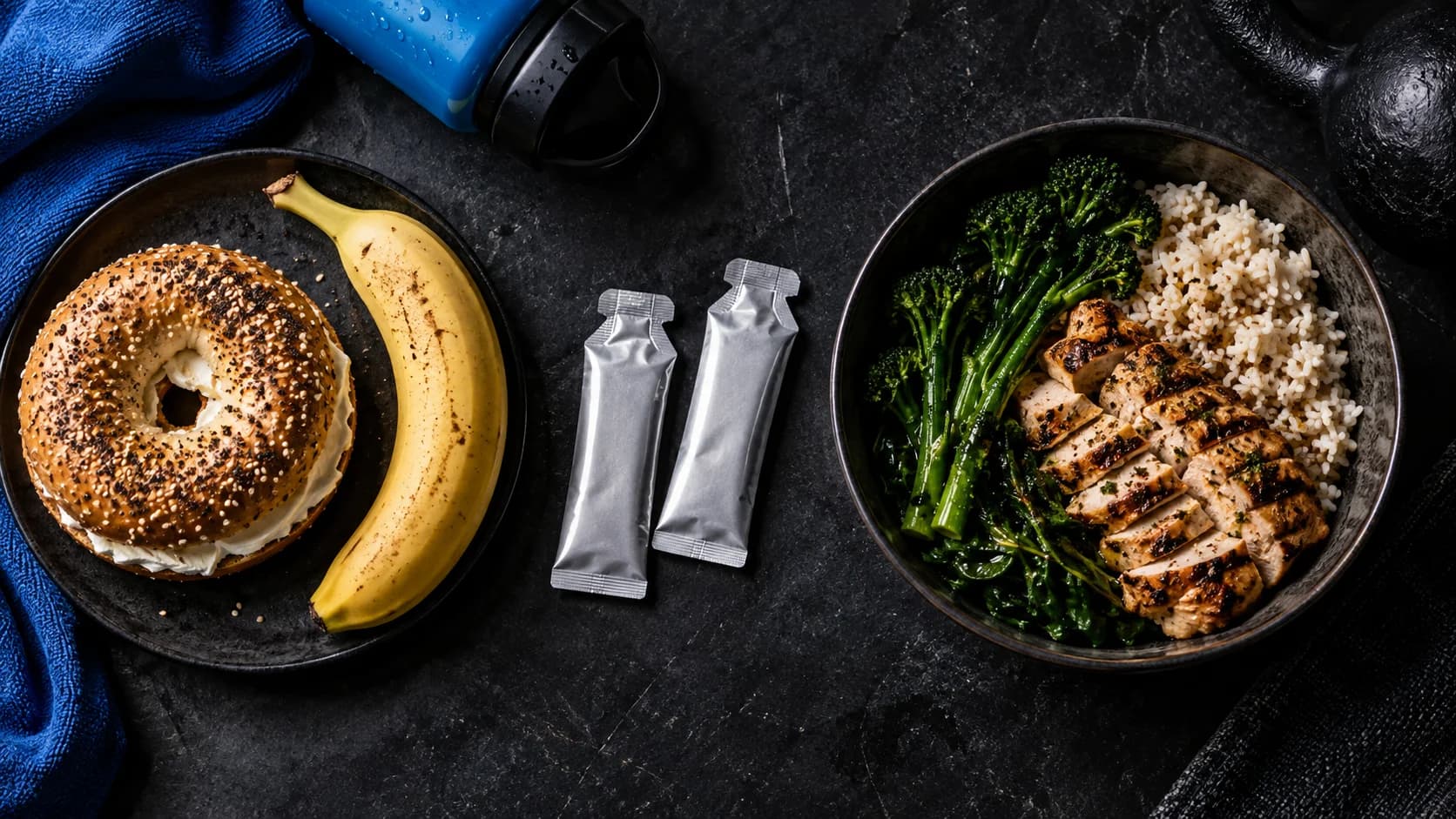
ACSM's pre-exercise guidance for key sessions and competition is 1 to 4 g/kg of carbohydrate in the 1 to 4 hours before.4 For a 70 kg athlete that is 70 to 280 g. Keep fat and fibre low if your stomach is sensitive. For events under 90 minutes, ACSM's fuelling-up guidance is 7 to 12 g/kg across the preceding 24 hours, so eat the day-before meals you plan for race week.4
Copy race day exactly. Eat the planned breakfast at the planned gap before your planned start, take the caffeine dose you plan to race on, and drink 5 to 10 mL/kg of fluid 2 to 4 hours before, as ACSM advises.4 If your heat starts at 2 p.m., run the simulation in the afternoon. Caffeine dose and timing sit in HYROX race nutrition by finish time and caffeine for performance.
Brandt's athletes avoided intense exercise for 48 hours before their simulation.1 That was a lab control. It is also a sensible way to protect your own simulation, because arriving fresh makes the finish time a fair input for the race plan. Put the hard station day earlier in the week and keep the two days before the simulation easy.
04How much carbohydrate to take during a simulation
ACSM places 1 to 2.5 hour efforts, stop-and-start sports included, at 30 to 60 g/h, and efforts of 45 to 75 minutes at small amounts or a mouth rinse.4 The ISSN nutrient-timing stand gives 30 to 60 g/h for high-intensity work longer than 60 minutes, particularly beyond 70.8 Brandt's simulated Open median of 86.5 minutes lands inside those bands. Use your actual finish time to pick your row in HYROX race nutrition by finish time, which sets the plan for each finish band, and test that exact plan here.
Carry everything from the start. The rulebook lets you carry nutrition and a hydration pack and puts water in the Roxzone at least once per pass. It penalises accepting food from anyone outside the aid stations and littering a wrapper.6 Your gym has no Roxzone table, so set one bottle in a fixed spot and drink only there. Open sports gels only on the runs or at that spot, and pocket every wrapper.
One simulation is one feeding exposure, and the gut adapts to repetition. Jeukendrup's review cites a 1991 study by Cunningham in which three days of 400 g/day of glucose shortened gastric half-emptying time from 29.1 to 20.7 minutes.9 Martinez and colleagues' systematic review found only 8 qualifying gut-training studies. In two of them, a 2-week repeated carbohydrate-feeding protocol cut gut discomfort by an average of 47 percent, and symptom results across the review were mixed.10 Cox and colleagues gave 16 cyclists and triathletes either high carbohydrate during daily training or an energy-matched lower amount for 28 days. Oxidation of ingested glucose during 100 minutes of steady riding rose from 54.6 to 63.6 g only in the high group. Performance improved by about 6 percent in both.11
Those adaptations build across weeks of practice, and a monthly simulation gives you one rep. Take the race gel in your hard compromised-running sessions and half simulations too, so the full simulation checks a skill you already have. The studies used cycling and running at steadier intensities. Swallowing a gel in a short Roxzone window at near-max heart rate is untested, which is why you rehearse it before race day. Gut training for race nutrition lays out a progression.
05How to measure sweat loss in a simulation
Nobody has measured sweat rates in HYROX. ACSM's general range runs from 0.3 to 2.4 L/h, which is too wide to plan a race from.4 The simulation gives you a number for your own body at race effort.
Weigh yourself nude before, towel off and weigh again after, and record the fluid you drank and any urine passed. Estimate sweat loss in litres as the body-mass loss in kilograms plus fluid consumed in litres minus urine passed in litres, then divide by session duration in hours to get L/h. Sawka's ACSM fluid position recommends weighing before and after exercise to estimate sweat rate, with the goal of keeping body-weight loss from water deficit under 2 percent.12 For a 75 kg athlete, 2 percent is 1.5 kg. If you finish lighter than that, drink more at your Roxzone spot next time. If you finish heavier than you started, drink less. After the session, replace 1.25 to 1.5 L of fluid for every kilogram lost.4
A gym simulation happens in different heat and air from an event hall, and no data link the two. Treat your number as a starting point, and repeat the test if your venue will run hotter than your gym. The full calculation and a drinking cap sit in how to measure sweat rate.
06How to recover from a full HYROX simulation
The timing of your next hard session decides the recovery plan. If it falls within 8 hours, ACSM's speedy-refuelling guidance is 1 to 1.2 g/kg/h of carbohydrate for the first 4 hours.4 Alghannam's review of 3 to 6 hour recoveries found that at least 1.2 g/kg/h maximised glycogen repletion.13 Glycogen refills at about 5 percent an hour, so eating early buys refuelling time.4
If the next hard session is a day or more away, the precise shake matters less. Burke, van Loon, and Hawley describe resynthesis in two phases. About 1 g/kg in the first 4 hours helps. From 4 to 24 hours, total carbohydrate that matches the next session's needs matters more than the type, form, or timing.14 Hit the day's carbohydrate total and the refuelling job is done.
Add 20 to 40 g of protein soon after, then every 3 to 4 hours. The ISSN timing and protein stands both use that dose, and the timing stand reports that 30 to 40 g of casein before bed raises overnight muscle protein synthesis.815
If you cannot face food after 100 wall balls, protein earns a bigger role. Alghannam found that added protein helps glycogen storage when carbohydrate is at or below 0.8 g/kg/h, and the ISSN timing stand lists 0.8 g/kg/h of carbohydrate with 0.2 to 0.4 g/kg/h of protein as an option.813 A milk-based recovery drink or a fruit smoothie gets you there when solid food will not.
How long a HYROX simulation takes to recover from is unmeasured. The scoping review gives 48 to 72 hours for full recovery from intense functional-fitness sessions, drawn from general HIFT research with no HYROX data behind it.2 Plan the next 48 hours as easy work on full carbohydrate, and treat that as a coaching choice.
07How often to run a full HYROX simulation
No study has compared simulation frequencies or timings, so any schedule you read is someone's coaching judgment. Make the choice from cost. One practical arrangement is a fueled day before, the session itself, and about two easy days after. That two-day recovery window comes from general functional-fitness research, not HYROX data.2 It puts three or four days of your week around one workout. Count what your week can pay for before you count simulations.
Run a full one when you have a written race fuel plan to test, a finish time that needs updating, or no sweat-loss number yet. If none of those apply, a half simulation or a run-plus-station block at race pace rehearses transitions and the gel plan at lower cost. It also adds the repeated feeding exposures that the gut-training studies used.10 Whatever frequency you pick is untested. Keep the last full simulation outside the taper.
08How to taper without another full simulation
Bosquet's 2007 meta-analysis pooled 27 studies of competitive athletes. The largest effect came from a 2-week taper, an exponential volume cut of 41 to 60 percent, and no change in training intensity or frequency.16 None of those athletes raced HYROX. The finding still argues against a full simulation in the final two weeks, since it adds the volume the taper is trying to remove.
Hold intensity with short race-pace pieces, such as two runs and two stations at race effort, and take the race gel during them. That example is a coaching choice, since no HYROX taper study exists. Carbohydrate follows volume down through most of the taper under the same fuel-for-the-work logic, then rises in the last 36 to 48 hours.5 The race-week top-up and its water weight sit in HYROX race nutrition by finish time and the race-week nutrition plan.
09When a calorie deficit breaks the build
Adding simulations while cutting calories is the pattern to watch. The 2023 IOC consensus on Relative Energy Deficiency in Sport defines low energy availability as insufficient energy remaining after exercise expenditure to support the body’s physiological needs, and it flags a growing role for low carbohydrate availability.17 A build that adds a race-length session every few weeks raises expenditure at the same time a diet lowers intake.
If you are dieting through a HYROX build, fuel the simulation and its recovery day in full and take the deficit on easy days. Deficit sizing and the warning signals that tell you to stop are in the deficit and recovery sections of hybrid athlete weekly fueling.
10What to write down before the next simulation
Grade the simulation on the plan as well as the clock. Write the left column before you start and fill in the right column after you finish.

| Before the simulation | After the simulation |
|---|---|
| Breakfast, grams of carbohydrate, and time before start | How it sat through the sleds and burpees |
| Caffeine dose and timing | Energy on the last two runs |
| Gels planned and where you take each one | Gels taken, wrappers pocketed, and any gut symptoms |
| Nude weight | Nude weight and fluid drunk |
| Division loads and 100 wall balls | Finish time and run splits |
If the gels stayed down, weight loss stayed under 2 percent, and the last kilometer held pace, keep that plan as your starting version for race day. If one of those failed, change that one thing and test it in a shorter hard session before you spend another full simulation on it.
Footnotes
Brandt T, Ebel C, Lebahn C, Schmidt A. Acute physiological responses and performance determinants in Hyrox. A new running-focused high intensity functional fitness trend. Front Physiol. 2025, 16, 1519240. Frontiers.
Back to textBack to text 2Back to text 3Villarroel López P, Juárez Santos-García D. High intensity functional training in hybrid competitions. A scoping review of performance models and physiological adaptations. J Funct Morphol Kinesiol. 2025, 10(4), 365. PMC.
Back to textBack to text 2Back to text 3HYROX. Best HYROX preparation. Official HYROX guidance by race designer Mintra Tilly, undated. hyrox.com.
Back to textThomas DT, Erdman KA, Burke LM. American College of Sports Medicine Joint Position Statement. Nutrition and athletic performance. Med Sci Sports Exerc. 2016, 48(3), 543-568. PubMed.
Back to textBack to text 2Back to text 3Back to text 4Back to text 5Back to text 6Back to text 7Back to text 8Back to text 9Back to text 10Back to text 11Back to text 12Impey SG, Hearris MA, Hammond KM, et al. Fuel for the work required. A theoretical framework for carbohydrate periodization and the glycogen threshold hypothesis. Sports Med. 2018, 48(5), 1031-1048. PMC.
Back to textBack to text 2Back to text 3Back to text 4HYROX. Official Singles Rulebook, Season 26/27. Division loads, 100 wall balls, carry-in nutrition, hydration packs, Roxzone water, and 2-minute penalties for outside assistance and littering. HYROX rulebook PDF.
Back to textBack to text 2Yeo WK, Paton CD, Garnham AP, Burke LM, Carey AL, Hawley JA. Skeletal muscle adaptation and performance responses to once a day versus twice every second day endurance training regimens. J Appl Physiol. 2008, 105(5), 1462-1470. PubMed.
Back to textKerksick CM, Arent S, Schoenfeld BJ, et al. International Society of Sports Nutrition position stand. Nutrient timing. J Int Soc Sports Nutr. 2017, 14, 33. PMC.
Back to textBack to text 2Back to text 3Jeukendrup AE. Training the gut for athletes. Sports Med. 2017, 47(Suppl 1), 101-110. PMC.
Back to textMartinez IG, Mika AS, Biesiekierski JR, Costa RJS. The effect of gut-training and feeding-challenge on markers of gastrointestinal status in response to endurance exercise. A systematic literature review. Sports Med. 2023, 53(6), 1175-1200. PMC.
Back to textBack to text 2Cox GR, Clark SA, Cox AJ, et al. Daily training with high carbohydrate availability increases exogenous carbohydrate oxidation during endurance cycling. J Appl Physiol. 2010, 109(1), 126-134. PubMed.
Back to textSawka MN, Burke LM, Eichner ER, Maughan RJ, Montain SJ, Stachenfeld NS. American College of Sports Medicine position stand. Exercise and fluid replacement. Med Sci Sports Exerc. 2007, 39(2), 377-390. PubMed.
Back to textAlghannam AF, Gonzalez JT, Betts JA. Restoration of muscle glycogen and functional capacity. Role of post-exercise carbohydrate and protein co-ingestion. Nutrients. 2018, 10(2), 253. PMC.
Back to textBack to text 2Burke LM, van Loon LJC, Hawley JA. Postexercise muscle glycogen resynthesis in humans. J Appl Physiol. 2017, 122(5), 1055-1067. Journal of Applied Physiology.
Back to textJäger R, Kerksick CM, Campbell BI, et al. International Society of Sports Nutrition position stand. Protein and exercise. J Int Soc Sports Nutr. 2017, 14, 20. PMC.
Back to textBosquet L, Montpetit J, Arvisais D, Mujika I. Effects of tapering on performance. A meta-analysis. Med Sci Sports Exerc. 2007, 39(8), 1358-1365. PubMed.
Back to textMountjoy M, Ackerman KE, Bailey DM, et al. 2023 International Olympic Committee's (IOC) consensus statement on Relative Energy Deficiency in Sport (REDs). Br J Sports Med. 2023, 57(17), 1073-1097. PubMed.
Back to text